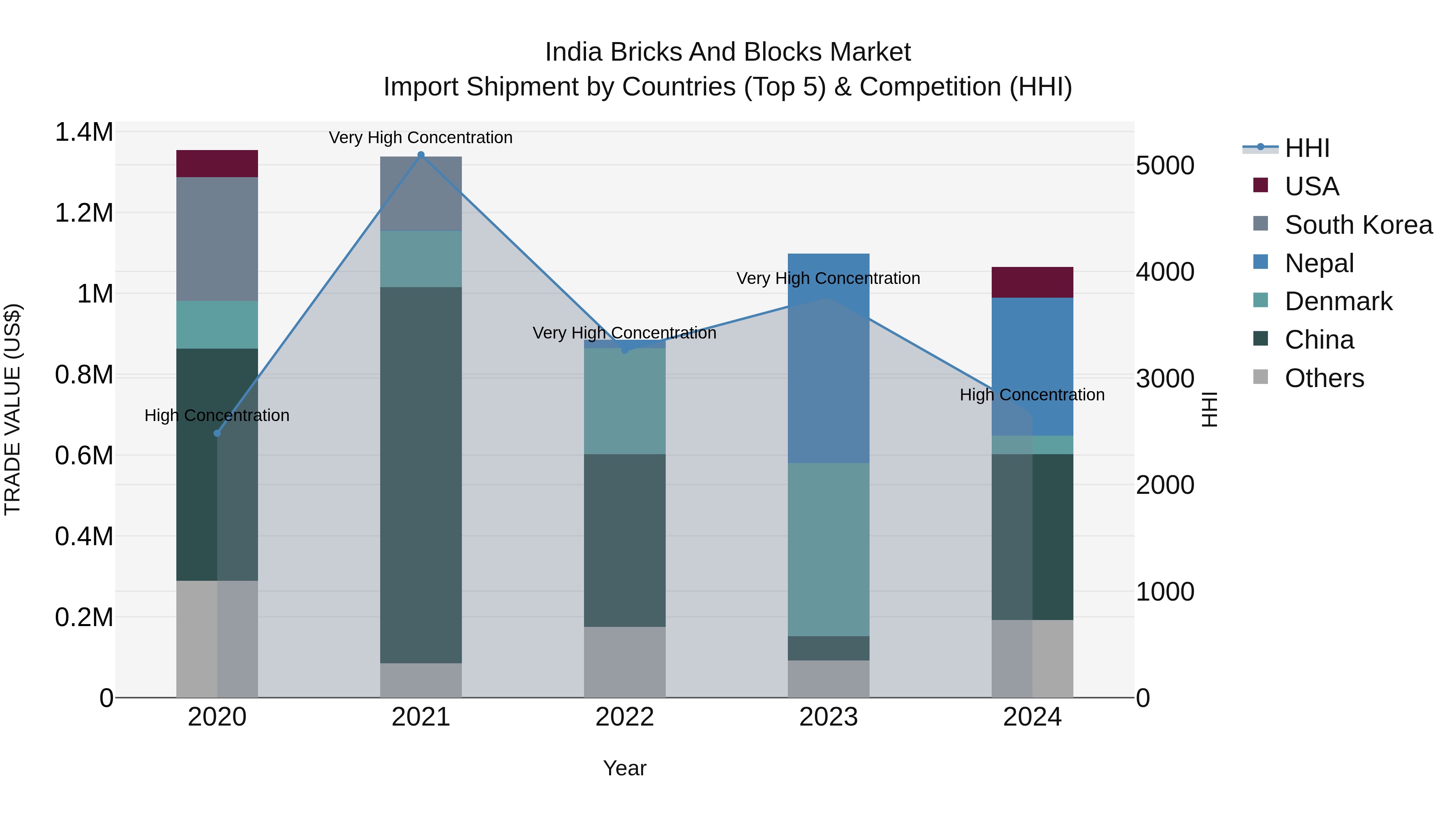
India Bricks and Blocks Market Top 5 Importing Countries and Market Competition (HHI) Analysis
India`s import of bricks and blocks in 2024 continued to be dominated by top exporters such as China, Nepal, Belgium, USA, and Denmark. The market concentration, as measured by HHI, remained high in 2024, indicating a competitive landscape. Despite the negative compound annual growth rate (CAGR) of -5.81% from 2020 to 2024, there was a slight improvement in the growth rate from 2023 to 2024, with a decline of -2.96%. This suggests a challenging market environment, but also potential opportunities for growth and diversification in the coming years.
India Bricks and Blocks Market Growth Rate
According to 6Wresearch internal database and industry insights, the India Bricks and Blocks Market is projected to grow at a compound annual growth rate (CAGR) of 9.5% during the forecast period (2026-2032).
Five-Year Growth Trajectory of the India Bricks and Blocks Market with Core Drivers
Below is an evaluation of the year-wise growth rate along with key drivers:
| Years | Estimated Annual Growth (%) | Growth Drivers |
| 2021 | 5.8% | Post-lockdown revival of stalled residential projects in Tier-1 cities. |
| 2022 | 6.5% | Increased government allocation for the Pradhan Mantri Awas Yojana (PMAY). |
| 2023 | 7.1% | Transition from traditional red bricks to high-performance AAC blocks in high-rise construction. |
| 2024 | 7.8% | Regulatory push for fly ash utilization and emission controls in brick kilns. |
| 2025 | 8.5% | Expansion of industrial corridors and the rise of green building certifications. |
Topics Covered in the India Bricks and Blocks Market Report
The India Bricks and Blocks Market report thoroughly covers the market by type and application. The report provides a detailed analysis of ongoing market trends, opportunities/high-growth areas, and market drivers that will help stakeholders align strategies based on current and future market dynamics.
India Bricks and Blocks Market Highlights
| Report Name |
India Bricks and Blocks Market |
| Forecast period | 2026-2032 |
| CAGR | 9.5% |
| Market Size |
Residential Construction and Infrastructure Development |
India Bricks and Blocks Market Synopsis
India Bricks and Blocks Market is anticipated to witness steady growth in the coming years owing to rapid urbanization and expanding construction activities across residential, commercial, and industrial sectors. The increasing requirement for durable and cost-efficient building materials is encouraging builders to adopt advanced masonry solutions such as autoclaved aerated concrete blocks and concrete bricks.
Along with this, the expanding infrastructure projects including metro rail networks, expressways, and industrial parks is creating a remarkable demand for bricks and blocks across the country. Besides this, the government’s focus on sustainable construction and the adoption of eco-friendly building materials is actively influencing manufacturers to develop lightweight and energy-efficient block products.
Evaluation of Growth Drivers in India Bricks and Blocks Market
Below are some major drivers and their influence on the market dynamics:
| Drivers | Primary Segments Affected | Why It Matters |
| Fly Ash Mandates | By Type (AAC, Others) | MOEFCC regulations mandate 100% ash utilization, favoring fly ash-based products. |
| Thermal Efficiency Needs | By Type (AAC, Calcium Silicate) | Increasing energy costs in buildings propel demand for materials with superior insulation. |
| Precast Adoption | By Type (Concrete Blocks) | High-speed infrastructure projects prefer precast concrete units for faster turnaround. |
| Rising Demand for Urban Housing | By Application (Building) | Enormous housing deficits in urban areas require scalable masonry solutions. |
| Cost-Effectiveness | By Type (AAC) | AAC blocks decrease mortar usage and labor costs by up to 20%, improving project ROI |
India Bricks and Blocks Market is expected to grow at a CAGR of 9.5% during the forecast period (2026-2032). Due to rising number of real estate developments, growing government expenditure on urban infrastructure, and development of industrial zones, it is expected that there will be massive demand for masonry materials across the country.
Apart from this, major innovations in lightweight and high-strength block technologies are driving construction speed and structural efficiency, thereby attracting builders and contractors. Also, rising awareness regarding energy-efficient buildings and improved insulation materials is further accelerating India Bricks and Blocks Market growth across residential and commercial construction projects.
Evaluation of Restraints in India Bricks and Blocks Market
Below are some key restraints and their influence on the market dynamics:
| Restraints | Primary Segments Affected | What This Means |
| Raw Material Volatility | By Type (Concrete Bricks) | Instability in cement and aggregate prices directly affects the production cost of blocks. |
| Environmental Bans | By Type (Clay Bricks) | Prohibitions on traditional kilns near NCR and urban hubs disrupt the supply of red bricks. |
| Logistical Costs | By Type (AAC, Concrete) | Heavy weight of bricks makes transportation expensive over long distances. |
| Labor Familiarity | By Type (Calcium Silicate) | Rural masons often lack the training to work with specialized interlocking or AAC units. |
| Water Scarcity | By Type (Clay Bricks) | Enormous water requirements for curing traditional bricks curb production in dry regions |
India Bricks and Blocks Market Challenges
The India Bricks and Blocks Market is expected to expand steadily during the forecast period. However, certain operational challenges may hinder the pace of growth to some extent. In general, traditional brick manufacturing depends heavily on coal-based kilns, which are increasingly facing environmental restrictions due to rising concerns regarding emissions and land degradation. Besides this, the fragmented structure of the industry, where many small-scale producers operate with limited technological capabilities, often leads to variations in product quality and supply reliability.
India Bricks and Blocks Market Trends
There are various latest trends that are impacting the India Bricks and Blocks Industry:
- Increasing Use of Autoclaved Aerated Concrete (AAC) Blocks: Builders are using AAC blocks as they are lighter than other types of blocks as well have better insulating properties and faster installation times making them an ideal material for use when building modern building projects.
- Increase in Automation of Manufacturing Bricks: The use of automated machines for making brick and the introduction of more energy efficient kilns will give manufacturers greater productivity while also producing a consistent quality of product.
- Rising Demand for Environmentally Friendly Building Materials: As more people become aware of the environmental issues connected to building materials being used today, the need for building materials made from recycled materials or using fly ash is also increasing since it decreases the carbon footprint related to the production of traditional clay bricks.
Investment Opportunities in the India Bricks and Blocks Market
There are several major investment opportunities in the India Bricks and Blocks Industry including:
- Investment in Fly Ash Brick Plants: Due to the increases in regulation around the environment; an investment into a fly ash facility will see a healthy growth potential especially in those areas that are served by large coal based thermal generating stations.
- Investing in Smart Building Materials: Companies that are manufacturing high strength, low weight products that have good thermal insulating properties will be ideally placed to take advantage of increased demand for sustainable building materials going forward.
- Long Term Supply Agreements Related to Larger Infrastructure Projects: Long term supply agreements associated with larger-scale projects like metro rail systems, multi-use industrial corridors, and logistics parks will provide stability to any one company for several years going forward.
Top 5 Leading Players in the India Bricks and Blocks Market
Below is a list of prominent companies leading the India Bricks and Blocks Market:
1. Wienerberger India Pvt. Ltd.
| Company Name | Wienerberger India Pvt. Ltd. |
|---|---|
| Established Year | 1819 (India Operations Established Later) |
| Headquarters | Vienna, Austria (India Office – Noida, Uttar Pradesh) |
| Official Website | Click Here |
Wienerberger India is a leading manufacturer of advanced clay building materials, offering high-performance clay bricks and blocks designed for sustainable and energy-efficient construction projects.
2. Magicrete Building Solutions Pvt. Ltd.
| Company Name | Magicrete Building Solutions Pvt. Ltd. |
|---|---|
| Established Year | 2008 |
| Headquarters | Surat, Gujarat |
| Official Website | Click Here |
Magicrete specializes in AAC blocks and construction chemicals, providing lightweight masonry solutions that improve building insulation and reduce structural load.
3. Biltech Building Elements Limited
| Company Name | Biltech Building Elements Limited |
|---|---|
| Established Year | 1993 |
| Headquarters | New Delhi, Delhi |
| Official Website | Click Here |
Biltech Building Elements is recognized for producing autoclaved aerated concrete blocks and other innovative building materials that support faster and more sustainable construction methods.
4. UltraTech Cement Limited
| Company Name | UltraTech Cement Limited |
|---|---|
| Established Year | 1983 |
| Headquarters | Mumbai, Maharashtra |
| Official Website | Click Here |
UltraTech Cement has expanded its portfolio into value-added construction materials including ready-to-use concrete blocks and masonry solutions that support modern infrastructure and residential construction projects.
5. Siporex India Pvt. Ltd.
| Company Name | Siporex India Pvt. Ltd. |
|---|---|
| Established Year | 1972 |
| Headquarters | Pune, Maharashtra |
| Official Website | - |
Siporex India is a pioneer in AAC block manufacturing in the country and provides lightweight, fire-resistant, and thermally efficient building blocks widely used in residential and commercial construction.
Government Regulations in the India Bricks and Blocks Market
According to Indian Government Data, regulatory initiatives have played a significant role in encouraging the use of sustainable building materials across construction projects. One example is the Fly Ash Utilization Policy released by the Ministry of Environment, Forest and Climate Change whereby thermal power plants are required to make fly ash available to nearby brick manufacturers to produce bricks in an environmentally friendly manner. In addition, the Pradhan Mantri Awas Yojana (PMAY) housing program has supported the development of affordable housing by increasing the need for low-cost masonry materials necessary for the construction of mass-produced affordable housing units in both urban and rural areas.
Future Insights of the India Bricks and Blocks Market
In terms of future growth prospects for the India Bricks & Blocks Industry, steady growth is predicted due to the growing trend of using modern construction technology along with the increased acceptance of sustainable building materials within the market.
Continued innovation in automated production and energy-efficient kilns will help improve production capacity. The Indian government has made a commitment to support affordable housing and infrastructure projects.
Therefore, the India Brick and Block Industry will continue to evolve towards producing environmentally responsible construction materials which will ultimately lower energy consumption while providing for increased levels of structural integrity.
Market Segmentation Analysis
The report offers a comprehensive study of the following market segments and their leading categories:
By Type – Concrete Bricks and Blocks to Lead the Market
According to Vasudha, Senior Research Analyst, 6Wresearch, Concrete Bricks and Blocks are expected to hold the leading position in the India Bricks and Blocks Market due to their high strength, durability, and ease of manufacturing. These materials offer uniform size and shape, which improves construction efficiency and reduces labor costs during building projects.
By Applications – Building to Lead the Market
Building segment is anticipated to lead the India Bricks and Blocks Market share due to the rapid expansion of residential and commercial construction activities across metropolitan and emerging cities. Increasing housing demand, redevelopment of urban spaces, and expansion of commercial complexes are major factors supporting this segment’s dominance.
Key Attractiveness of the Report
- 10 Years of Market Numbers
- Historical Data Starting from 2022 to 2025
- Base Year: 2025
- Forecast Data until 2032
- Key Performance Indicators Impacting the Market
- Major Upcoming Developments and Projects
Key Highlights of the Report:
- India Bricks and Blocks Market Outlook
- Market Size of India Bricks and Blocks Market, 2025
- Forecast of India Bricks and Blocks Market, 2032
- Historical Data and Forecast of India Bricks and Blocks Revenues & Volume for the Period 2022-2032
- India Bricks and Blocks Market Trend Evolution
- India Bricks and Blocks Market Drivers and Challenges
- India Bricks and Blocks Price Trends
- India Bricks and Blocks Porter's Five Forces
- India Bricks and Blocks Industry Life Cycle
- Historical Data and Forecast of India Bricks and Blocks Market Revenues & Volume By Type for the Period 2022-2032
- Historical Data and Forecast of India Bricks and Blocks Market Revenues & Volume By Clay Bricks for the Period 2022-2032
- Historical Data and Forecast of India Bricks and Blocks Market Revenues & Volume By Concrete Bricks and Blocks for the Period 2022-2032
- Historical Data and Forecast of India Bricks and Blocks Market Revenues & Volume By Calcium Silicate Bricks for the Period 2022-2032
- Historical Data and Forecast of India Bricks and Blocks Market Revenues & Volume By Autoclaved Aerated Concrete for the Period 2022-2032
- Historical Data and Forecast of India Bricks and Blocks Market Revenues & Volume By Others for the Period 2022-2032
- Historical Data and Forecast of India Bricks and Blocks Market Revenues & Volume By Applications for the Period 2022-2032
- Historical Data and Forecast of India Bricks and Blocks Market Revenues & Volume By Building for the Period 2022-2032
- Historical Data and Forecast of India Bricks and Blocks Market Revenues & Volume By Path for the Period 2022-2032
- Historical Data and Forecast of India Bricks and Blocks Market Revenues & Volume By Parterre for the Period 2022-2032
- Historical Data and Forecast of India Bricks and Blocks Market Revenues & Volume By Other for the Period 2022-2032
- India Bricks and Blocks Import Export Trade Statistics
- Market Opportunity Assessment By Type
- Market Opportunity Assessment By Applications
- India Bricks and Blocks Top Companies Market Share
- India Bricks and Blocks Competitive Benchmarking By Technical and Operational Parameters
- India Bricks and Blocks Company Profiles
- India Bricks and Blocks Key Strategic Recommendations
Market Covered
The report offers a comprehensive study of the following market segments:
By Type
- Clay Bricks
- Concrete Bricks and Blocks
- Calcium Silicate Bricks
- Autoclaved Aerated Concrete
- Others
By Applications
- Building
- Path
- Parterre
- Other






































