India Chocolate Market Size & Growth Rate
According to 6Wresearch internal database and industry insights, the India Chocolate Market was valued at USD 3 Billion in 2025 and is projected to reach USD 5.14 Billion by 2032, growing at a CAGR of approximately 8% during 2026–2032.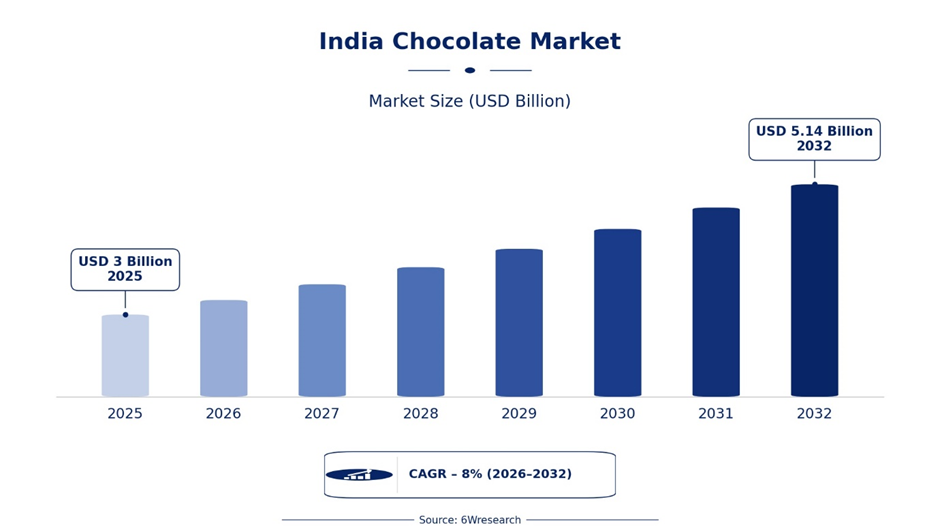
India Chocolate Market Highlights
|
Report Metric |
Details |
|
Report Name |
India Chocolate Market (2026-2032) Report |
|
Market Size 2025 |
USD 3 Billion |
|
Market Size 2032 |
USD 5.14 Billion |
|
Absolute Growth 2025–2032 |
USD 2.14 Billion |
|
CAGR 2026–2032 |
8% |
|
Peak Annual Growth |
9.4% (2027) |
|
Forecast Period |
2026–2032 |
|
Historical Data |
2022–2025 |
|
Base Year |
2025 |
|
Leading Product Types, 2025 |
Milk Chocolate (74% share) |
|
Fastest-Growing Product Types |
Dark Chocolate (11.2% CAGR) |
|
Leading Distribution Channels, 2025 |
Grocery/Mom N Pop Stores (41% share) |
|
Fastest-Growing Distribution Channels |
Online Channel (14.5% CAGR) |
|
Leading Chocolate Types, 2025 |
Molded Or Bar Chocolates (38% share) |
|
Fastest-Growing Chocolate Types |
Others (Box Chocolates, Novelties, Etc.) (10.6% CAGR) |
|
Growing Sector |
Premium Dark and Gifting Chocolate Ranges |
|
Key End Users |
Individual Consumers, Gifting Households, Corporate Gifting Buyers, Hospitality and Food Service Operators, Bakery and Confectionery Manufacturers |
India Chocolate Market Year-wise Growth Rate and Key Drivers (2022–2032)
This graph illustrates the annual growth rates of the market from 2022 to 2032, highlighting a steady upward trajectory and projected market expansion over the forecast period.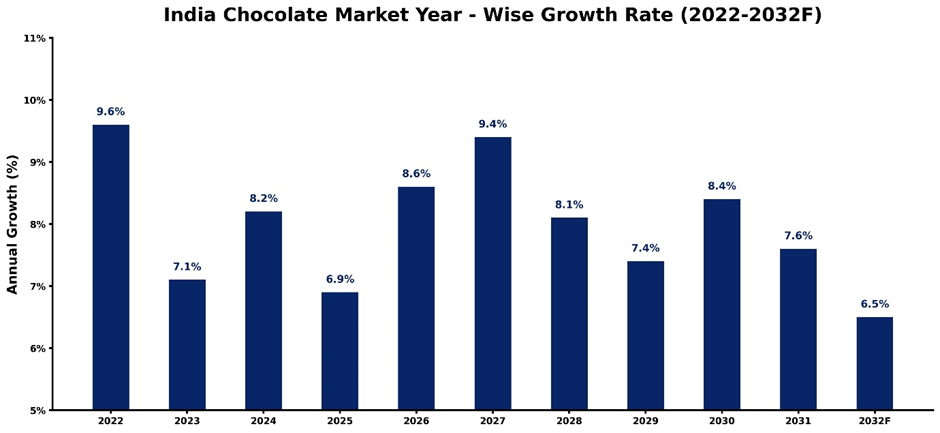 The following table presents the estimated annual growth rate for each year together with the principal factor influencing market performance.
|
Year |
Estimated Annual Growth (%) |
Market Rationale |
|
2022 |
9.6% |
Reopening of retail outlets and the return of festive gatherings after pandemic restrictions drove a strong rebound in purchases. |
|
2023 |
7.1% |
Elevated cocoa, sugar and packaging costs led manufacturers to curtail promotions and trim pack weights, which slowed value growth. |
|
2024 |
8.2% |
Premium launches, higher-cocoa ranges and the rise of instant-delivery platforms in metropolitan cities lifted value sales. |
|
2025 |
6.9% |
Record cocoa prices in December 2024 were passed on through higher shelf prices, which weighed on unit volumes. |
|
2026 |
8.6% |
Easing cocoa procurement costs are expected to restore manufacturer margins and allow wider promotions and larger pack formats. |
|
2027 |
9.4% |
Implementation of the India–UK trade agreement is expected to widen access to imported premium chocolates and expand gifting assortments. |
|
2028 |
8.1% |
Rising awareness of sugar intake is expected to moderate indulgence purchases among health-conscious urban households and favour smaller portions. |
|
2029 |
7.4% |
Mainstream bar penetration in metropolitan cities is expected to approach saturation, which should slow incremental volume growth. |
|
2030 |
8.4% |
Wider distribution reach and organised retail formats in smaller towns are expected to extend chocolate availability and lift unit sales. |
|
2031 |
7.6% |
Higher base effects and stronger competition from biscuits, dairy desserts and local confectionery are expected to moderate mass-market growth. |
|
2032 |
6.5% |
Growth is expected to stabilise as the premium base enlarges and festive demand cycles become more predictable. |
Note: Market size estimations and growth projections presented in this report are based on 6Wresearch proprietary forecasting methodology, utilizing the latest available industry data, government publications, and primary research inputs.
India Chocolate Market Synopsis
The India Chocolate Market is witnessing steady growth, supported by evolving consumer preferences and expanding retail distribution channels. The market comprises milk, white and dark chocolate sold as bars, countlines, panned pieces, boxed assortments and novelties through retail and online channels. Growth is driven by rising disposable incomes, expanding gifting occasions during Diwali and Raksha Bandhan, premiumisation of dark and artisanal offerings, and wider availability through instant-delivery platforms. However, volatile cocoa prices and growing scrutiny of sugar content continue to constrain pricing flexibility and volume expansion.
Market Dynamics Impact Analysis (2026–2032)
|
Factor |
Type |
Impact |
Primary Segment Affected |
|
Rising incomes and premiumisation |
Driver |
High |
Dark Chocolate |
|
Occasion-led gifting demand |
Driver |
High |
Molded Or Bar Chocolates |
|
Expansion of instant-delivery and e-commerce platforms |
Opportunity |
High |
Online Channel |
|
Private label and contract manufacturing partnerships |
Opportunity |
Medium |
Supermarkets/Hypermarkets |
|
Cocoa and sugar price volatility |
Restraint |
High |
Milk Chocolate |
|
Heat-sensitive storage in small outlets |
Restraint |
Medium |
Grocery/Mom N Pop Stores |
|
Higher tax rate relative to traditional sweets |
Challenge |
Medium |
Countlines & Straight Lines |
|
Market concentration and shelf-space competition |
Challenge |
Medium |
Convenience Stores |
Evaluation of Drivers in India Chocolate Market (2026–2032)
Below mentioned are some major drivers and their influence on market dynamics.
|
Drivers |
Primary Segment Affected |
Why It Matters (Evidence) |
|
Rising incomes and premiumisation |
Dark Chocolate |
Higher urban incomes encourage consumers to trade up from mass bars to higher-cocoa products. Per capita chocolate consumption in India remains at roughly 200 grams a year, far below Western European levels, which leaves considerable room for expansion. |
|
Occasion-led gifting |
Molded Or Bar Chocolates |
Brands position chocolate as a modern alternative to traditional sweets during Diwali, birthdays and weddings, which widens consumption occasions. Cadbury Celebrations gift packs and similar festive ranges are launched ahead of each festive season to capture this demand. |
|
Digital reach of consumers |
Online Channel |
Growth in internet connectivity allows brands to reach buyers beyond store catchments and to sell gift boxes and premium variants directly. India internet subscriber base has crossed 900 million, creating a large pool of potential online buyers. |
|
Domestic cocoa sourcing and manufacturing |
Milk Chocolate |
Local cocoa sourcing and in-country production reduce import dependence and shorten supply chains for large producers. Mondelez India cocoa sustainability programme works with farmers in southern states to improve yields and bean quality. |
|
Expansion of organised retail |
Supermarkets/ Hypermarkets |
Modern trade formats offer wider chocolate assortments, controlled storage and promotional visibility, which raise the trial of premium products. DMart alone operates more than 400 stores across the country. |
Sustained demand in the India Chocolate Market is underpinned by a young and urbanising consumer base, with a median age of approximately 28 years, which favours experimentation with new flavours and formats. Furthermore, rising middle-class incomes are increasing discretionary spending on confectionery, while greater exposure to global food culture through social media is reshaping taste preferences. Continued capital commitments by multinational and domestic confectioners towards plant capacity, packaging automation and temperature-controlled handling are improving product consistency and availability. In addition, advances in recipe development and the introduction of regional flavours are broadening the consumer base across smaller cities.
Evaluation of Restraints in India Chocolate Market
Below mentioned are some major restraints and their influence on market dynamics.
|
Market Restraint |
Primary Segment Affected |
Why It Matters (Evidence) |
|
Volatility in cocoa and sugar prices |
Milk Chocolate |
India depends on imports for a large part of its cocoa requirement, and manufacturers therefore absorb global price swings. Cocoa traded above USD 12,000 per tonne in December 2024, which forced smaller packs and price increases. |
|
Front-of-pack labelling and sugar scrutiny |
Countlines & Straight Lines |
High-sugar products risk unfavourable ratings on packaging, which can dampen purchase intent among health-conscious buyers. The 2022 draft of the Food Safety and Standards Authority of India proposed an Indian Nutrition Rating star system for packaged foods. |
|
Heat and humidity during storage and transport |
Grocery/Mom N Pop Stores |
Cocoa butter softens at about 34 degrees Celsius, and many small outlets lack refrigeration, which results in melting, wastage and weaker summer sales across northern and central India. |
|
Price sensitivity in mass-market packs |
Choco-Panned & Sugar Panned |
A large portion of volumes is sold in low-priced packs, which limits how much input cost inflation manufacturers can pass on. Entry price points of INR 5 and INR 10 remain important for impulse purchases. |
|
High distribution cost for new entrants |
Grocery/Mom N Pop Stores |
Reaching small outlets requires large field forces and trade margins, which raises entry barriers for new brands. India is estimated to have around 12 million kirana stores that shape general trade distribution. |
India Chocolate Market Challenges
The India Chocolate Industry faces several challenges, including an 18% GST rate on chocolates, which is considerably higher than the rate applicable to traditional sweets, thereby widening the price gap for cost-conscious households. Furthermore, market concentration limits shelf visibility for emerging premium manufacturers, as the leading brand reportedly accounts for more than half of sales. Regulatory obligations also add to operating costs, as extended producer responsibility guidelines notified in February 2022 require brands to recover plastic wrappers used to protect chocolate from heat. Additionally, a shortage of technical skills in tempering and flavour development restricts premium product innovation and leaves smaller brands dependent on imported expertise.
Trends in the India Chocolate Market
The following are some of the key trends shaping the growth of the India Chocolate Market Growth are.
- Shift from Mass-Market Milk Bars to Premium Dark Chocolate: Consumers in metropolitan cities are increasingly shifting from sweet milk bars towards higher-cocoa dark chocolate, supported by product launches such as Cadbury Bournville and craft brands, including Paul and Mike and Mason & Co. This trend favours manufacturers offering single-origin sourcing, transparent cocoa content and premium packaging, while also increasing average realisation per unit for suppliers.
- Chocolate Emerging as a Gifting Alternative to Traditional Sweets: Brands are increasingly positioning chocolate gift packs for festivals, birthdays and corporate occasions, with imported assortments from Ferrero and Lindt gaining visibility in household and corporate gifting. This trend benefits suppliers of assorted boxes, festive packaging and personalised hampers, while also increasing the need for seasonal capacity planning among manufacturers and organised retailers.
- Reduced-Sugar and High-Cocoa Variants Prioritised over Standard Recipes: Manufacturers are introducing no-added-sugar, high-cocoa and protein-enriched variants as consumers in India become more conscious of their sugar intake and increasingly prefer clearer nutritional information. Consequently, reformulation capabilities are becoming a competitive requirement, while suppliers of alternative sweeteners, cocoa nibs and functional ingredients stand to benefit from the new product pipelines of established brands.
Investment Opportunities in the India Chocolate Market
The following are some of the key investment opportunities in the India Chocolate Market.
- Bean-to-Bar and Dark Chocolate Capacity: The growing preference for high-cocoa and single-origin products is creating opportunities for domestic premium chocolate production. Investors can establish small-batch grinding, conching and tempering facilities in Karnataka, Kerala or Maharashtra, source cocoa beans through farmer cooperatives and offer contract manufacturing services to emerging craft labels. Furthermore, FSSAI licensing and organic or fair-trade certification can support export readiness.
- Temperature-Controlled Storage and Distribution: High summer temperatures limit chocolate availability across northern and central India, creating demand for refrigerated warehousing, insulated transportation and retail visi-coolers. Accordingly, investors can develop cold-storage hubs near Delhi NCR and Nagpur or supply cooling equipment to retail chains. They can also enter the market through partnerships with established third-party logistics providers and franchise-based distributors.
- Premium Gifting and Hamper Units: The growing demand for corporate and occasion-based gifting is creating opportunities for dedicated production of assorted boxes, personalised hampers and festive packaging. Investors can establish assembly and printing units in Mumbai, Delhi NCR and Bengaluru, while entering the market through supply contracts with corporate procurement firms, e-commerce marketplaces and hospitality groups.
Leading Players in India Chocolate Market
Stated below are some of the leading companies contributing significantly to the India Chocolate Market share.
1. Mondelez India Foods
| Company Name | Mondelez India Foods |
|---|---|
| Established Year | 1948 |
| Headquarters | Mumbai, India |
| Official Website | Click Here |
Mondelez India Foods is a leading manufacturer of chocolate and confectionery in the country. Its portfolio spans mass-market bars, countlines, panned products and gifting packs distributed through an extensive national network.
2. Nestlé India Limited
| Company Name | Nestlé India Limited |
|---|---|
| Established Year | 1959 |
| Headquarters | Gurugram, India |
| Official Website | Click Here |
Nestlé India Limited manufactures chocolate confectionery, including wafer-based countlines, under established household brands. It supplies these products through general trade, modern retail and online platforms across the country.
3. Ferrero Group
| Company Name | Ferrero Group |
|---|---|
| Established Year | 1946 |
| Headquarters | Alba, Italy |
| Official Website | Click Here |
Ferrero Group supplies premium pralines and hazelnut-based confectionery in India, with a focus on gifting occasions. It serves consumers primarily through modern retail and online channels.
4. Mars, Incorporated
| Company Name | Mars, Incorporated |
|---|---|
| Established Year | 1911 |
| Headquarters | McLean, Virginia, United States |
| Official Website | Click Here |
Mars, Incorporated markets chocolate bars and confectionery in India through its Mars Wrigley business and local subsidiary. Its products reach consumers through general trade, modern retail and online platforms.
Government Initiatives in the India Chocolate Market
The Government of India supports the food processing sector through the Pradhan Mantri Kisan Sampada Yojana, which has a central allocation of INR 4,600 crore for 2021–26 and provides funding for cold-chain and processing infrastructure. Furthermore, the Production Linked Incentive Scheme for the Food Processing Industry, approved in 2021 with an outlay of INR 10,900 crore, supports domestic manufacturing capacity. In addition, 100% foreign direct investment is permitted under the automatic route in the food processing sector.
The Food Safety and Standards Authority of India implements the Food Safety and Standards Act, 2006, and regulates chocolate composition, licensing and labelling, with a draft front-of-pack labelling framework issued in 2022. Moreover, the Directorate of Cashewnut and Cocoa Development supports cocoa cultivation across four southern states, while the Eat Right India movement, launched in 2018, encourages packaged food manufacturers to reformulate products and provide clearer nutritional information.
Future Insights into the India Chocolate Market
The future trajectory of the India Chocolate Market is expected to be shaped by deeper trade integration, with the India–EFTA Trade and Economic Partnership Agreement, which came into force in October 2025, carrying an investment commitment of USD 100 billion over 15 years. Additionally, advances in manufacturing automation and ingredient traceability are expected to improve product consistency and cost efficiency across production facilities. Continued expansion of road and warehousing infrastructure will further strengthen distribution networks and extend reliable product availability to smaller cities. Meanwhile, steady growth in household aspirations and urban spending is expected to sustain demand for new chocolate formats and flavours.
Market Segmentation Analysis
The report offers a comprehensive study of the following market segments and their leading categories in the market.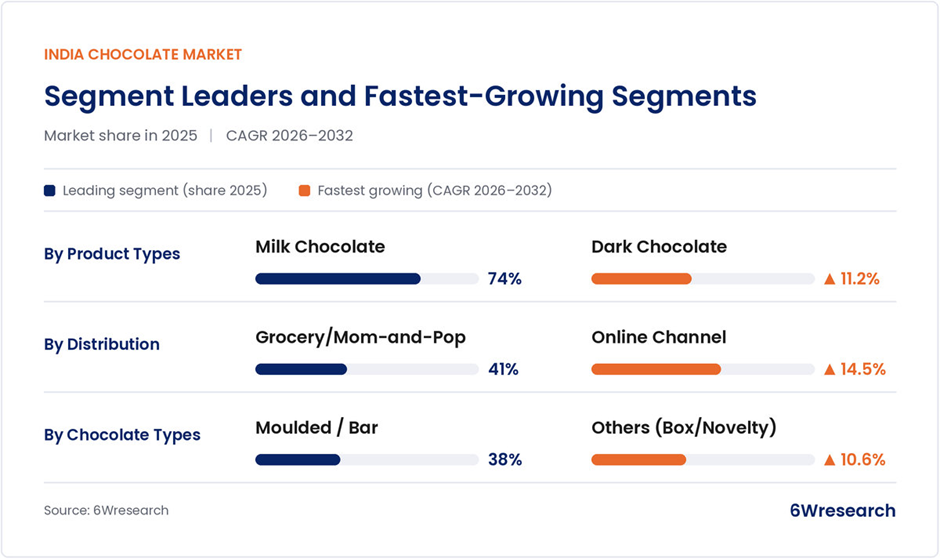
By Product Types – Milk Chocolate Led, While Dark Chocolate Is Expected to Grow Fastest
According to Ravi Bhandari, Research Head at 6Wresearch, Milk Chocolate leads the market with a 74% share in 2025, supported by the mass appeal of sweeter flavour profiles and the wide availability of affordable bars and small packs across general trade channels in India. Meanwhile, Dark Chocolate is expected to record the fastest growth, at a CAGR of 11.2% during 2026 to 2032, driven by rising health awareness and the expansion of single-origin and craft product ranges among urban consumers.
By Distribution Channels – Grocery/Mom-and-Pop Stores Led, While the Online Channel Is Expected to Grow Fastest
With a 41% share in 2025, Grocery/Mom-and-Pop Stores remain the primary point of purchase, as an extensive network of neighbourhood outlets provides convenient access to low-priced chocolate products for households in towns and villages, where organised retail remains limited. In contrast, the Online Channel is expected to expand at a CAGR of 14.5% during 2026 to 2032, driven by instant-delivery platforms and marketplace gifting listings across metropolitan and Tier 2 cities.
By Chocolate Types – Moulded or Bar Chocolates Led, While Others (Box Chocolates, Novelties, etc.) Are Expected to Grow Fastest
Moulded or Bar Chocolates accounted for the leading share of 38% in 2025, supported by strong consumer recall of tablet formats and their suitability for sharing and festive gifting among Indian households. Meanwhile, Others (Box Chocolates, Novelties, etc.) are projected to grow at the highest CAGR of 10.6% during 2026 to 2032, owing to rising demand for premium assortments, personalised hampers and imported chocolate boxes.
Key Attractiveness of the Report
- 10 Years of Market Numbers
- Historical Data Starting from 2022 to 2025
- Base Year 2025
- Forecast Data until 2032
- Key Performance Indicators Impacting the Market
- Major Upcoming Developments and Projects
Key Highlights of the Report:
- India Chocolate Market Outlook
- Market Size of India Chocolate Market, 2025
- Forecast of India Chocolate Market, 2032
- Historical Data and Forecast of India Chocolate Revenues & Volume for the Period 2022 - 2032
- India Chocolate Market Trend Evolution
- India Chocolate Market Drivers and Challenges
- India Chocolate Price Trends
- India Chocolate Porter's Five Forces
- India Chocolate Industry Life Cycle
- Historical Data and Forecast of India Chocolate Market Revenues & Volume By Product Types for the Period 2022 – 2032
- Historical Data and Forecast of India Chocolate Market Revenues & Volume By Milk Chocolate for the Period 2022 – 2032
- Historical Data and Forecast of India Chocolate Market Revenues & Volume By White Chocolate for the Period 2022 – 2032
- Historical Data and Forecast of India Chocolate Market Revenues & Volume By Dark Chocolate for the Period 2022 – 2032
- Historical Data and Forecast of India Chocolate Market Revenues & Volume By Distribution Channels for the Period 2022 – 2032
- Historical Data and Forecast of India Chocolate Market Revenues & Volume By Supermarkets/ Hypermarkets for the Period 2022 – 2032
- Historical Data and Forecast of India Chocolate Market Revenues & Volume By Grocery/ Mom N Pop Stores for the Period 2022 – 2032
- Historical Data and Forecast of India Chocolate Market Revenues & Volume By Convenience Stores for the Period 2022 – 2032
- Historical Data and Forecast of India Chocolate Market Revenues & Volume By Online Channel for the Period 2022 – 2032
- Historical Data and Forecast of India Chocolate Market Revenues & Volume By Others for the Period 2022 – 2032
- Historical Data and Forecast of India Chocolate Market Revenues & Volume By Chocolate Types for the Period 2022 – 2032
- Historical Data and Forecast of India Chocolate Market Revenues & Volume By Countlines & Straight Lines for the Period 2022 – 2032
- Historical Data and Forecast of India Chocolate Market Revenues & Volume By Molded Or Bar Chocolates for the Period 2022 – 2032
- Historical Data and Forecast of India Chocolate Market Revenues & Volume By Choco-Panned & Sugar Panned for the Period 2022 – 2032
- Historical Data and Forecast of India Chocolate Market Revenues & Volume By Others for the Period 2022 – 2032
- India Chocolate Import Export Trade Statistics
- Market Opportunity Assessment By Product Type
- Market Opportunity Assessment By Distribution Channel
- Market Opportunity Assessment By Chocolate Type
- India Chocolate Top Companies Market Share
- India Chocolate Competitive Benchmarking By Technical and Operational Parameters
- India Chocolate Company Profiles
- India Chocolate Key Strategic Recommendations
Market Covered
The report offers a comprehensive study of the subsequent market segments:
By Product Types
- Milk Chocolate
- White Chocolate
- Dark Chocolate
By Distribution Channels
- Supermarkets/ Hypermarkets
- Grocery/ Mom N Pop Stores
- Convenience Stores
- Online Channel
- Others
By Chocolate Types
- Countlines & Straight Lines
- Molded Or Bar Chocolates
- Choco-Panned & Sugar Panned
- Others






































