India Cutting Equipment Market Size, Share & Growth Rate
The India Cutting Equipment Market was estimated at USD 1486 Million in 2025 and is projected to reach USD 2127 Million by 2032, growing at a CAGR of 5.3% from 2026 to 2032. This trajectory is propelled by robust industrial growth, particularly in sectors like metal fabrication and construction, which are increasingly adopting advanced cutting technologies to enhance productivity. Furthermore, government initiatives aimed at boosting manufacturing capabilities are playing a pivotal role in this positive outlook.
India Cutting Equipment Market Year-wise Growth Rate and Key Drivers
This graph highlights how the India Cutting Equipment Market has steadily grown over the years, supported by major growth factors.
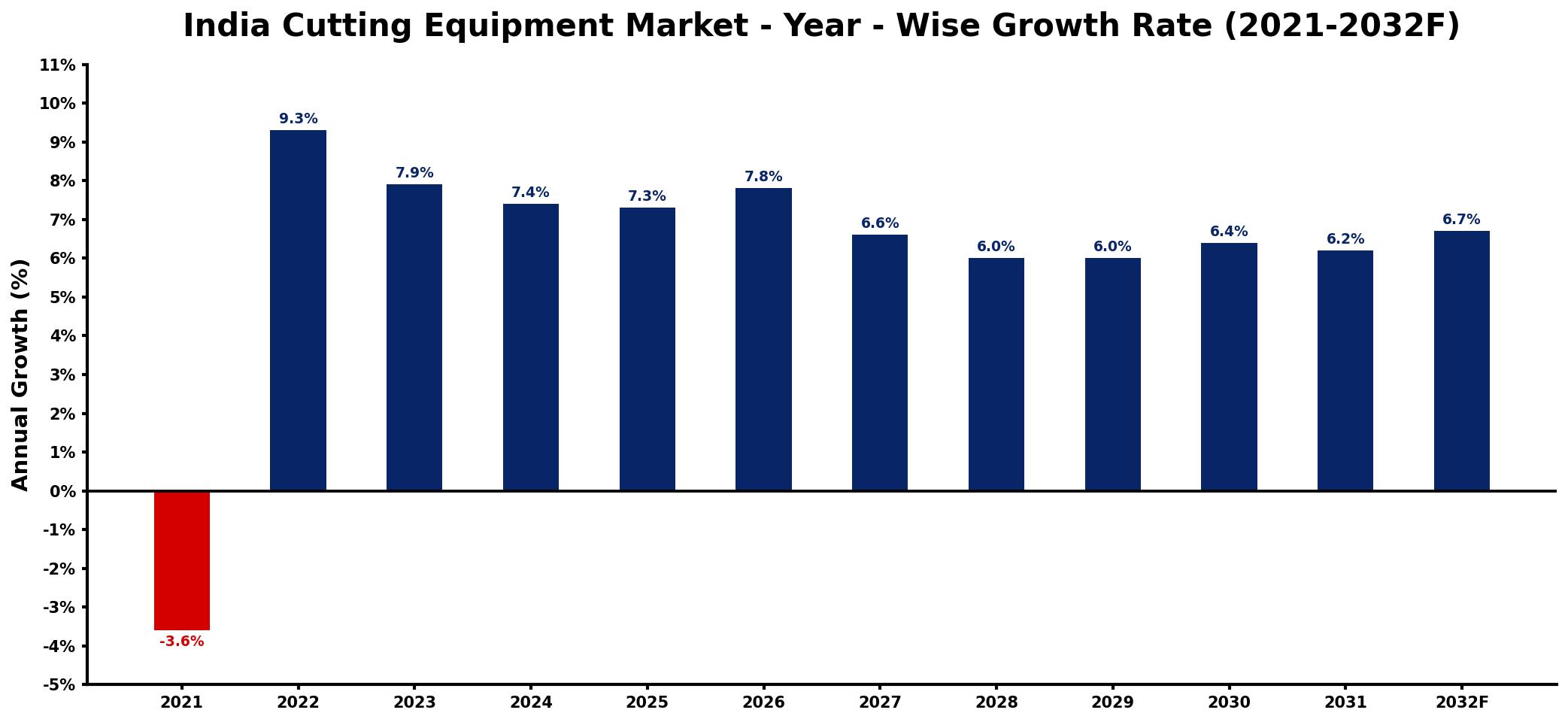
The table below presents the year‑wise growth rates along with the key drivers influencing the market
| Year | Growth Rate | Major Drivers |
| 2021 | -3.6% | Decrease in industrial production rates |
| 2022 | 9.3% | Rising demand for automation solutions |
| 2023 | 7.9% | Growth in renewable energy sector |
| 2024 | 7.4% | Expansion of manufacturing facilities |
| 2025 | 7.3% | Increase in construction activities |
| 2026 | 7.8% | Surge in aerospace investments |
| 2027 | 6.6% | Advancements in precision technology |
| 2028 | 6.0% | Enhancement of logistics infrastructure |
| 2029 | 6.0% | Growing focus on sustainability practices |
| 2030 | 6.4% | Investment in smart city projects |
| 2031 | 6.2% | Rise in automotive production volumes |
| 2032 | 6.7% | Emergence of advanced materials applications |
Note: Market size estimations and growth projections presented in this report are based on 6Wresearch's proprietary forecasting methodology, utilizing the latest available industry data, government publications, and primary research inputs.
India Cutting Equipment Market Synopsis
The surge in industrial automation is the most significant force shaping the cutting equipment market in India today. As manufacturers strive for efficiency, the integration of CNC systems and automated cutting solutions has become indispensable for precision cutting operations across various industries.
Moreover, the rapid expansion of infrastructure projects backed by government funding is also driving the demand for cutting equipment. This upward trajectory underscores the essential role cutting equipment plays in enabling advancements across multiple sectors, including aerospace, automotive, and shipbuilding.
India Cutting Equipment Market Key Takeaways
- The market is driven by increased automation and advanced cutting technologies.
- Government initiatives such as the "Make in India" campaign are fostering growth in manufacturing capabilities.
- Investment in infrastructure development continues to support demand for cutting equipment.
- Challenges include a shortage of skilled operators for advanced cutting machinery.
- The recovery post-COVID-19 has reignited interest and investment in cutting technologies.
Evaluation of Restraints in India Cutting Equipment Market
Despite the promising growth trajectory, the cutting equipment market in India faces substantial challenges that could limit its potential. The most pressing issue is the acute shortage of skilled labor capable of operating sophisticated machinery. This gap in expertise may slow the adoption of innovative technologies and hinder productivity improvements for manufacturers. Additionally, fluctuating raw material costs and global supply chain vulnerabilities can disrupt production schedules, further complicating market dynamics.
India Cutting Equipment Market Trends
Emerging trends in the India Cutting Equipment Market indicate a shift toward more sustainable and energy-efficient cutting technologies. Companies are increasingly exploring options that not only enhance operational efficiencies but also minimize environmental impact. Moreover, the rise of smart manufacturing, driven by the Internet of Things (IoT), is paving the way for intelligent cutting systems that allow for real-time monitoring and optimization of cutting processes.
India Cutting Equipment Market Opportunities
The cutting equipment market in India presents substantial opportunities, particularly in sectors experiencing rapid industrialization. The automotive and aerospace industries, for instance, are increasingly seeking high-precision cutting solutions to meet stringent quality requirements. Additionally, investments in renewable energy infrastructure, such as wind and solar, provide new avenues for cutting equipment utilization, enabling companies to diversify their applications and customer base.
Government Initiatives in the India Cutting Equipment Market
The Indian government has been actively promoting manufacturing through various initiatives aimed at enhancing industrial capabilities. Policies to incentivize local production, improve infrastructure, and attract foreign investment are shaping the market landscape. Programs like "Make in India" and significant public spending on infrastructure development create an environment conducive to growth and innovation in the cutting equipment sector, providing businesses with the support needed to upgrade their technologies.
Future Insights of the India Cutting Equipment Market
Looking ahead to 2026-2032, the India Cutting Equipment Market is expected to evolve significantly as technological advancements continue to disrupt traditional cutting methods. Enhanced capabilities in automation and smart technology integration are set to redefine operational standards in manufacturing. As industries increasingly prioritize sustainability, the demand for eco-friendly cutting solutions will likely become a focal point, further influencing investment strategies and market dynamics.
India Cutting Equipment Market Latest Developments (2025 - 2026)
Recent developments in the India Cutting Equipment Market reflect a strong shift towards automation and digitalization. Companies are investing in research and development to introduce more efficient and precise cutting technologies. Collaboration between domestic and international players is also on the rise, aimed at fostering innovation and improving technology access. Notably, sectors like aerospace and construction are witnessing intensified focus on upgrading cutting solutions to enhance productivity and quality.
India Cutting Equipment Market - Key Attractiveness of the Report
- 10 Years of Market Numbers
- Historical Data Starting from 2022 to 2025
- Base Year: 2025
- Forecast Data until 2032
- Key Performance Indicators Impacting the Market
- Major Upcoming Developments and Projects
Key Highlights of the Report:
- India Cutting Equipment Market Outlook
- Market Size of India Cutting Equipment Market, 2025
- Forecast of India Cutting Equipment Market, 2032
- Historical Data and Forecast of India Cutting Equipment Revenues & Volume for the Period 2022-2032F
- India Cutting Equipment Market Trend Evolution
- India Cutting Equipment Market Drivers and Challenges
- India Cutting Equipment Price Trends
- India Cutting Equipment Porter's Five Forces
- India Cutting Equipment Industry Life Cycle
- Historical Data and Forecast of India Cutting Equipment Market Revenues & Volume By Equipment Type for the Period 2022-2032F
- Historical Data and Forecast of India Cutting Equipment Market Revenues & Volume By Manual for the Period 2022-2032F
- Historical Data and Forecast of India Cutting Equipment Market Revenues & Volume By Mechanized for the Period 2022-2032F
- Historical Data and Forecast of India Cutting Equipment Market Revenues & Volume By Cutting Technology for the Period 2022-2032F
- Historical Data and Forecast of India Cutting Equipment Market Revenues & Volume By Plasma cutting for the Period 2022-2032F
- Historical Data and Forecast of India Cutting Equipment Market Revenues & Volume By Oxy-fuel cutting for the Period 2022-2032F
- Historical Data and Forecast of India Cutting Equipment Market Revenues & Volume By Laser cutting for the Period 2022-2032F
- Historical Data and Forecast of India Cutting Equipment Market Revenues & Volume By Waterjet cutting for the Period 2022-2032F
- Historical Data and Forecast of India Cutting Equipment Market Revenues & Volume By Carbon arc cutting for the Period 2022-2032F
- Historical Data and Forecast of India Cutting Equipment Market Revenues & Volume By End Use Industry for the Period 2022-2032F
- Historical Data and Forecast of India Cutting Equipment Market Revenues & Volume By Construction for the Period 2022-2032F
- Historical Data and Forecast of India Cutting Equipment Market Revenues & Volume By Heavy metal fabrication for the Period 2022-2032F
- Historical Data and Forecast of India Cutting Equipment Market Revenues & Volume By Shipbuilding & offshore for the Period 2022-2032F
- Historical Data and Forecast of India Cutting Equipment Market Revenues & Volume By Automotive for the Period 2022-2032F
- Historical Data and Forecast of India Cutting Equipment Market Revenues & Volume By Others for the Period 2022-2032F
- Historical Data and Forecast of India Cutting Equipment Market Revenues & Volume By Type for the Period 2022-2032F
- Historical Data and Forecast of India Cutting Equipment Market Revenues & Volume By Equipment for the Period 2022-2032F
- Historical Data and Forecast of India Cutting Equipment Market Revenues & Volume By Consumables/Accessories for the Period 2022-2032F
- India Cutting Equipment Import Export Trade Statistics
- Market Opportunity Assessment By Equipment Type
- Market Opportunity Assessment By Cutting Technology
- Market Opportunity Assessment By End Use Industry
- Market Opportunity Assessment By Type
- India Cutting Equipment Top Companies Market Share
- India Cutting Equipment Competitive Benchmarking By Technical and Operational Parameters
- India Cutting Equipment Company Profiles
- India Cutting Equipment Key Strategic Recommendations






































