India Electric Locomotives Market Size, Share & Growth Rate
The India Electric Locomotives Market was estimated at USD 1143 Million in 2025 and is projected to reach USD 1631 Million by 2032, growing at a CAGR of 5.2% from 2026 to 2032. This growth trajectory is propelled by substantial investments in rail infrastructure and the increasing demand for efficient rail transportation. As India expands its electrification efforts and plans for high-speed rail systems, the market is poised for significant advancement.
India Electric Locomotives Market Year-wise Growth Rate and Key Drivers
This graph highlights how the India Electric Locomotives Market has steadily grown over the years, supported by major growth factors.
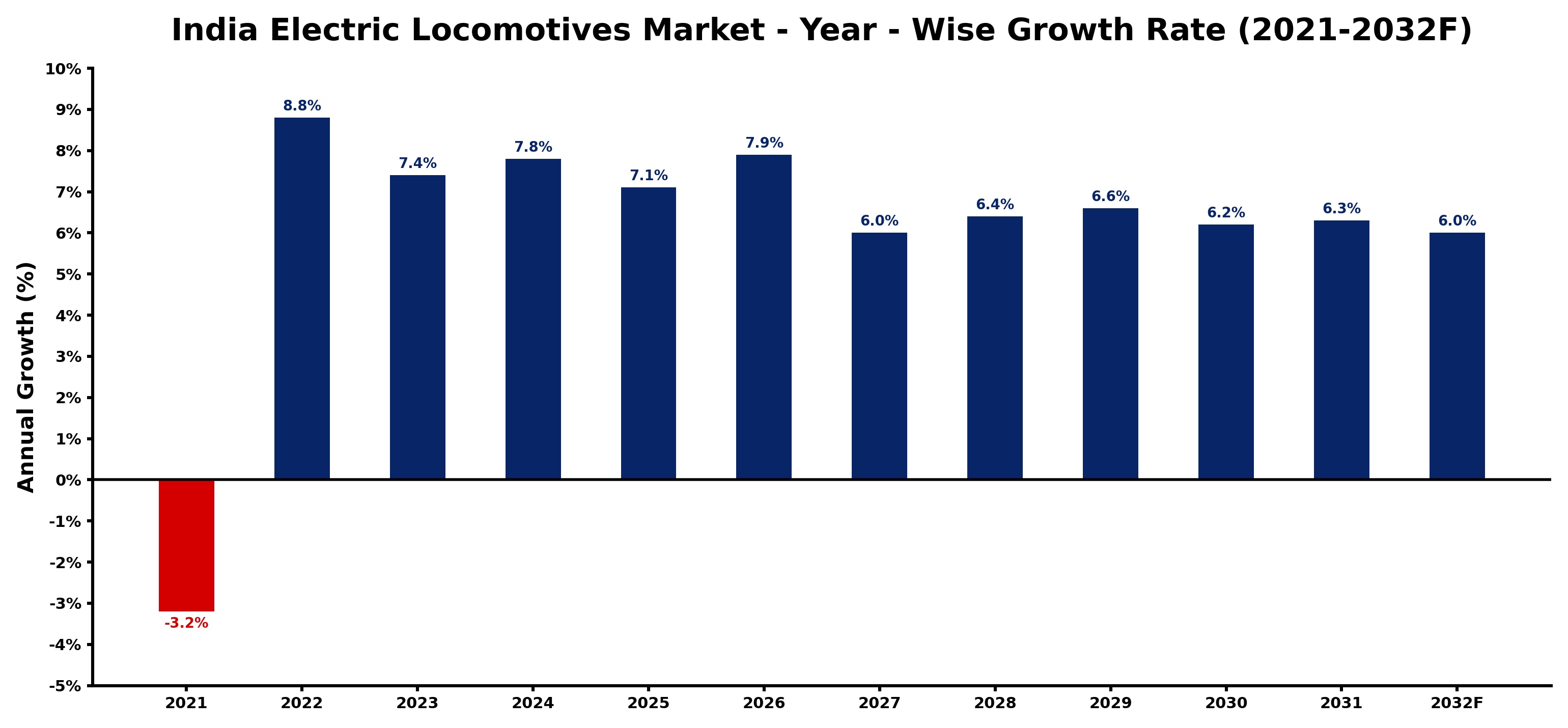
The table below presents the year‑wise growth rates along with the key drivers influencing the market
| Year | Growth Rate | Major Drivers |
| 2021 | -3.2% | Increasing adoption of advanced technologies |
| 2022 | 8.8% | Expansion of manufacturing activities |
| 2023 | 7.4% | Increasing adoption of advanced technologies |
| 2024 | 7.8% | Increasing industrial automation investments |
| 2025 | 7.1% | Expansion of commercial construction activities |
| 2026 | 7.9% | Growing renewable energy integration projects |
| 2027 | 6.0% | Rising electricity demand across industries |
| 2028 | 6.4% | Rising electricity demand across industries |
| 2029 | 6.6% | Expansion of transportation and logistics networks |
| 2030 | 6.2% | Increasing industrial infrastructure investments |
| 2031 | 6.3% | Increasing adoption of advanced technologies |
| 2032 | 6.0% | Expansion of manufacturing activities |
Note - Market size estimations and growth projections presented in this report are based on 6Wresearch's advanced forecasting approach, validated with industry datasets as of June 2026.
India Electric Locomotives Market Synopsis
The India Electric Locomotives Market is witnessing a transformative phase, characterized by robust investments in modernization and sustainability. With the Indian government prioritizing infrastructure development, electric locomotives are becoming integral to meeting both passenger and freight demands.
Electric locomotives not only promise reduced emissions but also enhance operational efficiency, making them an attractive alternative amid rising fuel costs. Furthermore, a growing focus on high-speed rail projects is expected to create new avenues for electric locomotive deployment across the country.
India Electric Locomotives Market Key Takeaways
- The market is driven by increasing investments in rail infrastructure and a push for sustainability.
- Advancements in technology are enhancing the performance and efficiency of electric locomotives.
- The shift towards high-speed rail systems will further catalyze the adoption of electric locomotives.
- Electrification of railway lines remains a significant factor influencing market growth.
- Key industries such as chemicals, petroleum, and metals & mining are contributing to rising demand.
Evaluation of Restraints in India Electric Locomotives Market
Despite the promising outlook, several factors may hinder the growth of the electric locomotives market in India. High initial investment costs pose a significant barrier, particularly for smaller operators and businesses lacking substantial capital resources. Additionally, the complexity of electric locomotive systems necessitates frequent maintenance, which can lead to higher long-term ownership costs. Consequently, these challenges must be navigated to fully realize the market's potential.
India Electric Locomotives Market Trends
Several trends are shaping the future of the India Electric Locomotives Market. Increasing electrification of rail networks is enhancing connectivity and operational efficiency, while technological advancements are leading to more energy-efficient locomotive designs. Moreover, a heightened focus on sustainable transportation solutions is pushing stakeholders towards adopting electric alternatives, spurred by global environmental mandates and national policies alike.
India Electric Locomotives Market Opportunities
The market presents substantial growth opportunities, particularly in the context of government initiatives aimed at expanding rail infrastructure. The introduction of high-speed trains will necessitate the deployment of more electric locomotives, creating demand for innovative technology solutions. Furthermore, industries reliant on efficient rail transport, such as agriculture, mining, and manufacturing, offer avenues for investment and partnership.
Government Initiatives in the India Electric Locomotives Market
The Indian government is actively supporting the transition to electric locomotives through various initiatives. This includes substantial public spending on rail infrastructure, along with policies that incentivize the electrification of railway networks. Collaborative programs with private sector stakeholders aim to foster innovation and improve the efficiency of rail transport, thereby facilitating the growth of the electric locomotives market.
Future Insights of the India Electric Locomotives Market
Looking forward to 2026-2032, the India Electric Locomotives Market is set for transformative growth. With increasing government focus on sustainable transport and ambitious infrastructure projects, electric locomotives will play a critical role in reshaping India's rail industry. The ongoing electrification efforts and advancements in technology are expected to enhance operational capabilities, positioning the market for substantial advancements in efficiency and performance.
India Electric Locomotives Market Latest Developments (May 2025 - June 2026)
Recent developments in the India Electric Locomotives Market indicate a growing momentum towards sustainable transportation solutions. The government has made significant announcements regarding the expansion of electrified rail networks, signaling robust future investments. Additionally, there is a noticeable uptick in collaborations between public and private sectors aimed at developing cutting-edge electric locomotive technologies, thus enhancing overall market dynamics.
India Electric Locomotives Market - Key Attractiveness of the Report
- 10 Years of Market Numbers
- Historical Data Starting from 2022 to 2025
- Base Year: 2025
- Forecast Data until 2032
- Key Performance Indicators Impacting the Market
- Major Upcoming Developments and Projects
Key industries such as chemicals, petroleum, and metals & mining are significantly increasing their demand for electric locomotives, given the need for reliable and efficient transport solutions.
Key Highlights of the Report:
- India Electric Locomotives Market Outlook
- Market Size of India Electric Locomotives Market, 2025
- Forecast of India Electric Locomotives Market, 2032
- Historical Data and Forecast of India Electric Locomotives Revenues & Volume for the Period 2022-2032F
- India Electric Locomotives Market Trend Evolution
- India Electric Locomotives Market Drivers and Challenges
- India Electric Locomotives Price Trends
- India Electric Locomotives Porter's Five Forces
- India Electric Locomotives Industry Life Cycle
- Historical Data and Forecast of India Electric Locomotives Market Revenues & Volume By Energy Transfer for the Period 2022-2032F
- Historical Data and Forecast of India Electric Locomotives Market Revenues & Volume By Overhead Lines for the Period 2022-2032F
- Historical Data and Forecast of India Electric Locomotives Market Revenues & Volume By Third Rail for the Period 2022-2032F
- Historical Data and Forecast of India Electric Locomotives Market Revenues & Volume By On-board Energy Storage for the Period 2022-2032F
- Historical Data and Forecast of India Electric Locomotives Market Revenues & Volume By Technology for the Period 2022-2032F
- Historical Data and Forecast of India Electric Locomotives Market Revenues & Volume By IGBT Module for the Period 2022-2032F
- Historical Data and Forecast of India Electric Locomotives Market Revenues & Volume By GTO Thyristor for the Period 2022-2032F
- Historical Data and Forecast of India Electric Locomotives Market Revenues & Volume By SiC Module for the Period 2022-2032F
- Historical Data and Forecast of India Electric Locomotives Market Revenues & Volume By Traction Units for the Period 2022-2032F
- Historical Data and Forecast of India Electric Locomotives Market Revenues & Volume By AC Traction Units for the Period 2022-2032F
- Historical Data and Forecast of India Electric Locomotives Market Revenues & Volume By DC Traction Units for the Period 2022-2032F
- Historical Data and Forecast of India Electric Locomotives Market Revenues & Volume By Multi System Units for the Period 2022-2032F
- Historical Data and Forecast of India Electric Locomotives Market Revenues & Volume By Application for the Period 2022-2032F
- Historical Data and Forecast of India Electric Locomotives Market Revenues & Volume By Passenger Transport for the Period 2022-2032F
- Historical Data and Forecast of India Electric Locomotives Market Revenues & Volume By Freight Transport for the Period 2022-2032F
- India Electric Locomotives Import Export Trade Statistics
- Market Opportunity Assessment By Energy Transfer
- Market Opportunity Assessment By Technology
- Market Opportunity Assessment By Traction Units
- Market Opportunity Assessment By Application
- India Electric Locomotives Top Companies Market Share
- India Electric Locomotives Competitive Benchmarking By Technical and Operational Parameters
- India Electric Locomotives Company Profiles
- India Electric Locomotives Key Strategic Recommendations






































