India Electrical Equipment Market Summary
The india electrical equipment market was estimated at USD 1208 Million in 2025 and is projected to reach USD 1740 Million by 2032, growing at a CAGR of 7.8% from 2026 to 2032.
India Electrical Equipment Market Year-wise Growth Rate and Key Drivers
This graph highlights how the India Electrical Equipment Market has steadily grown over the years, supported by major growth factors.
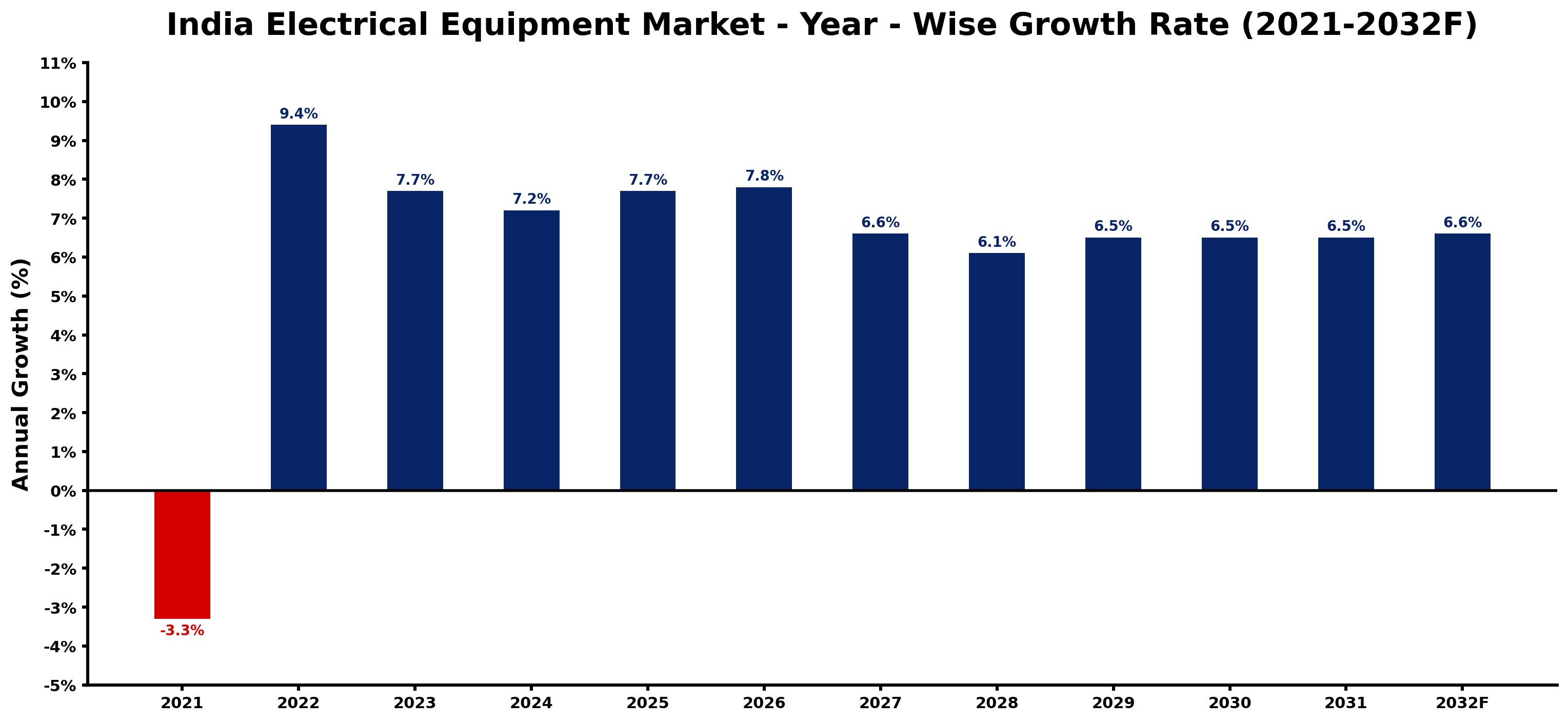
The table below presents the year wise growth rates along with the key drivers influencing the market
| Year | Growth Rate | Major Drivers |
| 2021 | -3.3% | Increased demand for renewable energy sources reduced investments in traditional electrical equipment technologies. |
| 2022 | 9.4% | Legacy copper grid failures prompt utilities to modernize their systems with advanced solutions. |
| 2023 | 7.7% | Enterprise budgets prioritizing energy efficiency lead to increased interest in smart technologies. |
| 2024 | 7.2% | Smart cities initiatives spark demand for innovative electrical equipment across urban landscapes. |
| 2025 | 7.7% | Manufacturing sector expansion accelerates demand for reliable power solutions amidst industry 4.0 shifts. |
| 2026 | 7.8% | Rural electrification projects continue to gain momentum, ensuring power access to underserved regions. |
| 2027 | 6.6% | Rapid urbanization creates pressure for improved electrical infrastructure in metropolitan areas. |
| 2028 | 6.1% | Renewable energy sources increasingly integrated into the grid drive new equipment requirements. |
| 2029 | 6.5% | Diverse industrial applications demand customized electrical solutions, enhancing market competitiveness. |
| 2030 | 6.5% | Technological convergence in IoT influences upgrades to existing electrical equipment standards. |
| 2031 | 6.5% | Sustainability mandates encourage companies to invest in eco-friendly electrical equipment alternatives. |
| 2032 | 6.6% | Emerging trends in electric mobility open new avenues for growth in electrical equipment sectors. |
Note - Market size estimations and growth projections presented in this report are based on 6Wresearch's advanced forecasting approach, validated with industry datasets as of June 2026.
India Electrical Equipment Market Synopsis
The India Electrical Equipment Market is projected to reach 7.8% and witness significant growth during the forecast period (2026-2032). This growth trajectory is primarily driven by increasing electricity consumption, a burgeoning population, and substantial investments in infrastructure development. The Indian government's commitment to expanding renewable energy sources, particularly solar and wind power generation, is expected to further bolster the market's expansion. Alongside this, rising industrialization and increasing foreign direct investment (FDI) inflows significantly contribute to the projected growth rate of the market.
India Electrical Equipment Market Growth Drivers
Several factors are propelling the growth of the India Electrical Equipment Market, including:
- Increasing electricity consumption: As one of the highest per capita electricity-consuming countries among its peers, India requires enhanced electrical equipment to cater to the growing demand. This surge is mainly fueled by rapid urbanization and industrialization, leading to heightened residential, commercial, and public sector needs.
- Growing population: With the World Bank estimating that India's population will reach 1.3 billion by 2025, predictions suggest that by 2050, India will account for nearly 1/5th of the world's population. This demographic growth is expected to create substantial demand for consumer durables, such as refrigerators and washing machines, thereby generating opportunities within the electrical equipment segment.
- Rising investments in infrastructure: Government and private sector investments in infrastructure projects are expected to significantly enhance the electrical equipment market. Initiatives focused on modernizing the grid and expanding distribution networks will further amplify demand for electrical equipment.
- Renewable energy initiatives: The Indian government's strategic push towards renewable energy sources is not only supportive of sustainable growth but also propels demand for electrical equipment tailored to these technologies. The adoption of solar and wind power is anticipated to stimulate market growth throughout the forecast period.
- Industrialization: The ongoing industrial growth within India is driving greater demand for efficient and reliable electrical equipment. The rise in manufacturing and the establishment of new industries are increasing the need for robust electrical solutions.
India Electrical Equipment Market Challenges and Restraints
While the India Electrical Equipment Market presents numerous growth opportunities, it also faces several significant challenges:
- High import duties: To bolster local manufacturing and diminish dependency on imports, the Indian government has imposed significant duties on certain electrical equipment categories. This results in higher prices for local consumers and could hinder adoption and market penetration.
- Low voltage infrastructure: Despite efforts made over the decades, many regions in India still lack adequate low voltage distribution networks. This lack of infrastructure complicates access for manufacturers and suppliers aiming to enter underdeveloped areas where a substantial portion of consumers resides.
- Regulatory challenges: Stringent regulations associated with establishing new manufacturing plants or refurbishing existing ones can deter investment and slow market growth. Compliance with these regulations requires considerable time and resources.
- Technological barriers: The rapid pace of technological advancements necessitates that manufacturers continuously innovate to keep pace with consumer expectations. Companies may struggle to invest in cutting-edge technology, potentially impacting their competitive standing.
- Market fragmentation: The presence of numerous market players leads to a fragmented landscape, causing increased competition and potentially squeezing profit margins for smaller and mid-sized firms.
India Electrical Equipment Market Trends and Opportunities
Emerging trends within the India Electrical Equipment Market indicate several promising opportunities:
- Adoption of smart grid technologies: The implementation of smart grids is transforming how energy is distributed and utilized. These technologies offer real-time information on energy consumption, allowing users to take control of their energy usage, which is expected to lead to energy savings and reduced carbon emissions.
- Increased focus on energy-efficient solutions: The growing awareness of energy conservation is propelling demand for energy-efficient electrical equipment. This focus aligns with both government initiatives and consumer preferences, creating a fertile environment for innovative solutions to thrive.
- Investment in renewable energy technologies: The growing emphasis on clean energy provides a rich ground for the development of specialized electrical equipment tailored for renewable energy applications, further enhancing market prospects.
- Expansion of e-commerce channels: The shift towards digital transformation and e-commerce platforms is reshaping how electrical equipment is marketed and sold, broadening access for consumers and contributing to market growth.
- Sustainability initiatives: The increasing focus on sustainability will likely compel manufacturers to innovate and develop products that are not only effective but also environmentally friendly. This trend could redefine market dynamics over the forecast period.
India Electrical Equipment Market Government Investment and Initiatives
The Government of India plays a crucial role in the development of the Electrical Equipment Market through numerous initiatives and investments:
- Infrastructure development plans: Government programs aimed at enhancing the national grid and improving the electrical distribution network have led to increased demand for high-quality electrical equipment.
- Promotion of renewable energy: Through various policy measures and initiatives, the government is advocating for the adoption of renewable energy sources, thereby creating a favorable environment for growth in the electrical equipment sector associated with these technologies.
- Support for local manufacturing: The Indian government has introduced policies to incentivize domestic production of electrical equipment, which is expected to bolster the local market and reduce dependency on imports.
- Financial aid for infrastructure projects: Increased public spending on infrastructure projects ensures a steady demand for electrical equipment, which is critical for supporting rapid urbanization and industrial growth.
- Skill development programs: Government initiatives focused on workforce development and training are essential in nurturing a skilled labor force capable of supporting the evolving electrical equipment landscape.
India Electrical Equipment Market Latest Developments (May 2025 - June 2026)
The India Electrical Equipment Market has witnessed various developments from May 2025 to June 2026, reflecting the dynamic nature of this industry. There has been a notable increase in investments aimed at enhancing renewable energy solutions, which aligns with the government's clean energy objectives. Additionally, several state initiatives have focused on modernizing electrical infrastructure, aiming to bridge the gap in low voltage distribution networks. Innovations in smart grid technology are becoming more prevalent, indicating a strategic shift towards automation and efficiency in energy consumption. Furthermore, there has been a growing trend towards sustainability, prompting manufacturers to explore environmentally friendly materials and production processes.
India Electrical Equipment Market - Key Attractiveness of the Report
- 10 Years of Market Numbers
- Historical Data Starting from 2022 to 2025
- Base Year: 2025
- Forecast Data until 2032
- Key Performance Indicators Impacting the Market
- Major Upcoming Developments and Projects
Key Highlights of the Report:
- India Electrical Equipment Market Outlook
- Market Size of India Electrical Equipment Market, 2025
- Forecast of India Electrical Equipment Market, 2032
- Historical Data and Forecast of India Electrical Equipment Revenues & Volume for the Period 2022-2032F
- India Electrical Equipment Market Trend Evolution
- India Electrical Equipment Market Drivers and Challenges
- India Electrical Equipment Price Trends
- India Electrical Equipment Porter's Five Forces
- India Electrical Equipment Industry Life Cycle
- Historical Data and Forecast of India Electrical Equipment Market Revenues & Volume By Types for the Period 2022-2032F
- Historical Data and Forecast of India Electrical Equipment Market Revenues & Volume By Electronic and electrical wires and cables for the Period 2022-2032F
- Historical Data and Forecast of India Electrical Equipment Market Revenues & Volume By Batteries and accumulators for the Period 2022-2032F
- Historical Data and Forecast of India Electrical Equipment Market Revenues & Volume By Wiring devices for the Period 2022-2032F
- Historical Data and Forecast of India Electrical Equipment Market Revenues & Volume By Electric lighting equipment for the Period 2022-2032F
- Historical Data and Forecast of India Electrical Equipment Market Revenues & Volume By Others for the Period 2022-2032F
- Historical Data and Forecast of India Electrical Equipment Market Revenues & Volume By Applications for the Period 2022-2032F
- Historical Data and Forecast of India Electrical Equipment Market Revenues & Volume By Residential end-users for the Period 2022-2032F
- Historical Data and Forecast of India Electrical Equipment Market Revenues & Volume By Non-residential end-users for the Period 2022-2032F
- India Electrical Equipment Import Export Trade Statistics
- Market Opportunity Assessment By Types
- Market Opportunity Assessment By Applications
- India Electrical Equipment Top Companies Market Share
- India Electrical Equipment Competitive Benchmarking By Technical and Operational Parameters
- India Electrical Equipment Company Profiles
- India Electrical Equipment Key Strategic Recommendations






































