India Energy Efficient Lighting Market Size, Share & Growth Rate
The India Energy Efficient Lighting Market was estimated at USD 1008 Million in 2025 and is projected to reach USD 1444 Million by 2032, growing at a CAGR of 5.3% from 2026 to 2032. This growth trajectory is primarily fueled by a combination of increasing energy conservation awareness and favorable government initiatives aimed at promoting sustainability. The rapid advancements in lighting technology, particularly in LED solutions, have also contributed to making energy-efficient lighting options more accessible and appealing across various sectors.
India Energy Efficient Lighting Market Year-wise Growth Rate and Key Drivers
This graph highlights how the India Energy Efficient Lighting Market has steadily grown over the years, supported by major growth factors.
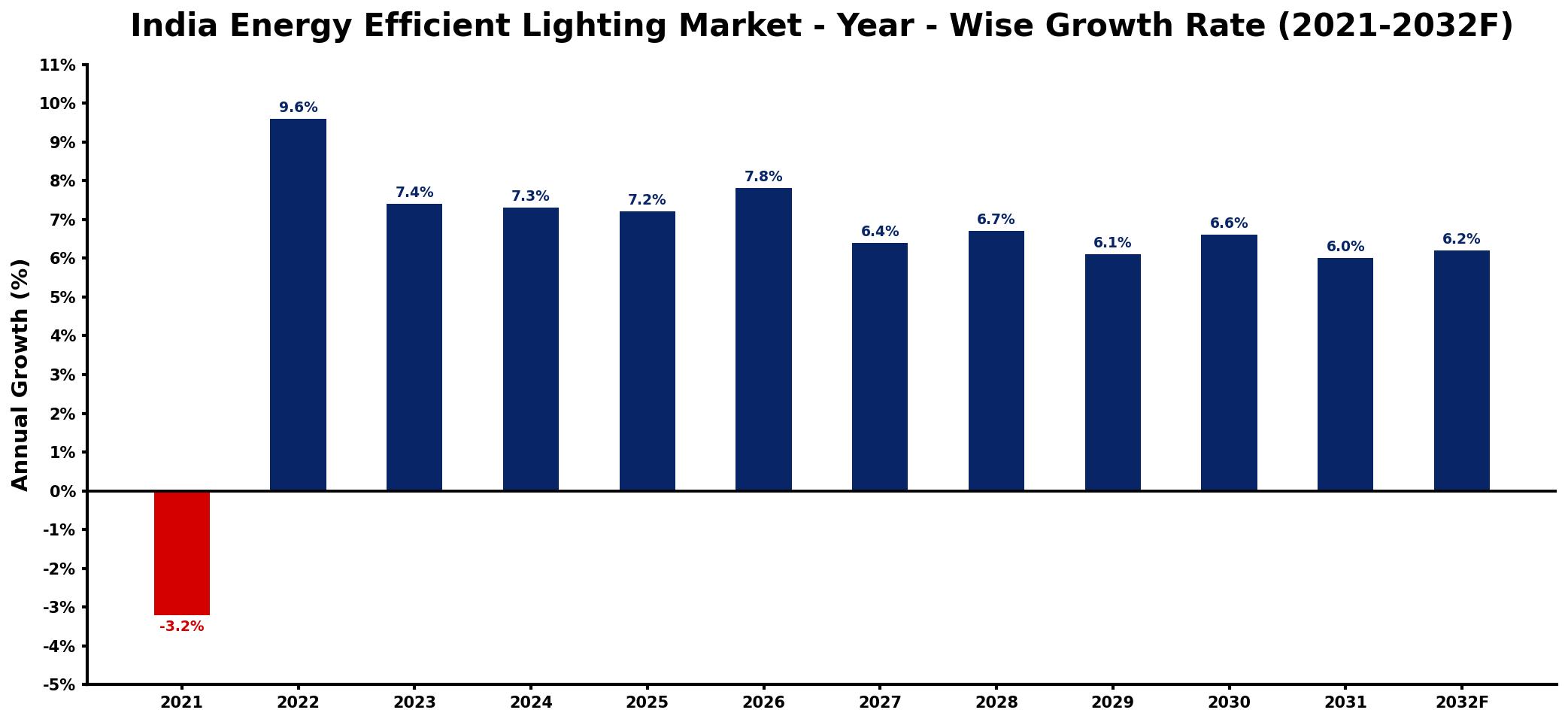
The table below presents the year‑wise growth rates along with the key drivers influencing the market
| Year | Growth Rate | Major Drivers |
| 2021 | -3.2% | decreased consumer demand for alternatives |
| 2022 | 9.6% | rising investments in renewable technologies |
| 2023 | 7.4% | growing urbanization and infrastructure projects |
| 2024 | 7.3% | increased focus on sustainability initiatives |
| 2025 | 7.2% | expansion of government incentive programs |
| 2026 | 7.8% | surge in residential retrofit projects |
| 2027 | 6.4% | growing awareness of climate impact |
| 2028 | 6.7% | increased adoption of smart solutions |
| 2029 | 6.1% | rising demand from commercial sectors |
| 2030 | 6.6% | growing regional consumption patterns |
| 2031 | 6.0% | growing partnerships in innovation |
| 2032 | 6.2% | increased consumer preference for quality |
Note: Market size estimations and growth projections presented in this report are based on 6Wresearch's proprietary forecasting methodology, utilizing the latest available industry data, government publications, and primary research inputs.
India Energy Efficient Lighting Market Synopsis
In India, the demand for energy-efficient lighting solutions is surging as consumers become more environmentally conscious and seek ways to reduce their energy bills. This trend is particularly evident in residential applications, where homeowners are increasingly replacing traditional bulbs with energy-efficient alternatives such as LEDs and CFLs.
Moreover, commercial and industrial sectors are embracing energy-efficient technologies to enhance operational efficiency and reduce overall carbon footprints. Government initiatives, including incentives and labeling programs, further bolster this shift toward sustainable lighting practices across the country.
India Energy Efficient Lighting Market Key Takeaways
- The market is propelled by increasing awareness of environmental sustainability and energy conservation.
- Government policies and regulations significantly influence the adoption of energy-efficient lighting technologies.
- Price reductions in LED technology make energy-efficient options more viable for various consumer segments.
- Consumer interest in smart lighting solutions is rising, spurred by IoT integration and smart home trends.
- Challenges such as initial investment costs and varying product quality impact market penetration.
Evaluation of Restraints in India Energy Efficient Lighting Market
Despite the positive growth outlook, the India Energy Efficient Lighting Market faces notable constraints that could hinder its expansion. A significant barrier is the general consumer awareness regarding the long-term benefits of energy-efficient lighting, which still lags behind traditional options. High initial costs associated with purchasing advanced lighting technologies deter potential buyers, particularly in price-sensitive segments. Additionally, the presence of subpar products in the market raises quality concerns, leading to skepticism among consumers. Addressing these challenges will be crucial for enhancing market adoption and achieving sustainable growth.
India Energy Efficient Lighting Market Trends
Current trends in the India Energy Efficient Lighting Market indicate a strong shift toward smart lighting solutions integrated with Internet of Things (IoT) technology. This evolution not only facilitates energy savings but also enhances user experience through automation and remote control features. Furthermore, the emergence of innovative lighting designs and customizable products is capturing consumer interest, allowing for personalized aesthetics alongside energy efficiency. As the focus on sustainability continues to grow, there is a notable rise in collaborative efforts between manufacturers and governmental bodies to foster awareness and promote eco-friendly lighting solutions.
India Energy Efficient Lighting Market Opportunities
The market holds substantial growth potential, especially within the residential sector where consumers are increasingly prioritizing energy-efficient solutions. Investment in innovative technologies such as smart lighting systems presents a lucrative opportunity for manufacturers to capture a wider audience. Additionally, as urbanization accelerates and infrastructure projects expand across India, the demand for energy-efficient lighting in public spaces and commercial establishments will continue to rise. Strategic partnerships and collaborations within the supply chain can further unlock opportunities, enhancing accessibility and distribution of energy-efficient products.
Government Initiatives in the India Energy Efficient Lighting Market
The Indian government has implemented various initiatives to promote the adoption of energy-efficient lighting solutions. Programs aimed at energy conservation include financial incentives, subsidies for purchasing energy-efficient products, and stringent regulations on lighting efficiency standards. Additionally, initiatives such as the UJALA scheme, which distributes LED bulbs at subsidized rates, highlight the government's commitment to enhancing energy efficiency across the country. Public awareness campaigns further engage consumers in the benefits of transitioning to energy-efficient lighting technologies.
Future Insights of the India Energy Efficient Lighting Market
Looking ahead to 2026-2032, the India Energy Efficient Lighting Market is poised for significant evolution. As technological advancements continue, the introduction of more cost-effective and efficient lighting solutions will likely attract a broader consumer base. Furthermore, increasing regulatory support and heightened consumer awareness about sustainability will drive market dynamics. The trend towards smart homes and energy management systems will also play a pivotal role in shaping future lighting preferences, suggesting a robust growth trajectory for the market.
India Energy Efficient Lighting Market Latest Developments (2025 - 2026)
Recent developments in the India Energy Efficient Lighting Market indicate a strong focus on enhancing product quality and expanding the range of energy-efficient options available to consumers. Many manufacturers are actively investing in R&D to introduce advanced lighting solutions that integrate IoT capabilities. Moreover, industry players are increasingly collaborating with local governments to ensure alignment with emerging energy efficiency regulations and standards, paving the way for more sustainable practices across the sector.
India Energy Efficient Lighting Market - Key Attractiveness of the Report
- 10 Years of Market Numbers
- Historical Data Starting from 2022 to 2025
- Base Year: 2025
- Forecast Data until 2032
- Key Performance Indicators Impacting the Market
- Major Upcoming Developments and Projects
Key Highlights of the Report:
- India Energy Efficient Lighting Market Outlook
- Market Size of India Energy Efficient Lighting Market, 2025
- Forecast of India Energy Efficient Lighting Market, 2032
- Historical Data and Forecast of India Energy Efficient Lighting Revenues & Volume for the Period 2022-2032F
- India Energy Efficient Lighting Market Trend Evolution
- India Energy Efficient Lighting Market Drivers and Challenges
- India Energy Efficient Lighting Price Trends
- India Energy Efficient Lighting Porter's Five Forces
- India Energy Efficient Lighting Industry Life Cycle
- Historical Data and Forecast of India Energy Efficient Lighting Market Revenues & Volume By Product Type for the Period 2022-2032F
- Historical Data and Forecast of India Energy Efficient Lighting Market Revenues & Volume By Incandescent Lamp for the Period 2022-2032F
- Historical Data and Forecast of India Energy Efficient Lighting Market Revenues & Volume By Light Emitting Diode for the Period 2022-2032F
- Historical Data and Forecast of India Energy Efficient Lighting Market Revenues & Volume By Arc Lamp for the Period 2022-2032F
- Historical Data and Forecast of India Energy Efficient Lighting Market Revenues & Volume By Gas Discharge Lamps for the Period 2022-2032F
- Historical Data and Forecast of India Energy Efficient Lighting Market Revenues & Volume By Application for the Period 2022-2032F
- Historical Data and Forecast of India Energy Efficient Lighting Market Revenues & Volume By Commercial for the Period 2022-2032F
- Historical Data and Forecast of India Energy Efficient Lighting Market Revenues & Volume By Residential for the Period 2022-2032F
- Historical Data and Forecast of India Energy Efficient Lighting Market Revenues & Volume By Government for the Period 2022-2032F
- Historical Data and Forecast of India Energy Efficient Lighting Market Revenues & Volume By Correlated Color Temperature for the Period 2022-2032F
- Historical Data and Forecast of India Energy Efficient Lighting Market Revenues & Volume By 2700K-3000K for the Period 2022-2032F
- Historical Data and Forecast of India Energy Efficient Lighting Market Revenues & Volume By 3500K??4000K for the Period 2022-2032F
- Historical Data and Forecast of India Energy Efficient Lighting Market Revenues & Volume By 4000K-5000K for the Period 2022-2032F
- Historical Data and Forecast of India Energy Efficient Lighting Market Revenues & Volume By 5000K-6500K for the Period 2022-2032F
- Historical Data and Forecast of India Energy Efficient Lighting Market Revenues & Volume By More Than 6500K for the Period 2022-2032F
- India Energy Efficient Lighting Import Export Trade Statistics
- Market Opportunity Assessment By Product Type
- Market Opportunity Assessment By Application
- Market Opportunity Assessment By Correlated Color Temperature
- India Energy Efficient Lighting Top Companies Market Share
- India Energy Efficient Lighting Competitive Benchmarking By Technical and Operational Parameters
- India Energy Efficient Lighting Company Profiles
- India Energy Efficient Lighting Key Strategic Recommendations






































