India Fatty Acid Market Top 5 Importing Countries and Market Competition (HHI) Analysis
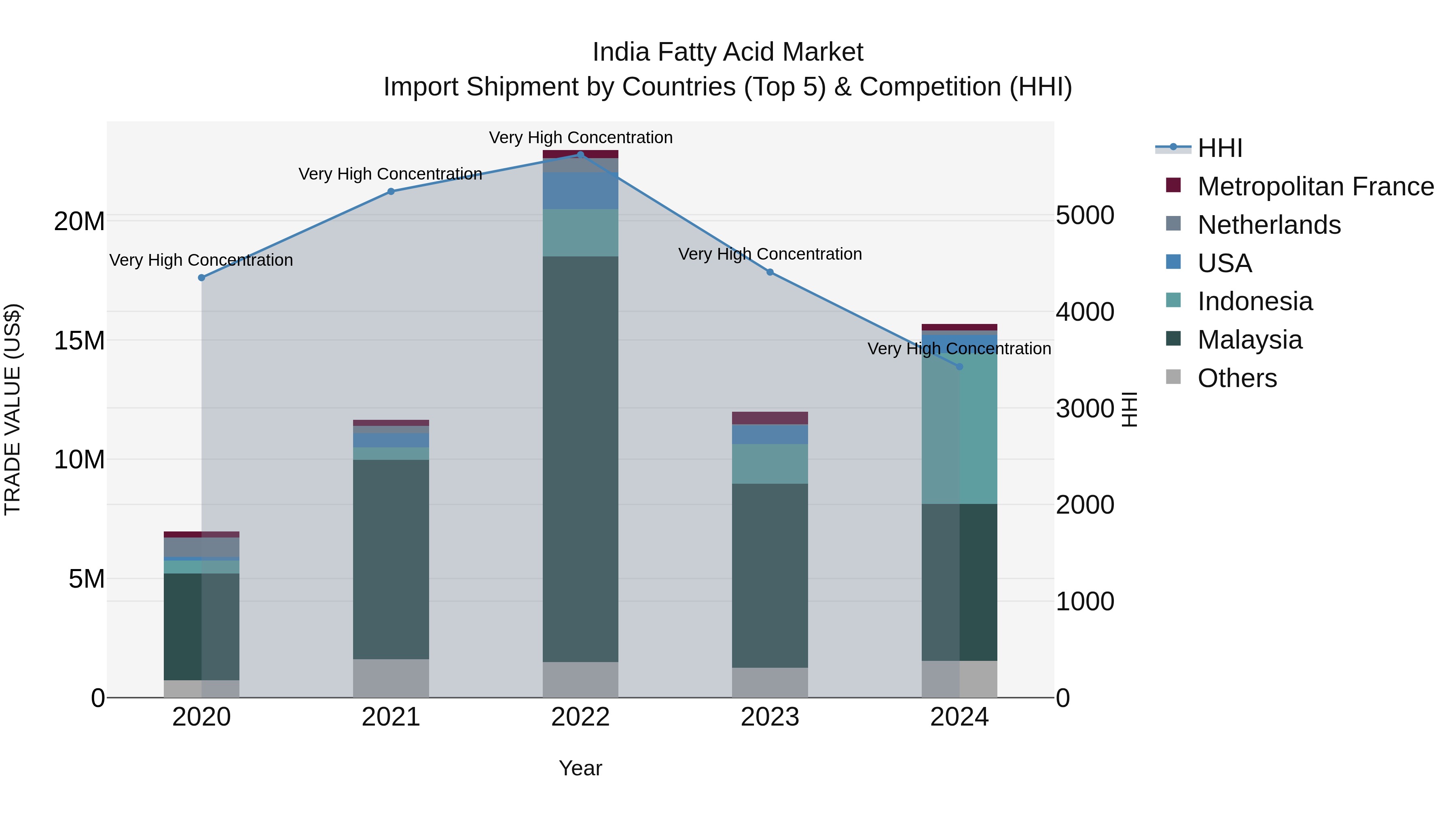
India`s fatty acid import market continued to witness strong growth in 2024, with key exporting countries such as Malaysia, Indonesia, USA, Japan, and Metropolitan France dominating the shipments. The high Herfindahl-Hirschman Index (HHI) indicates a concentrated market structure, while the impressive compound annual growth rate (CAGR) of 22.46% from 2020 to 2024 underscores the increasing demand for fatty acids. Moreover, the notable growth rate of 30.69% in 2024 signals a promising outlook for the industry, reflecting the importance of these imports in India`s market landscape.
India Fatty Acid Market Overview
The India fatty acid market is experiencing steady growth driven by various factors such as increasing demand from end-use industries like food & beverages, pharmaceuticals, and personal care products. The market is witnessing a shift towards healthier alternatives like omega-3 and omega-6 fatty acids due to rising health consciousness among consumers. Additionally, the growing awareness about the benefits of fatty acids for heart health and overall well-being is driving the market further. The presence of key players in the region, coupled with government initiatives promoting the production and consumption of fatty acids, is expected to fuel market growth. However, price fluctuations of raw materials and regulatory challenges may hinder market expansion to some extent. Overall, the India fatty acid market presents opportunities for manufacturers to innovate and cater to the evolving needs of consumers.
India Fatty Acid Market Trends
The India fatty acid market is witnessing several key trends currently. One significant trend is the growing demand for omega-3 fatty acids due to their health benefits, driving the market for fish oils and algal oils. Another trend is the increasing use of fatty acids in the cosmetics and personal care industry for their moisturizing and anti-aging properties. Additionally, there is a shift towards the use of sustainable and plant-based sources of fatty acids, with consumers showing a preference for products derived from plants like coconut oil, olive oil, and avocado oil. The market is also seeing a focus on product innovation and development of specialty fatty acids for specific applications such as functional foods, dietary supplements, and pharmaceuticals. Overall, these trends indicate a dynamic and evolving landscape in the India fatty acid market.
India Fatty Acid Market Challenges
In the India fatty acid market, some key challenges include fluctuating prices of raw materials, such as crude oil and palm oil, which directly impact production costs. Additionally, the industry faces competition from imported fatty acids, which can sometimes be offered at lower prices due to economies of scale. Regulatory hurdles and compliance with quality standards also pose challenges for market players. Moreover, consumer preferences are shifting towards healthier alternatives, leading to a growing demand for plant-based fatty acids over traditional animal-based sources. To stay competitive, companies in the Indian fatty acid market need to focus on innovation, sustainable sourcing practices, and efficient supply chain management to overcome these challenges and meet evolving market demands.
India Fatty Acid Market Investment Opportunities
One prominent investment opportunity in the Indian fatty acid market lies in the growing demand for oleochemicals. Oleochemicals are derived from natural sources such as vegetable oils and animal fats and find applications in various industries including pharmaceuticals, personal care products, food processing, and more. With increasing awareness about sustainability and environmental concerns, there is a shift towards using oleochemicals as a renewable and eco-friendly alternative to petrochemical-based products. Investing in production facilities for oleochemicals in India can be a lucrative opportunity due to the country`s abundant sources of raw materials, a large consumer base, and government initiatives promoting the use of bio-based products. Additionally, the expanding middle-class population and rising disposable incomes are driving the demand for oleochemical-based products, further enhancing the investment potential in this sector.
India Fatty Acid Market Government Policy
The Indian government has implemented various policies to regulate the fatty acid market with a focus on promoting domestic production and reducing reliance on imports. One of the key policies is the imposition of import duties on fatty acids to protect local manufacturers and encourage self-sufficiency. Additionally, the government has introduced quality standards and regulations to ensure the safety and efficacy of fatty acid products in the market. In line with the government`s initiatives to boost the agriculture and food processing sectors, there are also schemes and subsidies available to support farmers and businesses involved in the production of fatty acids from natural sources like oils and fats. Overall, these policies aim to foster growth and competitiveness in the Indian fatty acid market while maintaining quality standards and promoting sustainability.
India Fatty Acid Market Future Outlook
The future outlook for the India fatty acid market appears promising, driven by increasing consumer awareness of health and wellness, along with the growing demand for fatty acid-based products in various industries such as food, pharmaceuticals, and personal care. Rising disposable incomes, changing dietary habits, and the shift towards natural and organic ingredients are also expected to fuel market growth. Additionally, the government`s initiatives to promote domestic production and reduce import dependency in the chemical sector are likely to create opportunities for local players in the fatty acid market. With a focus on innovation, sustainability, and quality, key industry players are likely to invest in research and development to cater to evolving consumer preferences, thus contributing to the overall growth and development of the India fatty acid market.
Key Highlights of the Report:
- India Fatty Acid Market Outlook
- Market Size of India Fatty Acid Market,2024
- Forecast of India Fatty Acid Market, 2031
- Historical Data and Forecast of India Fatty Acid Revenues & Volume for the Period 2021-2031
- India Fatty Acid Market Trend Evolution
- India Fatty Acid Market Drivers and Challenges
- India Fatty Acid Price Trends
- India Fatty Acid Porter's Five Forces
- India Fatty Acid Industry Life Cycle
- Historical Data and Forecast of India Fatty Acid Market Revenues & Volume By Product Type for the Period 2021-2031
- Historical Data and Forecast of India Fatty Acid Market Revenues & Volume By Saturated Fatty Acids for the Period 2021-2031
- Historical Data and Forecast of India Fatty Acid Market Revenues & Volume By Unsaturated Fatty Acids for the Period 2021-2031
- Historical Data and Forecast of India Fatty Acid Market Revenues & Volume By Omega-3 Fatty Acids for the Period 2021-2031
- Historical Data and Forecast of India Fatty Acid Market Revenues & Volume By Medium-Chain Fatty Acids for the Period 2021-2031
- Historical Data and Forecast of India Fatty Acid Market Revenues & Volume By Technology Type for the Period 2021-2031
- Historical Data and Forecast of India Fatty Acid Market Revenues & Volume By Extraction and Distillation for the Period 2021-2031
- Historical Data and Forecast of India Fatty Acid Market Revenues & Volume By Hydrogenation for the Period 2021-2031
- Historical Data and Forecast of India Fatty Acid Market Revenues & Volume By Solvent Extraction for the Period 2021-2031
- Historical Data and Forecast of India Fatty Acid Market Revenues & Volume By Chemical Synthesis for the Period 2021-2031
- Historical Data and Forecast of India Fatty Acid Market Revenues & Volume By End User for the Period 2021-2031
- Historical Data and Forecast of India Fatty Acid Market Revenues & Volume By Food and Beverage Industry for the Period 2021-2031
- Historical Data and Forecast of India Fatty Acid Market Revenues & Volume By Pharmaceuticals and Nutraceuticals for the Period 2021-2031
- Historical Data and Forecast of India Fatty Acid Market Revenues & Volume By Health-Conscious Consumers for the Period 2021-2031
- Historical Data and Forecast of India Fatty Acid Market Revenues & Volume By Animal Feed Manufacturers for the Period 2021-2031
- Historical Data and Forecast of India Fatty Acid Market Revenues & Volume By Application for the Period 2021-2031
- Historical Data and Forecast of India Fatty Acid Market Revenues & Volume By Fats and Oils in Cooking and Baking for the Period 2021-2031
- Historical Data and Forecast of India Fatty Acid Market Revenues & Volume By Dietary Supplements and Medicinal Uses for the Period 2021-2031
- Historical Data and Forecast of India Fatty Acid Market Revenues & Volume By Nutritional Supplements for the Period 2021-2031
- Historical Data and Forecast of India Fatty Acid Market Revenues & Volume By Animal Nutrition and Feed Additives for the Period 2021-2031
- India Fatty Acid Import Export Trade Statistics
- Market Opportunity Assessment By Product Type
- Market Opportunity Assessment By Technology Type
- Market Opportunity Assessment By End User
- Market Opportunity Assessment By Application
- India Fatty Acid Top Companies Market Share
- India Fatty Acid Competitive Benchmarking By Technical and Operational Parameters
- India Fatty Acid Company Profiles
- India Fatty Acid Key Strategic Recommendations






































