India Hams, Shoulders and Cuts of Swine Market Size, Share & Growth Rate
The India Hams, Shoulders and Cuts of Swine Market was estimated at USD 800 Million in 2025 and is projected to reach USD 1155 Million by 2032, growing at a CAGR of 5.4% from 2026 to 2032. This upward trajectory is largely driven by the increasing disposable income among urban consumers, which has led to a higher demand for protein-rich food options. Additionally, the growing health consciousness among consumers is steering their choices towards healthier meat alternatives, including hams and pork cuts, further fueling market expansion.
India Hams, Shoulders and Cuts of Swine Market Growth Rate Analysis (2021-2032)
The India Hams, Shoulders, and Cuts of Swine market has rebounded remarkably since the downturn of -3.5% in 2021, reflecting a robust recovery driven by increasing consumer demand and investments in supply chain efficiency. Growth surged to 9.1% in 2022 and stabilized at 8.1% in 2023, supported by rising disposable incomes and changing dietary preferences towards protein-rich foods. A favorable regulatory environment, complemented by advancements in logistics and refrigeration technologies, has further enhanced market accessibility. Projections indicate continued expansion, with growth rates around 7.7% to 6.4% anticipated through 2029. This sustained upward trend suggests a solid foundation for future dynamics within the Indian meat sector.
India Hams, Shoulders and Cuts of Swine Market Year-wise Growth Rate and Key Drivers
This graph highlights how the India Hams, Shoulders and Cuts of Swine Market has steadily grown over the past five years, supported by major growth factors.
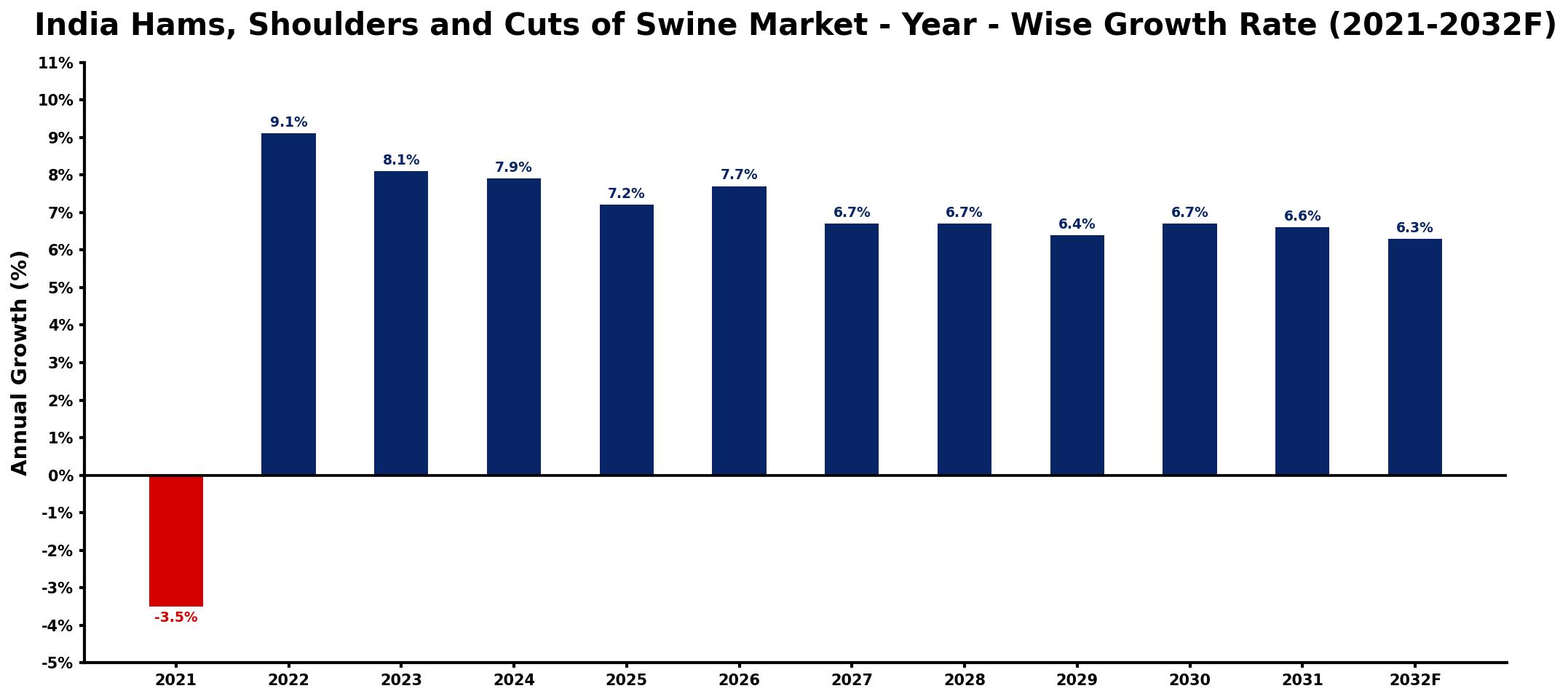
The table below presents the year‑wise growth rates along with the key drivers influencing the market
| Year | Growth Rate | Major Drivers |
| 2021 | -3.5% | Supply chain disruptions impact availability |
| 2022 | 9.1% | increased capital investment inflows |
| 2023 | 8.1% | Growing restaurant sector boosts consumption |
| 2024 | 7.9% | Increased export opportunities drive growth |
| 2025 | 7.2% | Technological advancements enhance production efficiency |
| 2026 | 7.7% | Higher disposable incomes support spending |
| 2027 | 6.7% | E-commerce expansion facilitates access |
| 2028 | 6.7% | Culinary trends favor diverse offerings |
| 2029 | 6.4% | Increased awareness of sustainable sourcing |
| 2030 | 6.7% | Rising urbanization drives consumption patterns |
| 2031 | 6.6% | Health-focused product innovations attract consumers |
| 2032 | 6.3% | Growing population fuels market demand |
Note: Market size estimations and growth projections presented in this report are based on 6Wresearch's proprietary forecasting methodology, utilizing the latest available industry data, government publications, and primary research inputs.
India Hams, Shoulders and Cuts of Swine Market Synopsis
The India hams, shoulders, and cuts of swine market is characterized by a vibrant and evolving landscape. With urban populations increasingly favoring pork due to its taste and nutritional benefits, manufacturers are enhancing their product offerings to meet consumer demands for quality and variety.
This market is not only benefiting from rising health consciousness but also from changes in dietary preferences that align with modern eating habits. As consumers move towards more convenient and longer-lasting food products, the appeal of hams and cuts of swine is becoming increasingly pronounced.
India Hams, Shoulders and Cuts of Swine Market Key Takeaways
- Urban consumer trends are driving significant growth in the demand for pork-based products.
- Health consciousness is influencing a shift towards protein-rich diets, favoring swine cuts.
- Product innovation and quality improvements are key strategies among producers to capture market share.
- Regulatory challenges pose constraints but also opportunities for companies to enhance compliance and operations.
- The market is poised for steady growth, underpinned by rising incomes and changing dietary patterns.
Evaluation of Restraints in India Hams, Shoulders and Cuts of Swine Market
Despite the promising outlook for the India hams, shoulders, and cuts of swine market, several restraints threaten to impede its growth. The stringent government regulations regarding animal husbandry practices can be particularly burdensome for small-scale producers, often leading to a rise in operational costs. These regulations necessitate substantial investment in facility upgrades, which can squeeze profit margins and create barriers to entry for new entrants. Consequently, while the larger players may absorb these challenges, smaller entities may find it increasingly difficult to compete effectively, limiting overall market capacity.
India Hams, Shoulders and Cuts of Swine Market Trends
Current trends indicate a shift towards premiumization within the swine products category, as consumers are willing to pay more for high-quality and ethically sourced products. Additionally, the adoption of advanced processing technologies is enhancing the shelf-life and flavor profiles of hams and cuts, making them more appealing to a health-conscious demographic. E-commerce platforms are also gaining traction, facilitating greater access to diverse product ranges while catering to the increasingly busy lifestyles of urban consumers.
India Hams, Shoulders and Cuts of Swine Market Opportunities
The India hams, shoulders, and cuts of swine market presents numerous growth opportunities, particularly in regions witnessing rapid urbanization and rising disposable incomes. Retailers can explore innovative marketing strategies to educate consumers about the nutritional benefits of pork. Furthermore, as health trends continue to shape dietary preferences, introducing value-added products with enhanced health benefits could significantly elevate demand. Collaborations with local farmers to ensure quality and sustainability will not only appeal to ethical consumers but also strengthen supply chains.
Government Initiatives in the India Hams, Shoulders and Cuts of Swine Market
The Indian government has been increasingly supportive of the livestock sector, with initiatives aimed at improving animal husbandry standards and promoting sustainable farming practices. Public spending on agricultural infrastructure and livestock health is designed to bolster productivity and support the meat industry. Programs focused on enhancing traceability and quality assurance are also underway, providing a framework that encourages compliance among producers, which is essential for market growth.
Future Insights of the India Hams, Shoulders and Cuts of Swine Market
Looking ahead to 2026-2032, the India hams, shoulders, and cuts of swine market is expected to continue its robust growth trajectory. As urbanization deepens and incomes rise, consumers will increasingly seek out convenient, nutritious, and flavorful options. The integration of technology in production and distribution channels will likely streamline operations and enhance product availability. Moreover, evolving culinary trends and dietary preferences will foster a market environment ripe for innovation, ensuring that the swine cuts segment remains a vital component of Indias meat industry.
India Hams, Shoulders and Cuts of Swine Market Latest Developments (2025 - 2026)
Recent industry developments indicate a marked shift towards health-oriented product lines, with companies launching new offerings aimed at health-conscious consumers. Additionally, supply chain adjustments are being made to enhance resilience following disruptions caused by external factors, ensuring consistent product availability. The trend toward sustainability continues to gather momentum, leading various producers to adopt environmentally friendly practices in their operations.
India Hams, Shoulders and Cuts of Swine Market - Key Attractiveness of the Report
- 10 Years of Market Numbers
- Historical Data Starting from 2022 to 2025
- Base Year: 2025
- Forecast Data until 2032
- Key Performance Indicators Impacting the Market
- Major Upcoming Developments and Projects
Key Highlights of the Report:
- India Hams, Shoulders and Cuts of Swine Market Outlook
- Market Size of India Hams, Shoulders and Cuts of Swine Market, 2025
- Forecast of India Hams, Shoulders and Cuts of Swine Market, 2032
- Historical Data and Forecast of India Hams, Shoulders and Cuts of Swine Revenues & Volume for the Period 2022-2032F
- India Hams, Shoulders and Cuts of Swine Market Trend Evolution
- India Hams, Shoulders and Cuts of Swine Market Drivers and Challenges
- India Hams, Shoulders and Cuts of Swine Price Trends
- India Hams, Shoulders and Cuts of Swine Porter's Five Forces
- India Hams, Shoulders and Cuts of Swine Industry Life Cycle
- Historical Data and Forecast of India Hams, Shoulders and Cuts of Swine Market Revenues & Volume By Product Type for the Period 2022-2032F
- Historical Data and Forecast of India Hams, Shoulders and Cuts of Swine Market Revenues & Volume By Processed Meat for the Period 2022-2032F
- Historical Data and Forecast of India Hams, Shoulders and Cuts of Swine Market Revenues & Volume By Frozen Meat for the Period 2022-2032F
- Historical Data and Forecast of India Hams, Shoulders and Cuts of Swine Market Revenues & Volume By Chilled Meat for the Period 2022-2032F
- Historical Data and Forecast of India Hams, Shoulders and Cuts of Swine Market Revenues & Volume By Canned Meat for the Period 2022-2032F
- Historical Data and Forecast of India Hams, Shoulders and Cuts of Swine Market Revenues & Volume By Fresh Meat for the Period 2022-2032F
- Historical Data and Forecast of India Hams, Shoulders and Cuts of Swine Market Revenues & Volume By Animal Type for the Period 2022-2032F
- Historical Data and Forecast of India Hams, Shoulders and Cuts of Swine Market Revenues & Volume By Cattle and Buffalo for the Period 2022-2032F
- Historical Data and Forecast of India Hams, Shoulders and Cuts of Swine Market Revenues & Volume By Pig for the Period 2022-2032F
- Historical Data and Forecast of India Hams, Shoulders and Cuts of Swine Market Revenues & Volume By Poultry for the Period 2022-2032F
- Historical Data and Forecast of India Hams, Shoulders and Cuts of Swine Market Revenues & Volume By Sheep and Goat for the Period 2022-2032F
- Historical Data and Forecast of India Hams, Shoulders and Cuts of Swine Market Revenues & Volume By Other Animals for the Period 2022-2032F
- Historical Data and Forecast of India Hams, Shoulders and Cuts of Swine Market Revenues & Volume By Distribution Channel for the Period 2022-2032F
- Historical Data and Forecast of India Hams, Shoulders and Cuts of Swine Market Revenues & Volume By Business to Consumers (B2C) for the Period 2022-2032F
- Historical Data and Forecast of India Hams, Shoulders and Cuts of Swine Market Revenues & Volume By Modern Groceries for the Period 2022-2032F
- Historical Data and Forecast of India Hams, Shoulders and Cuts of Swine Market Revenues & Volume By Wet & Butcher Shops for the Period 2022-2032F
- Historical Data and Forecast of India Hams, Shoulders and Cuts of Swine Market Revenues & Volume By Convenience Stores for the Period 2022-2032F
- Historical Data and Forecast of India Hams, Shoulders and Cuts of Swine Market Revenues & Volume By Business to Business (B2B) for the Period 2022-2032F
- Historical Data and Forecast of India Hams, Shoulders and Cuts of Swine Market Revenues & Volume By Other Channel for the Period 2022-2032F
- India Hams, Shoulders and Cuts of Swine Import Export Trade Statistics
- Market Opportunity Assessment By Product Type
- Market Opportunity Assessment By Animal Type
- Market Opportunity Assessment By Distribution Channel
- India Hams, Shoulders and Cuts of Swine Top Companies Market Share
- India Hams, Shoulders and Cuts of Swine Competitive Benchmarking By Technical and Operational Parameters
- India Hams, Shoulders and Cuts of Swine Company Profiles
- India Hams, Shoulders and Cuts of Swine Key Strategic Recommendations






































