India LED Professional Lighting Market Summary
The india led professional lighting market was estimated at USD 667 Million in 2025 and is projected to reach USD 958 Million by 2032, growing at a CAGR of 8.1% from 2026 to 2032.
India LED Professional Lighting Market Year-wise Growth Rate and Key Drivers
This graph highlights how the India LED Professional Lighting Market has steadily grown over the past five years, supported by major growth factors.
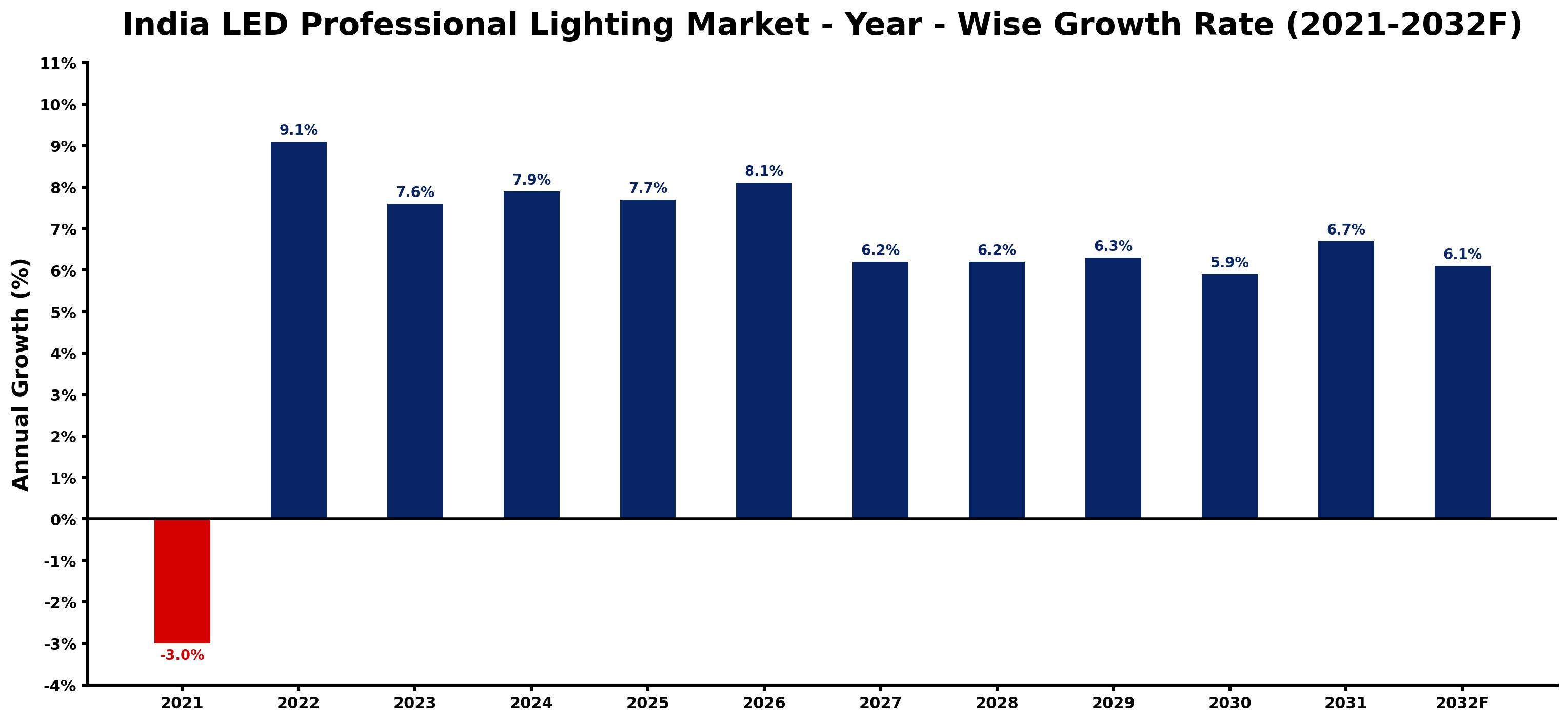
The table below presents the year wise growth rates along with the key drivers influencing the market
| Year | Growth Rate | Major Drivers |
| 2021 | -3.0% | Supply chain disruptions caused delays in project implementations, leading to decreased demand for LED professional lighting solutions. |
| 2022 | 9.1% | Local manufacturing capabilities expanded, reducing costs and enhancing product availability. |
| 2023 | 7.6% | Urbanization trends accelerated, necessitating improved lighting infrastructure in metropolitan areas. |
| 2024 | 7.9% | Corporate sustainability initiatives emphasized energy-efficient technologies in commercial spaces. |
| 2025 | 7.7% | Smart lighting integration gained traction, attracting tech-savvy consumers seeking automation. |
| 2026 | 8.1% | Investment in green buildings rose, driving LED adoption in new constructions significantly. |
| 2027 | 6.2% | Increased awareness of climate change highlighted the need for sustainable lighting options. |
| 2028 | 6.2% | Tourism resurgence led to upgrades in hospitality lighting, boosting professional market growth. |
| 2029 | 6.3% | Collaborations between tech firms and lighting manufacturers fostered innovative product development. |
| 2030 | 5.9% | Enhanced distribution networks improved accessibility of professional lighting solutions nationwide. |
| 2031 | 6.7% | Fast-paced urban development projects necessitated advanced lighting technologies in public spaces. |
| 2032 | 6.1% | Focus on smart cities encouraged investments in LED infrastructure, ensuring future market stability. |
Note - Market size estimations and growth projections presented in this report are based on 6Wresearch's advanced forecasting approach, validated with industry datasets as of June 2026.
India LED Professional Lighting Market Synopsis
The India LED Professional Lighting Market is projected to reach 8.1% and witness significant growth during the forecast period (2026-2032). This market is rapidly evolving due to various factors, including heightened governmental focus on energy efficiency, a positive economic climate, and an increasing demand for sustainable infrastructure solutions. These driving forces are expected to propel the market forward, leading to a projected CAGR of 16.8% during this period.
India LED Professional Lighting Market Growth Drivers
Several key factors are contributing to the growth of the India LED Professional Lighting Market. Firstly, the growing awareness regarding energy conservation is prompting businesses and consumers alike to prefer LED lighting solutions over traditional options. Secondly, significant investments in infrastructure and urban development are fueling the demand for professional lighting installations across commercial and residential sectors. Furthermore, the technological advancements in LED technology, which provide superior performance and longevity, are further compelling consumers to transition toward LED solutions. Lastly, the increased emphasis on green building certifications and sustainability initiatives is also influencing market growth positively.
India LED Professional Lighting Market Trends and Opportunities
The India LED Professional Lighting Market is witnessing several trends that are reshaping its landscape. The integration of smart lighting technologies, such as IoT-enabled systems, is becoming more prevalent, allowing for enhanced control and energy savings. Additionally, with the construction of smart cities, there is a growing need for efficient lighting solutions, which presents a substantial opportunity for market expansion. The application of LED lighting in various sectors, including hospitality, healthcare, and retail, is also on the rise, driven by aesthetic and functional requirements. Moreover, the shift towards human-centric lighting solutions is emerging as a vital trend, focusing on enhancing the well-being and productivity of individuals in various environments.
India LED Professional Lighting Market Challenges and Restraints
Despite the promising outlook for the India LED Professional Lighting Market, several challenges could potentially hinder its growth. Price sensitivity among consumers remains a concern, as initial costs for LED installations can be higher than traditional lighting options. Additionally, the lack of awareness and understanding regarding the benefits of LED technology hampers its widespread adoption, particularly in rural areas. Moreover, regulatory challenges and stringent standards can pose obstacles for manufacturers and suppliers. Lastly, competition from other lighting technologies may affect market penetration and growth.
India LED Professional Lighting Market Government Investment and Initiatives
The Indian government has implemented various initiatives to promote energy-efficient solutions, including LED lighting. Public policies aimed at reducing energy consumption and carbon emissions have led to increased spending on energy-efficient lighting solutions. Initiatives such as the National LED Programme and various state-level schemes are focused on replacing conventional lighting with LEDs in public spaces, streets, and government buildings. Moreover, the government encourages private and public entities to adopt LED lighting through tax incentives and rebates, further bolstering market growth.
India LED Professional Lighting Market Latest Developments (May 2025 - June 2026)
Recent developments in the India LED Professional Lighting Market reflect a growing trend toward innovation and sustainability. Manufacturers are increasingly investing in research and development to enhance lighting technologies, focusing on energy efficiency and smart lighting solutions. Industry-wide collaborations and partnerships are also emerging, aimed at integrating LED solutions with building management systems for better energy control. Furthermore, the market is experiencing an increase in the introduction of new product lines that cater to varied consumer preferences, including customizable lighting options that align with aesthetic trends.
India LED Professional Lighting Market - Key Attractiveness of the Report
- 10 Years of Market Numbers
- Historical Data Starting from 2022 to 2025
- Base Year: 2025
- Forecast Data until 2032
- Key Performance Indicators Impacting the Market
- Major Upcoming Developments and Projects
Key Highlights of the Report:
- India LED Professional Lighting Market Outlook
- Market Size of India LED Professional Lighting Market, 2025
- Forecast of India LED Professional Lighting Market, 2032
- Historical Data and Forecast of India LED Professional Lighting Revenues & Volume for the Period 2022-2032
- India LED Professional Lighting Market Trend Evolution
- India LED Professional Lighting Market Drivers and Challenges
- India LED Professional Lighting Price Trends
- India LED Professional Lighting Porter's Five Forces
- India LED Professional Lighting Industry Life Cycle
- Historical Data and Forecast of India LED Professional Lighting Market Revenues & Volume By Product Type for the Period 2022-2032
- Historical Data and Forecast of India LED Professional Lighting Market Revenues & Volume By LED Bulbs for the Period 2022-2032
- Historical Data and Forecast of India LED Professional Lighting Market Revenues & Volume By LED Fixtures for the Period 2022-2032
- Historical Data and Forecast of India LED Professional Lighting Market Revenues & Volume By Bare LED Tubes for the Period 2022-2032
- Historical Data and Forecast of India LED Professional Lighting Market Revenues & Volume By LED Down lights for the Period 2022-2032
- Historical Data and Forecast of India LED Professional Lighting Market Revenues & Volume By Applications for the Period 2022-2032
- Historical Data and Forecast of India LED Professional Lighting Market Revenues & Volume By Indoor for the Period 2022-2032
- Historical Data and Forecast of India LED Professional Lighting Market Revenues & Volume By Outdoor for the Period 2022-2032
- Historical Data and Forecast of India LED Professional Lighting Market Revenues & Volume By Automotive for the Period 2022-2032
- Historical Data and Forecast of India LED Professional Lighting Market Revenues & Volume By Backlighting for the Period 2022-2032
- India LED Professional Lighting Import Export Trade Statistics
- Market Opportunity Assessment By Product Type
- Market Opportunity Assessment By Applications
- India LED Professional Lighting Top Companies Market Share
- India LED Professional Lighting Competitive Benchmarking By Technical and Operational Parameters
- India LED Professional Lighting Company Profiles
- India LED Professional Lighting Key Strategic Recommendations






































