India Mustard Oil Market Top 5 Importing Countries and Market Competition (HHI) Analysis
Despite a high Herfindahl-Hirschman Index indicating market concentration, India`s mustard oil import shipments in 2024 were mainly sourced from UAE, Germany, Australia, Ukraine, and Belarus. The industry experienced a significant decline with a negative compound annual growth rate of -41.22% from 2020 to 2024. The growth rate in 2024 also showed a decrease of -15.21% compared to the previous year. This data suggests a challenging market environment for mustard oil imports in India, highlighting potential shifts in sourcing and consumer demand.
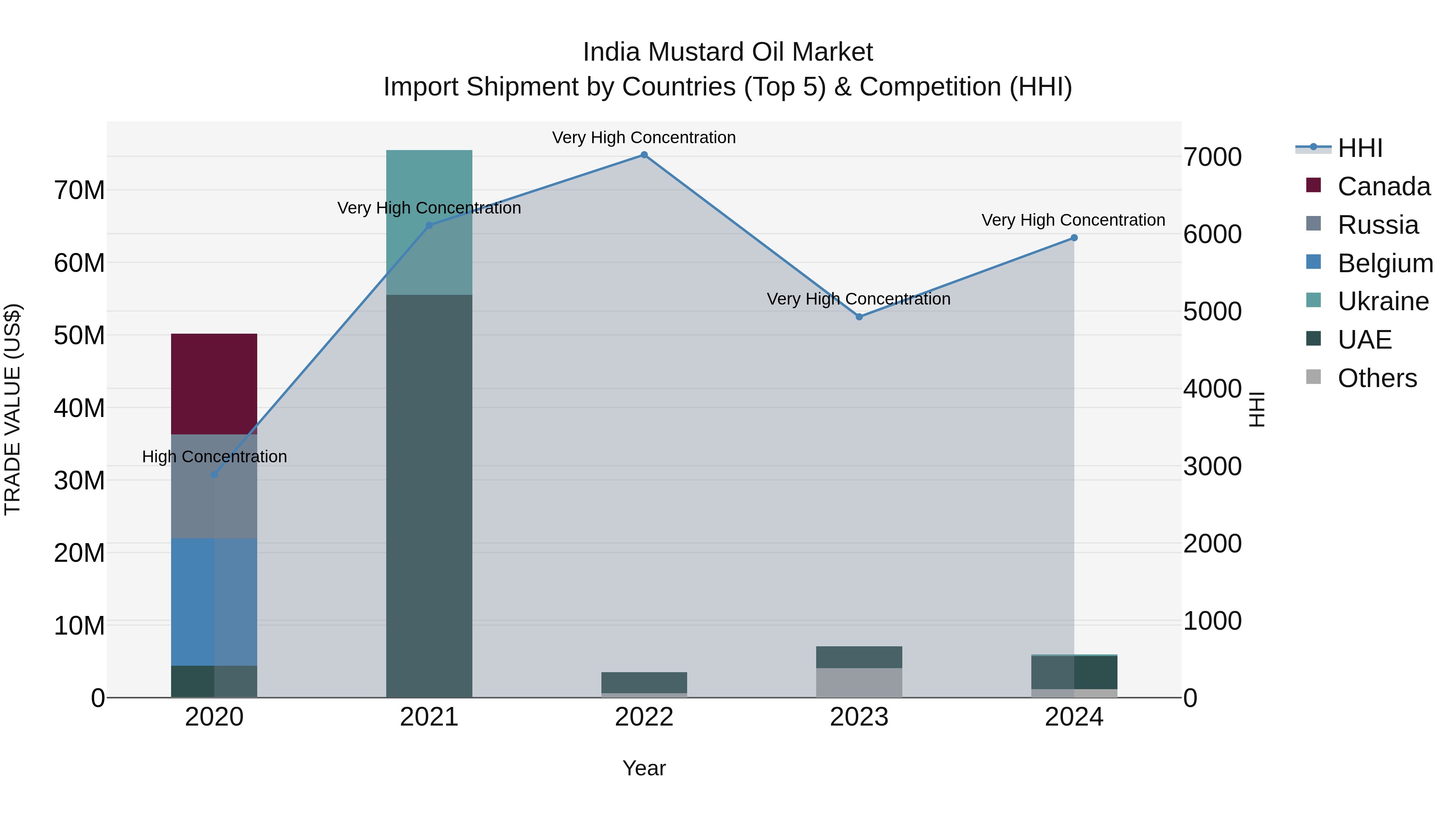
India Export Potential Assessment For Mustard oil Market (Values in USD Thousand)
India Mustard Oil Market Growth Rate
According to 6Wresearch internal database and industry insights, the India Mustard Oil Market is projected to grow at a compound annual growth rate (CAGR) of 7.8% during the forecast period (2026–2032).
Topics Covered in the India Mustard Oil Market Report
The India Mustard Oil Market report thoroughly covers the market by Product Type, Production Process Type, Application Type, and Distribution Type. The report provides a detailed analysis of ongoing market trends, opportunities/high-growth areas, and market drivers that will help stakeholders devise and align strategies according to current and future market dynamics.
India Mustard Oil Market Highlights
| Report Name | India Mustard Oil Market |
| Forecast period | 2026–2032 |
| CAGR | 7.8% |
| Growing Sector | Cooking |
India Mustard Oil Market Synopsis
The increasing preference for traditional, natural, and healthy cooking oils is a major factor driving demand in the India Mustard Oil Industry. The norther and eastern India supports consistent consumption due to its strong cultural usage. The surging awareness regarding mustard oil’s antimicrobial, digestive, and cardiovascular benefits is further bolstering its demand. Along with this, the development of food processing, pharmaceuticals, and ayurvedic applications, along with surging penetration of organized retail channels, is contributing to sustained India Mustard Oil Market Growth.
Evaluation of Growth Drivers in the India Mustard Oil Market
Below are some prominent drivers and their influence on the market dynamics:
| Drivers | Primary Segments Affected | Why it Matters |
| Rising Health Awareness | By Application Type (Cooking, Pharmaceutical) | Boosts preference for natural and cholesterol-free edible oils. |
| Growth in Packaged Food Industry | By Application Type (Cooking, Others) | Increases bulk consumption of mustard oil. |
| Expansion of Retail Channels | By Distribution Type (Supermarkets, Online Retail) | Improves product availability and brand penetration. |
| Ayurvedic and Herbal Demand | By Application Type (Pharmaceutical, Aromatherapy) | Supports use of mustard oil in traditional medicine. |
| Government Support to Oilseed Farming | By Production Process Type (Pressing Extraction) | Ensures steady supply of raw mustard seeds. |
The India Mustard Oil Market Size is projected to grow at a CAGR of 7.8% during the forecast period (2026–2032). The surging application in pharmaceutical usage, while rising consumption of natural edible oils and expansion of packaged food manufacturing are major factors contributing to growth. Along with this, high domestic manufacturing of mustard seeds, and growing consumer trust in traditional oils, is further fueling the market. In addition, enhancements in oil extraction techniques and branding of high-end cold-pressed mustard oils are forming new growth opportunities across urban and semi-urban regions. Then the number of health-conscious households are also rising and are helping in the expansion of retail penetration. The sustained market penetration is facilitated with rising consumer awareness of nutritional benefits of mustard oil.
Evaluation of Restraints in the India Mustard Oil Market
Below are some prominent restraints and their influence on the market dynamics:
| Challenges | Primary Segments Affected | Why it Matters |
| Price Volatility of Mustard Seeds | By Product Type (All Types) | Impacts profit margins and retail pricing stability. |
| Taste Preference Limitations | By Application Type (Cooking) | Strong pungent flavor restricts its usage in certain consumer groups. |
| Competition from Refined Oils | By Distribution Type (Supermarkets) | Availability of neutral-flavored oils affects consumer switching behavior. |
| Storage and Shelf-Life Issues | By Production Process Type (Pressing Extraction) | Requires improved packaging and controlled handling solutions. |
| Limited Standardization in Quality | By Product Type (Traditional and Cold-Pressed) | Creates inconsistency in product quality and consumer |
India Mustard Oil Market Challenges
The price volatility of mustard seed and changing regional taste preferences negatively influence market growth. Furthermore, the growing competition from refined and blended edible oils have an impact on urban consumption. In addition, maintenance of quality and shelf life demands fundings in better extraction, storage, and packaging technologies. Through branding, consumer education, and supply chain optimization these issues should be addressed as it is important for sustained growth of the market.
India Mustard Oil Market Trends
Several key trends are influencing the growth of the India Mustard Oil Industry:
- Rising Demand for Cold-Pressed Oils: Due to the perceived health benefits of mustard oil, consumers are shifting toward traditionally extracted mustard oils.
- Surge in Ayurvedic Applications: The expanding application in herbal medicines and therapeutic formulations is contributing to market growth.
- Development of Online Retail: The expansion of digital platforms are improving accessibility and visibility of brands across regions.
- Premiumization of Edible Oils: The popularity of Branded and fortified mustard oil variants is surging hugely.
Investment Opportunities in the India Mustard Oil Market
Some key investment opportunities include:
- Cold-Pressed Mustard Oil Production: The premium position of the product is certified with high fundings in traditional and low-heat extraction techniques.
- Value-Added Products: The health-conscious consumer will find, fortified and variants of blended mustard oil more attractive.
- Organized Retail Expansion: The market distribution can be bolstered with supermarkets and online platforms partnerships.
- Pharmaceutical-Grade Mustard Oil: The long-term investment potential is offered with rising application in ayurvedic and medicinal purposes.
Top 5 Leading Players in the India Mustard Oil Market
Below is the list of prominent companies leading the India Mustard Oil Market:
1. Emami Limited
| Company Name | Emami Limited |
|---|---|
| Established Year | 1974 |
| Headquarters | Kolkata, India |
| Official Website | Click Here |
Emami is a leading producer of branded mustard oil, offering high-purity products widely used for cooking and therapeutic applications.
2. Adani Wilmar Limited
| Company Name | Adani Wilmar Limited |
|---|---|
| Established Year | 1999 |
| Headquarters | Ahmedabad, India |
| Official Website | Click Here |
Adani Wilmar manufactures mustard oil under popular edible oil brands with a strong nationwide distribution network.
3. Patanjali Ayurved Limited
| Company Name | Patanjali Ayurved Limited |
|---|---|
| Established Year | 2006 |
| Headquarters | Haridwar, India |
| Official Website | Click Here |
Patanjali offers mustard oil focusing on traditional extraction and ayurvedic benefits, catering to health-conscious consumers.
4. Agro Tech Foods Limited
| Company Name | Agro Tech Foods Limited |
|---|---|
| Established Year | 1986 |
| Headquarters | Gurugram, India |
| Official Website | - |
Agro Tech Foods supplies edible oils including mustard oil for household and food service applications.
5. Dhara
| Company Name | Dhara (Mother Dairy Fruit & Vegetable Pvt. Ltd.) |
|---|---|
| Established Year | 1974 |
| Headquarters | Noida, India |
| Official Website | Click Here |
Dhara produces mustard oil emphasizing purity, nutritional value, and consistent quality standards.
Government Regulations Introduced in the India Mustard Oil Market
According to Indian Government Data, several initiatives support the edible oil sector through programs such as the National Mission on Edible Oils–Oilseeds, which promotes domestic mustard seed production. Minimum Support Price (MSP) schemes for oilseeds help stabilize farmer income. Apart from this, there is the Food Safety and Standards Authority of India (FSSAI) keeping a check on the quality and labeling standards, taking care of consumer safety and product transparency. The incentives provided by government for modern oilseed processing improve efficiency and supply chain flow.
Future Insights of the India Mustard Oil Market
The India Mustard Oil Market Share is anticipated to grow consistently with rising preference for traditional edible oils, expansion of ayurvedic usage, and increasing retail penetration. Advancements in extraction technology and branding of high-end products will improve market competitiveness. Robust domestic production and government-led oilseed programs will further continue to support long-term growth. Growing awareness about the health benefits is further strengthening consumer demand across urban and semi-urban regions
Market Segmentation Analysis
The report offers a comprehensive study of the following market segments and their leading categories:
By Product Type – Black Mustard Oil to Lead the Market
According to Harshita, Senior Research Analyst, 6Wresearch, Black mustard oil dominates due to its strong aroma, high pungency, and widespread culinary usage across northern and eastern India.
By Production Process Type – Pressing Extraction to Lead the Market
Pressing extraction will dominate the market due to its properties of preserving natural nutrients and flavor, preferred for traditional consumption. With this, the surging need for cold-pressed and minimally processed oils is further bolstering incorporation among health-conscious consumers.
By Application Type – Cooking to Lead the Market
Cooking dominates due to extensive household and commercial usage in Indian cuisine. Regular use in regional food preparations continues to help with continuous demand across both urban and rural households.
By Distribution Type – Supermarkets to Lead the Market
Supermarkets lead due to better product visibility, quality assurance, and consumer trust in branded oils. Organized retail expansion and promotional activities are further improving sales volumes and brand reach.
Key Attractiveness of the Report
- 10 Years of Market Numbers
- Historical Data Starting from 2022 to 2025
- Base Year: 2025
- Forecast Data until 2032
- Key Performance Indicators Impacting the Market
- Major Upcoming Developments and Projects
Key Highlights of the Report:
- · India Mustard oil Market Outlook
- Market Size of India Mustard oil Market, 2025
- Forecast of India Mustard oil Market, 2032
- Historical Data and Forecast of India Mustard oil Revenues & Volume for the Period 2022-2032
- India Mustard oil Market Trend Evolution
- India Mustard oil Market Drivers and Challenges
- India Mustard oil Price Trends
- India Mustard oil Porter's Five Forces
- India Mustard oil Industry Life Cycle
- Historical Data and Forecast of India Mustard oil Market Revenues & Volume By Product Type for the Period 2022-2032
- Historical Data and Forecast of India Mustard oil Market Revenues & Volume By Black mustard Oil for the Period 2022-2032
- Historical Data and Forecast of India Mustard oil Market Revenues & Volume By Brown mustard Oil for the Period 2022-2032
- Historical Data and Forecast of India Mustard oil Market Revenues & Volume By White Mustard Oil for the Period 2022-2032
- Historical Data and Forecast of India Mustard oil Market Revenues & Volume By Production Process type for the Period 2022-2032
- Historical Data and Forecast of India Mustard oil Market Revenues & Volume By Pressing Extraction for the Period 2022-2032
- Historical Data and Forecast of India Mustard oil Market Revenues & Volume By Distillation extraction for the Period 2022-2032
- Historical Data and Forecast of India Mustard oil Market Revenues & Volume By Application Type for the Period 2022-2032
- Historical Data and Forecast of India Mustard oil Market Revenues & Volume By Pharmaceutical for the Period 2022-2032
- Historical Data and Forecast of India Mustard oil Market Revenues & Volume By Aromatherapy for the Period 2022-2032
- Historical Data and Forecast of India Mustard oil Market Revenues & Volume By Cooking for the Period 2022-2032
- Historical Data and Forecast of India Mustard oil Market Revenues & Volume By Soaps for the Period 2022-2032
- Historical Data and Forecast of India Mustard oil Market Revenues & Volume By Others for the Period 2022-2032
- Historical Data and Forecast of India Mustard oil Market Revenues & Volume By Distribution Type for the Period 2022-2032
- Historical Data and Forecast of India Mustard oil Market Revenues & Volume By Online Retail for the Period 2022-2032
- Historical Data and Forecast of India Mustard oil Market Revenues & Volume By Supermarkets for the Period 2022-2032
- Historical Data and Forecast of India Mustard oil Market Revenues & Volume By Departmental Stores for the Period 2022-2032
- India Mustard oil Import Export Trade Statistics
- Market Opportunity Assessment By Product Type
- Market Opportunity Assessment By Production Process type
- Market Opportunity Assessment By Application Type
- Market Opportunity Assessment By Distribution Type
- India Mustard oil Top Companies Market Share
- India Mustard oil Competitive Benchmarking By Technical and Operational Parameters
- India Mustard oil Company Profiles
- India Mustard oil Key Strategic Recommendations
Markets Covered
The report offers a comprehensive study of the following market segments:
By Product Type
- Black Mustard Oil
- Brown Mustard Oil
- White Mustard Oil
By Production Process Type
- Pressing Extraction
- Distillation Extraction
By Application Type
- Pharmaceutical
- Aromatherapy
- Cooking
- Soaps
- Others
By Distribution Type
- Online Retail
- Supermarkets
- Departmental Stores






































