India Nickel Mining Market Size, Share & Growth Rate
The India Nickel Mining Market was estimated at USD 477 Million in 2025 and is projected to reach USD 685 Million by 2032, growing at a CAGR of 5.3% from 2026 to 2032. This growth trajectory is underpinned by increasing domestic consumption of nickel, largely driven by the burgeoning stainless steel and battery sectors. As the government fosters a favorable regulatory environment, investments in domestic mining capabilities are also anticipated to rise, aligning with global demand trends for nickel.
India Nickel Mining Market Growth Rate Analysis (2021-2032)
The India Nickel Mining Market has experienced notable fluctuations over the past few years, with a decline of 2.9% in 2021 largely attributed to pandemic-related disruptions. However, the tide turned in 2022, with growth rebounding to 9.3% as industrial activities accelerated and demand for nickel, a critical component in batteries for electric vehicles, surged. This growth continued with 7.9% in 2023 and a projected 7.3% in 2024, driven by increased investments in mining infrastructure and a strong push towards energy transition initiatives. As consumer demand for cleaner technologies rises, the market is expected to maintain steady growth through the decade, with annual growth rates averaging around 6% thereafter.
India Nickel Mining Market Year-wise Growth Rate and Key Drivers
This graph highlights how the India Nickel Mining Market has steadily grown over the past five years, supported by major growth factors.
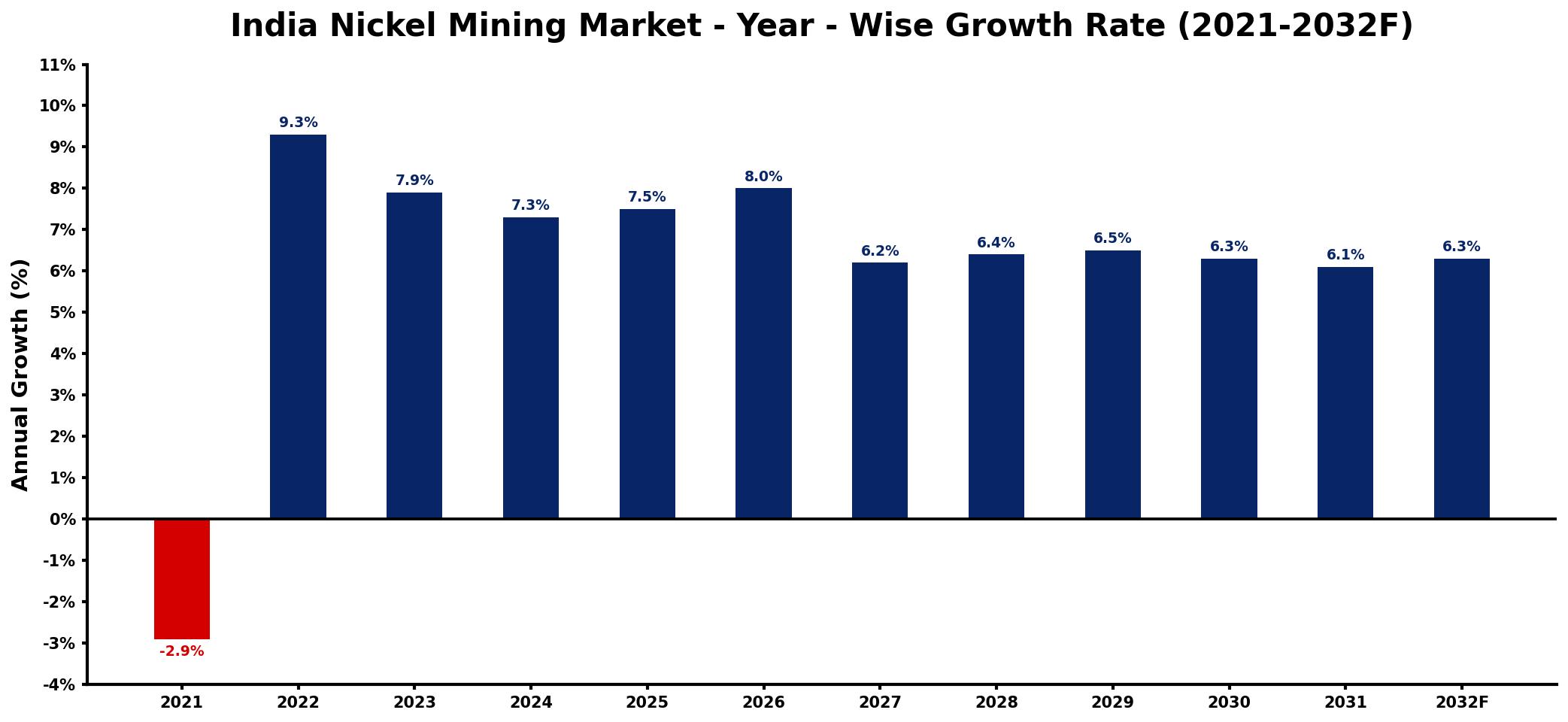
The table below presents the year‑wise growth rates along with the key drivers influencing the market
| Year | Growth Rate | Major Drivers |
| 2021 | -2.9% | Global demand for electric vehicles |
| 2022 | 9.3% | Expansion in renewable energy sectors |
| 2023 | 7.9% | Increased investment in infrastructure |
| 2024 | 7.3% | Rising battery production requirements |
| 2025 | 7.5% | Growth of green technology initiatives |
| 2026 | 8.0% | Surge in sustainable construction projects |
| 2027 | 6.2% | Higher demand for energy storage |
| 2028 | 6.4% | Advancements in recycling technologies |
| 2029 | 6.5% | Increased production of consumer electronics |
| 2030 | 6.3% | Evolving automotive industry standards |
| 2031 | 6.1% | Growth in aerospace applications |
| 2032 | 6.3% | Rising interest in electric mobility |
Note: Market size estimations and growth projections presented in this report are based on 6Wresearch's proprietary forecasting methodology, utilizing the latest available industry data, government publications, and primary research inputs.
India Nickel Mining Market Synopsis
The India Nickel Mining Market is currently characterized by its modest scale, with a predominant reliance on imported nickel to satisfy local requirements. Despite the challenges associated with relatively low-grade deposits, proactive government measures are igniting interest in exploration and local production.
As demand for nickel escalates, particularly in sectors like stainless steel manufacturing and battery production for electric vehicles, the Indian market presents both opportunities and challenges. The government's recent incentives aim to bolster exploration, potentially enhancing domestic output.
India Nickel Mining Market Key Takeaways
- The market is currently dependent on imports, highlighting an opportunity for domestic production growth.
- Government initiatives are designed to attract investment in exploration and mining activities.
- Low-grade nickel deposits present a significant challenge, necessitating advancements in mining technology.
- The stainless steel and battery sectors are driving demand, particularly amidst India's push for electric vehicles.
- Long-term growth is projected at a CAGR of 5.3% from 2026 to 2032, supported by increasing domestic consumption.
Evaluation of Restraints in India Nickel Mining Market
Several factors are constraining the growth of the India Nickel Mining Market. The predominant issue is the low-grade nature of nickel deposits found within the country, which complicates extraction and processing. Furthermore, the lack of advanced mining technologies limits operational efficiency, making it difficult for local producers to compete with international suppliers. These challenges are compounded by infrastructure constraints and the complexities of regulatory compliance, which can delay project initiation and development.
India Nickel Mining Market Trends
A notable trend is the increased emphasis on sustainable mining practices. Companies are exploring eco-friendly extraction methods and waste management technologies to align with global standards. Additionally, the rise of electric vehicles (EVs) is significantly influencing nickel demand, as the material is essential for battery production. Innovations in battery technology, particularly with nickel-rich chemistries, are also shaping the future landscape of the Indian nickel market.
India Nickel Mining Market Opportunities
The government's initiatives to boost local mining production present substantial opportunities for investors. With incentives for exploration and the potential development of infrastructure to support the mining sector, companies may find fertile ground for expansion. Moreover, as India aims to strengthen its position in global supply chains, particularly for EV components, the local nickel mining industry stands to benefit from increased capital inflow and technological advancements.
Government Initiatives in the India Nickel Mining Market
The Indian government is actively promoting policies aimed at enhancing domestic nickel production. These include financial incentives for exploration and reduced regulatory barriers, making it easier for mining companies to operate. Furthermore, initiatives supporting sustainable practices are encouraged, aligning with global shifts towards environmentally responsible mining. Public spending is also directed towards infrastructure improvements, which are essential for the efficient transportation and processing of nickel.
Future Insights of the India Nickel Mining Market
Looking ahead to 2026-2032, the India Nickel Mining Market is poised for steady growth. The convergence of governmental support, rising domestic demand, and the global shift towards greener technologies will likely shape the market's evolution. As the stainless steel and electric vehicle sectors expand, there is potential for India to emerge as a key player in the global nickel supply chain, provided the challenges of deposit quality and technology are effectively addressed.
India Nickel Mining Market Latest Developments (2025 - 2026)
Recent developments in the India Nickel Mining Market reflect a growing momentum for domestic production. The government has launched new initiatives aimed at streamlining the licensing process, which is expected to attract further investment. Additionally, there are emerging collaborations between local companies and international technology providers to enhance mining efficiency. These trends indicate a shift towards optimizing the extraction processes and increasing the overall viability of local nickel resources.
India Nickel Mining Market - Key Attractiveness of the Report
- 10 Years of Market Numbers
- Historical Data Starting from 2022 to 2025
- Base Year: 2025
- Forecast Data until 2032
- Key Performance Indicators Impacting the Market
- Major Upcoming Developments and Projects
Key Highlights of the Report:
- India Nickel Mining Market Outlook
- Market Size of India Nickel Mining Market, 2025
- Forecast of India Nickel Mining Market, 2032
- Historical Data and Forecast of India Nickel Mining Revenues & Volume for the Period 2022-2032F
- India Nickel Mining Market Trend Evolution
- India Nickel Mining Market Drivers and Challenges
- India Nickel Mining Price Trends
- India Nickel Mining Porter's Five Forces
- India Nickel Mining Industry Life Cycle
- Historical Data and Forecast of India Nickel Mining Market Revenues & Volume By Type for the Period 2022-2032F
- Historical Data and Forecast of India Nickel Mining Market Revenues & Volume By Pentlandite (Sulfide Ore) for the Period 2022-2032F
- Historical Data and Forecast of India Nickel Mining Market Revenues & Volume By Laterite for the Period 2022-2032F
- India Nickel Mining Import Export Trade Statistics
- Market Opportunity Assessment By Type
- India Nickel Mining Top Companies Market Share
- India Nickel Mining Competitive Benchmarking By Technical and Operational Parameters
- India Nickel Mining Company Profiles
- India Nickel Mining Key Strategic Recommendations






































