India Oil and Gas Pipeline Market Top 5 Importing Countries and Market Competition (HHI) Analysis
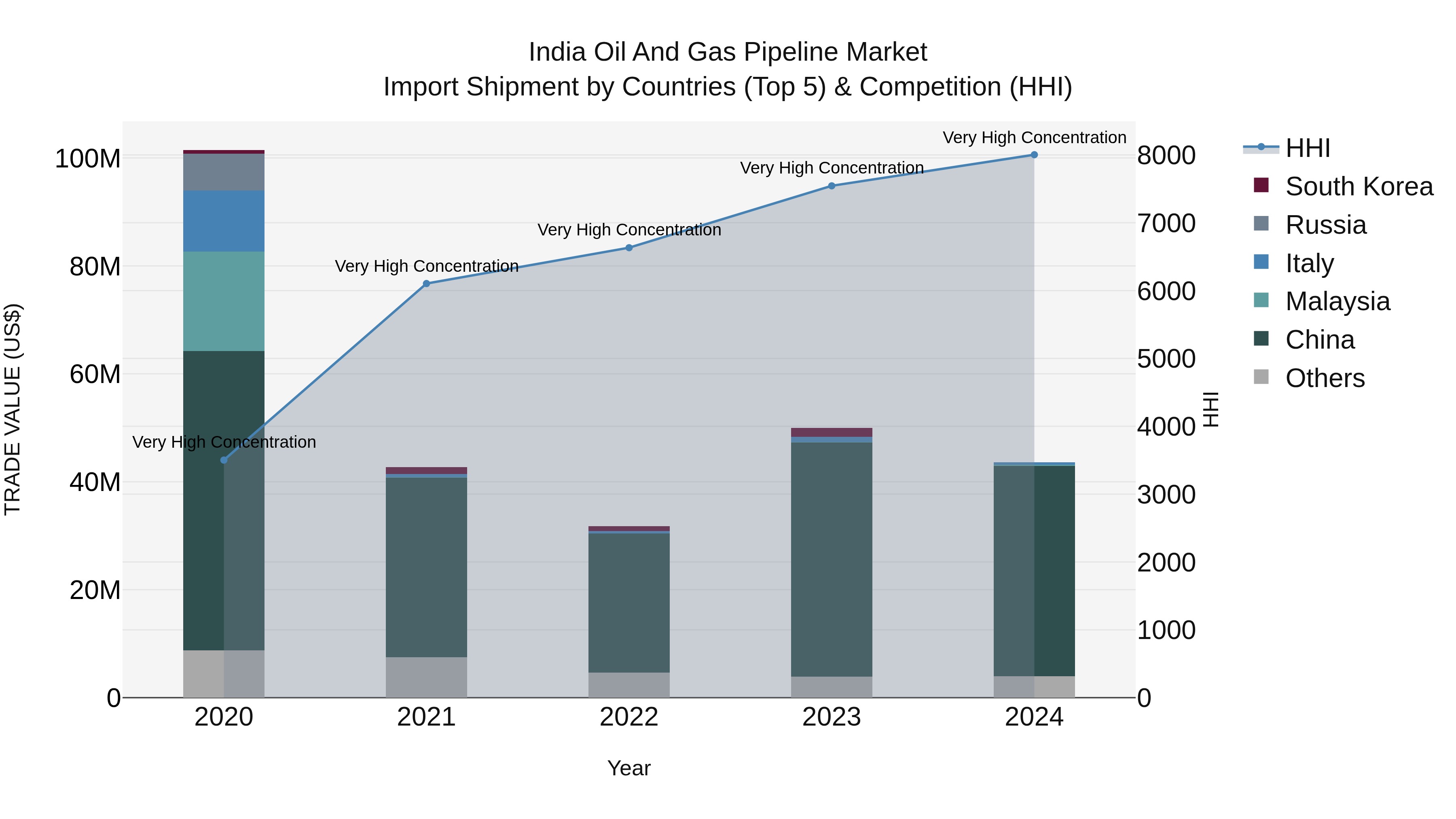
India`s oil and gas pipeline import shipments in 2024 saw significant contributions from top exporting countries like China, Germany, Japan, Italy, and Kuwait. Despite a high Herfindahl-Hirschman Index (HHI) indicating concentration, the industry experienced a notable decline with a Compound Annual Growth Rate (CAGR) of -19.02% from 2020 to 2024. The growth rate for 2023-24 was -12.78%, reflecting challenges in the market. This data suggests a complex landscape for India`s oil and gas pipeline imports, influenced by both domestic and global factors.
India Oil And Gas Pipeline Market Synopsis
The India oil and gas pipeline market is projected to reach USD 28.85 billion, registering a CAGR of 6.9% during the forecast period. India has an extensive network of pipelines in both natural gas and crude oil sectors with over 10,000 km length across the nation. This network includes several cross country pipelines that cater to demand from various parts of India including remote areas such as Jammu & Kashmir, Assam, Uttarakhand, etc. The rising energy needs have led to increased investments in the sector for expansion of existing networks along with setting up new ones which will be beneficial for growth of the market going forward. Moreover, increasing investments into renewable sources are also expected to create additional opportunities in this market landscape during the forecast period.
Market Drivers of the market
The India oil and gas pipeline market is experiencing substantial growth as the country seeks to expand its energy infrastructure to meet the rising energy demand. The construction of new pipelines and the modernization of existing ones are driven by the need to enhance energy transportation and distribution across the nation.
Challenges of the Market
The oil and gas pipeline market in India faces several challenges that impact its expansion and efficiency. One of the significant challenges is the complex land acquisition process required for pipeline construction. Lengthy bureaucratic procedures and public resistance can delay projects and escalate costs.Moreover, the vulnerability of pipelines to external damages and leaks poses environmental and safety concerns. Ensuring the integrity and security of the pipeline infrastructure becomes a crucial challenge for operators.Additionally, the price volatility in the oil and gas industry can impact the demand for pipeline projects, leading to uncertainties in the market.
Covid-19 Impact on the Market
The COVID-19 pandemic had significant consequences for India oil and gas pipeline market. The decline in oil and gas consumption and fluctuations in prices led to deferred projects and investments. The pandemic`s impact on the energy sector disrupted the pipeline market, affecting its growth and development.
Key Players of the Market
Some of the key players in the India Oil and Gas Pipeline Market include Reliance Industries Limited, India Oil Corporation Limited, Tata Steel Ltd., Jindal SAW Ltd., and Essar Steel India Limited.
Key Highlights of the Report:
- India Oil And Gas Pipeline Market Outlook
- Market Size of India Oil And Gas Pipeline Market, 2024
- Forecast of India Oil And Gas Pipeline Market, 2031
- Historical Data and Forecast of India Oil And Gas Pipeline Revenues & Volume for the Period 2021-2031
- India Oil And Gas Pipeline Market Trend Evolution
- India Oil And Gas Pipeline Market Drivers and Challenges
- India Oil And Gas Pipeline Price Trends
- India Oil And Gas Pipeline Porter's Five Forces
- India Oil And Gas Pipeline Industry Life Cycle
- Historical Data and Forecast of India Oil And Gas Pipeline Market Revenues & Volume By Location of Deployment for the Period 2021-2031
- Historical Data and Forecast of India Oil And Gas Pipeline Market Revenues & Volume By Onshore for the Period 2021-2031
- Historical Data and Forecast of India Oil And Gas Pipeline Market Revenues & Volume By Offshore for the Period 2021-2031
- Historical Data and Forecast of India Oil And Gas Pipeline Market Revenues & Volume By Type for the Period 2021-2031
- Historical Data and Forecast of India Oil And Gas Pipeline Market Revenues & Volume By Crude Oil Pipeline for the Period 2021-2031
- Historical Data and Forecast of India Oil And Gas Pipeline Market Revenues & Volume By Gas Pipeline for the Period 2021-2031
- India Oil And Gas Pipeline Import Export Trade Statistics
- Market Opportunity Assessment By Location of Deployment
- Market Opportunity Assessment By Type
- India Oil And Gas Pipeline Top Companies Market Share
- India Oil And Gas Pipeline Competitive Benchmarking By Technical and Operational Parameters
- India Oil And Gas Pipeline Company Profiles
- India Oil And Gas Pipeline Key Strategic Recommendations






































