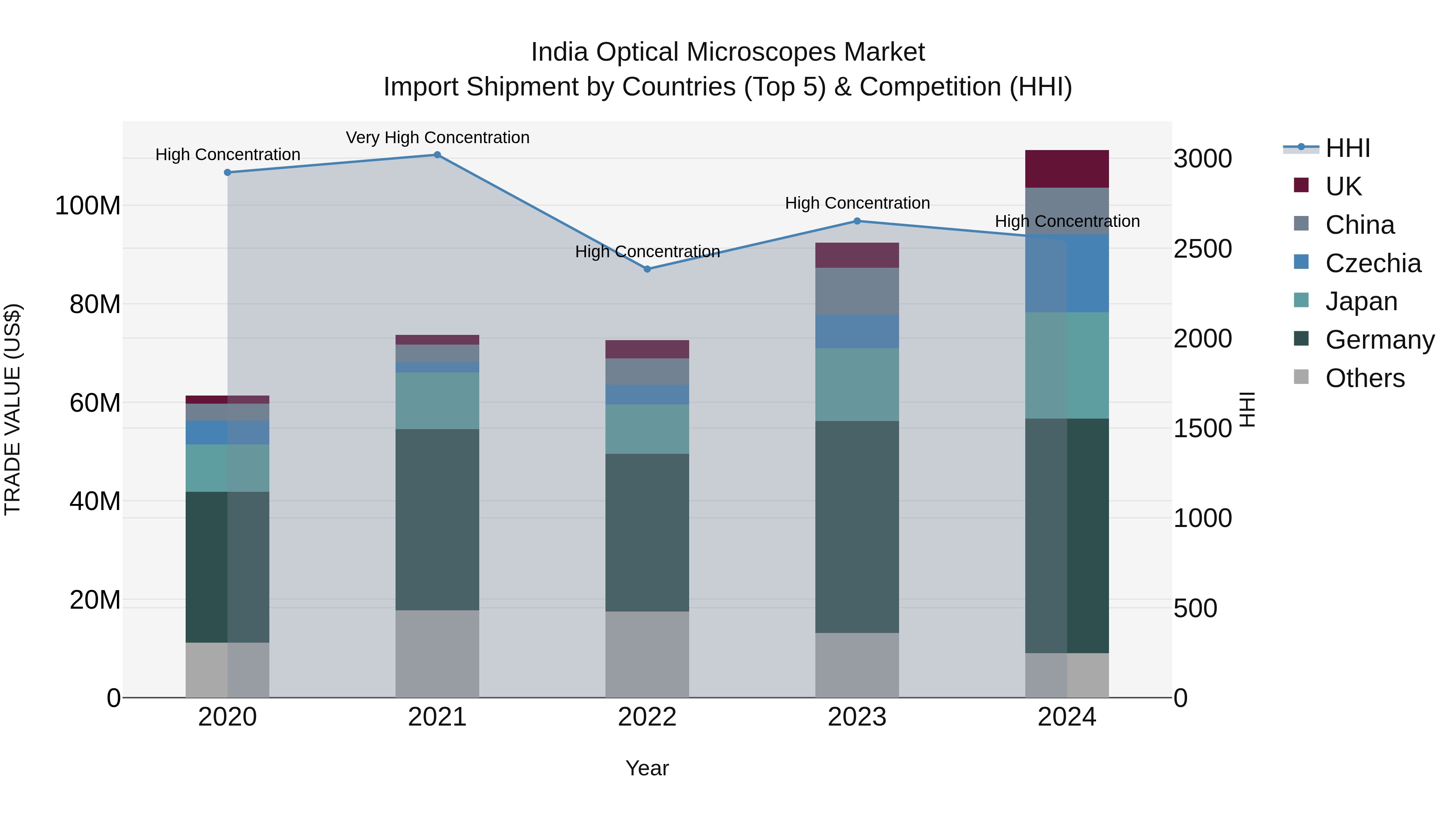
India Optical Microscopes Market Top 5 Importing Countries and Market Competition (HHI) Analysis
The optical microscopes import market in India continued to thrive in 2024, with Germany, Japan, Czechia, China, and the UK emerging as key exporting countries. Despite high concentration with a high Herfindahl-Hirschman Index (HHI), the market maintained a strong Compound Annual Growth Rate (CAGR) of 16.02% from 2020 to 2024. The growth rate for 2023-24 surged to 20.31%, indicating a robust expansion in demand for optical microscopes in India. This trend signals promising opportunities for market players and underscores the significance of these top exporting countries in driving the market`s growth.
India Optical Microscopes Market Synopsis
The India optical microscope`s market size was valued at $27 million in 2018 and is anticipated to register a CAGR of 11% on account of increasing usage across various end-user industries like healthcare, life sciences, and semiconductor manufacturing sector coupled with technological advancements such as 3D laser scanning microscopy systems and confocal laser scanning microscopy systems among others that are driving the growth trajectory for this segment globally.
Market Drivers of the market
The optical microscopes market in India is being driven by several key factors that have contributed to its steady growth. The rapid development of life sciences research and education has increased the demand for advanced imaging solutions, including optical microscopes. These microscopes play a crucial role in various research applications, such as biology, pathology, and material analysis. Furthermore, the availability of a wide range of optical microscopes, including compound microscopes, stereo microscopes, and digital microscopes, has attracted users from different fields, contributing to the market`s continuous expansion.
Challenges of the Market
The optical microscopes market in India has been growing steadily, driven by applications in research, education, and various industries. However, the market faces challenges. One of the key challenges is the increasing competition from digital imaging technologies and electron microscopes, which offer higher magnification and advanced imaging capabilities. The cost of sophisticated optical microscopes may also pose affordability challenges for educational institutions and smaller laboratories. Additionally, the lack of standardized regulations and quality control measures in the microscope industry may raise concerns about product authenticity and performance. To overcome these challenges, manufacturers need to focus on product innovation, offering unique features and user-friendly functionalities to cater to the diverse needs of the India market.
Covid-19 Impact on the Market
The optical microscopes market in India faced challenges during the COVID-19 pandemic, primarily due to restrictions on educational institutions, research laboratories, and non-essential manufacturing facilities. This led to decreased demand for microscopy instruments during the lockdown periods. However, the market showed resilience as online education and research activities surged. Educational institutions and research centers shifted towards virtual learning and remote microscopy, stimulating the demand for digital microscopes and imaging solutions.
Key Players of the Market
The optical microscopes market in India is experiencing steady growth, driven by increasing applications in research, education, and various industries like life sciences and material analysis. Key players in this market include renowned companies like Carl Zeiss India, Nikon India, Olympus India, and Leica Microsystems India. These companies offer a wide range of optical microscopes, including compound microscopes, stereo microscopes, and digital microscopes, catering to different user requirements.
Key Highlights of the Report:
- India Optical Microscopes Market Outlook
- Market Size of India Optical Microscopes Market, 2024
- Forecast of India Optical Microscopes Market, 2031
- Historical Data and Forecast of India Optical Microscopes Revenues & Volume for the Period 2021-2031
- India Optical Microscopes Market Trend Evolution
- India Optical Microscopes Market Drivers and Challenges
- India Optical Microscopes Price Trends
- India Optical Microscopes Porter's Five Forces
- India Optical Microscopes Industry Life Cycle
- Historical Data and Forecast of India Optical Microscopes Market Revenues & Volume By Product for the Period 2021-2031
- Historical Data and Forecast of India Optical Microscopes Market Revenues & Volume By Digital Microscopes for the Period 2021-2031
- Historical Data and Forecast of India Optical Microscopes Market Revenues & Volume By Stereo Microscope for the Period 2021-2031
- Historical Data and Forecast of India Optical Microscopes Market Revenues & Volume By Inverted Microscopes for the Period 2021-2031
- Historical Data and Forecast of India Optical Microscopes Market Revenues & Volume By Other Products (Accessories, Software) for the Period 2021-2031
- Historical Data and Forecast of India Optical Microscopes Market Revenues & Volume By End User for the Period 2021-2031
- Historical Data and Forecast of India Optical Microscopes Market Revenues & Volume By Hospitals and Clinics for the Period 2021-2031
- Historical Data and Forecast of India Optical Microscopes Market Revenues & Volume By Academic and Research Institutes for the Period 2021-2031
- Historical Data and Forecast of India Optical Microscopes Market Revenues & Volume By Diagnostics Laboratories for the Period 2021-2031
- Historical Data and Forecast of India Optical Microscopes Market Revenues & Volume By Other End Users for the Period 2021-2031
- India Optical Microscopes Import Export Trade Statistics
- Market Opportunity Assessment By Product
- Market Opportunity Assessment By End User
- India Optical Microscopes Top Companies Market Share
- India Optical Microscopes Competitive Benchmarking By Technical and Operational Parameters
- India Optical Microscopes Company Profiles
- India Optical Microscopes Key Strategic Recommendations






































