India Organic Poultry Market Size, Share & Growth Rate
The India Organic Poultry Market was estimated at USD 915 Million in 2025 and is projected to reach USD 1307 Million by 2032, growing at a CAGR of 5.2% from 2026 to 2032. This upward trajectory is fueled by the increasing consumer shift towards organic and health-conscious food choices, alongside government initiatives aimed at enhancing the competitive landscape of the poultry sector. Furthermore, the growing awareness of the health benefits of organic poultry, coupled with rising demand for clean protein sources, sets a robust foundation for continued market expansion.
India Organic Poultry Market Year-wise Growth Rate and Key Drivers
This graph highlights how the India Organic Poultry Market has steadily grown over the years, supported by major growth factors.
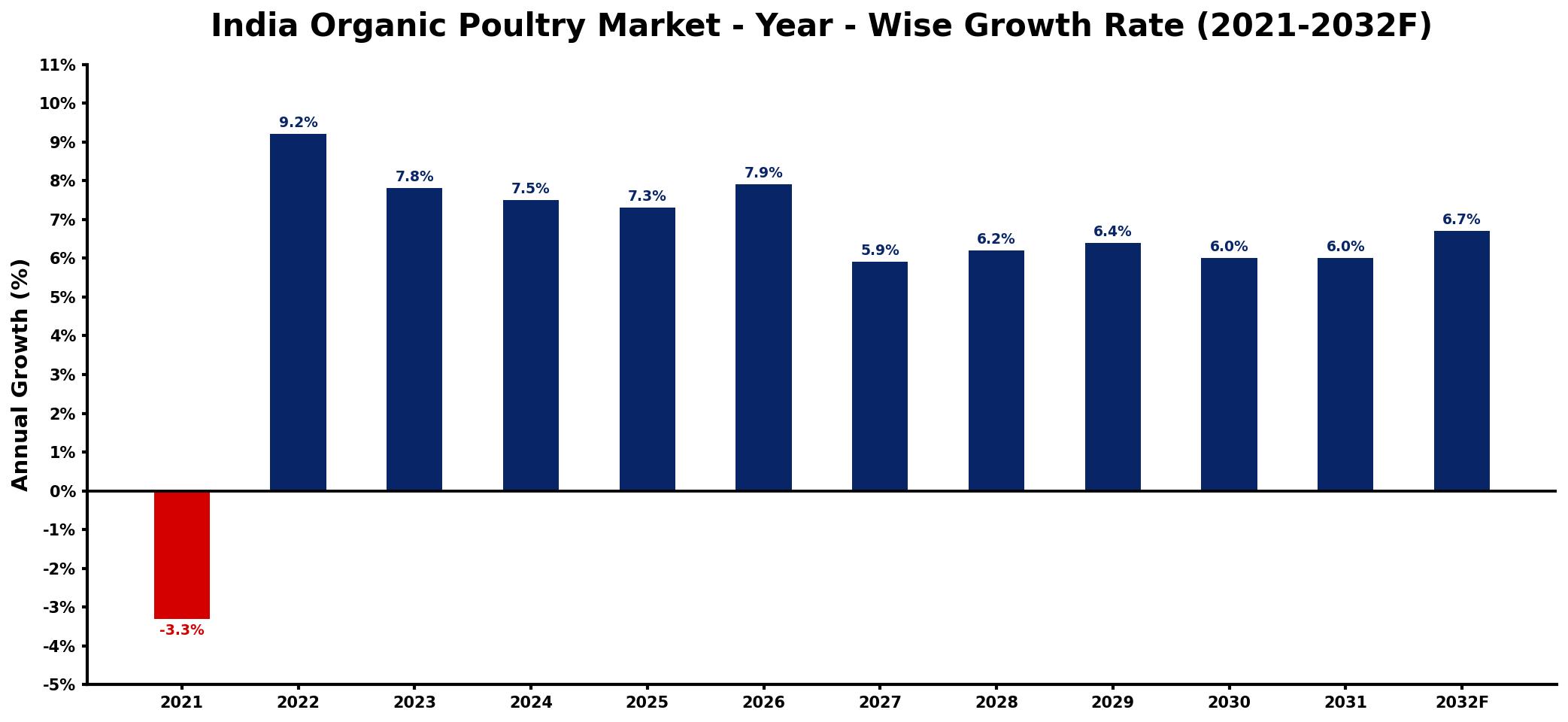
The table below presents the year‑wise growth rates along with the key drivers influencing the market
| Year | Growth Rate | Major Drivers |
| 2021 | -3.3% | Consumer preferences shifted towards alternatives |
| 2022 | 9.2% | increased overall sector activity |
| 2023 | 7.8% | Sustainable farming practices gained traction |
| 2024 | 7.5% | Rising disposable income drove demand |
| 2025 | 7.3% | Innovative marketing strategies attracted customers |
| 2026 | 7.9% | E-commerce expansion facilitated access |
| 2027 | 5.9% | Regulatory support encouraged market growth |
| 2028 | 6.2% | Increased investment in supply chain |
| 2029 | 6.4% | Diverse product offerings enhanced appeal |
| 2030 | 6.0% | Growing urban population fueled sales |
| 2031 | 6.0% | Health trends prioritized nutrition choices |
| 2032 | 6.7% | Collaborations with retailers expanded reach |
Note: Market size estimations and growth projections presented in this report are based on 6Wresearch's proprietary forecasting methodology, utilizing the latest available industry data, government publications, and primary research inputs.
India Organic Poultry Market Synopsis
In recent years, the Indian organic poultry market has witnessed remarkable growth, driven by shifting consumer preferences towards organic food products. However, as the market matures, there is a pressing need for addressing challenges such as feed sourcing and production costs, which could impede further growth.
Looking ahead, the market is poised to evolve, with a pronounced emphasis on sustainability and ethical farming practices. Consumers are increasingly willing to pay a premium for organically produced poultry, which presents a significant opportunity for producers to tap into a more health-conscious demographic.
India Organic Poultry Market Key Takeaways
- The market is set to experience significant growth driven by heightened consumer health consciousness.
- There is an increasing willingness among consumers to invest in premium organic poultry products.
- Government initiatives are playing a crucial role in enhancing the competitiveness of the organic poultry sector.
- Challenges related to feed sourcing and disease management remain pivotal for market players.
- Heightened awareness of the environmental impact of conventional poultry farming is shifting consumer behavior.
Evaluation of Restraints in India Organic Poultry Market
Despite the market's promising growth trajectory, several restraints hinder its full potential. One significant challenge is the high cost of organic feed, which can substantially affect production margins for farmers. The limited availability of organic feed coupled with unique disease control challenges in organic farming also complicates operations. Additionally, establishing a robust certification system for organic produce is critical, as inconsistency in standards could deter consumer trust. Thus, addressing these issues is essential for sustained market expansion.
India Organic Poultry Market Trends
Current trends in the India organic poultry market reflect a growing preference for ethically raised and sustainably produced food. Innovations in farming practices, alongside increased investments in organic certification processes, are reshaping the market landscape. Additionally, the rise in direct-to-consumer sales channels is enhancing access to organic poultry products, further driving demand. As consumers become more informed about food sourcing and production methods, transparency and traceability are expected to become key competitive differentiators.
India Organic Poultry Market Opportunities
The organic poultry market in India presents ample opportunities for growth and investment. With a rising middle class increasingly inclined toward healthier food options, there is substantial potential for producers to introduce innovative organic poultry products. Furthermore, creating partnerships with local farmers for sustainable sourcing of organic feed could enhance product quality and availability. As the government continues to support organic farming initiatives, there will be numerous avenues for market players to expand their presence and tap into emerging consumer demands.
Government Initiatives in the India Organic Poultry Market
The Indian government has been proactive in promoting the organic poultry sector through various initiatives aimed at enhancing competitiveness. Policies encouraging sustainable farming practices, subsidies for organic certification, and investments in organic feed production are all part of the broader strategy to boost the market. Moreover, public awareness campaigns about the benefits of organic food have been instrumental in increasing consumer interest and demand.
Future Insights of the India Organic Poultry Market
Looking ahead to the period from 2026 to 2032, the India organic poultry market is likely to see continued evolution driven by demographic shifts and health trends. As more consumers prioritize health and sustainability, demand for organic poultry is expected to rise significantly. The integration of technology in organic farming practices could also lead to improvements in yield and product quality. Additionally, as the certification framework strengthens, consumer trust in organic products will likely increase, propelling market growth further.
India Organic Poultry Market Latest Developments (2025 - 2026)
Recent developments in the organic poultry sector highlight a growing interest in sustainable farming practices. The market is witnessing an influx of new entrants focused on organic poultry production, as consumer demand continues to rise. Moreover, collaborations between producers and agricultural universities are emerging to promote research on organic farming methods. Such initiatives are expected to bolster the industry's resilience and improve productivity, setting a positive outlook for the coming years.
India Organic Poultry Market - Key Attractiveness of the Report
- 10 Years of Market Numbers
- Historical Data Starting from 2022 to 2025
- Base Year: 2025
- Forecast Data until 2032
- Key Performance Indicators Impacting the Market
- Major Upcoming Developments and Projects
Key Highlights of the Report:
- India Organic Poultry Market Outlook
- Market Size of India Organic Poultry Market, 2025
- Forecast of India Organic Poultry Market, 2032
- Historical Data and Forecast of India Organic Poultry Revenues & Volume for the Period 2022-2032F
- India Organic Poultry Market Trend Evolution
- India Organic Poultry Market Drivers and Challenges
- India Organic Poultry Price Trends
- India Organic Poultry Porter's Five Forces
- India Organic Poultry Industry Life Cycle
- Historical Data and Forecast of India Organic Poultry Market Revenues & Volume By Type for the Period 2022-2032F
- Historical Data and Forecast of India Organic Poultry Market Revenues & Volume By Organic Eggs for the Period 2022-2032F
- Historical Data and Forecast of India Organic Poultry Market Revenues & Volume By Organic Meat for the Period 2022-2032F
- Historical Data and Forecast of India Organic Poultry Market Revenues & Volume By Sales Channel for the Period 2022-2032F
- Historical Data and Forecast of India Organic Poultry Market Revenues & Volume By Business To Business for the Period 2022-2032F
- Historical Data and Forecast of India Organic Poultry Market Revenues & Volume By Business To Consumer for the Period 2022-2032F
- India Organic Poultry Import Export Trade Statistics
- Market Opportunity Assessment By Type
- Market Opportunity Assessment By Sales Channel
- India Organic Poultry Top Companies Market Share
- India Organic Poultry Competitive Benchmarking By Technical and Operational Parameters
- India Organic Poultry Company Profiles
- India Organic Poultry Key Strategic Recommendations






































