India Pan Masala Market (2026-2032) | Outlook, Trends, Value, Revenue, Forecast, Analysis, Growth, Industry, Size, Share, Segmentation
Market Forecast By Type (Beverages, Mint, Cardamom, Saffron and Saffron Flavor, Rose flavor and Rose flavor with Saffron (Gulab), Others (Lemon, Orange, Nutmeg, etc.)), By Price (Premium, Non premium), By Distribution Channel (Hypermarkets/ supermarkets, Convenience stores, Tobacconists/ Cigar shops, Online sales platforms) and Competitive Landsape
| Product Code: ETC4377767 | Publication Date: Dec 2022 | Updated Date: Aug 2026 | Product Type: Report | |
| Publisher: 6Wresearch | Author: Ravi Bhandari | No. of Pages: 70 | No. of Figures: 35 | No. of Tables: 5 |
India Pan Masala Market Growth Rate
According to 6Wresearch internal databases and industry insights, the India Pan Masala Market is projected to grow at a compound annual growth rate (CAGR) of 5.9% during 2026–2032.
India Pan Masala Market Year-wise Growth Rate and Key Drivers (2022–2032)
This graph illustrates the annual growth rates of the India Pan Masala Market from 2022 to 2032, highlighting a steady upward trajectory and projected market expansion over the forecast period.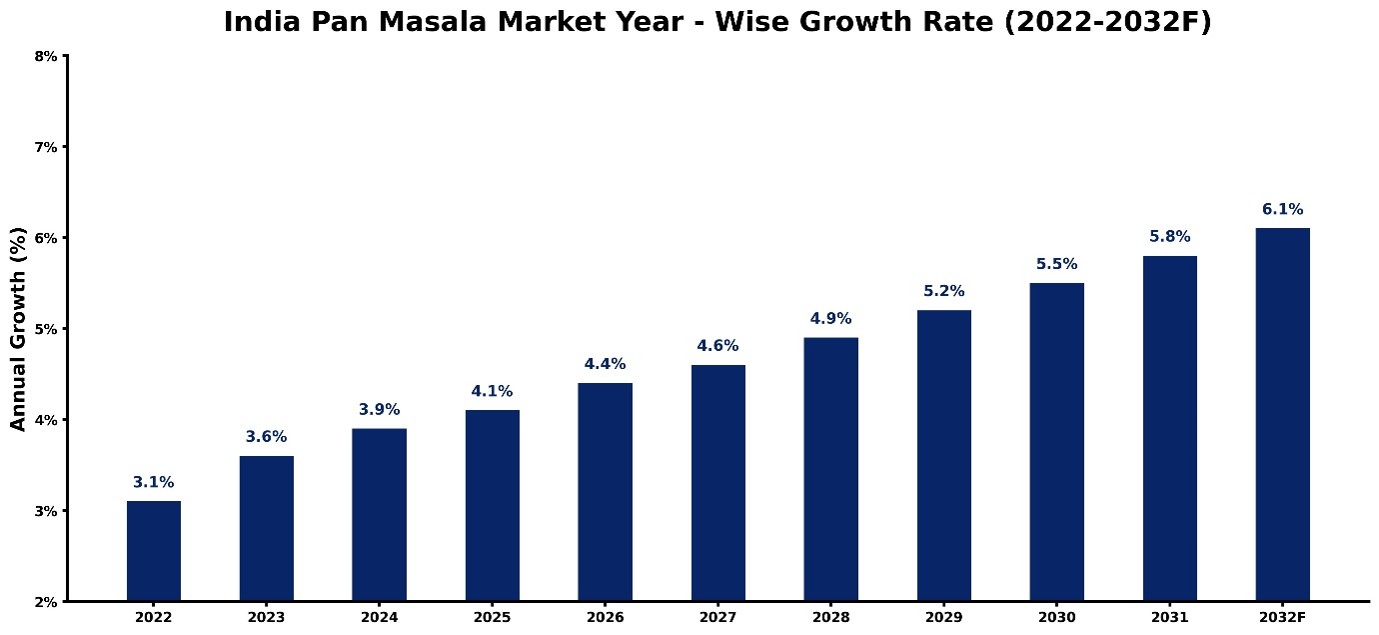
The following table summarizes the historical and forecast growth rates along with the major factors influencing market performance:
| Year | Estimated Growth (%) | Market Rationale |
| 2022 | 3.1 | Strong post-pandemic recovery in FMCG distribution and increased rural consumption supported demand. |
| 2023 | 3.6 | Premium flavored variants and wider retail availability accelerated sales across Tier II and Tier III cities. |
| 2024 | 3.9 | Higher disposable income and improved retail penetration strengthened organized market growth. |
| 2025 | 4.1 | Product innovation, attractive packaging, and expansion of premium product portfolios boosted consumer demand. |
| 2026 | 4.4 | Rising demand for premium pan masala and expanding distribution through organized retail support market growth. |
| 2027 | 4.6 | Increasing consumption among urban consumers and product diversification stimulate market expansion. |
| 2028 | 4.9 | Growth of modern retail and e-commerce channels improves nationwide accessibility. |
| 2029 | 5.2 | Investment in automated manufacturing and premium ingredient sourcing enhances product quality. |
| 2030 | 5.5 | Growing preference for branded products and improved logistics strengthen market penetration. |
| 2031 | 5.8 | Continuous flavor innovation and stronger regional brand expansion contribute to sustained demand. |
| 2032 | 6.1 | Rising premiumization and increasing organized retail share support long-term industry growth. |
Topics Covered in the India Pan Masala Market Report
The India Pan Masala Market Report provides an in-depth assessment based on Type, Price, and Distribution Channel. It offers detailed insights into key industry trends, growth drivers, emerging opportunities, competitive developments, and high-growth segments. The report presents an objective assessment of current dynamics and future prospects, enabling stakeholders to make informed business decisions and develop effective strategies aligned with the evolving industry landscape.
India Pan Masala Market Highlights
| Report Name | India Pan Masala Market |
| Forecast Period | 2026–2032 |
| CAGR | 5.90% |
| Growing Sector | Fast-Moving Consumer Goods (FMCG) |
India Pan Masala Market Synopsis
The India Pan Masala Market has continued to record steady growth, driven by changes in consumer tastes, brand awareness, availability, and constant product innovations. Pan masala is a mixture of various components like areca nut (in case of availability), cardamom, catechu, edible lime, permitted flavourings, natural spices, menthol, saffron extracts, aromatic herbs, among others, developed mainly for the purpose of mouth freshening. The manufacturers have been launching the product in premium packaging and regional variants, including sachet packing to appeal to premium as well as value-conscious consumers. Further, rising penetration across convenience stores, supermarkets, and digital commerce platforms has significantly improved product accessibility.
Evaluation of Growth Drivers in India Pan Masala Market (2026–2032)
Below are some of the major drivers influencing market growth.
| Drivers | Primary Segment Affected | Why It Matters (Evidence) |
| Expanding Retail Network | Convenience Stores | Wider product availability across urban and rural India increases consumer accessibility. |
| Premium Product Innovation | Premium Price Segment | Introduction of saffron, cardamom, and herbal variants attracts premium consumers. |
| Rising Disposable Income | Premium Products | Higher purchasing power supports spending on branded and premium pan masala products. |
| Packaging & Branding Advancements | All Distribution Channels | Attractive packaging improves shelf visibility and enhances consumer engagement. |
| Growing Organized FMCG Distribution | Hypermarkets/Supermarkets | Expansion of organized retail improves nationwide market penetration. |
The India Pan Masala Market is projected to experience a growth rate of CAGR 5.9% during the forecast period (2026-2032). owing to changes in consumer preferences, introduction of premium products, and development of organized retailing infrastructure. The organized retailing of FMCG continues to become stronger, with modern trade contributing 15% to 18% of packaged FMCG sales, thus creating scope for increased penetration of branded pan masala. In addition, the premium packaged segment has experienced an average annual growth of more than 9% in the urban areas.
Additionally, there are over 12 million traditional retail shops in India's retailing network and thus the coverage is wide even in rural areas. The rapid expansion of e-commerce and quick-commerce platforms has further enhanced accessibility for premium offerings, with online FMCG transactions recording double-digit annual growth, positioning the market for long-term growth.
Evaluation of Restraints in India Pan Masala Market
Below are the major restraints affecting market performance.
| Restraints | Primary Segment Affected | What This Means (Evidence) |
| Stringent Food Safety Regulations | Manufacturers | Compliance with food quality standards increases operational costs. |
| Raw Material Price Volatility | Premium Products | Fluctuating prices of cardamom, saffron, and flavoring ingredients affect profitability. |
| Health Awareness Among Consumers | Traditional Products | Growing awareness encourages some consumers to reduce discretionary consumption. |
| Intense Market Competition | Small Manufacturers | Strong competition limits pricing flexibility and profit margins. |
| Rising Packaging Costs | Entire Market | Higher packaging material prices increase production expenses. |
India Pan Masala Market Challenges
The India pan masala industry faces several operational and regulatory challenges despite maintaining positive growth momentum. The manufacturers continue to face fluctuations in prices of major ingredients such as cardamom, saffron, edible fragrances, and packaging materials resulting in an uncertainty in production costs.
In India, for instance, the prices of spices fluctuate between 10% and 25% year-on-year depending on the state of the harvest and the availability of supply. Meeting the FSSAI food safety standards, labeling norms and quality inspections has also made the operations more complex, especially for regional manufacturers.
Further, growing consumer knowledge about health issues and preferences for healthier lifestyles began to affect consumer choices, especially the young generation. Industry research shows that more than 40% of urban consumers read the ingredients' information on labels while buying packaged food and mouth fresheners.
India Pan Masala Market Trends
Latest trends shaping the India pan masala market include:
- Organized Retail Formats Expansion: Supermarkets, hypermarkets, and organized FMCG retailers have been expanding their presence in Tier II and Tier III cities. Organized retail accounts for 18-20% of branded FMCG sales in urban areas and ensures better visibility and brand recall.
- Expansion of Digital Commerce Marketplaces: The e-commerce grocery and quick-commerce portals have offered lucrative distribution channels for luxury pan masala products. India’s online grocery market is growing at more than 25% annually, providing producers access to a young consumer base on digital platforms.
- Flavor Customization by Region: Manufacturers are developing new formulations that meet the preferences of people from different regions. Flavors containing cardamom, mint, saffron, rose, lemon, and herbs have been gaining popularity among Indians in different states.
Investment Opportunities in the India Pan Masala Market
Potential investment opportunities in the India pan masala market are as follows:
- Opportunities in Premium Product Categories: Investment in premium products remains lucrative since consumers tend to favor high-quality products with unique flavors and fancy packaging. Premium products are expected to grow more than economy products during the forecast period.
- Package Innovation Opportunities: There is an increasing demand for eco-friendly and lightweight packaging. Investments in innovation in packaging can increase product life, decrease wastage, and enhance branding.
- Development of Exports-Focused Products: Manufacturers of Indian pan masala can leverage the diaspora of Indians in other countries to expand their exports by investing in certification of international standard packaging and labeling.
Top Players in India Pan Masala Market
Below are some of the leading players operating in the India Pan Masala Market.
Dharampal Satyapal Group (DS Group)
| Company Name | Dharampal Satyapal Group (DS Group) |
| Headquarter | Noida, Uttar Pradesh, India |
| Established | 1929 |
| Website | Click Here |
DS Group is one of India's leading FMCG companies and a prominent manufacturer of premium pan masala products under well-recognized brands.
Manikchand Group
| Company Name | Manikchand Group |
| Headquarter | Pune, Maharashtra, India |
| Established | 1958 |
| Website | Click Here |
Manikchand Group is a well-established player in India's pan masala industry, offering a diversified portfolio of flavored mouth fresheners and premium products.
Vimal (JB Industries)
| Company Name | Vimal (JB Industries) |
| Headquarter | Ahmedabad, Gujarat, India |
| Established | 1992 |
| Website | Click Here |
Vimal has built a strong presence in India's premium pan masala segment through continuous product innovation, large-scale advertising campaigns, and an extensive dealer network.
Kothari Products Limited
| Company Name | Kothari Products Limited |
| Headquarter | Kanpur, Uttar Pradesh, India |
| Established | 1983 |
| Website | Click Here |
Kothari Products Limited focuses on expanding production capacity, strengthening distribution networks, and introducing innovative product offerings to maintain competitiveness.
Government Initiatives being implemented in the India Pan Masala Market
The Indian government is intensifying its regulatory measures on the pan masala industry, covering food safety, manufacturing quality, taxation, and consumer protection. FSSAI updates its standards on the permissibility of ingredients, labeling of food, food additives, hygiene, and manufacturing processes to ensure consumer safety. The Food Safety and Standards Act, 2006 has been introduced to enhance strict quality control measures in food manufacturing facilities.
Moreover, Legal Metrology Rules require manufacturers to make standardized declarations on packaged commodities in terms of quantity, manufacturing date, maximum retail price and composition. All these regulatory measures will help promote product standardisation, consumer assurance, and accountability in the organised pan masala market.
Future Insights of the India Pan Masala Market
The India Pan Masala Market is expected to experience stable growth over the coming years as manufacturers continue investing in premiumization, flavor innovation, and wider distribution networks. Premium products are projected to account for an increasingly larger share of branded sales, supported by rising disposable incomes and changing consumer preferences.
In addition, organized retail will constitute more than 25% of branded product sales by 2032. Digital commerce will grow at more than 20% per annum creating new avenues for premium product launches. Overall, continuous innovation, stronger regulatory compliance, improved retail penetration, and technological modernization are likely to support the long-term competitiveness and resilience of the India pan masala market growth throughout the forecast period.
Market Segmentation Analysis
This report presents a detailed analysis of the market segments along with their leading categories.
By Type – Cardamom Pan Masala Dominates the Market, Saffron-Based Variants Register the Fastest Growth
According to Ravi Bhandari, Research Head, 6Wresearch, Cardamom Pan Masala accounted for approximately 34.83% of the India pan masala market share in 2025 due to its widespread consumer acceptance, refreshing aroma, balanced taste profile, and strong presence across both urban and rural markets. On the other hand, Saffron and Saffron Flavor Pan Masala is anticipated to register a growth rate of nearly 7.91% during 2026–2032, driven by increasing consumer preference for premium products and growing disposable incomes.
By Price – Non-Premium Segment Retains Market Leadership While Premium Products Gain Momentum
Non-Premium category dominated the market with a share of nearly 72.63% in 2025 and sustained its leadership position owing to its affordability, wide retail distribution and high consumption in rural and semi-urban regions. However, the Premium segment is expected to grow at a CAGR of 8.43% till 2032, owing to increasing purchasing power and growing demand for premium quality ingredients.
Convenience Stores Lead Sales, Online Platforms by Distribution Channel See the Quickest Expansion
The convenience stores distribution channel is estimated to capture a share of 48.93% in 2025 owing to their wide geographical coverage, easy accessibility, high product availability and strong impulse buying behavior. In contrast, Online Sales Platforms are forecast to record a CAGR of 10.23% during the forecast period (2026–2032), spurred by rapid expansion of e-commerce, improved digital payment infrastructure, and the growing popularity of quick-commerce services.
Note: Market size estimations and growth projections presented in this report are based on 6Wresearch's proprietary forecasting methodology, utilizing the latest available industry data, government publications, and primary research inputs.
Key Attractiveness of the Report
- 10 Years of Market Numbers
- Historical Data Starting from 2022 to 2025
- Base Year: 2025
- Forecast Data until 2032
- Key Performance Indicators Impacting the Market
- Major Upcoming Developments and Projects
Key Highlights of the Report:
- India Pan Masala Market Outlook
- Market Size of India Pan Masala Market, 2025
- Forecast of India Pan Masala Market, 2032
- Historical Data and Forecast of India Pan Masala Revenues & Volume for the Period 2022 - 2032F
- India Pan Masala Market Trend Evolution
- India Pan Masala Market Drivers and Challenges
- India Pan Masala Price Trends
- India Pan Masala Porter's Five Forces
- India Pan Masala Industry Life Cycle
- Historical Data and Forecast of India Pan Masala Market Revenues & Volume By Type for the Period 2022 - 2032F
- Historical Data and Forecast of India Pan Masala Market Revenues & Volume By Beverages for the Period 2022 - 2032F
- Historical Data and Forecast of India Pan Masala Market Revenues & Volume By Mint for the Period 2022 - 2032F
- Historical Data and Forecast of India Pan Masala Market Revenues & Volume By Cardamom for the Period 2022 - 2032F
- Historical Data and Forecast of India Pan Masala Market Revenues & Volume By Saffron & Saffron Flavor for the Period 2022 - 2032F
- Historical Data and Forecast of India Pan Masala Market Revenues & Volume By Rose Flavor And Rose Flavor With Saffron (Gulab) for the Period 2022 - 2032F
- Historical Data and Forecast of India Pan Masala Market Revenues & Volume By Others for the Period 2022 - 2032F
- Historical Data and Forecast of India Pan Masala Market Revenues & Volume By Lemon for the Period 2022 - 2032F
- Historical Data and Forecast of India Pan Masala Market Revenues & Volume By Orange for the Period 2022 - 2032F
- Historical Data and Forecast of India Pan Masala Market Revenues & Volume By Nutmeg for the Period 2022 - 2032F
- Historical Data and Forecast of India Pan Masala Market Revenues & Volume By Price for the Period 2022 - 2032F
- Historical Data and Forecast of India Pan Masala Market Revenues & Volume By Premium for the Period 2022 - 2032F
- Historical Data and Forecast of India Pan Masala Market Revenues & Volume By Non-Premium for the Period 2022 - 2032F
- Historical Data and Forecast of India Pan Masala Market Revenues & Volume By Distribution Channel for the Period 2022 - 2032F
- Historical Data and Forecast of India Pan Masala Market Revenues & Volume By Hypermarkets/ Supermarkets for the Period 2022 - 2032F
- Historical Data and Forecast of India Pan Masala Market Revenues & Volume By Convenience Stores for the Period 2022 - 2032F
- Historical Data and Forecast of India Pan Masala Market Revenues & Volume By Tobacconists/ Cigar Shops for the Period 2022 - 2032F
- Historical Data and Forecast of India Pan Masala Market Revenues & Volume By Online Sales Platforms for the Period 2022 - 2032F
- India Pan Masala Import Export Trade Statistics
- Market Opportunity Assessment By Type
- Market Opportunity Assessment By Price
- Market Opportunity Assessment By Distribution Channel
- India Pan Masala Top Companies Market Share
- India Pan Masala Company Profiles
- India Pan Masala Key Strategic Recommendations
Market Scope and Segmentation
The report delivers a widespread study of the subsequent market segments:
By Type
- Beverages
- Mint
- Cardamom
- Saffron and Saffron Flavor
- Rose flavor and Rose flavor with Saffron (Gulab)
- Others (Lemon, Orange, Nutmeg, etc.)
By Price
- Premium
- Non premium
By Distribution Channel:
- Premium
- Hypermarkets/ supermarkets
- Convenience stores
- Tobacconists/ Cigar shops
- Online sales platforms
India Pan Masala Market (2026-2032): FAQs
The India Pan Masala Market is projected to grow at a CAGR of 5.9% during 2026–2032, supported by premium product innovation
The market is majorly driven by rising disposable incomes, growing retail infrastructure and increasing penetration of organized FMCG distribution channels in terms of drivers.
Major companies include Dharampal Satyapal (DS) Group, Manikchand Group, Vimal (JB Industries), and Kothari Products Limited.
Increasing premiumization, increasing online retail trends, manufacturing automation, and stronger branding strategies by the leading companies are the key trends in the market
6Wresearch actively monitors the India Pan Masala Market and publishes its comprehensive annual report, highlighting emerging trends, growth drivers, revenue analysis, and forecast outlook. Our insights help businesses to make data-backed strategic decisions with ongoing market dynamics. Our analysts track relevent industries related to the India Pan Masala Market, allowing our clients with actionable intelligence and reliable forecasts tailored to emerging regional needs.
Yes, we provide customisation as per your requirements. To learn more, feel free to contact us on sales@6wresearch.com
| 1. Executive Summary |
| 2. Introduction |
| 2.1 Key Highlights of the Report |
| 2.2 Report Description |
| 2.3 Market Scope and Segmentation |
| 2.4 Research Methodology |
| 2.5 Assumptions |
| 3. India Pan Masala Market Overview |
| 3.1 India Pan Masala Market Revenues 2022 - 2032F |
| 3.2 India Pan Masala Market Industry Life Cycle |
| 3.3 India Pan Masala Market Porter’s Five Forces Model |
| 3.4 India Pan Masala Market Revenue Share, By Type 2022 & 2032F |
| 3.5 India Pan Masala Market Revenue Share, By Price 2022 & 2032F |
| 3.6 India Pan Masala Market Revenue Share, By Distribution Channel 2022 & 2032F |
| 4. Impact Analysis of COVID-19 on India Pan Masala Market |
| 5. India Pan Masala Market Dynamics |
| 5.1 Impact Analysis |
| 5.2 Market Drivers |
| 5.2.1 Changing consumer preferences towards convenient and portable snack options |
| 5.2.2 Rising disposable income levels leading to increased spending on premium pan masala products |
| 5.2.3 Growing urbanization and busy lifestyles driving demand for on-the-go consumables |
| 5.3 Market Restraints |
| 5.3.1 Increasing health concerns related to the consumption of pan masala products |
| 5.3.2 Stringent government regulations and bans on tobacco-related products |
| 5.3.3 Fluctuating prices of key ingredients impacting production costs |
| 6. India Pan Masala Market Trends & Evolution |
| 7. India Pan Masala Market Overview, By Type |
| 7.1 India Pan Masala Market Revenues, By Beverages 2022 - 2032F |
| 7.2 India Pan Masala Market Revenues, By Mint 2022 - 2032F |
| 7.3 India Pan Masala Market Revenues, By Cardamom 2022 - 2032F |
| 7.4 India Pan Masala Market Revenues, By Saffron 2022 - 2032F |
| 7.5 India Pan Masala Market Revenues, By Rose 2022 - 2032F |
| 7.6 India Pan Masala Market Revenues, By Others 2022 - 2032F |
| 8. India Pan Masala Market Overview, By Price |
| 8.1 India Pan Masala Market Revenues, By Premium 2022 - 2032F |
| 8.2 India Pan Masala Market Revenues, By Non Premium 2022 - 2032F |
| 9. India Pan Masala Market Overview, By Distribution Channel |
| 9.1 India Pan Masala Market Revenues, By Hypermarket/Supermarkets 2022 - 2032F |
| 9.2 India Pan Masala Market Revenues, By Convenience Store 2022 - 2032F |
| 9.3 India Pan Masala Market Revenues, By Tobacco 2022 - 2032F |
| 9.4 India Pan Masala Market Revenues, By Cigar 2022 - 2032F |
| 10. India Pan Masala Market - Key Performance Indicators |
| 10.1 Consumer engagement on social media platforms |
| 10.2 Number of new product launches in the pan masala market |
| 10.3 Percentage of repeat customers in the premium pan masala segment |
| 10.4 Market penetration in tier 2 and tier 3 cities |
| 10.5 Sustainability initiatives adopted by pan masala manufacturers |
| 11. India Pan Masala Market - Opportunity Assessment |
| 11.1 India Pan Masala Market Opportunity Assessment, By Type 2032F |
| 11.2 India Pan Masala Market Opportunity Assessment, By Price 2032F |
| 11.3 India Pan Masala Market Opportunity Assessment, By Distribution Channel 2032F |
| 12. India Pan Masala Market - Price Trend Analysis |
| 13. India Pan Masala Market Competitive Landscape |
| 13.1 India Pan Masala Market Revenue Ranking, By Companies 2025 |
| 13.2 India Pan Masala Market Competitive Benchmarking, By Operating Parameters |
| 14. Key Strategic Recommendations |
| 15. Disclaimer |
Global Go To Market Strategy - 2030
Export potential enables firms to identify high-growth global markets with greater confidence by combining advanced trade intelligence with a structured quantitative methodology. The framework analyzes emerging demand trends and country-level import patterns while integrating macroeconomic and trade datasets such as GDP and population forecasts, bilateral import–export flows, tariff structures, elasticity differentials between developed and developing economies, geographic distance, and import demand projections. Using weighted trade values from 2020–2024 as the base period to project country-to-country export potential for 2030, these inputs are operationalized through calculated drivers such as gravity model parameters, tariff impact factors, and projected GDP per-capita growth. Through an analysis of hidden potentials, demand hotspots, and market conditions that are most favorable to success, this method enables firms to focus on target countries, maximize returns, and global expansion with data, backed by accuracy.
By factoring in the projected importer demand gap that is currently unmet and could be potential opportunity, it identifies the potential for the Exporter (Country) among 190 countries, against the general trade analysis, which identifies the biggest importer or exporter.
To discover high-growth global markets and optimize your business strategy:
Click Here
Request Primary Research & Report
- Single User License$ 1,995
- Department License$ 2,400
- Site License$ 3,120
- Global License$ 3,795

Leadership Perspectives from Industry Events
Search
6Wresearch in the News
 Forbes
Citing 6Wresearch analytics to map global infrastructure and pharmaceutical industry trajectories.
 Bloomberg Law
Direct syndication of 6Wresearch's macro data points, capturing complex supply chain shifts.
 Reuters
Tracking industrial manufacturing adjustments and electronic security ecosystem scaling.
 Mint
Mint
Utilizing deep-tech sector market sizing to analyze global automation and robotics.
 The Economic Times
Anchoring features on industrial IoT growth metrics and connected smart-grid devices.
 Business Standard
Featuring strategic evaluations of Advanced Driver Assistance Systems (ADAS) and AI road safety.
 The Hindu
Spotlighting core commercial metrics ranging from unmanned aerial vehicles (UAVs) to consumer durables.
 Financial Express
Anchoring quarterly reviews on cross-border real estate tech and structural hardware manufacturing.
 Yahoo Finance
Syndicating the tracker's $30.1 billion untapped-market findings, spotlighting Japan, the US and China as India's top new-potential importers.
 India Today
Carrying the release on smartphones leading India's export potential to $94 billion by 2031, per 6WExportGTM data.
 Dailyhunt
Distributing the tracker findings to its regional readership, framing India's export diversification into Japan and Mexico.
 PR Newswire Original release
Publishing the full India Export Attractiveness Tracker 2026, detailing new trade corridors across iron ore, LCVs and pharmaceuticals.
 The Industrial
Highlighting the tracker's read on India's semiconductor ambitions and long-term chip-assembly export potential.
 PTI News
Reporting on the $66.81 billion pharmaceuticals export opportunity flagged in the tracker, amid looming US generic-drug tariffs.
 Tribune India
Covering the tracker's tariff-versus-regulation analysis across India's mature export markets in the US, China and UAE.
 ANI News
Amplifying the report's findings on polished diamonds, refined petroleum and medicines as India's core export engines.
 International Business Magazine
Covering the report's insight into how AEB, blind spot detection, and driver monitoring are reshaping India's ADAS market.
 Focus Gaming News
Highlighting the research forecast for Egypt's gambling market, projecting steady growth through 2032.
Thought Leadership and Analyst Meet





Our Clients








Latest Reports
- Namibia Financial Asset Management Market (2026-2032)
- Mozambique Financial Asset Management Market (2026-2032)
- Montenegro Financial Asset Management Market (2026-2032)
- Mongolia Financial Asset Management Market (2026-2032)
- Monaco Financial Asset Management Market (2026-2032)
- Micronesia Financial Asset Management Market (2026-2032)
- Mauritius Financial Asset Management Market (2026-2032)
- Mauritania Financial Asset Management Market (2026-2032)
- Marshall Islands Financial Asset Management Market (2026-2032)
- Malta Financial Asset Management Market (2026-2032)
Industry Events and Analyst Meet

EV India Expo 2026

HIMTEX 2026

India Refining Summit 2026

India EV Show 2026

EV tech India Expo 2026
Whitepaper
- Middle East & Africa Commercial Security Market Click here to view more.
- Middle East & Africa Fire Safety Systems & Equipment Market Click here to view more.
- GCC Drone Market Click here to view more.
- Middle East Lighting Fixture Market Click here to view more.
- GCC Physical & Perimeter Security Market Click here to view more.


