India Pearl Jewelry Market Size, Share & Growth Rate
The India Pearl Jewelry Market was estimated at USD 1231 Million in 2025 and is projected to reach USD 1779 Million by 2032, growing at a CAGR of 5.4% from 2026 to 2032. This growth trajectory is fueled by India's rich cultural heritage, where pearl jewelry is not merely an accessory but a significant part of traditional attire for many occasions. The increasing disposable income and the rising purchasing power of the burgeoning middle class are further driving demand, particularly for high-end jewelry. Additionally, the shift towards e-commerce has made pearl jewelry more accessible to a wider audience, enhancing its market penetration.
India Pearl Jewelry Market Growth Rate Analysis (2021-2032)
The Indian pearl jewelry market has seen significant fluctuations in recent years, beginning with a 3.1% decline in 2021, likely impacted by pandemic-related disruptions. However, the sector rebounded robustly in 2022, growing by 9%, fueled by a resurgence in consumer demand and increased investments in digital retail platforms. This upward momentum continued into 2023 with an 8.1% growth, as artisans embraced innovative design techniques, appealing to a younger demographic. Projections indicate steady growth through 2026, with rates around 7.7% annually, driven by rising disposable incomes and a revival of cultural celebrations that favor traditional jewelry. By 2032, the market is expected to maintain a growth rate of approximately 6.7%.
India Pearl Jewelry Market Year-wise Growth Rate and Key Drivers
This graph highlights how the India Pearl Jewelry Market has steadily grown over the past five years, supported by major growth factors.
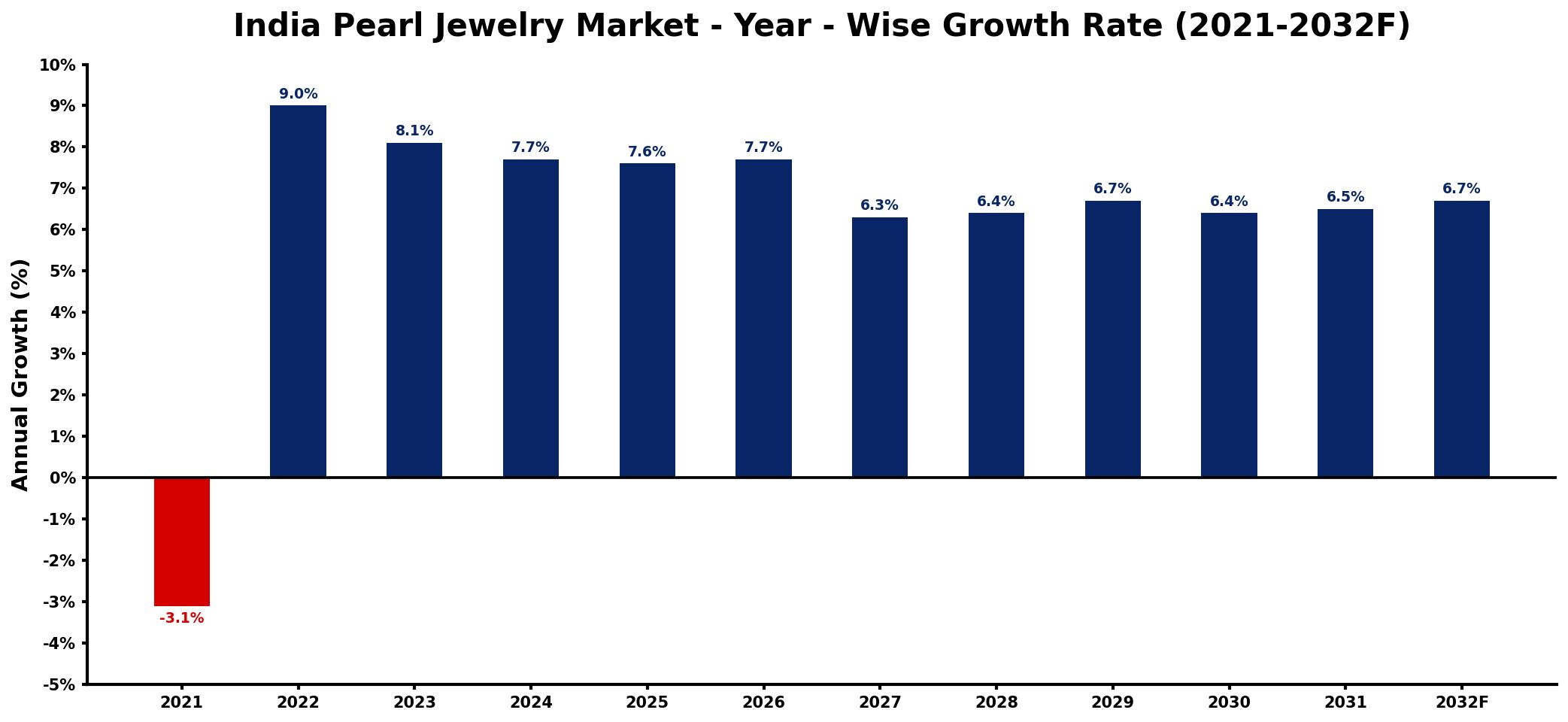
The table below presents the year‑wise growth rates along with the key drivers influencing the market
| Year | Growth Rate | Major Drivers |
| 2021 | -3.1% | decreased consumer spending trends |
| 2022 | 9.0% | increased disposable income levels |
| 2023 | 8.1% | growing luxury market segment |
| 2024 | 7.7% | expansion of online retail channels |
| 2025 | 7.6% | rising interest in sustainable products |
| 2026 | 7.7% | enhanced marketing strategies adopted |
| 2027 | 6.3% | increased tourism and gifting trends |
| 2028 | 6.4% | growing influence of social media |
| 2029 | 6.7% | growing downstream application demand |
| 2030 | 6.4% | increased celebrity endorsements observed |
| 2031 | 6.5% | growing demand for customization options |
| 2032 | 6.7% | rising popularity of artisanal products |
Note: Market size estimations and growth projections presented in this report are based on 6Wresearch's proprietary forecasting methodology, utilizing the latest available industry data, government publications, and primary research inputs.
India Pearl Jewelry Market Synopsis
In recent years, the India Pearl Jewelry Market has seen a remarkable uptick, driven by the cultural affinity for pearls. Celebrated for their elegance and versatility, pearls continue to adorn not only traditional attire but also modern designs, catering to a diverse consumer base.
As the middle class in India expands, so does the appetite for luxury items, including pearl jewelry. This market evolution is accompanied by a notable trend towards online shopping, providing consumers with convenient access to a broad array of options in terms of styles and price points.
India Pearl Jewelry Market Key Takeaways
- The market is propelled by India's deep-rooted cultural ties to pearl jewelry.
- Growing disposable income among consumers is fostering increased spending on luxury items.
- Online shopping platforms are significantly enhancing market accessibility and consumer reach.
- Challenges in sourcing high-quality pearls remain a concern, as India largely depends on imports.
- Environmental awareness is shaping consumer choices, influencing demand for sustainable practices in pearl sourcing.
Evaluation of Restraints in India Pearl Jewelry Market
Despite the positive growth trajectory of the India Pearl Jewelry Market, several limitations persist. The reliance on imported pearls creates challenges in maintaining consistent quality and authenticity. This can sometimes lead to consumer mistrust, particularly in an age where transparency is highly valued. Moreover, as awareness of environmental issues grows, there is increasing pressure on jewelers to adopt sustainable practices, complicating sourcing decisions. These factors could hinder market expansion if not adequately addressed.
India Pearl Jewelry Market Trends
Several trends are currently influencing the India Pearl Jewelry Market. The fusion of traditional designs with contemporary styles is capturing the attention of younger consumers, who seek unique expressions of identity through jewelry. Additionally, the growing focus on ethical sourcing has led brands to explore avenues for sustainability, which can enhance brand reputation and appeal to a conscientious consumer base.
Furthermore, customization is becoming increasingly popular, with consumers expressing a desire for personalized jewelry pieces that tell their stories. E-commerce platforms are responding to these trends by offering enhanced customization tools, allowing buyers to design their pieces according to personal preferences.
India Pearl Jewelry Market Opportunities
The future holds significant growth opportunities for the India Pearl Jewelry Market. As e-commerce continues to thrive, businesses have the chance to tap into previously underserved markets, particularly in rural and semi-urban areas. By leveraging technology, brands can offer virtual try-ons and augmented reality experiences, enhancing consumer engagement. Additionally, partnerships with local artisans can help in promoting regional designs, tapping into the increasing demand for authenticity in luxury purchases.
Government Initiatives in the India Pearl Jewelry Market
The Indian government has recognized the potential of the pearl jewelry sector and is implementing various initiatives aimed at boosting this market. Policies promoting skill development in traditional crafts are being introduced to enhance local craftsmanship, thereby supporting small artisans. Moreover, the government is also focusing on creating a conducive environment for exports, encouraging businesses to explore international markets.
Future Insights of the India Pearl Jewelry Market
Looking ahead to the 2026-2032 period, the India Pearl Jewelry Market is expected to evolve significantly. With advancements in technology and a growing inclination towards personalized and sustainable products, the market will likely see an influx of innovative designs and business models. Additionally, increasing awareness about ethical consumption among consumers may lead brands to prioritize sustainable sourcing and production methods, ultimately shaping the future landscape of the pearl jewelry industry.
India Pearl Jewelry Market Latest Developments (2025 - 2026)
Recent developments in the India Pearl Jewelry Market suggest a dynamic shift towards digital engagement. Many retailers are enhancing their online platforms to improve customer experiences through virtual showrooms and tailored recommendations. Additionally, sustainability initiatives are gaining traction, with several brands introducing eco-friendly collections and promoting transparent sourcing practices. This reflects a broader commitment to aligning with consumer expectations regarding environmental responsibility.
India Pearl Jewelry Market - Key Attractiveness of the Report
- 10 Years of Market Numbers
- Historical Data Starting from 2022 to 2025
- Base Year: 2025
- Forecast Data until 2032
- Key Performance Indicators Impacting the Market
- Major Upcoming Developments and Projects
Key Highlights of the Report:
- India Pearl Jewelry Market Outlook
- Market Size of India Pearl Jewelry Market, 2025
- Forecast of India Pearl Jewelry Market, 2032
- Historical Data and Forecast of India Pearl Jewelry Revenues & Volume for the Period 2022-2032F
- India Pearl Jewelry Market Trend Evolution
- India Pearl Jewelry Market Drivers and Challenges
- India Pearl Jewelry Price Trends
- India Pearl Jewelry Porter's Five Forces
- India Pearl Jewelry Industry Life Cycle
- Historical Data and Forecast of India Pearl Jewelry Market Revenues & Volume By Pearl Type for the Period 2022-2032F
- Historical Data and Forecast of India Pearl Jewelry Market Revenues & Volume By Freshwater for the Period 2022-2032F
- Historical Data and Forecast of India Pearl Jewelry Market Revenues & Volume By Saltwater for the Period 2022-2032F
- Historical Data and Forecast of India Pearl Jewelry Market Revenues & Volume By Material Type for the Period 2022-2032F
- Historical Data and Forecast of India Pearl Jewelry Market Revenues & Volume By Gold for the Period 2022-2032F
- Historical Data and Forecast of India Pearl Jewelry Market Revenues & Volume By Silver for the Period 2022-2032F
- Historical Data and Forecast of India Pearl Jewelry Market Revenues & Volume By Others for the Period 2022-2032F
- Historical Data and Forecast of India Pearl Jewelry Market Revenues & Volume By Jewelry Type for the Period 2022-2032F
- Historical Data and Forecast of India Pearl Jewelry Market Revenues & Volume By Necklace for the Period 2022-2032F
- Historical Data and Forecast of India Pearl Jewelry Market Revenues & Volume By Earrings for the Period 2022-2032F
- Historical Data and Forecast of India Pearl Jewelry Market Revenues & Volume By Rings for the Period 2022-2032F
- Historical Data and Forecast of India Pearl Jewelry Market Revenues & Volume By Others for the Period 2022-2032F
- India Pearl Jewelry Import Export Trade Statistics
- Market Opportunity Assessment By Pearl Type
- Market Opportunity Assessment By Material Type
- Market Opportunity Assessment By Jewelry Type
- India Pearl Jewelry Top Companies Market Share
- India Pearl Jewelry Competitive Benchmarking By Technical and Operational Parameters
- India Pearl Jewelry Company Profiles
- India Pearl Jewelry Key Strategic Recommendations






































