India Printed Signage Market Top 5 Importing Countries and Market Competition (HHI) Analysis
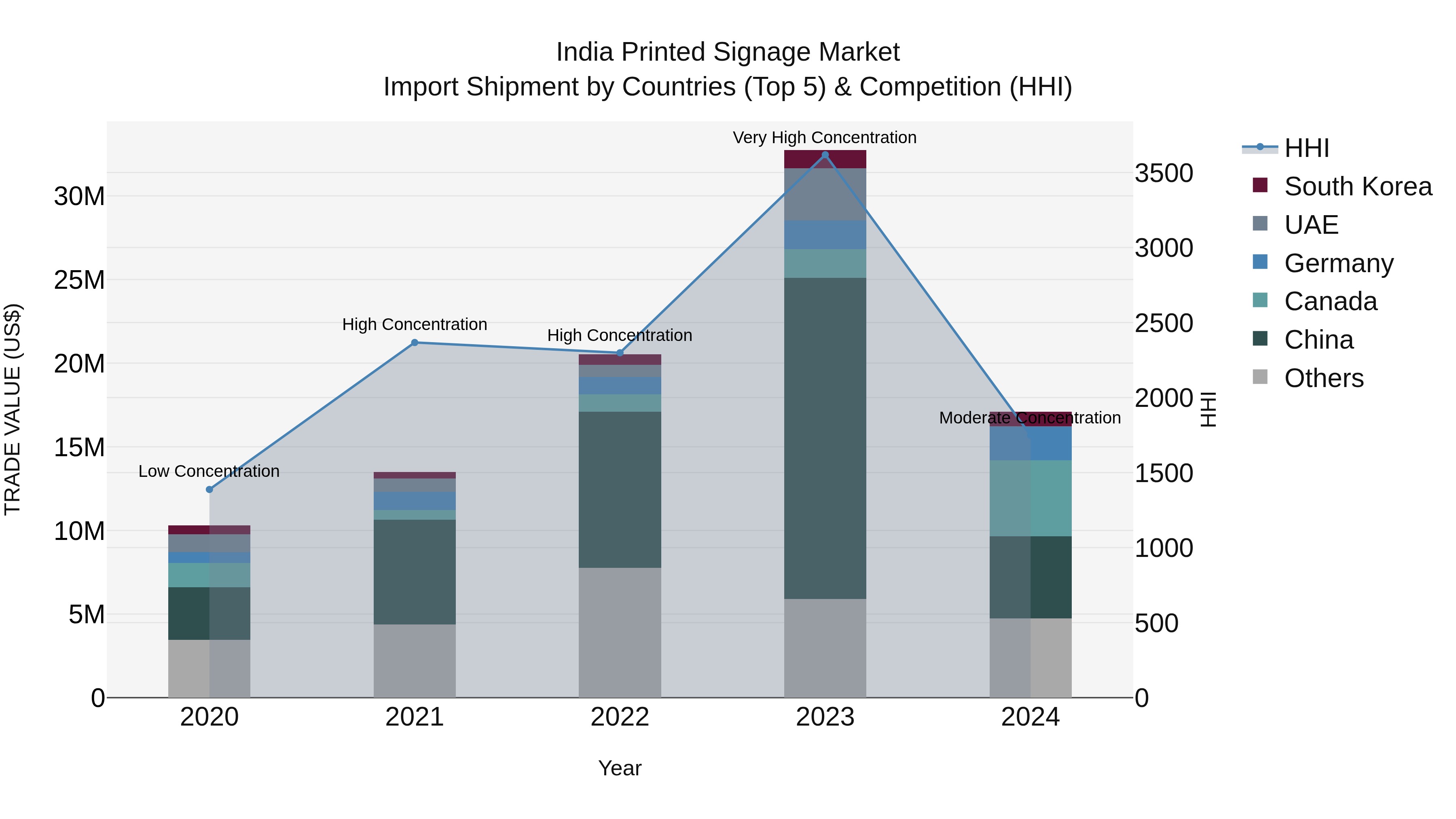
India`s printed signage import market in 2024 saw a shift in concentration levels from high to moderate, with top exporters being China, Canada, Germany, South Korea, and Italy. The industry experienced a notable CAGR of 13.52% from 2020 to 2024, indicating sustained growth. However, the growth rate dipped by -47.8% from 2023 to 2024, signaling a temporary slowdown. This dynamic landscape suggests opportunities for market players to adapt to changing conditions and capitalize on the evolving trends in the printed signage import sector.
India Printed Signage Market Synopsis
The India Printed Signage Market is experiencing significant growth driven by increasing demand from various sectors such as retail, hospitality, and transportation. The market is witnessing a shift towards digital and innovative printed signage solutions, leading to a rise in the adoption of technologies like UV printing and LED displays. Factors such as urbanization, infrastructural development, and the growing importance of visual communication are also contributing to market expansion. Key players in the market are focusing on offering customized and environmentally sustainable signage solutions to meet the diverse requirements of businesses. With the increasing emphasis on branding and marketing, the India Printed Signage Market is expected to continue its growth trajectory in the coming years, presenting opportunities for both domestic and international players to capitalize on this burgeoning market.
India Printed Signage Market Trends
The India Printed Signage Market is experiencing notable trends such as the growing adoption of digital signage solutions, increased demand for personalized and interactive signage, and a shift towards environmentally sustainable materials. Digital signage offers dynamic content delivery and real-time updates, catering to businesses looking for engaging customer experiences. Personalized and interactive signage, including augmented reality features, is becoming popular among retailers and event organizers to enhance customer engagement. Furthermore, there is a rising awareness about sustainability, leading to an interest in eco-friendly materials and printing techniques in the signage industry. Overall, these trends indicate a move towards more innovative and sustainable solutions in the India Printed Signage Market.
India Printed Signage Market Challenges
In the India Printed Signage Market, some key challenges include intense competition among numerous local and international players, price sensitivity among customers, and the need for continuous innovation to stand out in a crowded market. Additionally, varying regulations and compliance requirements across different states in India can pose challenges for companies operating nationwide. The market also faces challenges related to the adoption of digital signage technologies, as businesses and consumers gradually shift towards digital platforms. Furthermore, economic fluctuations and uncertainties can impact the demand for printed signage services, making it essential for companies to adapt quickly to changing market conditions and customer preferences in order to stay competitive and sustain growth in the industry.
India Printed Signage Market Investment Opportunities
The India Printed Signage Market offers promising investment opportunities due to the country`s rapidly growing retail, hospitality, and real estate sectors. With increasing urbanization and infrastructure development, the demand for high-quality printed signage for advertising, branding, and wayfinding purposes is on the rise. Investing in advanced printing technologies, such as UV printing and digital signage, can help businesses meet the evolving needs of clients in a cost-effective and efficient manner. Additionally, there is a growing trend towards sustainable and eco-friendly signage solutions, presenting opportunities for investments in environmentally friendly printing materials and processes. Overall, the India Printed Signage Market offers a dynamic landscape for investors looking to capitalize on the country`s expanding commercial and industrial sectors.
Jordan Agar Market Government Policies
The Indian government has implemented various policies and regulations related to the Printed Signage Market to ensure safety, environmental sustainability, and quality standards. Some key policies include the restriction on the use of hazardous chemicals in printing inks and materials to protect public health and the environment. The government also mandates compliance with size and placement guidelines to maintain aesthetics and prevent visual clutter in public spaces. Additionally, there are regulations in place to promote local manufacturing and support small businesses in the signage industry. Overall, these policies aim to balance the growth of the Printed Signage Market with the protection of public interests and the environment in India.
India Printed Signage Market Future Outlook
The India Printed Signage Market is poised for steady growth in the coming years, driven by increasing urbanization, infrastructure development, and a growing focus on branding and advertising. With the rise of retail, hospitality, and transportation sectors, there is a rising demand for printed signage for promotional purposes, wayfinding, and brand visibility. Additionally, advancements in digital printing technologies are enabling more customized and visually appealing signage solutions, further fueling market growth. As businesses continue to invest in enhancing their physical presence and customer engagement strategies, the Printed Signage Market in India is expected to expand significantly, offering opportunities for the printing industry and related services to thrive in the foreseeable future.
Key Highlights of the Report:
- India Printed Signage Market Outlook
- Market Size of India Printed Signage Market, 2024
- Forecast of India Printed Signage Market, 2031
- Historical Data and Forecast of India Printed Signage Revenues & Volume for the Period 2021- 2031
- India Printed Signage Market Trend Evolution
- India Printed Signage Market Drivers and Challenges
- India Printed Signage Price Trends
- India Printed Signage Porter's Five Forces
- India Printed Signage Industry Life Cycle
- Historical Data and Forecast of India Printed Signage Market Revenues & Volume By Product for the Period 2021- 2031
- Historical Data and Forecast of India Printed Signage Market Revenues & Volume By Billboard for the Period 2021- 2031
- Historical Data and Forecast of India Printed Signage Market Revenues & Volume By Backlit Display for the Period 2021- 2031
- Historical Data and Forecast of India Printed Signage Market Revenues & Volume By Pop Display for the Period 2021- 2031
- Historical Data and Forecast of India Printed Signage Market Revenues & Volume By Banner for the Period 2021- 2031
- Historical Data and Forecast of India Printed Signage Market Revenues & Volume By Corporate Graphics for the Period 2021- 2031
- Historical Data and Forecast of India Printed Signage Market Revenues & Volume By Others for the Period 2021- 2031
- Historical Data and Forecast of India Printed Signage Market Revenues & Volume By Type for the Period 2021- 2031
- Historical Data and Forecast of India Printed Signage Market Revenues & Volume By Indoor Printed Signage for the Period 2021- 2031
- Historical Data and Forecast of India Printed Signage Market Revenues & Volume By Outdoor Printed Signage for the Period 2021- 2031
- Historical Data and Forecast of India Printed Signage Market Revenues & Volume By End-user Vertical for the Period 2021- 2031
- Historical Data and Forecast of India Printed Signage Market Revenues & Volume By BFSI for the Period 2021- 2031
- Historical Data and Forecast of India Printed Signage Market Revenues & Volume By Retail for the Period 2021- 2031
- Historical Data and Forecast of India Printed Signage Market Revenues & Volume By Sports and Leisure for the Period 2021- 2031
- Historical Data and Forecast of India Printed Signage Market Revenues & Volume By Entertainment for the Period 2021- 2031
- Historical Data and Forecast of India Printed Signage Market Revenues & Volume By Transportation and Logistics for the Period 2021- 2031
- Historical Data and Forecast of India Printed Signage Market Revenues & Volume By Healthcare for the Period 2021- 2031
- Historical Data and Forecast of India Printed Signage Market Revenues & Volume By Others for the Period 2021- 2031
- India Printed Signage Import Export Trade Statistics
- Market Opportunity Assessment By Product
- Market Opportunity Assessment By Type
- Market Opportunity Assessment By End-user Vertical
- India Printed Signage Top Companies Market Share
- India Printed Signage Competitive Benchmarking By Technical and Operational Parameters
- India Printed Signage Company Profiles
- India Printed Signage Key Strategic Recommendations






































