India Retail and Wholesale Market Top 5 Importing Countries and Market Competition (HHI) Analysis
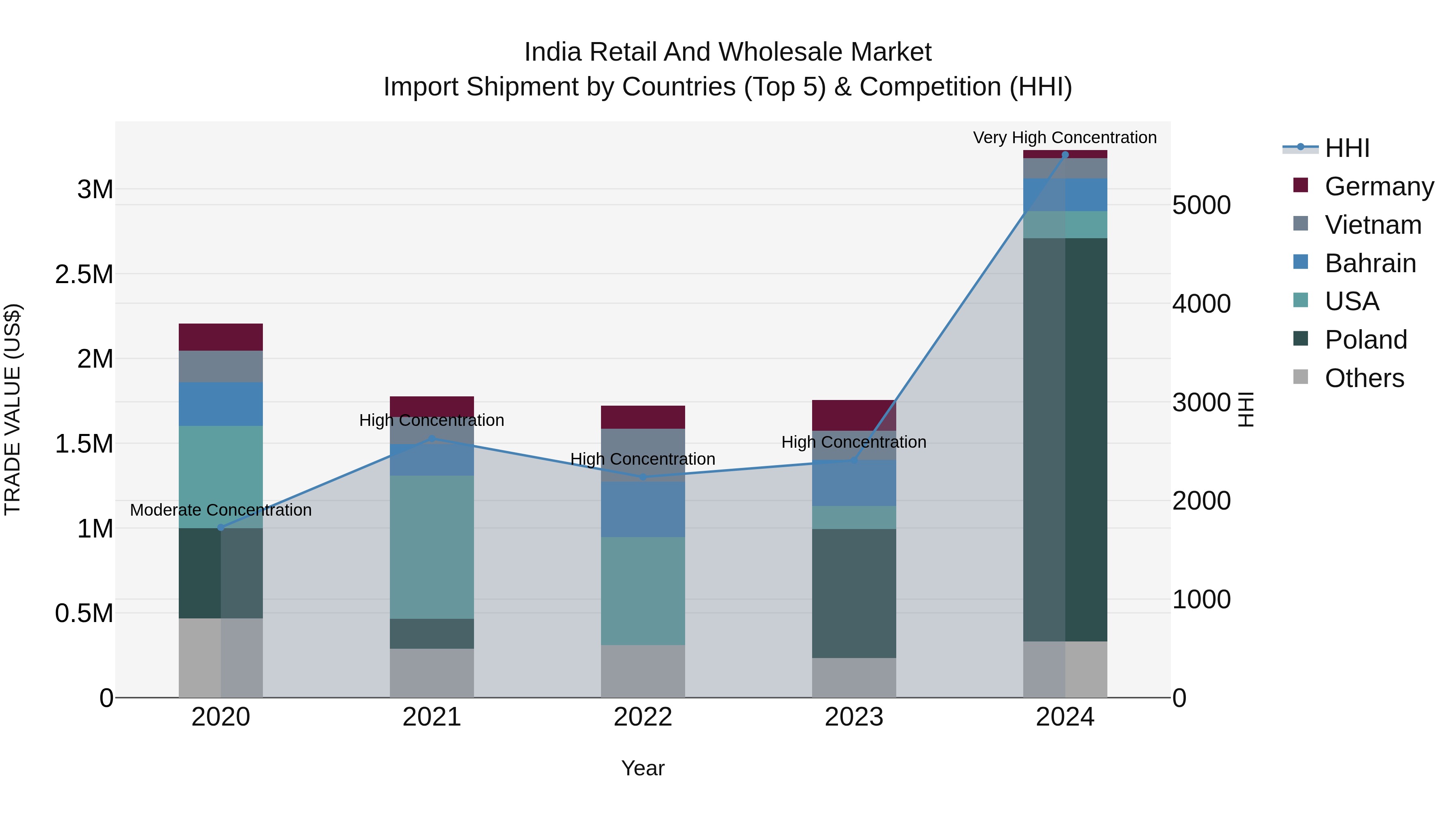
India`s retail and wholesale import shipments experienced significant growth in 2024, with a high concentration of imports from top countries such as Poland, Bahrain, USA, UK, and Vietnam. The HHI measure of market concentration surged from high to very high in just one year, indicating a more consolidated market landscape. The impressive CAGR of 10.0 from 2020 to 2024 highlights the steady growth trajectory of import shipments, while the exceptional growth rate of 83.82 in 2024 showcases the rapid expansion and increasing importance of international trade in India`s retail and wholesale sector.
India Retail and Wholesale Market Growth Rate
According to 6Wresearch internal database and industry insights, the India Retail and Wholesale Market is projected to grow at a compound annual growth rate (CAGR) of 7.8% during the forecast period (2026-2032).
Topics Covered in the India Retail and Wholesale Market Report
The India Retail and Wholesale Market report thoroughly covers the market by Type, Ownership, Price range, and Distribution Channels. The market report provides an unbiased and detailed analysis of ongoing market trends, opportunities/high growth areas, and market drivers, which help stakeholders devise and align their market strategies according to the current and future market dynamics.
India Retail and Wholesale Market Highlights
| Report Name | India Retail and Wholesale Market |
| Forecast Period | 2026–2032 |
| CAGR | 7.8% |
| Growing Sector | Supermarkets & Organised Retail Chains |
India Retail and Wholesale Market Synopsis
India Retail and Wholesale Industry is considered to be one of the largest and most dynamic markets around the world. This market contributes significantly to India's GDP and acts as a base for the economy by providing jobs to millions of people. This market comprises traditional mom-and-pop stores as well as modern retail formats. The India Retail and Wholesale Market has changed significantly over the past decade with the increase in disposable income, urbanization, technology, and the growing middle-class population.
Evaluation of Growth Drivers in the India Retail and Wholesale Market
Below mentioned are some prominent drivers and their influence on the market dynamics:
| Drivers | Primary Segments Affected | Why it Matters (Evidence) |
| Rising Urban Consumer Spending | Retail, Supermarkets | Higher disposable income encourages frequent purchases and growth in organized retail outlets. |
| Expansion of Organized Retail Chains | Retail Chain, Supermarkets/Hypermarkets | Major retailers continue expanding store networks in urban and semi-urban regions. |
| Growth of Wholesale Distribution Networks | Wholesale, Convenience Stores | Strong supply chains improve product availability and reduce inventory shortages. |
| Digital Payment and Technology Adoption | Retail, Department Stores | Cashless payments and digital billing systems enhance consumer convenience and operational efficiency. |
| Government Support for Retail Infrastructure | All Types, Supermarkets & Others | Logistics Parks and other retail policy systems are essential to develop a growing modern retail segment for the country. |
India Retail and Wholesale Market is expected to grow at the CAGR of 7.8% during the forecast period of 2026-2032. With an increase in the amount of disposable income among consumers, coupled with the pace at which urbanization is taking place, the demand for different goods and services is on the rise. In addition to that, the increased prevalence of smartphones and the internet have led to an increase in e-commerce as well.
Evaluation of Restraints in the India Retail and Wholesale Market
Below mentioned are some major restraints and their influence on the market dynamics:
| Restraints | Primary Segments Affected | What This Means (Evidence) |
| Intense Competition Among Retailers | Retail, Supermarkets | Large retail chains and local stores compete aggressively, impacting margins. |
| High Real Estate Costs | Retail Chains, Department Stores | Expensive commercial spaces increase operational costs for retailers. |
| Supply Chain Inefficiencies | Wholesale, Convenience Stores | Logistics disruptions affect timely delivery of goods across regions. |
| Fragmented Retail Structure | Independent Retailers | Large presence of small retailers limits rapid growth of organized retail. |
| Price Sensitivity Among Consumers | Economy Segment, Retail | Consumers often prefer lower-priced goods, affecting premium retail sales. |
India Retail and Wholesale Market Challenges
Despite these opportunities, there are challenges in this sector. For instance, infrastructure challenges, such as poor logistics and supply chain management, are still affecting smooth business operations in this sector. The dominance of the unorganized retail sector presents a major challenge in terms of competition to the organized retail sector, making it difficult to penetrate this market.
Changing consumer demands and their increasing expectations also require constant innovation, which could be a challenge to small retail businesses. Complexity in regulatory requirements in different states is another challenge to businesses aiming to operate smoothly in this sector.
India Retail and Wholesale Market Trends
Major trends that are shaping the India Retail and Wholesale Market growth are as follows:
- Rise of Organized Retail Chains: Supermarket and hypermarket retail chains are growing at a rapid rate, covering urban as well as semi-urban markets, thereby providing a variety of products to the consumers at their convenience.
- Introduction of Digital Payment Systems: Retailers are using digital payment systems, mobile wallets, and contactless payments, which is enhancing the convenience factor for the consumers, as well as for the billing process.
- Rise of Specialty Retail Stores: Specialty retail stores, such as electronic retail stores, fashion stores, and lifestyle stores, are becoming more popular among the population due to the variety of products being offered at the retail stores.
- Modernization of Supply Chain: Retailers and wholesalers are using advanced technology for the supply chain, such as the use of technology for warehouse management, which is helping them to avoid the shortage of products.
Investment Opportunities in the India Retail and Wholesale Market
Investment opportunities that are prominent in the India Retail and Wholesale Industry include:
- Development of Modern Retail Chain: Investors are looking to invest in the development of supermarkets and hypermarkets to capitalize on the increasing consumer base.
- Wholesale Logistics Infrastructure: Building large-scale distribution centers to ensure the efficient movement of products to the markets.
- Retail Technology Platforms: Investors can invest in AI-based retail technologies, digital billing platforms, etc.
- Expansion of Specialty Retail Stores: Opportunities also exist for the development of retail stores specializing in the sale of electronics, fashion, etc.
Top 5 Leading Players in the India Retail and Wholesale Market
Key companies actively shaping the India Retail and Wholesale Market share include:
1. Reliance Retail Limited
| Company Name | Reliance Retail Limited |
|---|---|
| Established Year | 2006 |
| Headquarters | Mumbai, India |
| Official Website | Click Here |
Reliance Retail Limited operates one of the largest retail networks in India, offering groceries, electronics, apparel, and consumer goods through supermarkets, specialty stores, and digital platforms while strengthening supply chains and expanding organized retail presence across the country.
2. Walmart Inc.
| Company Name | Walmart Inc. |
|---|---|
| Established Year | 1962 |
| Headquarters | Arkansas, USA |
| Official Website | Click Here |
Walmart plays a significant role in India’s wholesale trade sector through its cash-and-carry business operations and partnerships that strengthen supply chain efficiency, offering bulk goods distribution and improving product accessibility for retailers and small businesses.
3. Amazon India
| Company Name | Amazon India |
|---|---|
| Established Year | 2013 (India operations) |
| Headquarters | Seattle, USA |
| Official Website | Click Here |
Amazon India operates a large digital retail platform supporting millions of sellers and buyers, integrating technology-driven logistics systems and warehousing networks that enhance product availability, efficient distribution, and consumer convenience across multiple retail categories.
4. Future Retail Limited
| Company Name | Future Retail Limited |
|---|---|
| Established Year | 1987 |
| Headquarters | Mumbai, India |
| Official Website | Click Here |
Future Retail operates supermarket and department store chains offering groceries, fashion, and household products, while strengthening organized retail infrastructure through modern store formats and supply chain systems designed to enhance shopping experiences for consumers.
5. Tata Digital (Tata Group Retail Operations)
| Company Name | Tata Digital (Tata Group Retail Operations) |
|---|---|
| Established Year | 2019 |
| Headquarters | Mumbai, India |
| Official Website | Click Here |
Tata Digital supports integrated retail ecosystems by combining physical stores with digital commerce platforms, enabling efficient retail distribution networks and providing consumers with a wide variety of products across grocery, lifestyle, and electronics categories.
Government Regulations Introduced in the India Retail and Wholesale Market
According to Indian Government Data, The India retail and wholesale market operates under a framework of regulations designed to ensure fair competition, consumer protection, and sustainable growth. For example, the government has formulated policies like the Foreign Direct Investment (FDI) policy, whereby the government allows up to 51% FDI in multiband and 100% FDI in single-brand retail, provided certain conditions are met. This policy has the aim of attracting more and more foreign investments into the country.
Future Insights of the India Retail and Wholesale Market
The retail and wholesale market in India is on the verge of a revolutionary change in the coming years, with the market benefiting from advancements in technology, changing consumer behaviour, and the support of the government. A rapid increase in the adoption of digital platforms such as smartphones will be witnessed in the near future, which will provide a further boost to the e-commerce industry. Artificial intelligence, machine learning, and blockchain technology are expected to revolutionize the supply chain.
Market Segmentation Analysis
The report offers a comprehensive study of the subsequent market segments and their leading categories:
Retail Segment to Dominate the Market – By Type
According to Parth, Senior Research Analyst, 6Wresearch, the retail segment is experiencing significant growth in the India retail and wholesale market, emerging as the dominating force. This growth spurt could be due to the rise of the Internet and the use of smartphones and the ease of shopping online. E-commerce sites have managed to tap into the Tier II and Tier III cities and have provided new avenues for consumers.
Key Attractiveness of the Report
- 10 Years of Market Numbers.
- Historical Data Starting from 2022 to 2025.
- Base Year: 2025.
- Forecast Data until 2032.
- Key Performance Indicators Impacting the Market.
- Major Upcoming Developments and Projects.
Key Highlights of the Report:
- India Retail And Wholesale Market Outlook
- Market Size of India Retail And Wholesale Market, 2025
- Forecast of India Retail And Wholesale Market, 2032
- Historical Data and Forecast of India Retail And Wholesale Revenues & Volume for the Period 2022-2032
- India Retail And Wholesale Market Trend Evolution
- India Retail And Wholesale Market Drivers and Challenges
- India Retail And Wholesale Price Trends
- India Retail And Wholesale Porter's Five Forces
- India Retail And Wholesale Industry Life Cycle
- Historical Data and Forecast of India Retail And Wholesale Market Revenues & Volume By Type for the Period 2022-2032
- Historical Data and Forecast of India Retail And Wholesale Market Revenues & Volume By Retail for the Period 2022-2032
- Historical Data and Forecast of India Retail And Wholesale Market Revenues & Volume By Wholesale for the Period 2022-2032
- Historical Data and Forecast of India Retail And Wholesale Market Revenues & Volume By Ownership for the Period 2022-2032
- Historical Data and Forecast of India Retail And Wholesale Market Revenues & Volume By Retail Chain/Wholesale Chain for the Period 2022-2032
- Historical Data and Forecast of India Retail And Wholesale Market Revenues & Volume By Independent Retailer/Independent Wholesalers for the Period 2022-2032
- Historical Data and Forecast of India Retail And Wholesale Market Revenues & Volume By Price Range for the Period 2022-2032
- Historical Data and Forecast of India Retail And Wholesale Market Revenues & Volume By Premium for the Period 2022-2032
- Historical Data and Forecast of India Retail And Wholesale Market Revenues & Volume By Mid-Range for the Period 2022-2032
- Historical Data and Forecast of India Retail And Wholesale Market Revenues & Volume By Economy for the Period 2022-2032
- Historical Data and Forecast of India Retail And Wholesale Market Revenues & Volume By Distribution Channel for the Period 2022-2032
- Historical Data and Forecast of India Retail And Wholesale Market Revenues & Volume By Supermarkets/Hypermarkets for the Period 2022-2032
- Historical Data and Forecast of India Retail And Wholesale Market Revenues & Volume By Convenience Stores for the Period 2022-2032
- Historical Data and Forecast of India Retail And Wholesale Market Revenues & Volume By Department Stores for the Period 2022-2032
- Historical Data and Forecast of India Retail And Wholesale Market Revenues & Volume By Specialty Stores for the Period 2022-2032
- India Retail And Wholesale Import Export Trade Statistics
- Market Opportunity Assessment By Type
- Market Opportunity Assessment By Ownership
- Market Opportunity Assessment By Price Range
- Market Opportunity Assessment By Distribution Channel
- India Retail And Wholesale Top Companies Market Share
- India Retail And Wholesale Competitive Benchmarking By Technical and Operational Parameters
- India Retail And Wholesale Company Profiles
- India Retail And Wholesale Key Strategic Recommendations
Markets Covered
The report provides a detailed analysis of the following market segments:
By Type
- Retail
- Wholesale
By Ownership
- Retail Chain/Wholesale Chain
- Independent Retailer/Independent Wholesalers
By Price Range
- Premium
- Mid-Range
- Economy
By Distribution Channel
- Supermarkets/Hypermarkets
- Convenience Stores
- Department Stores
- Specialty Stores






































