India Sea Bass Market Size, Share & Growth Rate
The India Sea Bass Market was estimated at USD 422 Million in 2025 and is projected to reach USD 609 Million by 2032, growing at a CAGR of 5.4% from 2026 to 2032. This growth is fueled by escalating consumer interest in healthy, high-quality seafood options, alongside the expanding aquaculture industry that is enhancing local production capabilities. Urbanization is also driving the trend, as more consumers shift towards premium dining experiences that feature sea bass.
India Sea Bass Market Year-wise Growth Rate and Key Drivers
This graph highlights how the India Sea Bass Market has steadily grown over the years, supported by major growth factors.
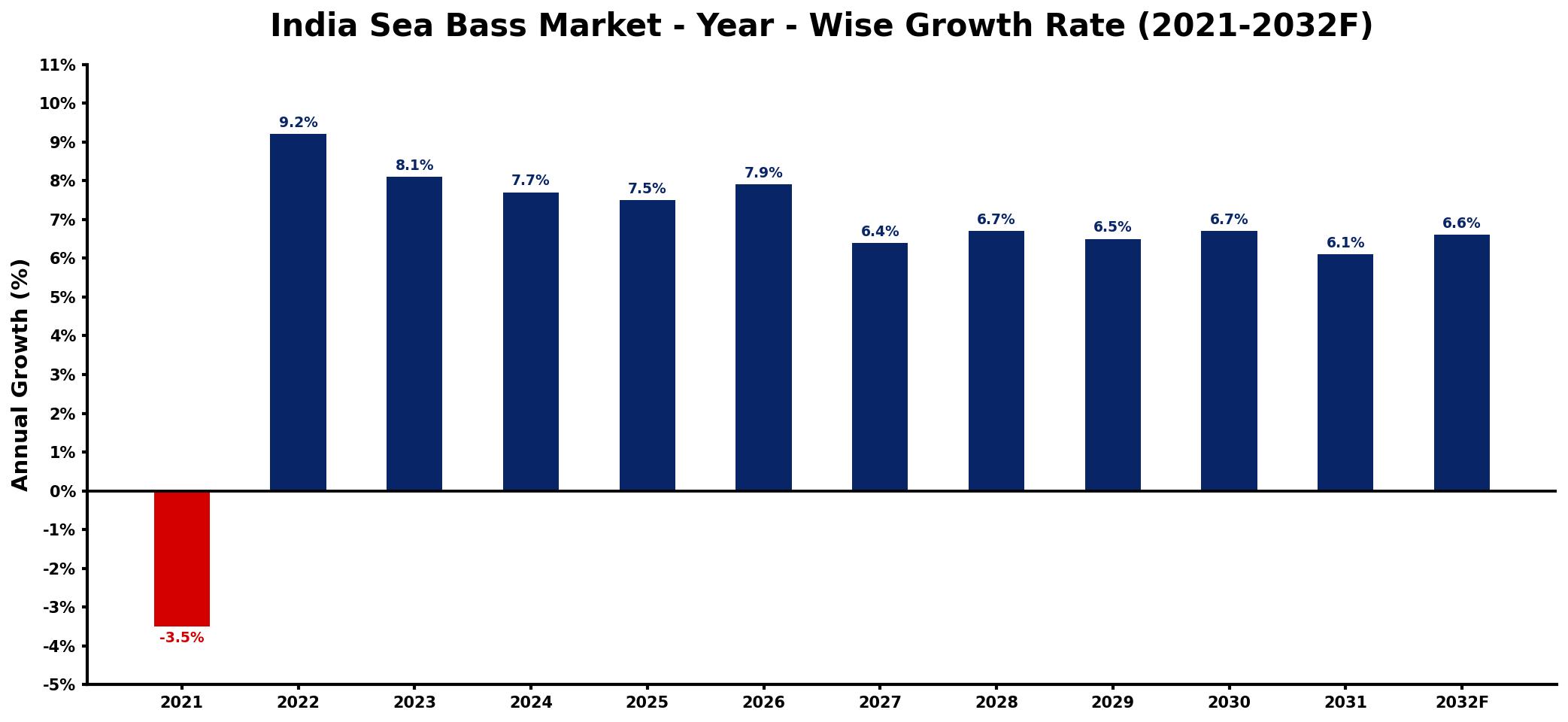
The table below presents the year‑wise growth rates along with the key drivers influencing the market
| Year | Growth Rate | Major Drivers |
| 2021 | -3.5% | decrease in consumer spending habits |
| 2022 | 9.2% | rise in health consciousness trends |
| 2023 | 8.1% | increased capital investment inflows |
| 2024 | 7.7% | expansion of aquaculture facilities |
| 2025 | 7.5% | growth in export opportunities |
| 2026 | 7.9% | development of innovative farming techniques |
| 2027 | 6.4% | increase in culinary tourism activities |
| 2028 | 6.7% | strengthening underlying market demand |
| 2029 | 6.5% | rising popularity of gourmet dining |
| 2030 | 6.7% | enhanced marketing of local cuisine |
| 2031 | 6.1% | expanding manufacturing base activity |
| 2032 | 6.6% | increased investment in cold storage |
Note: Market size estimations and growth projections presented in this report are based on 6Wresearch's proprietary forecasting methodology, utilizing the latest available industry data, government publications, and primary research inputs.
India Sea Bass Market Synopsis
The Indian Sea Bass market showcases a robust domestic catch of 116,893 tonnes, complemented by an export value of $83.7 million USD. Although this marks a slight decrease from previous years, the overall trend remains upward, signaling resilience and potential for recovery in the face of challenges. The market's evolution is underscored by an increasing preference for sustainable seafood among health-conscious consumers.
Furthermore, the market dynamics are shaped by a growing number of upscale restaurants that prioritize high-quality sea bass dishes. Enhanced fishing and processing technologies have facilitated better handling and distribution of sea bass, making it accessible to a wider consumer base across urban areas. The combination of these factors positions the India Sea Bass market for continued growth.
India Sea Bass Market Key Takeaways
- Significant growth trajectory with a projected market size increase to USD 609 Million by 2032.
- Rising consumer awareness regarding the health benefits of sea bass as a preferred seafood option.
- Urbanization driving demand for premium dining experiences featuring sea bass.
- Improvements in aquaculture practices enhancing supply chain stability.
- Potential challenges from environmental concerns and supply chain disruptions.
Evaluation of Restraints in India Sea Bass Market
Despite positive growth indicators, the India Sea Bass market is constrained by fluctuating availability linked to seasonal and environmental factors, which can lead to supply chain disruptions. Price volatility is another significant concern, making planning challenging for market participants. Moreover, the issue of overfishing and associated environmental impacts poses a long-term threat to sustainability. Finally, inadequate infrastructure for seafood storage and transport further complicates logistics, hindering optimal market expansion.
India Sea Bass Market Trends
Several trends are currently shaping the India Sea Bass market. A notable shift towards aquaculture-driven production models is becoming prevalent, driven by the need to meet rising demand sustainably. Additionally, consumers are increasingly favoring seafood as part of a healthy lifestyle, leading to a surge in popularity for premium seafood offerings. The culinary versatility of sea bass is also being highlighted, with chefs experimenting with various global cuisines to attract discerning diners.
India Sea Bass Market Opportunities
There are numerous growth opportunities within the India Sea Bass market, particularly in enhancing aquaculture practices to ensure a more stable supply. Investment in technology for better storage and distribution can significantly improve market efficiency. Furthermore, the increasing trend of home cooking during recent times presents an avenue for retail sales of sea bass, especially in urban settings. Finally, establishing collaborations between aquaculture farms and upscale restaurants can further elevate brand visibility and consumer trust.
Government Initiatives in the India Sea Bass Market
The Indian government has been active in promoting sustainable fishing practices and boosting the aquaculture sector through various initiatives. Policies encouraging investment in fishing technology, training programs for local fishermen, and financial incentives for aquaculture ventures are significant steps taken to enhance the overall productivity and sustainability of the sea bass market. Support for research and development in sustainable fishing methods further strengthens the foundation of this burgeoning industry.
Future Insights of the India Sea Bass Market
Looking ahead from 2026 to 2032, the India Sea Bass market is expected to evolve significantly, driven by ongoing urbanization and shifts in consumer preferences towards premium seafood. Enhanced sustainability measures and innovations in aquaculture could also support long-term growth. Moreover, as international trade dynamics fluctuate, Indian sea bass could position itself as a strong competitor in global markets, especially if quality and sustainability are prioritized.
India Sea Bass Market Latest Developments (2025 - 2026)
Recent developments in the India Sea Bass market indicate a positive trajectory, with several initiatives focused on improving aquaculture practices. The introduction of new regulations aimed at promoting sustainable fishing has also gained traction. Industry stakeholders are increasingly collaborating to enhance market access and streamline supply chains, addressing some of the challenges that previously hindered growth.
India Sea Bass Market - Key Attractiveness of the Report
- 10 Years of Market Numbers
- Historical Data Starting from 2022 to 2025
- Base Year: 2025
- Forecast Data until 2032
- Key Performance Indicators Impacting the Market
- Major Upcoming Developments and Projects
Key Highlights of the Report:
- India Sea Bass Market Outlook
- Market Size of India Sea Bass Market, 2025
- Forecast of India Sea Bass Market, 2032
- Historical Data and Forecast of India Sea Bass Revenues & Volume for the Period 2022-2032F
- India Sea Bass Market Trend Evolution
- India Sea Bass Market Drivers and Challenges
- India Sea Bass Price Trends
- India Sea Bass Porter's Five Forces
- India Sea Bass Industry Life Cycle
- Historical Data and Forecast of India Sea Bass Market Revenues & Volume By Nature for the Period 2022-2032F
- Historical Data and Forecast of India Sea Bass Market Revenues & Volume By Wild for the Period 2022-2032F
- Historical Data and Forecast of India Sea Bass Market Revenues & Volume By Farmed for the Period 2022-2032F
- Historical Data and Forecast of India Sea Bass Market Revenues & Volume By Type for the Period 2022-2032F
- Historical Data and Forecast of India Sea Bass Market Revenues & Volume By Fresh for the Period 2022-2032F
- Historical Data and Forecast of India Sea Bass Market Revenues & Volume By Processed for the Period 2022-2032F
- Historical Data and Forecast of India Sea Bass Market Revenues & Volume By Sales Channel for the Period 2022-2032F
- Historical Data and Forecast of India Sea Bass Market Revenues & Volume By Food Service for the Period 2022-2032F
- Historical Data and Forecast of India Sea Bass Market Revenues & Volume By Hypermarket/Supermarket for the Period 2022-2032F
- Historical Data and Forecast of India Sea Bass Market Revenues & Volume By Specialty Stores for the Period 2022-2032F
- Historical Data and Forecast of India Sea Bass Market Revenues & Volume By Online Channels for the Period 2022-2032F
- India Sea Bass Import Export Trade Statistics
- Market Opportunity Assessment By Nature
- Market Opportunity Assessment By Type
- Market Opportunity Assessment By Sales Channel
- India Sea Bass Top Companies Market Share
- India Sea Bass Competitive Benchmarking By Technical and Operational Parameters
- India Sea Bass Company Profiles
- India Sea Bass Key Strategic Recommendations






































