India Shaving Foam Market Top 5 Importing Countries and Market Competition (HHI) Analysis
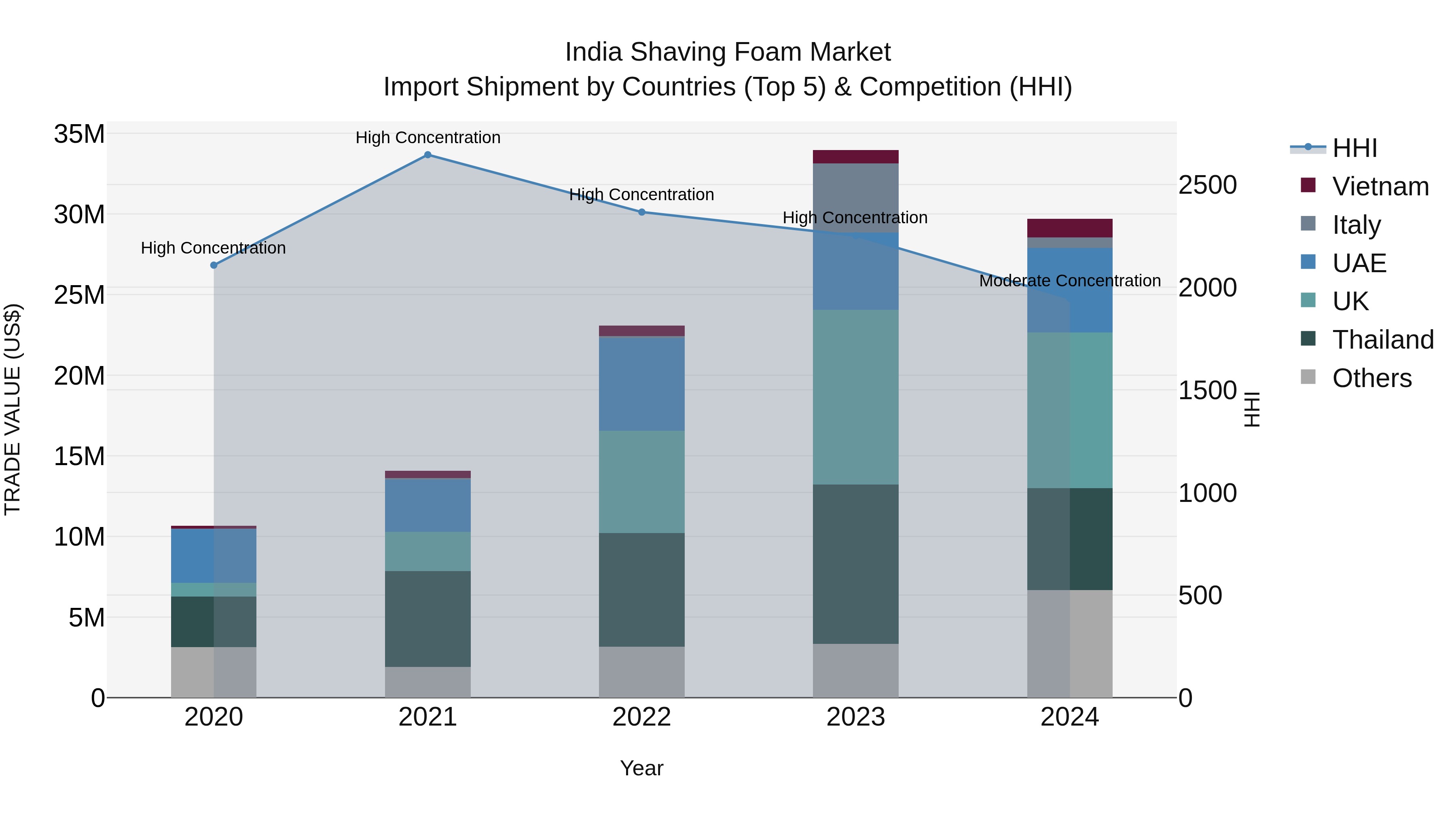
India`s shaving foam import market saw a significant shift in 2024, with top exporting countries being the UK, Thailand, UAE, Hungary, and Spain. The market experienced a transition from high to moderate concentration, indicating increased competition. Despite a remarkable CAGR of 29.2% from 2020 to 2024, there was a slight decline in growth rate by -12.51% in 2024. This data suggests a dynamic landscape in the shaving foam import sector in India, with opportunities for both domestic and international players to explore.
India Shaving Foam Market Synopsis
The India Shaving Foam Market is witnessing steady growth driven by factors such as increasing disposable income, changing grooming habits among men, and a rising preference for convenience products. Key players in the market are focusing on product innovation, offering a wide range of options catering to different skin types and preferences. The market is also seeing a shift towards natural and organic shaving foams due to growing awareness about the harmful effects of chemicals in personal care products. E-commerce platforms have played a significant role in expanding the reach of shaving foam products to a larger consumer base. With a growing male grooming industry in India, the shaving foam market is expected to continue its upward trajectory in the coming years, presenting opportunities for both domestic and international brands to capitalize on the evolving consumer preferences.
India Shaving Foam Market Trends
The India Shaving Foam Market is witnessing a shift towards natural and organic products as consumers are increasingly becoming conscious about the ingredients used in personal care products. This trend presents opportunities for companies to introduce eco-friendly and chemical-free shaving foams to cater to this growing segment of environmentally conscious consumers. Additionally, the rising popularity of grooming among Indian men, driven by urbanization and changing lifestyles, is fueling the demand for premium and specialized shaving foams. Companies can capitalize on this trend by offering innovative products with added benefits such as moisturizing properties, skin-nourishing ingredients, and unique fragrances to attract this discerning consumer base. E-commerce platforms are also playing a significant role in expanding the reach of shaving foam products, providing companies with a convenient channel to target a wider audience and increase sales.
India Shaving Foam Market Challenges
The India Shaving Foam market faces several challenges including increasing competition from alternative shaving products such as gels and creams, fluctuating raw material prices, and evolving consumer preferences towards natural and organic products. Additionally, the market is highly price-sensitive, making it difficult for brands to differentiate themselves solely on product quality. Distribution and retailing issues, such as limited shelf space and the dominance of traditional retail channels, also pose challenges for new entrants trying to establish a presence. Furthermore, cultural factors and changing grooming habits among Indian men add complexity to product positioning and marketing strategies in this market. Overall, companies operating in the India Shaving Foam market need to navigate these challenges strategically to maintain a competitive edge and sustain growth.
India Shaving Foam Market Investment Opportunities
The India Shaving Foam Market is primarily driven by factors such as the increasing focus on personal grooming and hygiene among the male population, rising disposable incomes, and the influence of social media and advertising. In addition, the growing trend of men preferring a clean-shaven look for professional and social reasons is boosting the demand for shaving foam products. The availability of a wide range of shaving foam products catering to different skin types and preferences, along with the expansion of distribution channels including online retail platforms, are also contributing to the market growth. Moreover, the introduction of innovative formulations with added skincare benefits and natural ingredients is attracting consumers looking for higher quality and performance in their shaving products.
India Shaving Foam Market Government Polices
The Indian government has implemented various policies affecting the shaving foam market. Import duties on raw materials used in manufacturing shaving foam impact production costs and pricing. Additionally, regulations by the Food Safety and Standards Authority of India (FSSAI) ensure product safety and quality through mandatory compliance with packaging and labeling requirements. The Goods and Services Tax (GST) regime has also influenced pricing and distribution channels for shaving foam products. Furthermore, environmental policies promoting sustainable practices may impact the use of certain ingredients in shaving foam formulations. Overall, government policies in India play a significant role in shaping the competitive landscape and consumer preferences within the shaving foam market.
India Shaving Foam Market Future Outlook
The India Shaving Foam Market is poised for steady growth in the coming years, driven by factors such as increasing urbanization, a rising trend of personal grooming among men, and the influence of social media on grooming habits. Consumers are becoming more conscious about grooming products and are willing to invest in premium shaving foams that offer enhanced benefits such as moisturization, sensitive skin care, and natural ingredients. The market is also witnessing a shift towards online purchasing channels, providing convenient options for consumers to explore and purchase a wide range of shaving foam products. Manufacturers are focusing on product innovation, packaging design, and marketing strategies to cater to the evolving preferences of Indian consumers, further fueling the growth potential of the India Shaving Foam Market.
Key Highlights of the Report:
- India Shaving Foam Market Outlook
- Market Size of India Shaving Foam Market, 2024
- Forecast of India Shaving Foam Market, 2031
- Historical Data and Forecast of India Shaving Foam Revenues & Volume for the Period 2021- 2031
- India Shaving Foam Market Trend Evolution
- India Shaving Foam Market Drivers and Challenges
- India Shaving Foam Price Trends
- India Shaving Foam Porter's Five Forces
- India Shaving Foam Industry Life Cycle
- Historical Data and Forecast of India Shaving Foam Market Revenues & Volume By Product for the Period 2021- 2031
- Historical Data and Forecast of India Shaving Foam Market Revenues & Volume By Organic for the Period 2021- 2031
- Historical Data and Forecast of India Shaving Foam Market Revenues & Volume By Conventional for the Period 2021- 2031
- Historical Data and Forecast of India Shaving Foam Market Revenues & Volume By Distribution Channel for the Period 2021- 2031
- Historical Data and Forecast of India Shaving Foam Market Revenues & Volume By Hypermarkets/Supermarkets for the Period 2021- 2031
- Historical Data and Forecast of India Shaving Foam Market Revenues & Volume By Departmental Stores for the Period 2021- 2031
- Historical Data and Forecast of India Shaving Foam Market Revenues & Volume By Speciality Stores for the Period 2021- 2031
- Historical Data and Forecast of India Shaving Foam Market Revenues & Volume By Online for the Period 2021- 2031
- India Shaving Foam Import Export Trade Statistics
- Market Opportunity Assessment By Product
- Market Opportunity Assessment By Distribution Channel
- India Shaving Foam Top Companies Market Share
- India Shaving Foam Competitive Benchmarking By Technical and Operational Parameters
- India Shaving Foam Company Profiles
- India Shaving Foam Key Strategic Recommendations






































