India Women`s Footwear Market Top 5 Importing Countries and Market Competition (HHI) Analysis
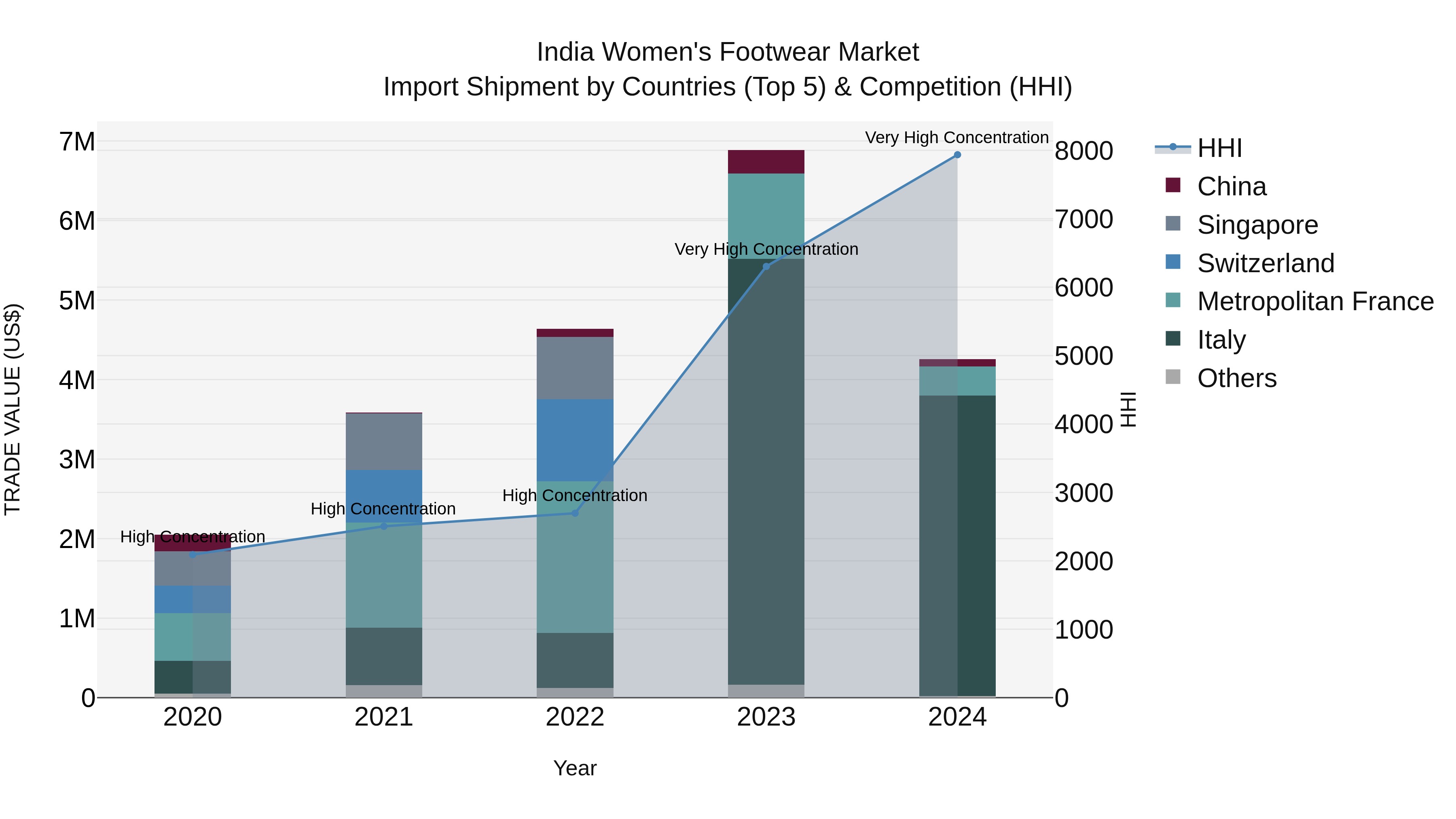
India`s women`s footwear import market in 2024 saw significant contributions from top exporting countries such as Italy, Metropolitan France, China, Vietnam, and Spain. Despite a high Herfindahl-Hirschman Index (HHI) indicating market concentration, the industry displayed a commendable compound annual growth rate (CAGR) of 20.07% from 2020 to 2024. However, there was a notable decline in growth rate from 2023 to 2024 at -38.19%, suggesting a potential shift in market dynamics that importers and stakeholders should monitor closely.
India Export Potential Assessment For Women's Footwear Market (Values in USD Thousand)
India Women's Footwear Market Growth Rate
According to 6Wresearch internal database and industry insights, the India Women's Footwear Market is projected to grow at a compound annual growth rate (CAGR) of 7.8% during the forecast period from 2026 to 2032.
Topics Covered in the India Women's Footwear Market Report
The India Women's Footwear Market report thoroughly covers the market by product type ,material type, and distribution channel providing an unbiased and detailed analysis of ongoing market trends, opportunities, challenges, and market drivers, helping stakeholders align their strategies with current and future market dynamics.
India Women's Footwear Market Highlights
| Report Name | India Women's Footwear Market |
| Forecast period | 2026-2032 |
| CAGR | 7.8% |
| Growing Sector | Women's Footwear |
India Women's Footwear Market Synopsis
The India Women's Footwear Market is expanding fast as people now spend more time watching fashion trends, wearing comfortable footwear and their changing lifestyle. The market growth results from higher consumer income, increased online shopping and their preference for premium branded footwear. The demand for comfortable footwear which offers both health and fitness benefits is increasing as people are becoming more health and fitness aware. The market will keep growing as consumers now want products which combine style and function while they shop more easily through digital platforms.
Evaluation of Growth Drivers in the India Women's Footwear Market
Below mentioned are some prominent drivers and their impact on the market dynamics:
| Drivers | Primary Segments Affected | Why It Matters (Evidence) |
| Rising Disposable Incomes | Shoes, Boots, Sports Shoes | Women’s increasing purchasing power is encouraging the demand for both luxury and casual footwear. |
| Fashion Consciousness | Heels & Pumps, Sandals | The growing trend of stylish footwear is attracting more consumers to invest in high-end and fashionable shoes. |
| Growth in Fitness Activities | Sports Shoes, Safety Shoes | As more women get interested in health and sports, there is a great need for the ultimate female shoes. |
| E-Commerce Growth | All Product Segments | With the growing convenience of online shopping, demand for footwear is rising, offering women an easier way to shop. |
| Comfort & Functionality Focus | Shoes, Sandals, Flip Flops | The emphasis on comfort is driving product innovation, especially in the realm of casual and everyday footwear. |
The India Women's Footwear Market Size is projected to grow at a CAGR of 7.8% from 2026 to 2032. The India Women's Footwear Market is driven by increasing disposable incomes, rising fashion consciousness, and a growing demand for stylish yet comfortable shoes. The expanding middle class and evolving lifestyles encourage demand for premium and luxury footwear. The rising interest in fitness and sports is driving the demand for sports shoes and safety footwear, while the growth of e-commerce is making it easier for consumers to access and purchase a wide variety of shoes online.
Evaluation of Restraints in the India Women's Footwear Market
Below mentioned are some major restraints and their influence on the market dynamics:
| Restraints | Primary Segments Affected | What This Means (Evidence) |
| Price Sensitivity | Shoes, Heels & Pumps | The high price of branded footwear limits market access for lower-income consumers. |
| Lack of Awareness About Quality | Sports Shoes, Safety Shoes | Consumers may be unaware of the benefits and comfort offered by specialty footwear. |
| Competition from Local Markets | Shoes, Sandals | Lower-priced footwear made locally is posing competition to international brands. |
| Quality Concerns | Flip Flops, Slippers | If the Quality and Durability of materials lack sturdiness it can impact customer’s trust. |
| Limited Availability of Sizes | Shoes, Sports Shoes | With certain types of accessories, there are a rather confusing few size. |
India Women's Footwear Market Challenges
The India Women’s Footwear Industry faces challenges like intense price competition which comes especially from unbranded local footwear. Consumers show doubts about affordable products as they question their quality and durability. The market needs to educate consumers about high-quality footwear benefits to overcome these obstacles. The development of delivery systems together with better access solutions will build consumer trust which will increase demand for branded premium footwear products in the market.
India Women's Footwear Market Trends
Here are some major trends changing the India Women's Footwear Market Growth dynamics:
- Increasing Preference for Comfortable Footwear: Consumers are choosing shoes that provide comfortable walking experience as they want to look stylish. The growing market demand for comfortable footwear drives manufacturers to produce shoes which include ergonomic designs.
- Rise in Online Shopping: Online platforms are becoming more popular for purchasing women’s footwear as they provide customers with extensive product options and delivery services to their homes. The adoption of footwear products will extend to all market segments due to this development.
- Fashion-Forward Footwear: With a growing emphasis on style, women’s footwear is increasingly designed to be fashionable while also serving practical purposes, including workwear, partywear, and casual options.
Investment Opportunities in the India Women's Footwear Market
The India Women's Footwear Market presents several investment opportunities, including:
- Investment in Comfort Technologies: Brands that invest in technologies that enhance comfort, such as memory foam insoles, arch support, and shock absorption, will attract health-conscious consumers looking for functional yet stylish shoes.
- Expansion of E-Commerce: Building strong online platforms and mobile apps that ensure a smooth customer experience will help brands gain a bigger share of the expanding digital consumer base.
- Focus on Affordable Footwear for Price-Sensitive Segments: Providing affordable, high-quality footwear to price-sensitive consumers will help grow the market, especially in rural and suburban regions.
Top 5 Leading Players in the India Women's Footwear Market
Below is the list of prominent companies leading the India Women’s Footwear Market Share:
1. Bata India Limited
| Company Name | Bata India Limited |
| Established Year | 1931 |
| Headquarters | Gurgaon, Haryana, India |
| Official Website | Click Here |
Bata is a leading footwear brand in India, offering a wide range of shoes for women, including casual, formal, and sports footwear. Known for its comfort and affordability, it caters to a broad customer base.
2. Adidas AG
| Company Name | Adidas AG |
| Established Year | 1949 |
| Headquarters | Herzogenaurach, Germany |
| Official Website | Click Here |
Adidas is a major player in India’s footwear market, especially in sports and performance shoes. With a focus on innovation and design, it has a strong presence in the women’s footwear segment.
3. Nike Inc.
| Company Name | Nike Inc. |
| Established Year | 1964 |
| Headquarters | Beaverton, Oregon, USA |
| Official Website | Click Here |
Nike is a global leader in athletic footwear and apparel. In India, it caters to women’s activewear footwear, including running shoes and sports-specific models.
4. Metro Shoes Ltd.
| Company Name | Metro Shoes Ltd. |
| Established Year | 1947 |
| Headquarters | Mumbai, Maharashtra, India |
| Official Website | Click Here |
Metro Shoes is a well-known brand in India offering a variety of stylish and trendy women’s footwear. It specializes in fashion-forward sandals, heels, and casual shoes.
5. Relaxo Footwears Ltd.
| Company Name | Relaxo Footwears Ltd. |
| Established Year | 1976 |
| Headquarters | New Delhi, India |
| Official Website | Click Here |
Relaxo Footwear is a popular brand known for its affordable and durable footwear. It offers a wide range of sandals, slippers, and sports shoes for women.
Government Regulations Introduced in the India Women's Footwear Market
According to Indian government data, the Indian government has implemented multiple programs to support the footwear sector which include guidelines for footwear quality established by the Bureau of Indian Standards (BIS). The government programs aim to improve product safety and product quality protection for consumers who use the products. The government has established hygiene requirements that must be followed for all leather footwear products which enter or leave the country. The "Make in India" initiative and similar programs help domestic footwear production which in turn benefits the national footwear sector.
Future Insights of the India Women's Footwear Market
The positive prospects for India Women's Footwear Market exist as both product design improvements and materials advancements together with increasing consumer spending power and expanding fashion-aware customer base show economic prospects. The market will grow as consumers increasingly seek comfortable shoes which meet their fitness needs. The e-commerce industry will maintain its critical function as it provides customers with better shopping options while businesses gain access to broader markets. Further, the market will sustain continuous growth through the next years as online shopping becomes more popular and consumer shopping habits change.
Market Segmentation Analysis
The report offers a comprehensive study of the following market segments and their leading categories:
By Product Type - Shoes to Dominate the Market
According to Ritika Kalra, Senior Research Analyst, 6Wresearch, The India Women's Footwear Market will be dominated by shoes as they provide multiple uses and comfortable wear and they are suitable for both informal and formal situations. Shoes have become an essential item which every woman needs to have in her daily life. People can choose between office shoes and casual shoes and formal event shoes to meet their needs at any time.
By Material Type - Leather to Dominate the Market
Leather is expected to dominate the India Women’s Footwear Market due to its durability, comfort, and classic appeal. Leather footwear is particularly popular for formal wear, office shoes, and luxury items. Its ability to adapt to
foot shape and offer comfort over long periods makes it a preferred choice among Indian consumers.
By Distribution Channel - Online to Dominate the Market
The online segment is expected to dominate the distribution channel of women’s footwear, due to the increasing adoption of e-commerce in India. Consumers appreciate the convenience of shopping from home, the availability of a wide range of options, and easy return/exchange policies. E-commerce platforms like Amazon, Flipkart, and Myntra have gained popularity among women for purchasing footwear.
Key Attractiveness of the Report
- 10 Years of Market Numbers
- Historical Data Starting from 2022 to 2025
- Base Year: 2025
- Forecast Data until 2032
- Key Performance Indicators Impacting the Market
- Major Upcoming Developments and Projects
Key Highlights of the Report:
- India Women's Footwear Market Outlook
- Market Size of India Women's Footwear Market, 2025
- Forecast of India Women's Footwear Market, 2032
- Historical Data and Forecast of India Women's Footwear Revenues & Volume for the Period 2022-2032F
- India Women's Footwear Market Trend Evolution
- India Women's Footwear Market Drivers and Challenges
- India Women's Footwear Price Trends
- India Women's Footwear Porter's Five Forces
- India Women's Footwear Industry Life Cycle
- Historical Data and Forecast of India Women's Footwear Market Revenues & Volume By Product Type for the Period 2022-2032F
- Historical Data and Forecast of India Women's Footwear Market Revenues & Volume By Shoes for the Period 2022-2032F
- Historical Data and Forecast of India Women's Footwear Market Revenues & Volume By Boots for the Period 2022-2032F
- Historical Data and Forecast of India Women's Footwear Market Revenues & Volume By Heels & Pumps for the Period 2022-2032F
- Historical Data and Forecast of India Women's Footwear Market Revenues & Volume By Sandals for the Period 2022-2032F
- Historical Data and Forecast of India Women's Footwear Market Revenues & Volume By Flip Flop & Slippers for the Period 2022-2032F
- Historical Data and Forecast of India Women's Footwear Market Revenues & Volume By Sports Shoes for the Period 2022-2032F
- Historical Data and Forecast of India Women's Footwear Market Revenues & Volume By Safety Shoes for the Period 2022-2032F
- Historical Data and Forecast of India Women's Footwear Market Revenues & Volume By Material Type for the Period 2022-2032F
- Historical Data and Forecast of India Women's Footwear Market Revenues & Volume By Rubber for the Period 2022-2032F
- Historical Data and Forecast of India Women's Footwear Market Revenues & Volume By Leather for the Period 2022-2032F
- Historical Data and Forecast of India Women's Footwear Market Revenues & Volume By Plastic for the Period 2022-2032F
- Historical Data and Forecast of India Women's Footwear Market Revenues & Volume By Velvet for the Period 2022-2032F
- Historical Data and Forecast of India Women's Footwear Market Revenues & Volume By Textiles for the Period 2022-2032F
- Historical Data and Forecast of India Women's Footwear Market Revenues & Volume By Others for the Period 2022-2032F
- Historical Data and Forecast of India Women's Footwear Market Revenues & Volume By Distribution Channel for the Period 2022-2032F
- Historical Data and Forecast of India Women's Footwear Market Revenues & Volume By Online for the Period 2022-2032F
- Historical Data and Forecast of India Women's Footwear Market Revenues & Volume By Supermarkets/Hypermarkets for the Period 2022-2032F
- Historical Data and Forecast of India Women's Footwear Market Revenues & Volume By Specialty Stores for the Period 2022-2032F
- Historical Data and Forecast of India Women's Footwear Market Revenues & Volume By Multi-brand Stores for the Period 2022-2032F
- Historical Data and Forecast of India Women's Footwear Market Revenues & Volume By Independent Retailers for the Period 2022-2032F
- India Women's Footwear Import Export Trade Statistics
- Market Opportunity Assessment By Product Type
- Market Opportunity Assessment By Material Type
- Market Opportunity Assessment By Distribution Channel
- India Women's Footwear Top Companies Market Share
- India Women's Footwear Competitive Benchmarking By Technical and Operational Parameters
- India Women's Footwear Company Profiles
- India Women's Footwear Key Strategic Recommendations
Market Segmentation
The Market report covers a detailed analysis of the following market segments:
By Product Type
- Shoes
- Boots
- Heels & Pumps
- Sandals
- Flip Flop & Slippers
- Sports Shoes
- Safety Shoes
By Material Type
- Rubber
- Leather
- Plastic
- Velvet
- Textiles
- Others
By Distribution Channel
- Online
- Supermarkets/Hypermarkets
- Specialty Stores
- Multi-brand Stores
- Independent Retailers






































