Indonesia Agricultural Product Market: Import Trend Analysis
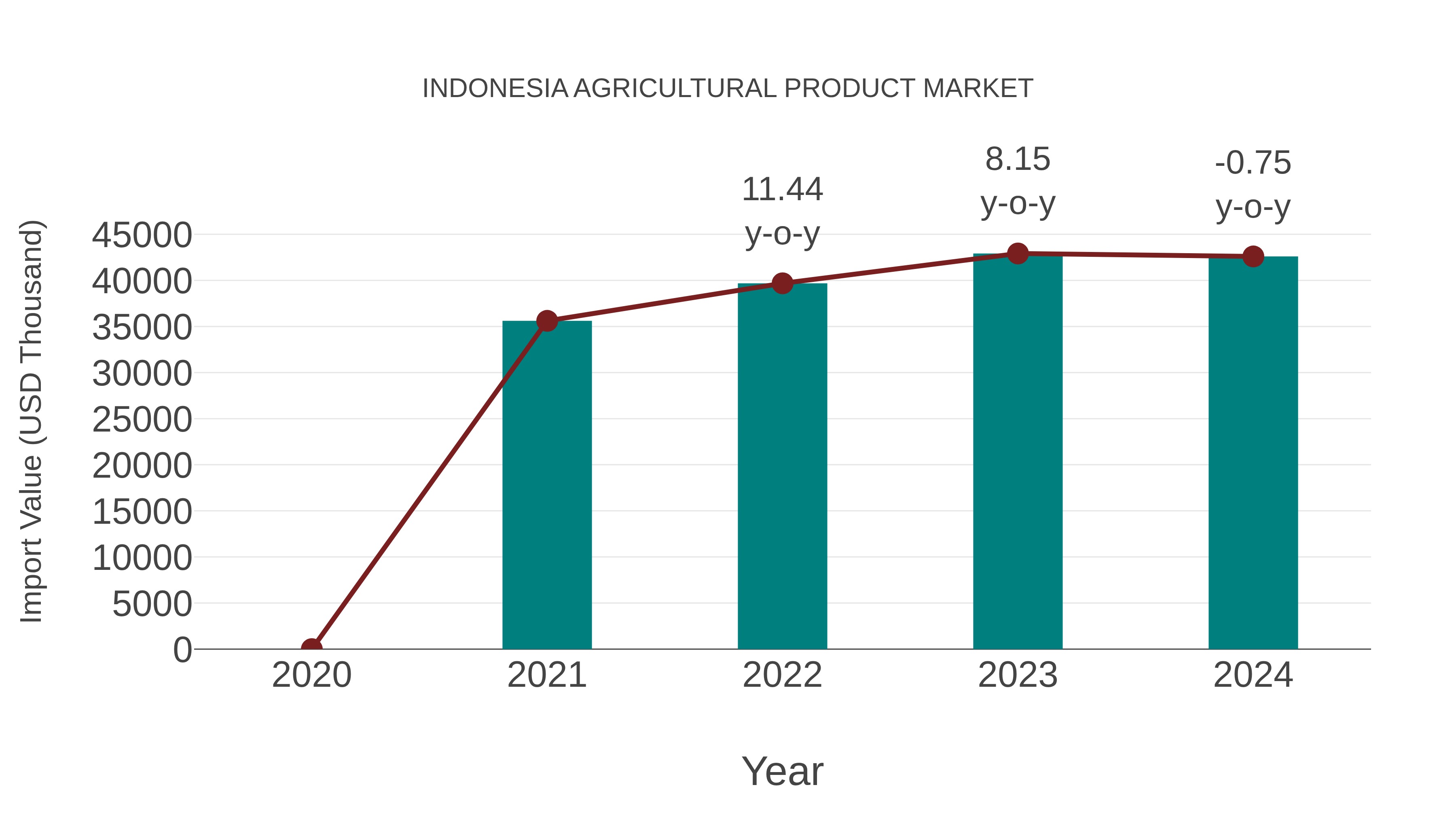
In the Indonesia agricultural product market, the import trend experienced a slight decline from 2023 to 2024, with a growth rate of -0.75%. However, the compound annual growth rate (CAGR) for the period 2020-2024 stood at a healthy 6.15%. This dip in import momentum could be attributed to shifts in demand patterns or evolving trade policies impacting market stability.
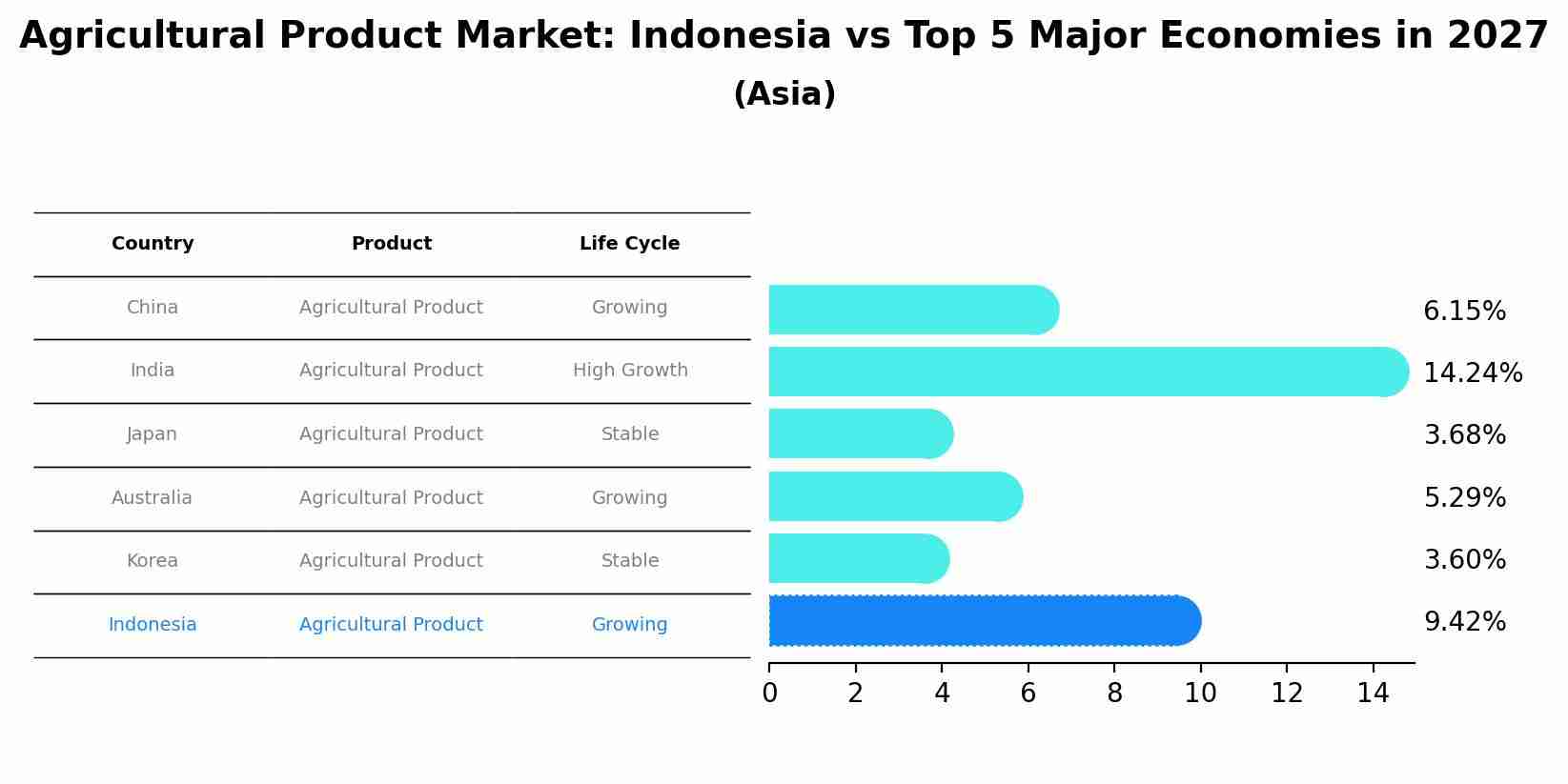
Agricultural Product Market: Indonesia vs Top 5 Major Economies in 2027 (Asia)
The Agricultural Product market in Indonesia is projected to grow at a growing growth rate of 9.42% by 2027, highlighting the country's increasing focus on advanced technologies within the Asia region, where China holds the dominant position, followed closely by India, Japan, Australia and South Korea, shaping overall regional demand.
Indonesia Agricultural Product Market Synopsis
The Indonesia Agricultural Product Market is vital to the nation`s economy, with agriculture being a significant contributor to GDP. The market outlook is influenced by various factors, including government policies, climate conditions, and global trade dynamics. The sector is diverse, encompassing a wide range of products such as rice, palm oil, rubber, and coffee. As Indonesia seeks to increase agricultural productivity and export potential, investments in infrastructure and technology are expected to drive growth in this sector. However, the market is also vulnerable to external factors like changing weather patterns and international trade regulations.
Drivers of the Market
The Indonesia Agricultural Product market is driven by several factors, including the country`s abundant natural resources, a large and growing population, and increasing demand for diverse food products. The government`s policies promoting agriculture, technological advancements, and investment in infrastructure further stimulate the sector. Climate change and weather patterns also play a significant role, affecting crop yields and prices. Additionally, global trade agreements and export opportunities contribute to the market`s outlook, making it essential for stakeholders to adapt to changing international standards and regulations.
Challenges of the Market
The agricultural product market in Indonesia faces numerous challenges. Climate change and extreme weather events can disrupt crop production and threaten food security. Smallholder farmers often lack access to modern farming technologies and financial resources, limiting their productivity. Land-use conflicts and deforestation pose environmental challenges. Additionally, ensuring fair pricing and distribution of agricultural products is an ongoing concern.
COVID-19 Impact on the Market
The agricultural product market saw mixed impacts during the pandemic. While food production remained essential and faced relatively minimal disruptions, the distribution and export of agricultural products were hindered by logistical challenges and changing global demand patterns. The shift towards e-commerce and direct-to-consumer sales also influenced market dynamics.
Key Players in the Market
Indonesia`s agricultural product market is diverse and competitive. Major players in this market include IndoAgro, SinarTani, and AgroMaju, which are engaged in the production and distribution of a wide range of agricultural products.
Key Highlights of the Report:
- Indonesia Agricultural Product Market Outlook
- Market Size of Indonesia Agricultural Product Market, 2025
- Forecast of Indonesia Agricultural Product Market, 2032
- Historical Data and Forecast of Indonesia Agricultural Product Revenues & Volume for the Period 2022-2032F
- Indonesia Agricultural Product Market Trend Evolution
- Indonesia Agricultural Product Market Drivers and Challenges
- Indonesia Agricultural Product Price Trends
- Indonesia Agricultural Product Porter's Five Forces
- Indonesia Agricultural Product Industry Life Cycle
- Historical Data and Forecast of Indonesia Agricultural Product Market Revenues & Volume By Type for the Period 2022-2032F
- Historical Data and Forecast of Indonesia Agricultural Product Market Revenues & Volume By Food for the Period 2022-2032F
- Historical Data and Forecast of Indonesia Agricultural Product Market Revenues & Volume By Fiber for the Period 2022-2032F
- Historical Data and Forecast of Indonesia Agricultural Product Market Revenues & Volume By Fuel for the Period 2022-2032F
- Historical Data and Forecast of Indonesia Agricultural Product Market Revenues & Volume By Raw Material for the Period 2022-2032F
- Historical Data and Forecast of Indonesia Agricultural Product Market Revenues & Volume By Application for the Period 2022-2032F
- Historical Data and Forecast of Indonesia Agricultural Product Market Revenues & Volume By Direct Consumption for the Period 2022-2032F
- Historical Data and Forecast of Indonesia Agricultural Product Market Revenues & Volume By Food & Fabrics for the Period 2022-2032F
- Historical Data and Forecast of Indonesia Agricultural Product Market Revenues & Volume By Construction & Paper Products for the Period 2022-2032F
- Historical Data and Forecast of Indonesia Agricultural Product Market Revenues & Volume By Others for the Period 2022-2032F
- Historical Data and Forecast of Indonesia Agricultural Product Market Revenues & Volume By Industry Vertical for the Period 2022-2032F
- Historical Data and Forecast of Indonesia Agricultural Product Market Revenues & Volume By Food & Nutrition for the Period 2022-2032F
- Historical Data and Forecast of Indonesia Agricultural Product Market Revenues & Volume By Sustainable Agribusiness for the Period 2022-2032F
- Historical Data and Forecast of Indonesia Agricultural Product Market Revenues & Volume By Production & Harvesting for the Period 2022-2032F
- Historical Data and Forecast of Indonesia Agricultural Product Market Revenues & Volume By Agribusiness Technological Inputs for the Period 2022-2032F
- Historical Data and Forecast of Indonesia Agricultural Product Market Revenues & Volume By Others for the Period 2022-2032F
- Indonesia Agricultural Product Import Export Trade Statistics
- Market Opportunity Assessment By Type
- Market Opportunity Assessment By Application
- Market Opportunity Assessment By Industry Vertical
- Indonesia Agricultural Product Top Companies Market Share
- Indonesia Agricultural Product Competitive Benchmarking By Technical and Operational Parameters
- Indonesia Agricultural Product Company Profiles
- Indonesia Agricultural Product Key Strategic Recommendations






































