Indonesia AI in Telecommunication Market Size & Growth Rate (2026-2032)
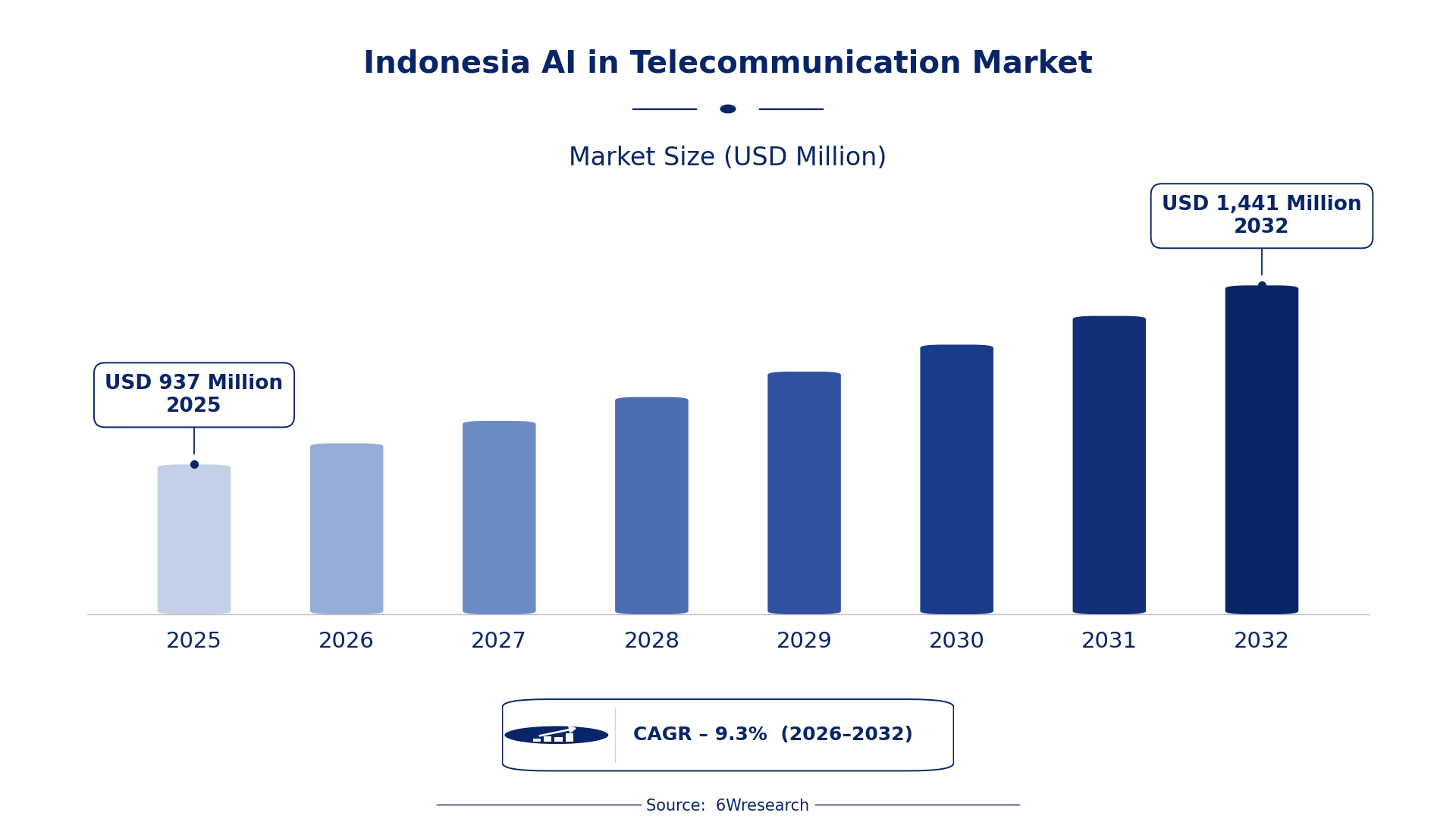
The Indonesia AI in Telecommunication Market was estimated at USD 937 Million in 2025 and is projected to reach USD 1441 Million by 2032, growing at a CAGR of 9.3% from 2026 to 2032.
Indonesia AI in Telecommunication Market Synopsis
The rising need for advanced network management and customer engagement solutions is driving the adoption of AI technologies within Indonesia's telecommunications sector. Telecom operators are increasingly leveraging AI to enhance operational efficiency, streamline customer interactions, and deliver tailored services that meet evolving consumer demands.
With an expanding digital economy and a surge in mobile connectivity, AI applications are becoming vital for telecom companies aiming to maintain competitive advantages. The integration of AI tools not only optimizes network performance but also provides predictive insights that enable timely responses to market fluctuations.
Indonesia AI in Telecommunication Market Year-wise Growth Rate and Key Drivers
This graph illustrates the annual growth rates of the Indonesia AI in Telecommunication Market from 2021 to 2032, highlighting a steady upward trajectory and projected expansion over the forecast period.
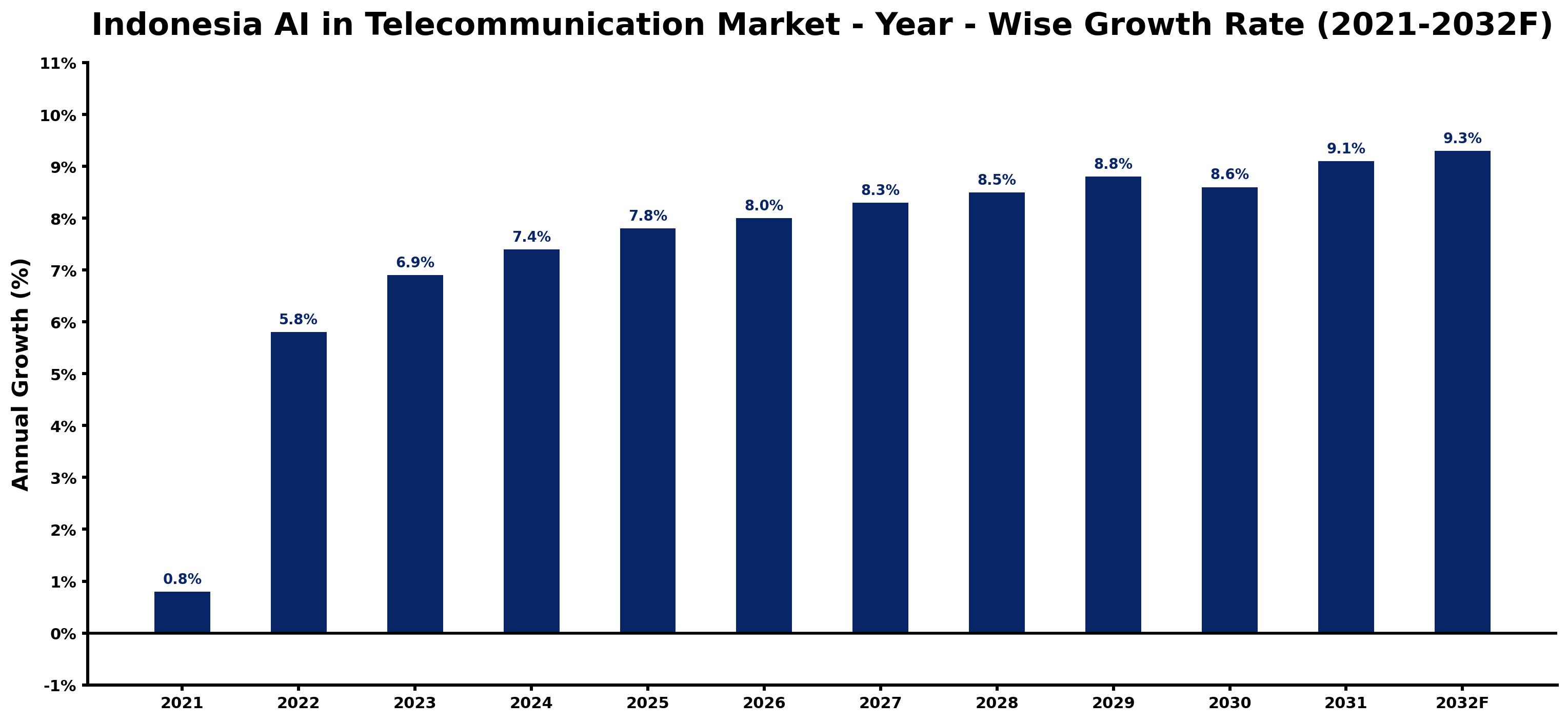
The table below presents the year‑wise growth rates along with the key drivers influencing the market
| Year | Growth Rate | Major Drivers |
| 2021 | 0.8% | Rapid mobile internet adoption by urban populations. |
| 2022 | 5.8% | Government support for AI startups in telecommunications. |
| 2023 | 6.9% | Local telecom operators investing in AI-driven customer service. |
| 2024 | 7.4% | Increased competition pushing AI innovations in telecom. |
| 2025 | 7.8% | Growing smartphone penetration facilitating AI communication tools. |
| 2026 | 8.0% | Partnerships between telecom firms and AI tech companies. |
| 2027 | 8.3% | Regulatory approvals for AI-based network optimization technologies. |
| 2028 | 8.5% | Rising consumer demand for personalized telecom services. |
| 2029 | 8.8% | Investment in smart infrastructure boosting AI applications. |
| 2030 | 8.6% | Enhancements in mobile applications utilizing AI functionalities. |
| 2031 | 9.1% | Local telecoms leveraging big data analytics for AI. |
| 2032 | 9.3% | Increasing government initiatives promoting digital transformation. |
Note: Market size estimations and growth projections presented in this report are based on 6Wresearch's proprietary forecasting methodology, utilizing the latest available industry data, government publications, and primary research inputs.
Indonesia AI in Telecommunication Market Key Takeaways
Below are some of the specific key takeaways from the market, including:
- AI is essential for enhancing customer experience and operational efficiency in the telecom sector.
- The market is experiencing growth driven by the demand for personalized services and improved network management.
- Regulatory compliance poses challenges for the integration of AI technologies.
- The COVID-19 pandemic highlighted the importance of AI in managing increased data traffic and network stability.
- Investment in AI infrastructure will significantly shape the future of telecom services in Indonesia.
Evaluation of Restraints in Indonesia AI in Telecommunication Market
Despite the promising outlook, the market is hindered by regulatory complexities that challenge operators in implementing AI technologies. Adherence to strict data privacy laws adds layers of difficulty when managing customer information. Additionally, the initial investment required for AI systems can be substantial, causing some companies to hesitate before fully committing to these innovations. As operators strive to balance innovation with compliance, the interplay between technology deployment and regulatory frameworks will play a significant role in shaping the market's trajectory.
Indonesia AI in Telecommunication Market Trends
In the Indonesian telecom sector, a key trend is the increasing use of AI-driven analytics to support decision-making. Operators are focusing on real-time data processing capabilities to enhance customer support and predict network issues before they arise. Additionally, the rise of 5G technology is pushing the boundaries for AI applications, as the need for higher data speeds and reliability becomes paramount.
Another notable trend is the growing adoption of chatbots and virtual assistants to handle customer inquiries, freeing up human resources for more complex issues. As these technologies evolve, they are expected to improve service delivery and customer satisfaction significantly.
Indonesia AI in Telecommunication Market Opportunities
Significant opportunities lie in developing AI solutions tailored for predictive maintenance and real-time monitoring of telecom infrastructure. By investing in such technologies, companies can not only enhance network reliability but also reduce operational costs. Furthermore, collaborative initiatives between telecom operators and tech companies can lead to innovative service offerings that appeal to the digitally savvy consumer base in Indonesia.
Government Initiatives in the Indonesia AI in Telecommunication Market
The Indonesian government is actively fostering an environment conducive to AI integration within the telecommunications sector. This support is crucial as it lays the groundwork for technological advancements and regulatory frameworks that can facilitate innovation. Recent policy developments reflect the government's commitment to enhancing digital infrastructure and ensuring compliance with global standards, ultimately aiming to propel the telecommunications industry forward.
- A recently completed national digital infrastructure upgrade programme aimed at improving connectivity across rural and urban areas.
- Currently ongoing initiatives to create a regulatory framework addressing AI ethics and data privacy, ensuring a secure environment for consumers.
- Planned public-private partnerships expected to expand access to telecom services in underserved regions by 2028.
- A new policy directive introduced in 2025 focusing on fostering innovation in AI technologies within the telecommunications space.
- Support programs for telecom operators to implement AI solutions while meeting regulatory compliance standards.
Future Insights of the Indonesia AI in Telecommunication Market
Looking ahead, the Indonesian AI in Telecommunication Market is on a trajectory of robust growth driven by increasing digitalization and the demand for enhanced telecom services. By 2032, the market will likely reflect a matured integration of AI technologies, fostering an environment where operators can rapidly adapt to changing consumer preferences. Innovations in AI will not only streamline operations but also pave the way for new service models that redefine customer engagement.
Indonesia AI in Telecommunication Market Latest Developments
Recent developments in the Indonesia AI in Telecommunication Market reflect a surge in activity as companies adapt to emerging trends and consumer needs. The past year has seen operators intensifying efforts to harness AI capabilities, leading to exciting advancements in customer engagement and network management.
- A leading regional operator launched an AI-driven customer service platform in early 2025, enhancing support response times significantly.
- In mid-2025, a major technology vendor began an ongoing project to implement predictive maintenance systems across several telecom networks.
- Plans for an AI application that will optimize resource allocation are set to begin rollout in the second half of 2026.
- A partnership between a local telecom firm and a global AI company, initiated in Q1 2025, focuses on developing smart solutions for network resilience.
- A recent initiative aimed at improving data analytics capabilities within telecom operations is currently underway, with expected completion by late 2025.
Indonesia AI in Telecommunication Market - Key Attractiveness of the Report
- 10 Years of Market Numbers
- Historical Data Starting from 2022 to 2025
- Base Year: 2025
- Forecast Data until 2032
- Key Performance Indicators Impacting the Market
- Major Upcoming Developments and Projects
Key Highlights of the Report:
- Indonesia AI in Telecommunication Market Outlook
- Market Size of Indonesia AI in Telecommunication Market, 2025
- Forecast of Indonesia AI in Telecommunication Market, 2032
- Historical Data and Forecast of Indonesia AI in Telecommunication Revenues & Volume for the Period 2022-2032F
- Indonesia AI in Telecommunication Market Trend Evolution
- Indonesia AI in Telecommunication Market Drivers and Challenges
- Indonesia AI in Telecommunication Price Trends
- Indonesia AI in Telecommunication Porter's Five Forces
- Indonesia AI in Telecommunication Industry Life Cycle
- Historical Data and Forecast of Indonesia AI in Telecommunication Market Revenues & Volume By Application for the Period 2022-2032F
- Historical Data and Forecast of Indonesia AI in Telecommunication Market Revenues & Volume By Customer analytics for the Period 2022-2032F
- Historical Data and Forecast of Indonesia AI in Telecommunication Market Revenues & Volume By Network security for the Period 2022-2032F
- Historical Data and Forecast of Indonesia AI in Telecommunication Market Revenues & Volume By Network optimization for the Period 2022-2032F
- Historical Data and Forecast of Indonesia AI in Telecommunication Market Revenues & Volume By Self-diagnostics for the Period 2022-2032F
- Historical Data and Forecast of Indonesia AI in Telecommunication Market Revenues & Volume By Virtual assistance for the Period 2022-2032F
- Historical Data and Forecast of Indonesia AI in Telecommunication Market Revenues & Volume By Others (contact center analytics and marketing campaign analytics) for the Period 2022-2032F
- Historical Data and Forecast of Indonesia AI in Telecommunication Market Revenues & Volume By Component for the Period 2022-2032F
- Historical Data and Forecast of Indonesia AI in Telecommunication Market Revenues & Volume By Solutions for the Period 2022-2032F
- Historical Data and Forecast of Indonesia AI in Telecommunication Market Revenues & Volume By Services for the Period 2022-2032F
- Historical Data and Forecast of Indonesia AI in Telecommunication Market Revenues & Volume By Deployment Mode for the Period 2022-2032F
- Historical Data and Forecast of Indonesia AI in Telecommunication Market Revenues & Volume By Cloud for the Period 2022-2032F
- Historical Data and Forecast of Indonesia AI in Telecommunication Market Revenues & Volume By On-premises for the Period 2022-2032F
- Historical Data and Forecast of Indonesia AI in Telecommunication Market Revenues & Volume By Technology for the Period 2022-2032F
- Historical Data and Forecast of Indonesia AI in Telecommunication Market Revenues & Volume By Machine learning and deep learning for the Period 2022-2032F
- Historical Data and Forecast of Indonesia AI in Telecommunication Market Revenues & Volume By Natural Language Processing (NLP) for the Period 2022-2032F
- Indonesia AI in Telecommunication Import Export Trade Statistics
- Market Opportunity Assessment By Application
- Market Opportunity Assessment By Component
- Market Opportunity Assessment By Deployment Mode
- Market Opportunity Assessment By Technology
- Indonesia AI in Telecommunication Top Companies Market Share
- Indonesia AI in Telecommunication Competitive Benchmarking By Technical and Operational Parameters
- Indonesia AI in Telecommunication Company Profiles
- Indonesia AI in Telecommunication Key Strategic Recommendations






































