Indonesia Air Traffic Control (ATC) Equipment Market Size, Share & Growth Rate
The Indonesia Air Traffic Control (ATC) Equipment Market was estimated at USD 1253 Million in 2025 and is projected to reach USD 1915 Million by 2032, growing at a CAGR of 6.2% from 2026 to 2032. This growth trajectory is primarily driven by the increasing demand for air travel, which has surged due to Indonesia's strategic position as a key hub in Southeast Asia. As the number of airports continues to expand and modernize, there is an escalating need for sophisticated ATC systems that can efficiently manage rising air traffic levels.
Indonesia Air Traffic Control (ATC) Equipment Market Year-wise Growth Rate and Key Drivers
This graph highlights how the Indonesia Air Traffic Control (ATC) Equipment Market has steadily grown over the years, supported by major growth factors.
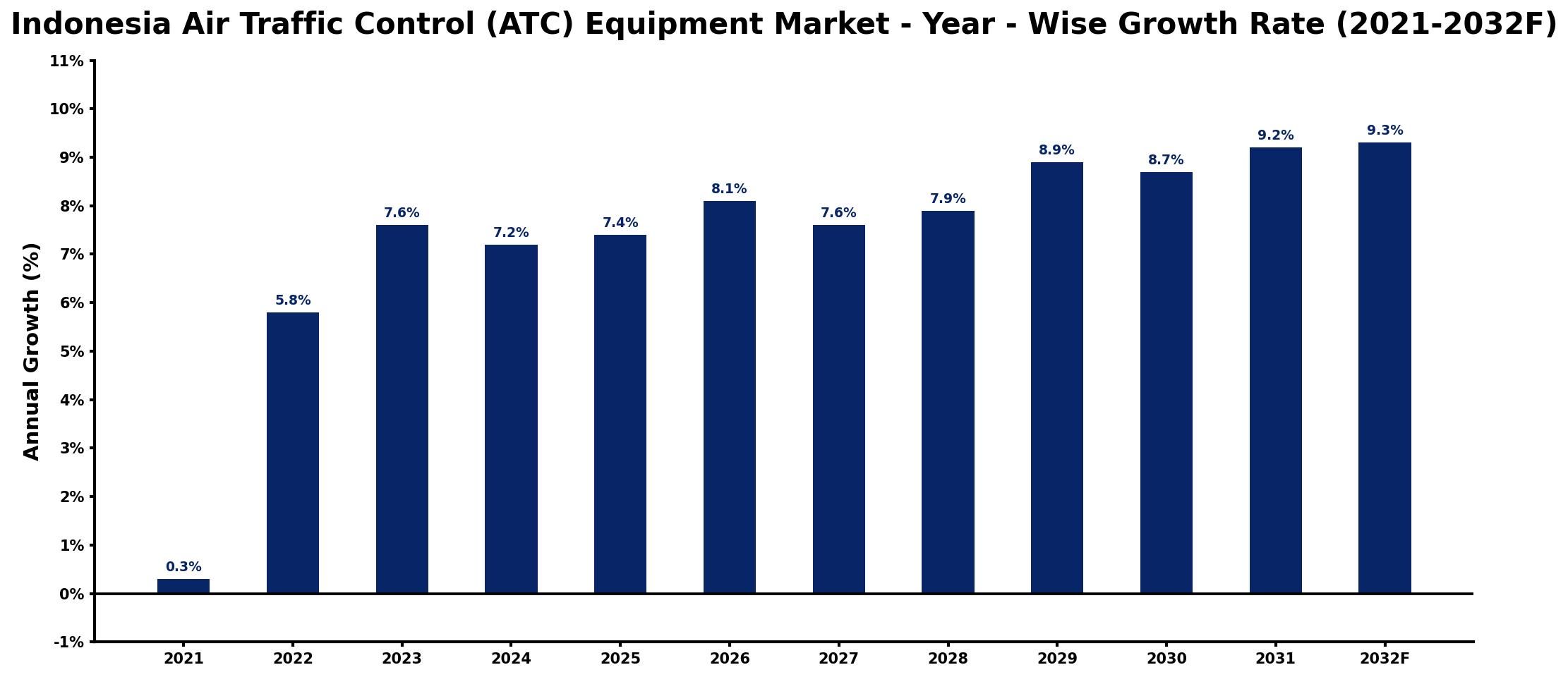
The table below presents the year‑wise growth rates along with the key drivers influencing the market
| Year | Growth Rate | Major Drivers |
| 2021 | 0.3% | Rising aviation passenger numbers |
| 2022 | 5.8% | Government infrastructure investment initiatives |
| 2023 | 7.6% | rising export shipment volumes |
| 2024 | 7.2% | rising end-use demand growth |
| 2025 | 7.4% | Technological advancements in navigation |
| 2026 | 8.1% | Growing demand for efficient operations |
| 2027 | 7.6% | expanding healthcare application demand |
| 2028 | 7.9% | Emerging aviation market opportunities |
| 2029 | 8.9% | Rising demand for modernization projects |
| 2030 | 8.7% | Expansion of international flight routes |
| 2031 | 9.2% | Strengthening regional trade agreements |
| 2032 | 9.3% | Innovations in flight management systems |
Note: Market size estimations and growth projections presented in this report are based on 6Wresearch's proprietary forecasting methodology, utilizing the latest available industry data, government publications, and primary research inputs.
Indonesia Air Traffic Control (ATC) Equipment Market Synopsis
The foremost force shaping the Indonesia Air Traffic Control Equipment Market today is the booming air travel sector. As both domestic and international flights increase, the urgency for advanced ATC solutions has never been more pressing. This demand not only emphasizes the need for cutting-edge technology but also ensures that safety and efficiency remain paramount in air traffic management.
In addition to growing passenger numbers, the Indonesian governments commitment to upgrading its aviation infrastructure significantly impacts the market. Investments are being funneled into modernizing existing ATC systems and establishing new facilities to support air traffic, thereby positioning Indonesia for future aviation growth.
Indonesia Air Traffic Control (ATC) Equipment Market Key Takeaways
- The market is poised for substantial growth, with a projected CAGR of 6.2% from 2026 to 2032.
- Increased air travel demand due to Indonesia's strategic position as a Southeast Asian hub is a primary growth driver.
- Modernization of airports and ATC systems is essential for managing rising air traffic efficiently.
- Geographical challenges related to Indonesias archipelago nature complicate ATC system implementation.
- Cybersecurity threats pose significant risks to the integrity of ATC systems, necessitating robust security measures.
Evaluation of Restraints in Indonesia Air Traffic Control (ATC) Equipment Market
The Indonesia Air Traffic Control Equipment Market faces several notable restraints. Firstly, the rapid increase in air traffic stemming from both tourism and economic growth has stretched the existing ATC infrastructure. While there is an urgent need for technological upgrades, limited budget allocations often hinder timely advancements. Furthermore, Indonesias unique geography—an extensive archipelago with varied terrains—complicates effective coverage and communication, adding layers of difficulty to the development and deployment of ATC systems. Cybersecurity issues further exacerbate these challenges, as the critical nature of ATC operations requires stringent security measures that can often be resource-intensive.
Indonesia Air Traffic Control (ATC) Equipment Market Trends
Emerging trends in the Indonesia Air Traffic Control Equipment Market include a significant shift toward automation and digitalization in ATC systems. This trend is essential to handle the increasing complexity of air traffic and enhance operational efficiencies. Additionally, there is a growing focus on integrating advanced radar systems and enhanced communication technologies to improve real-time tracking and data-sharing capabilities. The adoption of innovative navigation aids is also on the rise as stakeholders aim to enhance safety and operational reliability.
Indonesia Air Traffic Control (ATC) Equipment Market Opportunities
As the market evolves, several genuine growth opportunities have emerged. With the forecasted increase in air traffic, investment in modern ATC technologies will become critical. Companies that can provide solutions tailored to Indonesias specific geographical and regulatory challenges are poised to capitalize on this demand. Additionally, as the aviation sector recovers post-COVID-19, there will be renewed investment in infrastructure, providing fertile ground for expanding ATC equipment offerings.
Government Initiatives in the Indonesia Air Traffic Control (ATC) Equipment Market
The Indonesian government has launched various initiatives aimed at bolstering the aviation sector, which directly influences the ATC equipment market. These initiatives include policies focused on the modernization of existing airports and the establishment of new aviation hubs to improve connectivity. Furthermore, public funding is being allocated to upgrade ATC systems in accordance with international safety standards, enhancing overall air traffic management capabilities throughout the archipelago.
Future Insights of the Indonesia Air Traffic Control (ATC) Equipment Market
Looking ahead to the period from 2026 to 2032, the Indonesia Air Traffic Control Equipment Market is set for transformative growth. As air traffic continues to rise, the demand for advanced ATC equipment will intensify, driving significant investments in new technologies. The market is likely to embrace innovative solutions that address the dual challenges of expanding air traffic and ensuring safety. Key developments will focus on integrating smart technologies and enhancing resilience against cybersecurity threats, positioning Indonesia as a leader in the regional aviation landscape.
Indonesia Air Traffic Control (ATC) Equipment Market Latest Developments (2025 - 2026)
The industry is currently witnessing a wave of advancements aimed at enhancing air traffic management efficiency. Ongoing projects focus on the integration of state-of-the-art radar systems, which are designed to provide better coverage and accuracy across the diverse terrains of Indonesia. Moreover, ongoing collaborations between government entities and technology providers are leading to significant strides in automation and digital solutions in ATC operations, further propelling the sector toward modernized air traffic management.
Indonesia Air Traffic Control (ATC) Equipment Market - Key Attractiveness of the Report
- 10 Years of Market Numbers
- Historical Data Starting from 2022 to 2025
- Base Year: 2025
- Forecast Data until 2032
- Key Performance Indicators Impacting the Market
- Major Upcoming Developments and Projects
Key Highlights of the Report:
- Indonesia Air Traffic Control (ATC) Equipment Market Outlook
- Market Size of Indonesia Air Traffic Control (ATC) Equipment Market, 2025
- Forecast of Indonesia Air Traffic Control (ATC) Equipment Market, 2032
- Historical Data and Forecast of Indonesia Air Traffic Control (ATC) Equipment Revenues & Volume for the Period 2022-2032F
- Indonesia Air Traffic Control (ATC) Equipment Market Trend Evolution
- Indonesia Air Traffic Control (ATC) Equipment Market Drivers and Challenges
- Indonesia Air Traffic Control (ATC) Equipment Price Trends
- Indonesia Air Traffic Control (ATC) Equipment Porter's Five Forces
- Indonesia Air Traffic Control (ATC) Equipment Industry Life Cycle
- Historical Data and Forecast of Indonesia Air Traffic Control (ATC) Equipment Market Revenues & Volume By Product for the Period 2022-2032F
- Historical Data and Forecast of Indonesia Air Traffic Control (ATC) Equipment Market Revenues & Volume By Communications Equipment for the Period 2022-2032F
- Historical Data and Forecast of Indonesia Air Traffic Control (ATC) Equipment Market Revenues & Volume By Navigation Equipment for the Period 2022-2032F
- Historical Data and Forecast of Indonesia Air Traffic Control (ATC) Equipment Market Revenues & Volume By Surveillance Equipment for the Period 2022-2032F
- Historical Data and Forecast of Indonesia Air Traffic Control (ATC) Equipment Market Revenues & Volume By Air Traffic Control Equipment Application Outlook (USD Million, 2023-2032) for the Period 2022-2032F
- Historical Data and Forecast of Indonesia Air Traffic Control (ATC) Equipment Market Revenues & Volume By Commercial Aircraft for the Period 2022-2032F
- Historical Data and Forecast of Indonesia Air Traffic Control (ATC) Equipment Market Revenues & Volume By Private Aircraft for the Period 2022-2032F
- Historical Data and Forecast of Indonesia Air Traffic Control (ATC) Equipment Market Revenues & Volume By Military Aircraft for the Period 2022-2032F
- Indonesia Air Traffic Control (ATC) Equipment Import Export Trade Statistics
- Market Opportunity Assessment By Product
- Indonesia Air Traffic Control (ATC) Equipment Top Companies Market Share
- Indonesia Air Traffic Control (ATC) Equipment Competitive Benchmarking By Technical and Operational Parameters
- Indonesia Air Traffic Control (ATC) Equipment Company Profiles
- Indonesia Air Traffic Control (ATC) Equipment Key Strategic Recommendations






































