Indonesia Aviation Market Size, Share & Growth Rate
The Indonesia Aviation Market was estimated at USD 396 Million in 2025 and is projected to reach USD 522 Million by 2032, growing at a CAGR of 4.0% from 2026 to 2032. This growth trajectory is primarily fueled by the burgeoning middle class and the increasing demand for both domestic and international travel. As air travel becomes more accessible, the market is also benefiting from robust government investment in aviation infrastructure and the expansion of airline fleets to accommodate rising passenger numbers.
Indonesia Aviation Market Year-wise Growth Rate and Key Drivers
This graph highlights how the Indonesia Aviation Market has steadily grown over the years, supported by major growth factors.
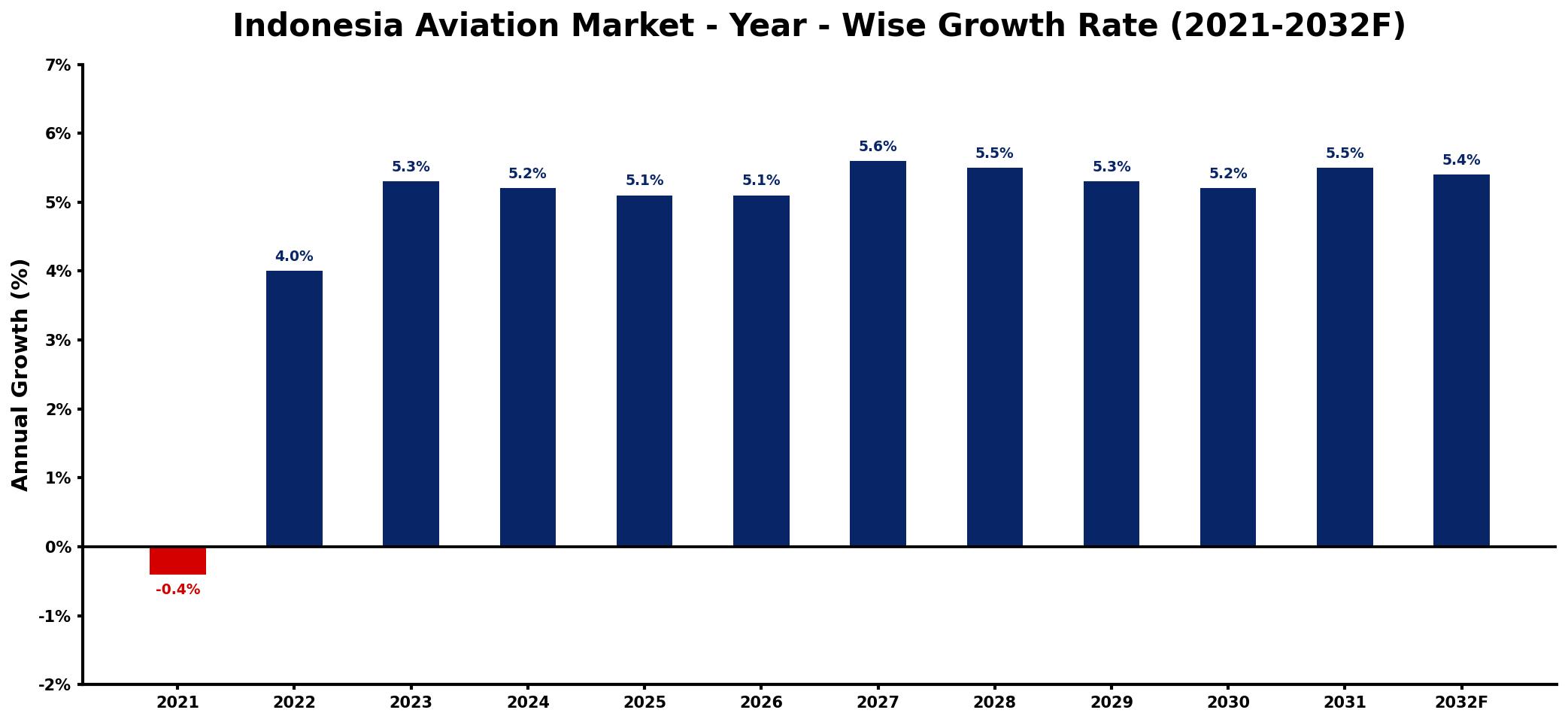
The table below presents the year‑wise growth rates along with the key drivers influencing the market
| Year | Growth Rate | Major Drivers |
| 2021 | -0.4% | Travel restrictions impact passenger demand |
| 2022 | 4.0% | Increase in domestic travel demand |
| 2023 | 5.3% | Rise in international tourism arrivals |
| 2024 | 5.2% | Expansion of fleet capacities |
| 2025 | 5.1% | Growth in low-cost carriers |
| 2026 | 5.1% | New routes enhance connectivity options |
| 2027 | 5.6% | Investment in airport infrastructure upgrades |
| 2028 | 5.5% | Partnerships boost regional travel services |
| 2029 | 5.3% | Technological advancements improve efficiency |
| 2030 | 5.2% | Sustainability initiatives attract investments |
| 2031 | 5.5% | Growing middle class drives travel |
| 2032 | 5.4% | Enhanced digital services improve experience |
Note: Market size estimations and growth projections presented in this report are based on 6Wresearch's proprietary forecasting methodology, utilizing the latest available industry data, government publications, and primary research inputs.
Indonesia Aviation Market Synopsis
Indonesia's vast archipelago, comprising over 17,000 islands, necessitates a robust air transport system to ensure efficient connectivity. Major cities such as Jakarta, Bali, and Surabaya are evolving into crucial hubs for both domestic and international flights, highlighting the importance of the aviation sector in the countrys economic development.
With the surge in tourism, the demand for air travel is experiencing unprecedented growth. Notably, the rise of low-cost carriers has democratized air travel, making it accessible for a larger segment of the population and driving increased frequency of flights across various routes.
Indonesia Aviation Market Key Takeaways
- The aviation market is integral to Indonesias connectivity and economic development.
- Government investments in airport infrastructure are set to enhance operational capacity and efficiency.
- Advancements in aircraft technology are being prioritized to meet sustainability goals.
- The rise of low-cost carriers is expanding the market reach and increasing passenger volumes.
- Robust growth is anticipated, supported by a combination of rising middle-class income and tourism influx.
Evaluation of Restraints in Indonesia Aviation Market
Despite its growth potential, the Indonesia aviation market grapples with significant infrastructure challenges. Many airports are under pressure to meet international standards in both capacity and safety protocols. Additionally, safety concerns regarding air traffic control and aircraft maintenance continue to necessitate ongoing improvements. Fluctuating fuel prices and the lingering effects of global events further complicate the industry's recovery and growth trajectory.
Indonesia Aviation Market Trends
Current trends in the Indonesia aviation market include the increasing integration of technology to enhance operational efficiency and passenger experience. The industry's pivot towards sustainable aviation practices is gaining momentum, driven by global climate concerns and regulatory pressures. Additionally, the growing prominence of online travel agencies is reshaping booking behaviors, allowing consumers to easily compare and select travel options.
Indonesia Aviation Market Opportunities
Opportunities for growth within the Indonesia aviation market are vast. The governments commitment to expanding airport infrastructure opens doors for investment in new terminals and modernization projects. Furthermore, the projected rise in both domestic tourism and international travelers offers lucrative prospects for airlines looking to expand their route networks. Innovations in fuel-efficient and eco-friendly aircraft also present a significant area for investment and development.
Government Initiatives in the Indonesia Aviation Market
The Indonesian government is actively supporting the aviation sector through various initiatives aimed at enhancing infrastructure and regulatory frameworks. Public spending on upgrading airports and air traffic management systems is a key focus, alongside programs designed to improve safety and operational efficiency. Initiatives promoting tourism further bolster the aviation market, aligning with national economic growth strategies.
Future Insights of the Indonesia Aviation Market
Looking ahead to 2026-2032, the Indonesia aviation market is poised for dynamic growth driven by rising disposable incomes and a burgeoning travel culture. As the industry recovers from the impacts of the pandemic, advancements in aircraft technology, including sustainability initiatives, will redefine operational standards. The market is expected to increasingly embrace digital transformation, enhancing customer engagement and streamlining airline operations.
Indonesia Aviation Market Latest Developments (2025 - 2026)
Recent developments in the Indonesia aviation industry highlight a strategic focus on fleet expansion and modernization efforts. Initiatives are being launched to attract foreign investment, aiming to bolster the countrys standing as a regional aviation hub. Additionally, partnerships between airlines and technology firms are emerging to drive innovations in customer service and operational efficiency, reflecting a shift towards a more competitive market environment.
Indonesia Aviation Market - Key Attractiveness of the Report
- 10 Years of Market Numbers
- Historical Data Starting from 2022 to 2025
- Base Year: 2025
- Forecast Data until 2032
- Key Performance Indicators Impacting the Market
- Major Upcoming Developments and Projects
Key Highlights of the Report:
- Indonesia Aviation Market Outlook
- Market Size of Indonesia Aviation Market, 2025
- Forecast of Indonesia Aviation Market, 2032
- Historical Data and Forecast of Indonesia Aviation Revenues & Volume for the Period 2022-2032F
- Indonesia Aviation Market Trend Evolution
- Indonesia Aviation Market Drivers and Challenges
- Indonesia Aviation Price Trends
- Indonesia Aviation Porter's Five Forces
- Indonesia Aviation Industry Life Cycle
- Historical Data and Forecast of Indonesia Aviation Market Revenues & Volume By Type for the Period 2022-2032F
- Historical Data and Forecast of Indonesia Aviation Market Revenues & Volume By Commercial Aviation for the Period 2022-2032F
- Historical Data and Forecast of Indonesia Aviation Market Revenues & Volume By Military Aviation for the Period 2022-2032F
- Historical Data and Forecast of Indonesia Aviation Market Revenues & Volume By General Aviation for the Period 2022-2032F
- Indonesia Aviation Import Export Trade Statistics
- Market Opportunity Assessment By Type
- Indonesia Aviation Top Companies Market Share
- Indonesia Aviation Competitive Benchmarking By Technical and Operational Parameters
- Indonesia Aviation Company Profiles
- Indonesia Aviation Key Strategic Recommendations






































