Indonesia Bricks and Blocks Market Summary
The indonesia bricks and blocks market was estimated at USD 159 Million in 2025 and is projected to reach USD 211 Million by 2032, growing at a CAGR of 5.1% from 2026 to 2032.
Indonesia Bricks and Blocks Market Year-wise Growth Rate and Key Drivers
This graph highlights how the Indonesia Bricks and Blocks Market has steadily grown over the past five years, supported by major growth factors.
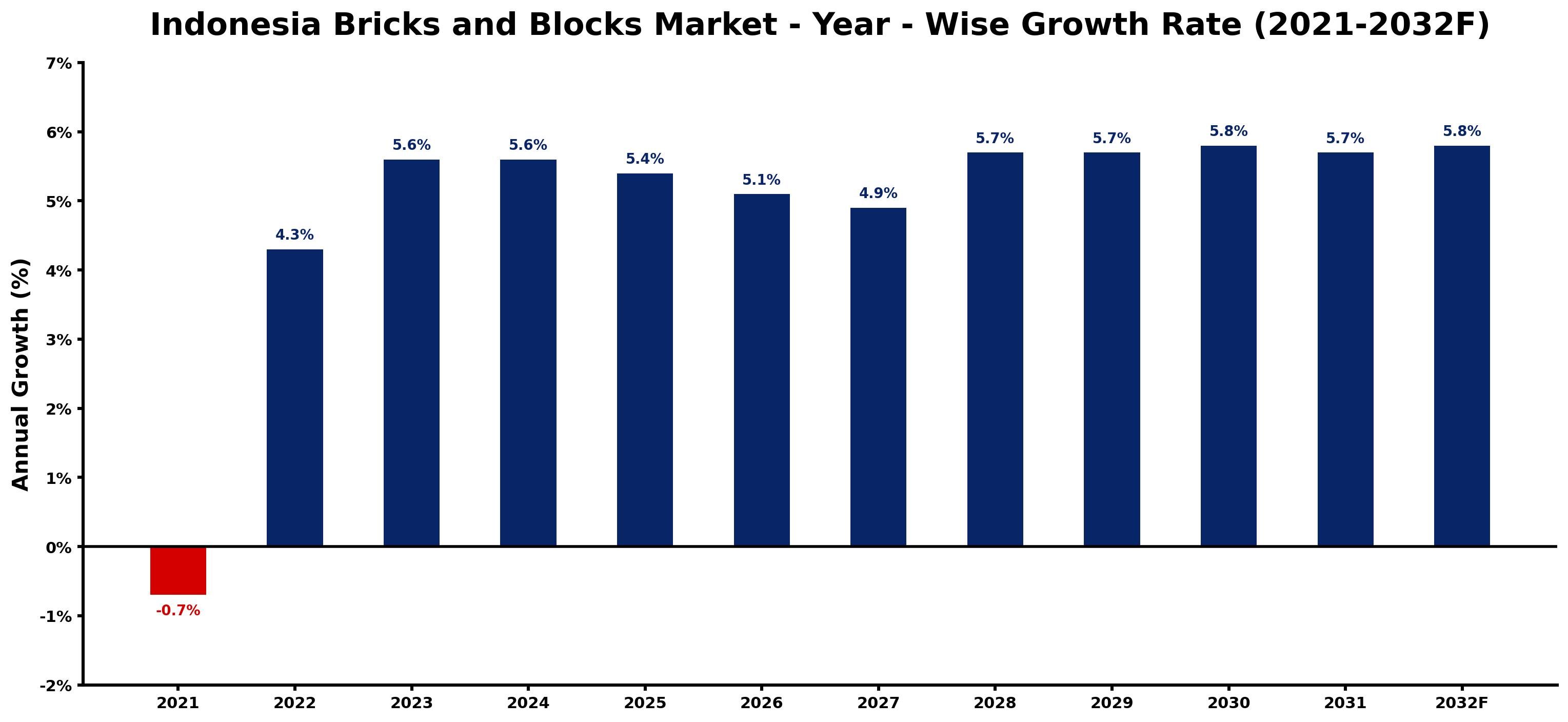
The table below presents the year wise growth rates along with the key drivers influencing the market
| Year | Growth Rate | Major Drivers |
| 2021 | -0.7% | Increased competition from alternative building materials diminished demand for traditional bricks and blocks in construction. |
| 2022 | 4.3% | Rising urbanization trends encouraged more residential projects across major Indonesian cities. |
| 2023 | 5.6% | Focus on affordable housing has spurred local manufacturers to innovate cost-effective solutions. |
| 2024 | 5.6% | Infrastructure developments, such as highways and bridges, significantly expanded brick and block consumption. |
| 2025 | 5.4% | Environmental considerations led to greater interest in sustainable materials and practices. |
| 2026 | 5.1% | Investment in smart city projects created opportunities for advanced construction techniques. |
| 2027 | 4.9% | Collaborations between local firms and international partners enhanced market competitiveness. |
| 2028 | 5.7% | Technological advancements in manufacturing processes improved product quality and efficiency. |
| 2029 | 5.7% | Consumer preferences shifted towards eco-friendly materials, driving innovation in block production. |
| 2030 | 5.8% | Rural development initiatives increased demand for bricks in less urbanized areas. |
| 2031 | 5.7% | Real estate market fluctuations prompted construction firms to optimize resource allocation. |
| 2032 | 5.8% | Regional trade agreements facilitated easier access to advanced building technologies and materials. |
Note - Market size estimations and growth projections presented in this report are based on 6Wresearch's advanced forecasting approach, validated with industry datasets as of June 2026.
Indonesia Bricks and Blocks Market Synopsis
The Indonesia Bricks and Blocks Market is projected to reach 5.1% and witness significant growth during the forecast period (2026-2032). The market is anticipated to grow at a compound annual growth rate (CAGR) of 3.4% during this period, driven by increasing construction activities in response to both residential and non-residential demands. The historical significance of bricks as one of the oldest building materials continues to resonate in modern construction due to their inherent strength and durability, making them ideal for various structural applications such as walls, columns, footings, and chimneys.
Indonesia Bricks and Blocks Market Growth Drivers
Several key factors are propelling growth in the Indonesia bricks and blocks market. Rapid urbanization and a rising population are pushing the demand for infrastructure development across the country. This surge in demand for construction correlates strongly with an increased requirement for bricks and blocks. The following points highlight the significant drivers:
- The growing population in Indonesia necessitates substantial residential housing developments, making bricks an essential building material.
- Urbanization trends increase demand for commercial buildings, schools, and hospitals, further boosting consumption of bricks and blocks.
- Government initiatives aimed at providing affordable housing solutions, such as the 'One Million Houses' program, are expected to stimulate market growth.
- Clay bricks are preferred for low-cost housing projects due to their superior earthquake resistance compared to traditional materials like stones or concrete blocks.
- Contractors and builders favor bricks for their cost-effectiveness, ensuring that housing projects remain within budget while maximizing durability.
Indonesia Bricks and Blocks Market Challenges and Restraints
While there are numerous opportunities for growth in the Indonesia bricks and blocks market, several challenges may impede its expansion. The reliance on brick production methods, which often involve burning coal or wood, generates harmful emissions that require stringent regulations to mitigate environmental impacts. The key challenges include:
- The production process for bricks creates toxic gases, necessitating regulation that may increase operational costs for manufacturers.
- Installation of bricks and blocks generally demands specialized equipment and skilled labor, rendering them less suitable for small-scale construction projects.
- High installation costs can deter consumers, particularly in cost-sensitive markets where budget constraints are paramount.
- Environmental concerns over emissions can lead to public opposition against brick production, complicating planning and permitting processes for new facilities.
- Shifts towards alternative construction materials that offer quicker installation and lower environmental impact can challenge traditional brick usage.
Indonesia Bricks and Blocks Market Government Investment and Initiatives
The Indonesian government has been proactive in enhancing the infrastructure landscape, significantly influencing the bricks and blocks market. Various public spending initiatives and development plans aim to bolster the construction sector. Key investments and initiatives include:
- Government housing programs aimed at achieving the target of building one million houses by 2030 will create a robust demand for bricks and blocks.
- Public infrastructure projects, including roads and bridges, are supported through government funding, increasing the need for durable building materials.
- Regulatory frameworks are being established to promote sustainable practices in brick production, helping to curb environmental impacts.
- Government incentives for eco-friendly construction practices encourage the development of innovative brick materials that reduce emissions during production.
- Collaboration with private sector stakeholders enhances funding opportunities for large-scale construction projects, driving demand for bricks and blocks.
Indonesia Bricks and Blocks Market Latest Developments (May 2025 - June 2026)
As the Indonesia bricks and blocks market evolves, several noteworthy developments have emerged in the recent period. These trends indicate ongoing shifts in market dynamics and opportunities. Recent developments include:
- Increased investment in eco-friendly brick production technologies aimed at reducing environmental impact, aligning with global sustainability trends.
- Growing adoption of modular construction methods, which may impact traditional brick usage but also open avenues for innovative brick applications.
- An uptick in public-private partnerships facilitating large infrastructure projects that prioritize quality materials like bricks and blocks.
- Strengthening of regulations to ensure compliance with emission standards in brick manufacturing, pushing manufacturers to innovate in their processes.
- The emergence of competitive pricing strategies due to market saturation, leading to a more favorable landscape for consumers and developers seeking cost-effective materials.
Indonesia Bricks and Blocks Market - Key Attractiveness of the Report
- 10 Years of Market Numbers
- Historical Data Starting from 2022 to 2025
- Base Year: 2025
- Forecast Data until 2032
- Key Performance Indicators Impacting the Market
- Major Upcoming Developments and Projects
Key Highlights of the Report:
- Indonesia Bricks and Blocks Market Outlook
- Market Size of Indonesia Bricks and Blocks Market, 2025
- Forecast of Indonesia Bricks and Blocks Market, 2032F
- Historical Data and Forecast of Indonesia Bricks and Blocks Revenues & Volume for the Period 2022-2032F
- Indonesia Bricks and Blocks Market Trend Evolution
- Indonesia Bricks and Blocks Market Drivers and Challenges
- Indonesia Bricks and Blocks Price Trends
- Indonesia Bricks and Blocks Porter's Five Forces
- Indonesia Bricks and Blocks Industry Life Cycle
- Historical Data and Forecast of Indonesia Bricks and Blocks Market Revenues & Volume By Type for the Period 2022-2032F
- Historical Data and Forecast of Indonesia Bricks and Blocks Market Revenues & Volume By Clay Bricks for the Period 2022-2032F
- Historical Data and Forecast of Indonesia Bricks and Blocks Market Revenues & Volume By Concrete Bricks and Blocks for the Period 2022-2032F
- Historical Data and Forecast of Indonesia Bricks and Blocks Market Revenues & Volume By Calcium Silicate Bricks for the Period 2022-2032F
- Historical Data and Forecast of Indonesia Bricks and Blocks Market Revenues & Volume By Autoclaved Aerated Concrete for the Period 2022-2032F
- Historical Data and Forecast of Indonesia Bricks and Blocks Market Revenues & Volume By Others for the Period 2022-2032F
- Historical Data and Forecast of Indonesia Bricks and Blocks Market Revenues & Volume By Applications for the Period 2022-2032F
- Historical Data and Forecast of Indonesia Bricks and Blocks Market Revenues & Volume By Building for the Period 2022-2032F
- Historical Data and Forecast of Indonesia Bricks and Blocks Market Revenues & Volume By Path for the Period 2022-2032F
- Historical Data and Forecast of Indonesia Bricks and Blocks Market Revenues & Volume By Parterre for the Period 2022-2032F
- Historical Data and Forecast of Indonesia Bricks and Blocks Market Revenues & Volume By Other for the Period 2022-2032F
- Indonesia Bricks and Blocks Import Export Trade Statistics
- Market Opportunity Assessment By Type
- Market Opportunity Assessment By Applications
- Indonesia Bricks and Blocks Top Companies Market Share
- Indonesia Bricks and Blocks Competitive Benchmarking By Technical and Operational Parameters
- Indonesia Bricks and Blocks Company Profiles
- Indonesia Bricks and Blocks Key Strategic Recommendations






































