Indonesia Concrete Aggregate Market: Import Trend Analysis
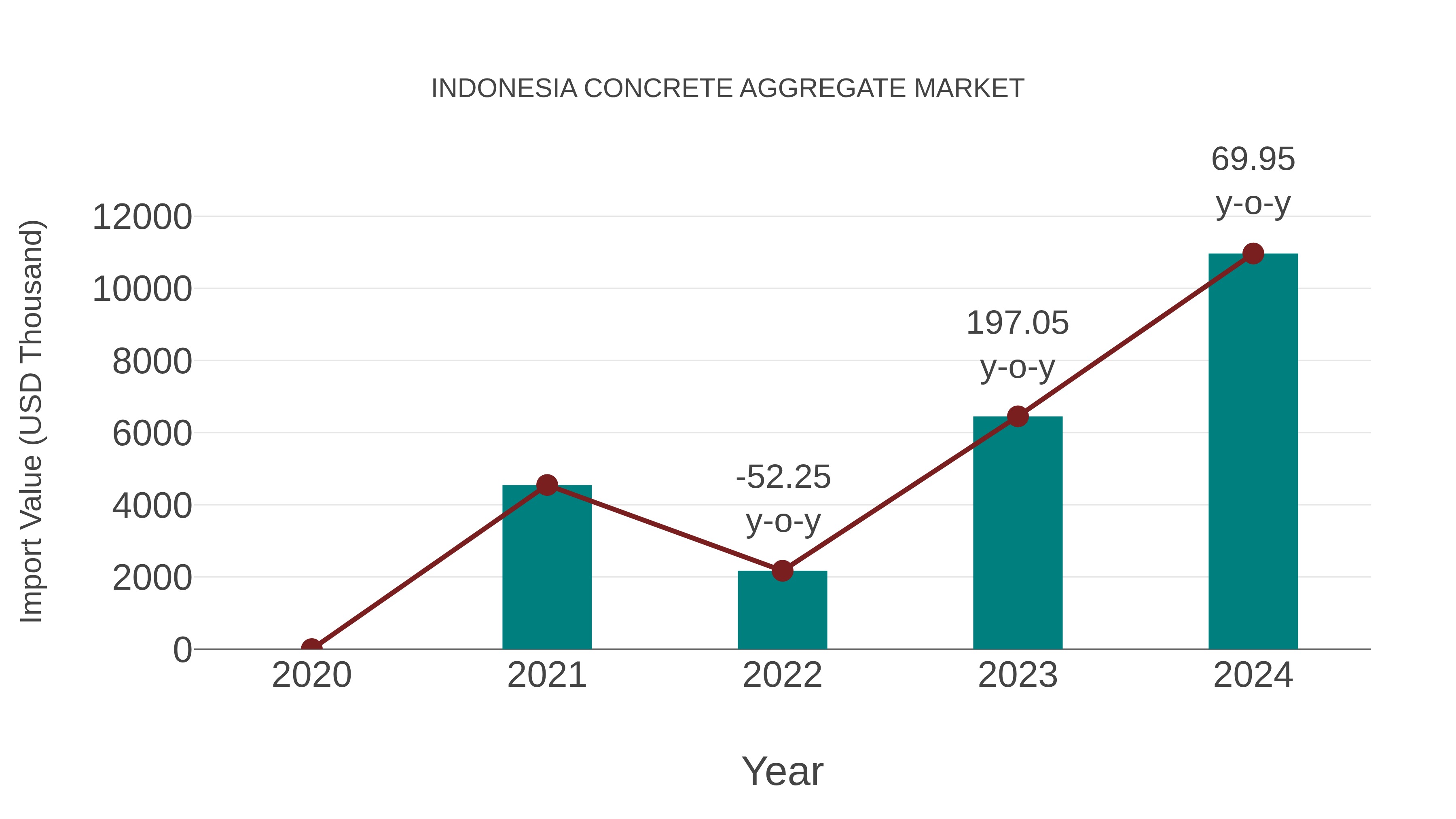
In the Indonesia concrete aggregate market, the import trend showed significant growth from 2023 to 2024, with a growth rate of 69.95%. The compound annual growth rate (CAGR) for imports over the period 2020-2024 stood at 34.08%. This surge in import momentum can be attributed to a notable shift in demand for construction materials, likely influenced by infrastructure development projects in the region.
Indonesia Concrete Aggregate Market Synopsis
The concrete aggregate market in Indonesia is estimated to reach USD 719 million by 2025 growing at a CAGR 8.2%. Increasing construction activities across residential, commercial and industrial sectors are anticipated to boost demand for concrete aggregates over the coming years owing to its wide application across these end-user industries. In addition, rising infrastructural development projects undertaken by government authorities with foreign investments will further support growth of this market over upcoming years. Furthermore, introduction of innovative products coupled with technological advancements are projected create potential opportunities for players operating within this industry landscape during the estimated timeframe.
Drivers of the Market
The Indonesia Concrete Aggregate market is witnessing steady growth due to ongoing construction and infrastructure development projects. Concrete aggregates, such as sand, gravel, and crushed stone, are essential components in concrete production. The expanding urbanization, commercial construction, and public infrastructure initiatives have driven the demand for concrete aggregates, supporting the growth of this market.
Challenges of the Market
The Indonesia Concrete Aggregate market confronts certain challenges that shape its outlook. The availability of high-quality aggregates, which are essential for producing durable concrete, can be inconsistent. Transportation costs and logistical issues can impact the affordability and accessibility of aggregates, particularly in remote or geographically challenging areas. Environmental concerns related to quarrying and mining practices could also lead to stricter regulations, affecting the sourcing of aggregates.
COVID-19 Impact on the Market
The concrete aggregate market involves the supply of materials used in construction, particularly for making concrete. Infrastructure development and urbanization are key drivers in this market. The pandemic might have initially disrupted construction activities, leading to decreased demand. As construction projects resume, the market is likely to recover, especially with government initiatives to stimulate economic growth.
Key Players in the Market
Concrete aggregates are essential components in construction. Key players might include companies like Holcim Indonesia, Semen Indonesia, and Indocement Tunggal Prakarsa.
Key Highlights of the Report:
- Indonesia Concrete Aggregate Market Outlook
- Market Size of Indonesia Concrete Aggregate Market, 2025
- Forecast of Indonesia Concrete Aggregate Market, 2032
- Historical Data and Forecast of Indonesia Concrete Aggregate Revenues & Volume for the Period 2022-2032F
- Indonesia Concrete Aggregate Market Trend Evolution
- Indonesia Concrete Aggregate Market Drivers and Challenges
- Indonesia Concrete Aggregate Price Trends
- Indonesia Concrete Aggregate Porter's Five Forces
- Indonesia Concrete Aggregate Industry Life Cycle
- Historical Data and Forecast of Indonesia Concrete Aggregate Market Revenues & Volume By Production for the Period 2022-2032F
- Historical Data and Forecast of Indonesia Concrete Aggregate Market Revenues & Volume By Natural for the Period 2022-2032F
- Historical Data and Forecast of Indonesia Concrete Aggregate Market Revenues & Volume By Artificial for the Period 2022-2032F
- Historical Data and Forecast of Indonesia Concrete Aggregate Market Revenues & Volume By Processed for the Period 2022-2032F
- Historical Data and Forecast of Indonesia Concrete Aggregate Market Revenues & Volume By Glass Ceramics for the Period 2022-2032F
- Historical Data and Forecast of Indonesia Concrete Aggregate Market Revenues & Volume By Manufactured Marbles for the Period 2022-2032F
- Historical Data and Forecast of Indonesia Concrete Aggregate Market Revenues & Volume By Bulk Density for the Period 2022-2032F
- Historical Data and Forecast of Indonesia Concrete Aggregate Market Revenues & Volume By ASTM C33 for the Period 2022-2032F
- Historical Data and Forecast of Indonesia Concrete Aggregate Market Revenues & Volume By mechanical properties for the Period 2022-2032F
- Historical Data and Forecast of Indonesia Concrete Aggregate Market Revenues & Volume By Abrasive power for the Period 2022-2032F
- Historical Data and Forecast of Indonesia Concrete Aggregate Market Revenues & Volume By Particle Size for the Period 2022-2032F
- Historical Data and Forecast of Indonesia Concrete Aggregate Market Revenues & Volume By Fine Aggregates for the Period 2022-2032F
- Historical Data and Forecast of Indonesia Concrete Aggregate Market Revenues & Volume By Coarse Aggregate for the Period 2022-2032F
- Indonesia Concrete Aggregate Import Export Trade Statistics
- Market Opportunity Assessment By Production
- Market Opportunity Assessment By Bulk Density
- Market Opportunity Assessment By mechanical properties
- Market Opportunity Assessment By Particle Size
- Indonesia Concrete Aggregate Top Companies Market Share
- Indonesia Concrete Aggregate Competitive Benchmarking By Technical and Operational Parameters
- Indonesia Concrete Aggregate Company Profiles
- Indonesia Concrete Aggregate Key Strategic Recommendations






































