Indonesia Concrete Vibrator Market Size, Share & Growth Rate
The Indonesia Concrete Vibrator Market was estimated at USD 366 Million in 2025 and is projected to reach USD 485 Million by 2032, growing at a CAGR of 4.1% from 2026 to 2032. This impressive growth is primarily fueled by the nation's ongoing infrastructure development projects, particularly in urban areas. As urbanization accelerates and the demand for efficient construction tools surges, concrete vibrators are becoming essential in ensuring the integrity and durability of new structures.
Indonesia Concrete Vibrator Market Year-wise Growth Rate and Key Drivers
This graph highlights how the Indonesia Concrete Vibrator Market has steadily grown over the years, supported by major growth factors.
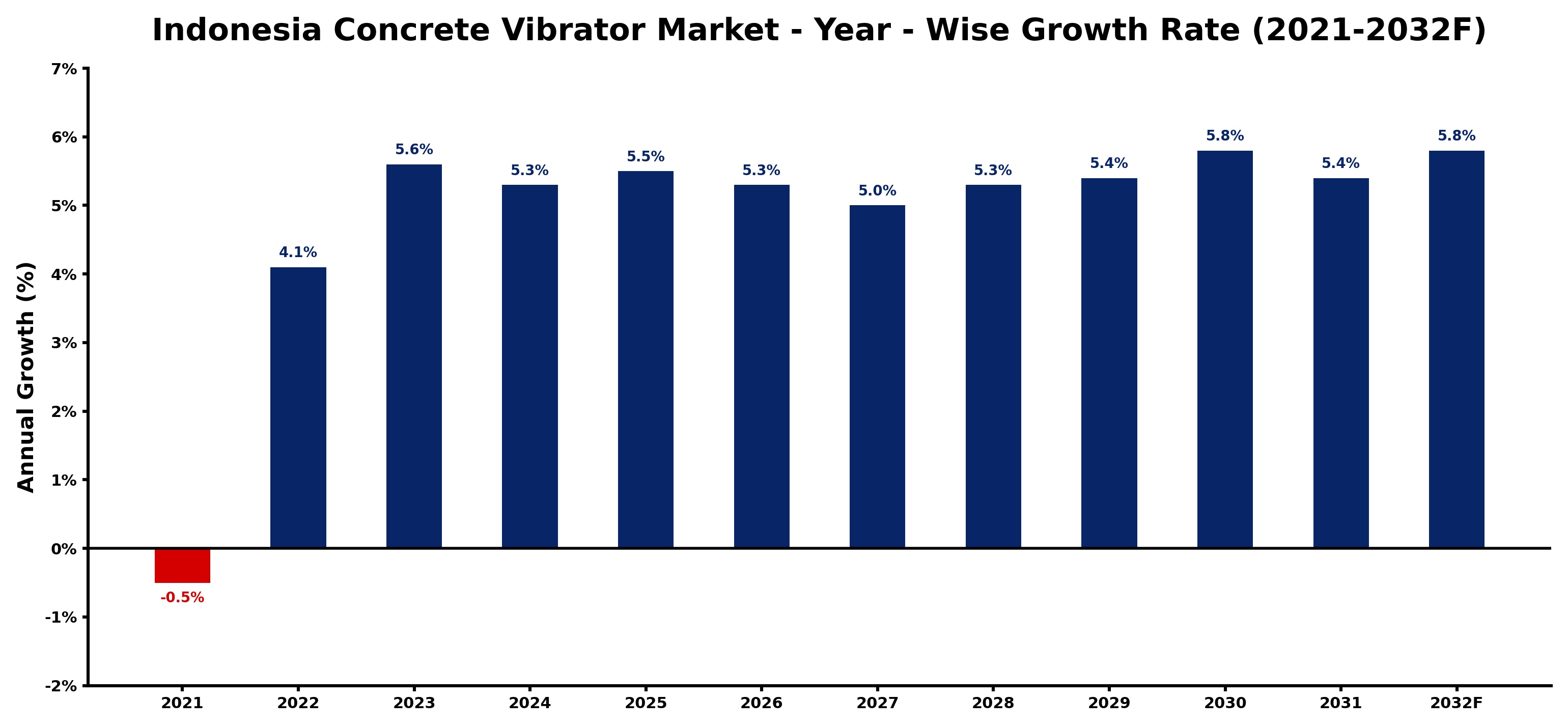
The table below presents the year‑wise growth rates along with the key drivers influencing the market
| Year | Growth Rate | Major Drivers |
| 2021 | -0.5% | Decreased investments in construction led to lower concrete vibrator demand |
| 2022 | 4.1% | Manufacturing investments in construction equipment drove concrete vibrator demand |
| 2023 | 5.6% | Improved infrastructure projects increased demand for concrete vibrators |
| 2024 | 5.3% | Infrastructure development projects boost demand for concrete vibrator production |
| 2025 | 5.5% | Technology integration in concrete mixing boosts vibrator demand significantly |
| 2026 | 5.3% | Improved manufacturing technologies boosted concrete vibrator production efficiency |
| 2027 | 5.0% | Regional construction projects boosted demand for concrete vibrators |
| 2028 | 5.3% | Improved technology integration boosted concrete vibrator manufacturing efficiency |
| 2029 | 5.4% | Higher construction project launches drive concrete vibrator demand growth |
| 2030 | 5.8% | Manufacturing investments in concrete products boost equipment demand efficiency |
| 2031 | 5.4% | Infrastructure development projects stimulated demand for concrete vibration equipment |
| 2032 | 5.8% | Manufacturing investments in infrastructure uplifted concrete vibrator demand |
Note - Market size estimations and growth projections presented in this report are based on 6Wresearch's advanced forecasting approach, validated with industry datasets as of June 2026.
Indonesia Concrete Vibrator Market Synopsis
The most powerful force currently shaping the Indonesia Concrete Vibrator Market is the rapid pace of infrastructure development. Supported by substantial government initiatives aimed at enhancing transportation and commercial sectors, the market is experiencing a significant uptick in demand. This focus on infrastructural expansion is pushing construction firms to prioritize high-quality equipment, further bolstering the need for advanced concrete vibrators.
Additionally, the shift toward smart city initiatives and the increasing emphasis on sustainability are influencing market dynamics. The introduction of lightweight, ergonomically designed models is making the operation safer and more comfortable for workers, while innovations in battery technology and wireless connectivity are paving the way for smarter, more efficient machinery.
Indonesia Concrete Vibrator Market Key Takeaways
- Market growth driven by substantial government infrastructure initiatives.
- Technological advancements are enhancing operational efficiency and safety.
- Increased urbanization is resulting in a surge in construction projects.
- Smart city initiatives are creating new opportunities in the housing sector.
- Emerging trends focus on sustainability and ergonomic designs in equipment.
Evaluation of Restraints in Indonesia Concrete Vibrator Market
While the market for concrete vibrators in Indonesia is on a growth trajectory, several challenges are hindering its potential. Rising raw material costs, largely due to inflationary pressures, have created an environment of uncertainty for manufacturers. This has been compounded by liquidity issues stemming from the COVID-19 pandemic, which has led to delayed project completions and cash flow constraints for many companies. Furthermore, compliance with stringent environmental regulations poses additional hurdles, potentially stymieing market players' ability to innovate and expand.
Indonesia Concrete Vibrator Market Trends
Several key trends are currently shaping the Indonesia Concrete Vibrator Market. Firstly, technological advancements are leading to the introduction of battery-powered variants and machines equipped with wireless communication capabilities. These innovations allow for improved operational efficiency and offer greater flexibility on job sites. Additionally, the demand for lightweight, user-friendly models that reduce operator fatigue is on the rise, reflecting a broader trend toward worker safety and comfort. These shifts indicate a market that is adapting to both technological demands and human-centric design principles.
Indonesia Concrete Vibrator Market Opportunities
Significant opportunities lie ahead for stakeholders in the Indonesia Concrete Vibrator Market. As the country continues to invest heavily in infrastructure, particularly in urban areas, the demand for advanced construction equipment is set to rise. The focus on sustainable construction practices presents additional avenues for innovation, as manufacturers can capitalize on the need for high-density materials and equipment capable of achieving optimal compaction. Furthermore, the smart city initiative presents a unique opportunity to introduce cutting-edge technology that enhances construction efficiency.
Government Initiatives in the Indonesia Concrete Vibrator Market
The Indonesian government is actively promoting infrastructural development through various initiatives and investments. Programs aimed at improving transportation networks, including roads and bridges, are fostering an environment conducive to construction activity. These initiatives not only enhance public infrastructure but also support the growing demand for efficient construction equipment, such as concrete vibrators. Government policies encouraging urban development and smart city projects further solidify the role of concrete vibrators in the national construction agenda.
Future Insights of the Indonesia Concrete Vibrator Market
Looking ahead to the period between 2026 and 2032, the Indonesia Concrete Vibrator Market is poised for substantial growth. The increasing demand for advanced construction tools, propelled by ongoing infrastructure projects and smart city initiatives, will likely sustain the market's upward trajectory. Furthermore, as technological innovations continue to emerge, operators will benefit from more efficient and user-friendly equipment. The push towards sustainable practices will also drive the adoption of high-quality concrete vibrators, positioning the market favorably for long-term success.
Indonesia Concrete Vibrator Market Latest Developments (May 2025 - June 2026)
Recent developments in the Indonesia Concrete Vibrator Market reflect a growing trend towards the integration of advanced technologies in construction equipment. There has been a noticeable increase in the launch of battery-operated models, aimed at addressing both efficiency and environmental concerns. Manufacturers are also emphasizing the importance of ergonomic designs to enhance operator safety. Additionally, partnerships between tech firms and construction equipment manufacturers are on the rise, aimed at developing smarter, more connected machinery that can further improve productivity on job sites.
Indonesia Concrete Vibrator Market - Key Attractiveness of the Report
- 10 Years of Market Numbers
- Historical Data Starting from 2022 to 2025
- Base Year: 2025
- Forecast Data until 2032
- Key Performance Indicators Impacting the Market
- Major Upcoming Developments and Projects
Key Highlights of the Report:
- Indonesia Concrete Vibrator Market Outlook
- Market Size of Indonesia Concrete Vibrator Market, 2025
- Forecast of Indonesia Concrete Vibrator Market, 2032
- Historical Data and Forecast of Indonesia Concrete Vibrator Revenues & Volume for the Period 2022-2032F
- Indonesia Concrete Vibrator Market Trend Evolution
- Indonesia Concrete Vibrator Market Drivers and Challenges
- Indonesia Concrete Vibrator Price Trends
- Indonesia Concrete Vibrator Porter's Five Forces
- Indonesia Concrete Vibrator Industry Life Cycle
- Historical Data and Forecast of Indonesia Concrete Vibrator Market Revenues & Volume By Type for the Period 2022-2032F
- Historical Data and Forecast of Indonesia Concrete Vibrator Market Revenues & Volume By External Vibrator for the Period 2022-2032F
- Historical Data and Forecast of Indonesia Concrete Vibrator Market Revenues & Volume By Internal Vibrator for the Period 2022-2032F
- Historical Data and Forecast of Indonesia Concrete Vibrator Market Revenues & Volume By Others for the Period 2022-2032F
- Historical Data and Forecast of Indonesia Concrete Vibrator Market Revenues & Volume By Application for the Period 2022-2032F
- Historical Data and Forecast of Indonesia Concrete Vibrator Market Revenues & Volume By Architectural Engineering for the Period 2022-2032F
- Historical Data and Forecast of Indonesia Concrete Vibrator Market Revenues & Volume By Dam Engineering for the Period 2022-2032F
- Historical Data and Forecast of Indonesia Concrete Vibrator Market Revenues & Volume By Mine and Well Engineering for the Period 2022-2032F
- Historical Data and Forecast of Indonesia Concrete Vibrator Market Revenues & Volume By Others for the Period 2022-2032F
- Indonesia Concrete Vibrator Import Export Trade Statistics
- Market Opportunity Assessment By Type
- Market Opportunity Assessment By Application
- Indonesia Concrete Vibrator Top Companies Market Share
- Indonesia Concrete Vibrator Competitive Benchmarking By Technical and Operational Parameters
- Indonesia Concrete Vibrator Company Profiles
- Indonesia Concrete Vibrator Key Strategic Recommendations






































