Indonesia Condiment Sauces Market (2025-2029) | Outlook, Analysis, Companies, Industry, Value, Forecast, Growth, Trends, Revenue, Size & Share
Market Forecast By Product (Chili/ Hot Sauce, Brown Sauce, National Specialties, Tomato Ketchup, Mustard Sauce, Soy-based Sauce) And Competitive Landscape
| Product Code: ETC218248 | Publication Date: Aug 2023 | Updated Date: Mar 2026 | Product Type: Market Research Report | |
| Publisher: 6Wresearch | Author: Ravi Bhandari | No. of Pages: 75 | No. of Figures: 35 | No. of Tables: 20 |
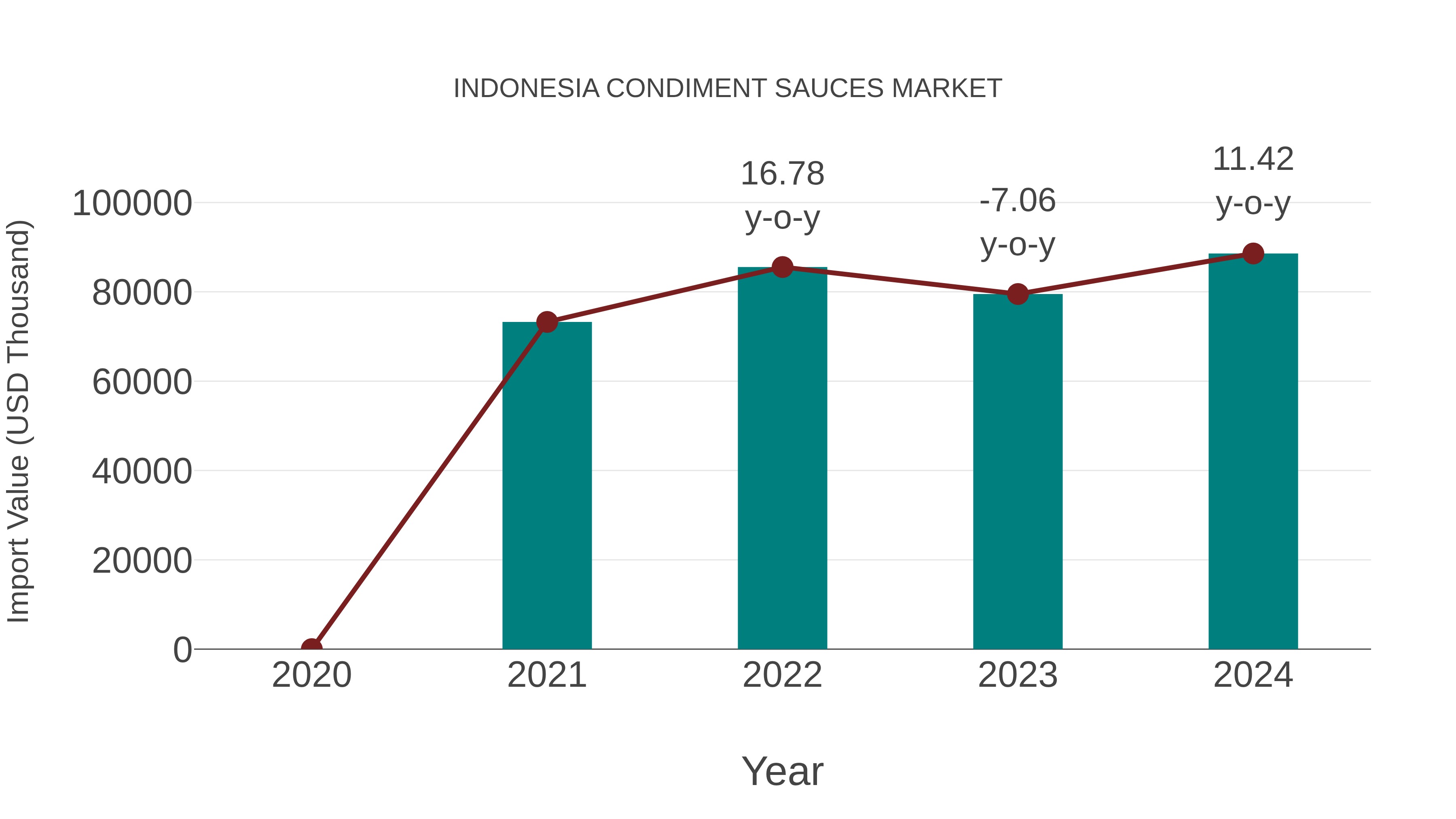
Indonesia Condiment Sauces Market: Import Trend Analysis
In the Indonesia condiment sauces market, the import trend showed a notable growth rate of 11.42% from 2023 to 2024, with a compound annual growth rate (CAGR) of 6.54% from 2020 to 2024. This import momentum can be attributed to shifting consumer preferences towards diverse international flavors, indicating a strong demand shift towards imported condiment sauces during this period.
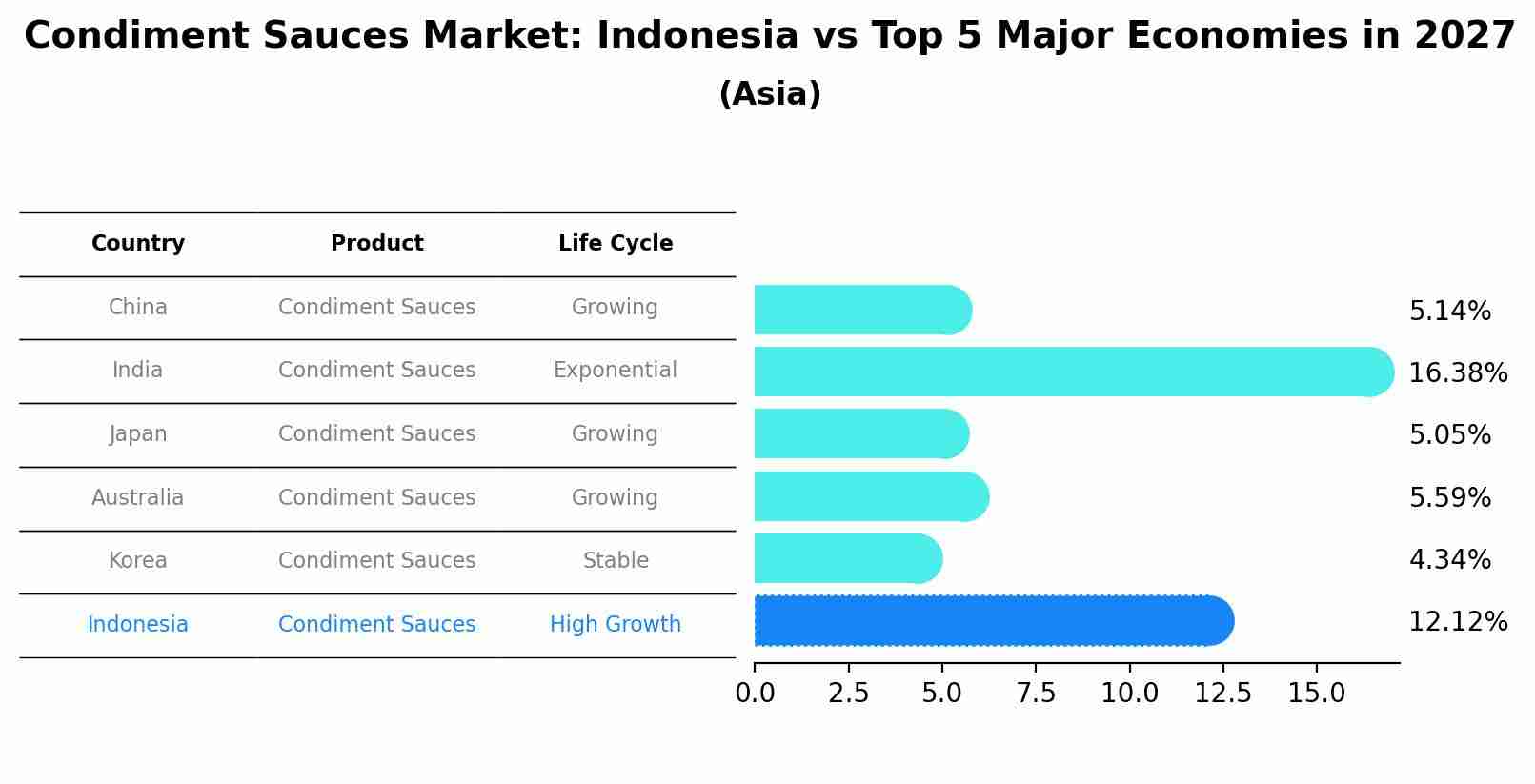
Condiment Sauces Market: Indonesia vs Top 5 Major Economies in 2027 (Asia)
The Condiment Sauces market in Indonesia is projected to grow at a high growth rate of 12.12% by 2027, highlighting the country's increasing focus on advanced technologies within the Asia region, where China holds the dominant position, followed closely by India, Japan, Australia and South Korea, shaping overall regional demand.
Indonesia Condiment Sauces Market Highlights
| Report Name | Indonesia Condiment Sauces Market |
| Forecast Period | 2025 - 2029 |
| CAGR | 13.37% |
| Growing Sector | Sauces & Condiments |
Topics Covered in the Indonesia Condiment Sauces Market Report
The Indonesia Condiment Sauces Market report thoroughly covers the market by product. The report provides an unbiased and detailed analysis of the ongoing market trends, opportunities/high-growth areas, and market drivers to help stakeholders align their strategies with current and future market dynamics.Indonesia Condiment Sauces Market Synopsis
The Indonesia Condiment Sauces Market Growth remains integral to local culinary traditions, with varieties like sambal and kecap manis entrenched in everyday use. Consumers increasingly demand premium and authentic flavours across chili, brown, tomato, mustard, and soy based sauces. Growth is attributed by rising spending power, expanding retail and foodservice channels, and rising influence of convenience seeking consumers. Challenges include competition from foreign brands and changing consumer preferences. However, the market shows robust potential given Indonesia’s rich condiment heritage and evolving consumption patterns.
Indonesia Condiment Sauces Market size is expected to grow at a significant CAGR of 13.37% during the forecast period 2025–2029. Indonesia condiment sauces market is driven by advancements in food processing, growing urbanization, and rising disposable incomes. The expansion of modern retail and foodservice channels further fuels growth. Increasing demand for authentic, spicy local flavours and consumer preference for convenience and global taste profiles promote innovation in chili, soy-based, and brown sauces. These factors collectively support market expansion, as both domestic and international culinary influences shape evolving tastes and purchasing behavior among Indonesia’s increasingly diverse and urban population.
Challenges Faced by the Market:
The Indonesia Condiment Sauces Industry faces challenges such as regulatory complexities in food safety, fragmented supply chains, and volatile raw material costs. Smaller artisanal producers struggle with scalability, while imported brands heighten competition. Limited cold chain infrastructure and inconsistent quality control restrict growth in refrigerated or specialty sauces. To harness rising demand, market players must overcome these operational and regulatory barriers while maintaining product consistency and supply efficiency.
Indonesia Condiment Sauces Market Trends
Businesses are integrating modern technologies like digital platforms, AI powered demand forecasting, and data analytics to optimize supply chains and enhance customer engagement in the Indonesia Condiment Sauces market. Mobile ordering and online platforms enable direct to consumer access, while AI chatbots and personalized marketing increase sales conversion. Another major trend is omnichannel retail strategies companies offer seamless integration between physical stores and e commerce, with services like click and collect, recipe apps, and subscription models improving convenience and consumer loyalty in the condiment sector.
Investment Opportunities in the Indonesia Condiment Sauces Market
Digital commerce expansion presents notable investment opportunities in the Indonesia Condiment Sauces Market in areas like e commerce platforms, logistics solutions, and fintech for payment facilitation current online penetration remains low while demand for convenient purchase of condiments rises. Infrastructure upgrades like modern warehousing, cold storage, and efficient distribution hubs offer another avenue for investors. Enhancing logistics, upgrading shopping centre retail spaces, and supporting artisanal producers through scalable facilities can help meet growing demand while improving operational efficiency.
Leading Players of the Indonesia Condiment Sauces Market
Prominent companies in the Indonesia Condiment Sauces Market include ABC Food, Indofood Sukses Makmur, and Heinz ABC. These firms hold significant Indonesia Condiment Sauces Market Share, with ABC Food leading in chili and tomato ketchup, Indofood dominating soy based and brown sauces, and Heinz ABC driving innovation and export growth. Each leverages strong distribution networks and localized flavors to strengthen their market position.
Government Regulations Introduced in the Indonesia Condiment Sauces Market
According to Indonesian government data, it supports condiment sector growth through initiatives like the Food Law No. 18/2012 regulating food safety, the Halal Product Assurance Act promoting halal certification, and the National Food and Drug Agency (BPOM) standards enforcement. Programs such as the Making Indonesia 4.0 framework encourage modernization of food processing SMEs, while export facilitation under ASEAN trade agreements enables condiment makers to expand regionally. These policies foster quality, scalability, and market access.
Future Insights of the Indonesia Condiment Sauces Market
The Indonesia Condiment Sauces Market is poised for dynamic growth with rising opportunities in export expansion and premium artisanal sauces. Emerging trends like plant based sauces, organic and heritage flavours, and integration of smart packaging technologies will influence the market. Demand for functional and clean label condiments is expected to increase. Challenges around regulation, supply continuity, and raw material sourcing remain, but innovation and investment in infrastructure and technology will support resilience and diversification.
Market Segmentation Analysis
The report offers a comprehensive study of the subsequent market segments and their leading categories.
Soy-based Sauce Emerging as the Fastest Growing Segment – By Product
According to Guneet Kaur, Senior Research Analyst, 6Wresearch, soy-based sauce is witnessing rapid growth driven by rising consumer inclination toward Asian cuisine, health-conscious choices, and versatile usage. Its widespread application across home cooking and foodservice sectors further contributes to its surging popularity.
Foodservice Sector Emerging as the Fastest Growing Segment – By Distribution Channel
The foodservice sector is experiencing swift growth due to increasing urban dining habits, growing café and restaurant culture, and demand for convenient, flavourful meals. Sauces serve as essential culinary enhancers, boosting their use across quick service restaurants and casual dining outlets across Indonesia.
Key Attractiveness of the Report
- 10 Years of Market Numbers.
- Historical Data Starting from 2021 to 2024
- Base Year: 2024
- Forecast Data until 2029.
- Key Performance Indicators Impacting the Market.
- Major Upcoming Developments and Projects.
Key Highlights of the Report:
- Indonesia Condiment Sauces Market Outlook
- Market Size of Indonesia Condiment Sauces Market, 2025
- Forecast of Indonesia Condiment Sauces Market, 2029
- Historical Data and Forecast of Indonesia Condiment Sauces Revenues & Volume for the Period 2019-2029
- Indonesia Condiment Sauces Market Trend Evolution
- Indonesia Condiment Sauces Market Drivers and Challenges
- Indonesia Condiment Sauces Price Trends
- Indonesia Condiment Sauces Porter's Five Forces
- Indonesia Condiment Sauces Industry Life Cycle
- Historical Data and Forecast of Indonesia Condiment Sauces Market Revenues & Volume By Product for the Period 2019-2029
- Historical Data and Forecast of Indonesia Condiment Sauces Market Revenues & Volume By Chili/ Hot Sauce for the Period 2019-2029
- Historical Data and Forecast of Indonesia Condiment Sauces Market Revenues & Volume By Brown Sauce for the Period 2019-2029
- Historical Data and Forecast of Indonesia Condiment Sauces Market Revenues & Volume By National Specialties for the Period 2019-2029
- Historical Data and Forecast of Indonesia Condiment Sauces Market Revenues & Volume By Tomato Ketchup for the Period 2019-2029
- Historical Data and Forecast of Indonesia Condiment Sauces Market Revenues & Volume By Mustard Sauce for the Period 2019-2029
- Historical Data and Forecast of Indonesia Condiment Sauces Market Revenues & Volume By Soy-based Sauce for the Period 2019-2029
- Indonesia Condiment Sauces Import Export Trade Statistics
- Market Opportunity Assessment By Product
- Indonesia Condiment Sauces Top Companies Market Share
- Indonesia Condiment Sauces Competitive Benchmarking By Technical and Operational Parameters
- Indonesia Condiment Sauces Company Profiles
- Indonesia Condiment Sauces Key Strategic Recommendations
Markets Covered
The report offers a comprehensive study of the subsequent market segments:
By Product:
- Chili/Hot Sauce
- Brown Sauce
- National Specialties
- Tomato Ketchup
- Mustard Sauce
- Soy based Sauce
Indonesia Condiment Sauces Market (2025-2029): FAQs
Indonesia Condiment Sauces Market growth CAGR is approximately 6.5% during the forecasted period.
Rising consumer spending, tradition driven flavour demand boost Indonesia Condiment Sauces Market.
Regulatory hurdles, supply cost volatility hinder Indonesia Condiment Sauces Market.
Soy based and chili sauces dominate Indonesia Condiment Sauces Market.
Digital commerce, organic sauces, export expansion define future Indonesia Condiment Sauces Market.
6Wresearch actively monitors the Indonesia Condiment Sauces Market and publishes its comprehensive annual report, highlighting emerging trends, growth drivers, revenue analysis, and forecast outlook. Our insights help businesses to make data-backed strategic decisions with ongoing market dynamics. Our analysts track relevent industries related to the Indonesia Condiment Sauces Market, allowing our clients with actionable intelligence and reliable forecasts tailored to emerging regional needs.
Yes, we provide customisation as per your requirements. To learn more, feel free to contact us on sales@6wresearch.com
| 1 Executive Summary |
| 2 Introduction |
| 2.1 Key Highlights of the Report |
| 2.2 Report Description |
| 2.3 Market Scope & Segmentation |
| 2.4 Research Methodology |
| 2.5 Assumptions |
| 3 Indonesia Condiment Sauces Market Overview |
| 3.1 Indonesia Country Macro Economic Indicators |
| 3.2 Indonesia Condiment Sauces Market Revenues & Volume, 2022 - 2032F |
| 3.3 Indonesia Condiment Sauces Market - Industry Life Cycle |
| 3.4 Indonesia Condiment Sauces Market - Porter's Five Forces |
| 3.5 Indonesia Condiment Sauces Market Revenues & Volume Share, By Product, 2022 - 2032F |
| 4 Indonesia Condiment Sauces Market Dynamics |
| 4.1 Impact Analysis |
| 4.2 Market Drivers |
| 4.2.1 Increasing urbanization leading to higher demand for convenient and quick meal solutions |
| 4.2.2 Growing popularity of Indonesian cuisine globally, leading to increased demand for condiment sauces |
| 4.2.3 Rising disposable income levels in Indonesia, allowing consumers to spend more on premium condiment sauces |
| 4.3 Market Restraints |
| 4.3.1 Fluctuating prices of key ingredients impacting production costs |
| 4.3.2 Intense competition in the condiment sauces market leading to price wars and margin pressures |
| 5 Indonesia Condiment Sauces Market Trends |
| 6 Indonesia Condiment Sauces Market, By Types |
| 6.1 Indonesia Condiment Sauces Market, By Product |
| 6.1.1 Overview and Analysis |
| 6.1.2 Indonesia Condiment Sauces Market Revenues & Volume, By Product, 2022 - 2032F |
| 6.1.3 Indonesia Condiment Sauces Market Revenues & Volume, By Chili/ Hot Sauce, 2022 - 2032F |
| 6.1.4 Indonesia Condiment Sauces Market Revenues & Volume, By Brown Sauce, 2022 - 2032F |
| 6.1.5 Indonesia Condiment Sauces Market Revenues & Volume, By National Specialties, 2022 - 2032F |
| 6.1.6 Indonesia Condiment Sauces Market Revenues & Volume, By Tomato Ketchup, 2022 - 2032F |
| 6.1.7 Indonesia Condiment Sauces Market Revenues & Volume, By Mustard Sauce, 2022 - 2032F |
| 6.1.8 Indonesia Condiment Sauces Market Revenues & Volume, By Soy-based Sauce, 2022 - 2032F |
| 7 Indonesia Condiment Sauces Market Import-Export Trade Statistics |
| 7.1 Indonesia Condiment Sauces Market Export to Major Countries |
| 7.2 Indonesia Condiment Sauces Market Imports from Major Countries |
| 8 Indonesia Condiment Sauces Market Key Performance Indicators |
| 8.1 Consumer engagement on social media platforms for condiment sauces brands |
| 8.2 Number of new product launches and innovations in the condiment sauces market |
| 8.3 Percentage growth in online sales of condiment sauces |
| 8.4 Consumer satisfaction and loyalty metrics for condiment sauces brands |
| 8.5 Sustainability practices and certifications adopted by condiment sauces manufacturers in Indonesia |
| 9 Indonesia Condiment Sauces Market - Opportunity Assessment |
| 9.1 Indonesia Condiment Sauces Market Opportunity Assessment, By Product, 2022 - 2032F |
| 10 Indonesia Condiment Sauces Market - Competitive Landscape |
| 10.1 Indonesia Condiment Sauces Market Revenue Share, By Companies, 2025 |
| 10.2 Indonesia Condiment Sauces Market Competitive Benchmarking, By Operating and Technical Parameters |
| 11 Company Profiles |
| 12 Recommendations |
| 13 Disclaimer |
Global Go To Market Strategy - 2030
Export potential enables firms to identify high-growth global markets with greater confidence by combining advanced trade intelligence with a structured quantitative methodology. The framework analyzes emerging demand trends and country-level import patterns while integrating macroeconomic and trade datasets such as GDP and population forecasts, bilateral import–export flows, tariff structures, elasticity differentials between developed and developing economies, geographic distance, and import demand projections. Using weighted trade values from 2020–2024 as the base period to project country-to-country export potential for 2030, these inputs are operationalized through calculated drivers such as gravity model parameters, tariff impact factors, and projected GDP per-capita growth. Through an analysis of hidden potentials, demand hotspots, and market conditions that are most favorable to success, this method enables firms to focus on target countries, maximize returns, and global expansion with data, backed by accuracy.
By factoring in the projected importer demand gap that is currently unmet and could be potential opportunity, it identifies the potential for the Exporter (Country) among 190 countries, against the general trade analysis, which identifies the biggest importer or exporter.
To discover high-growth global markets and optimize your business strategy:
Click Here
Pricing
- Single User License$ 1,995
- Department License$ 2,400
- Site License$ 3,120
- Global License$ 3,795

Leadership Perspectives from Industry Events
Search
Thought Leadership and Analyst Meet





Our Clients








6WResearch In News
- India Air Conditioner Market Set for Strong Rebound in 2026 After Weather-Led Correction and GST-Driven Recovery: 6Wresearch
- ADAS in India: How Automatic Emergency Braking, Blind Spot Detection & Driver Monitoring are Transforming Road Safety
- Doha a strategic location for EV manufacturing hub: IPA Qatar
- Demand for luxury TVs surging in the GCC, says Samsung
- Empowering Growth: The Thriving Journey of Bangladesh’s Cable Industry
- Demand for luxury TVs surging in the GCC, says Samsung
Latest Reports
- Nicaragua RPG Gaming Market (2026-2032)
- New Zealand RPG Gaming Market (2026-2032)
- Netherlands RPG Gaming Market (2026-2032)
- Nauru RPG Gaming Market (2026-2032)
- Namibia RPG Gaming Market (2026-2032)
- Mozambique RPG Gaming Market (2026-2032)
- Montenegro RPG Gaming Market (2026-2032)
- Mongolia RPG Gaming Market (2026-2032)
- Monaco RPG Gaming Market (2026-2032)
- Micronesia RPG Gaming Market (2026-2032)
Industry Events and Analyst Meet

EV India Expo 2026

HIMTEX 2026

India Refining Summit 2026

India EV Show 2026

EV tech India Expo 2026
Whitepaper
- Middle East & Africa Commercial Security Market Click here to view more.
- Middle East & Africa Fire Safety Systems & Equipment Market Click here to view more.
- GCC Drone Market Click here to view more.
- Middle East Lighting Fixture Market Click here to view more.
- GCC Physical & Perimeter Security Market Click here to view more.


