Indonesia Cybersecurity Market Growth Rate
According to 6Wresearch internal databases and industry insights, Indonesia Cybersecurity Market is projected to grow at a steady compound annual growth rate (CAGR) of 9.4% during the forecast period 2026–2032.
Indonesia Cybersecurity Market Year-wise Growth Rate and Key Drivers (2022-2032)
This graph illustrates the annual growth rates of the Indonesia Cybersecurity Market from 2022 to 2032, highlighting a steady upward trajectory and projected market expansion over the forecast period.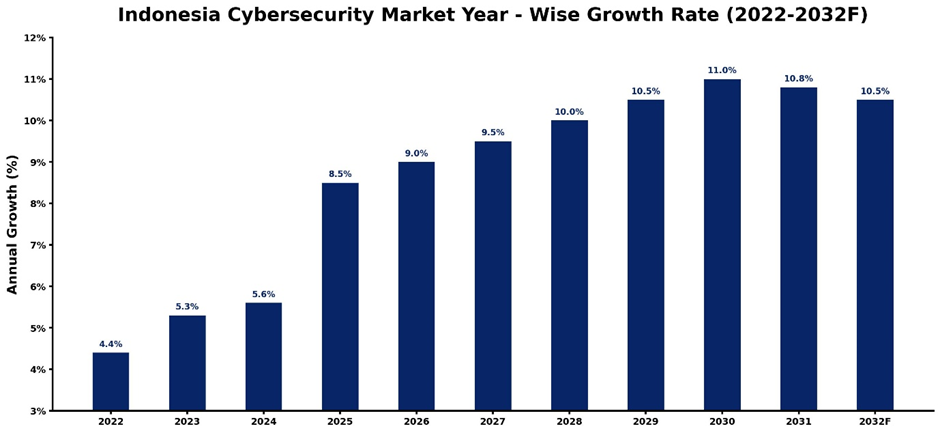
The following table summarizes the historical and forecasted growth rates of Indonesia Cybersecurity Market, along with the rationale behind each year’s performance.
| Year | Estimated Annual Growth (%) | Market Rationale |
| 2022 | 4.4% | Growth supported by post-pandemic digital transformation, increased online services, and rising need for protection against cyber threats. |
| 2023 | 5.3% | Increasing ransomware incidents, cloud adoption, and enterprise investment in endpoint security and identity management solutions supported market expansion. |
| 2024 | 5.6% | Growth driven by fintech, e-commerce, digital payments, and stronger demand for cybersecurity compliance solutions. |
| 2025 | 8.5% | Higher cybersecurity awareness after major cyber incidents increased spending on SOC services, threat detection, and data protection solutions. |
| 2026 | 9% | Cloud migration, AI adoption, and expansion of digital infrastructure increase demand for cybersecurity platforms and services. |
| 2027 | 9.5% | Enterprises adopt managed security services, zero-trust architecture, and AI-based monitoring to address sophisticated cyber threats. |
| 2028 | 10% | Growth supported by IoT expansion, smart infrastructure development, and Industry 4.0 adoption, which increase cybersecurity requirements. |
| 2029 | 10.5% | Banking, healthcare, telecom, and government sectors increase cybersecurity investments due to stricter security requirements. |
| 2030 | 11% | AI-driven cyberattacks, automated threats, and demand for advanced security analytics accelerate market growth. |
| 2031 | 10.8% | Continued digital economy expansion drives demand for encryption, identity protection, and cyber resilience solutions. |
| 2032 | 10.5% | Market growth continues due to mature cybersecurity adoption, regulatory compliance needs, cloud security expansion, and national cybersecurity initiatives. |
Topics Covered in the Indonesia Cybersecurity Market Report
The Indonesia Cybersecurity Market report thoroughly covers the market by security type, deployment, and end-user. The report provides an unbiased and detailed analysis of current market trends, emerging opportunities/high-growth areas, and key market drivers, helping stakeholders develop and align their cybersecurity strategies according to present and future market dynamics.
Indonesia Cybersecurity Market Highlights
| Report Name | Indonesia Cybersecurity Market |
| Forecast period | 2026-2032 |
| CAGR | 9.4% |
| Growing Sector | BFSI (Banking, Financial Services, and Insurance) |
Indonesia Cybersecurity Market Synopsis
Indonesia Cybersecurity Market will set to experience strong long-term structural growth, supported by increasing digital threats, rapid digital transformation, expanding internet penetration, and rising adoption of cloud-based services across enterprises. Indonesia is emerging as one of the fastest-growing cybersecurity markets in the Asia-Pacific region, influenced by government cybersecurity initiatives, data protection regulations, growth of digital payments, and increasing enterprise security investments. Also, the widespread artificial intelligence (AI) and fintech are encouraging cybersecurity spending across industries.
Evaluation of Growth Drivers in Indonesia Cybersecurity Market (2026–2032)
Below are the major drivers influencing market dynamics:
| Drivers | Primary Segment Affected | Why It Matters (Evidence) |
| Rising Cyber Threats & Data Breaches | Endpoint Security, Threat Intelligence, Managed Security Services | Increasing ransomware and large-scale data breaches are encouraging organizations to strengthen security infrastructure. |
| Cloud Adoption & Digital Transformation | Cloud Security, Identity Access Management (IAM), Data Security | Cloud platforms adoption among enterprises and government institutions is increasing need for cloud workload protection. |
| AI-Powered Cybersecurity & Advanced Threat Detection | AI Security, Security Analytics, SOC Solutions | Demand for AI-based threat detection increased due to surging AI-driven cyberattacks. |
| Government Cybersecurity Initiatives & Data Protection Regulations | Government Security, Critical Infrastructure, Enterprise Security | National cybersecurity programs are encouraging organizations to increase cybersecurity investments. |
| Growth of Digital Banking & Fintech Ecosystem | BFSI Security, Fraud Prevention, Transaction Security | Demand for fraud detection and financial data protection solutions boosts due to rapid growth of digital payments. |
| Expansion of Managed Security Services (MSS) | SMEs, Large Enterprises, Cloud Security | Shortage of skilled cybersecurity professionals is encouraging businesses to outsource security monitoring. |
The Indonesia Cybersecurity Market Share is set to experience the progress with a CAGR of 9.4% during 2026–2032. Rising cyber risks, increasing cloud adoption, AI-driven security solutions, digital banking growth, and evolving data protection regulations are key factors contributing for the market expansion. Indonesia’s digital economy keeps on expanding, with more than 220 million internet users and a huge base of online banking, e-commerce, and fintech users that will shape the demand for advanced cybersecurity solutions.
Evaluation of Restraints in Indonesia Cybersecurity Market
Below are the major restraints influencing market dynamics:
| Restraints | Primary Segment Affected | What This Means (Evidence) |
| Cybersecurity Talent Shortage | Security Operations, Managed Services, Enterprise Security | Limited availability of skilled cybersecurity professionals increases operational challenges. |
| High Cost of Advanced Security Solutions | SMEs & Mid-Sized Enterprises | AI-based security platforms require significant investment, limiting adoption among smaller businesses. |
| Limited Cybersecurity Awareness Among SMEs | Small and Medium Enterprises | Slower adoption of advanced protection solutions, as many SMEs still consider cybersecurity a cost rather than a business necessity. |
| Legacy IT Infrastructure Challenges | Large Enterprises & Government Organizations | Implementation of modern security frameworks such as zero-trust architecture is hindered by older technology systems. |
| Complex Regulatory Compliance Requirements | BFSI, Healthcare, Government | Due to changing data protection policies, organizations face increased operational costs. |
| Budget Constraints During Economic Uncertainty | SMEs & Non-Critical Industries | Cybersecurity upgrades delayed due to reduced technology spending during economic slowdowns. |
Indonesia Cybersecurity Market Challenges
The market has a number of challenges which include a shortfall of skilled cybersecurity professionals, increasing complexity of digital threats, and uneven security adoption across organizations. Indonesia recorded more than 400 million cyberattack attempts in recent years, that showcases the growing pressure on businesses to strengthen security infrastructure. The Indonesia Cybersecurity Market growth slows down as organizations continue to face difficulties implementing advanced cybersecurity frameworks due to high solution costs, limited internal expertise, and integration issues with legacy IT systems.
Indonesia Cybersecurity Market Trends
Major industry trends in the Indonesia cybersecurity market are summarized below:
- Growth of Managed Security Services (MSS): Businesses are actively outsourcing security monitoring and incident response operations, due to cybersecurity skill shortages and rising attack frequency.
- Cloud Security Expansion: Cloud adoption among Indonesian enterprises enhanced, results into increased demand for cloud workload protection, identity management, and data security solutions.
- BFSI Cybersecurity Growth: Digital banking, mobile payments, and fintech expansion are increasing investments in fraud prevention, transaction monitoring, and financial data protection.
- Government and Critical Infrastructure Security: Demand for advanced cybersecurity solutions is driven by rising focus on protecting government platforms, telecommunications networks, and essential infrastructure.
Investment Opportunities in Indonesia Cybersecurity Market
Strategic investment opportunities in the Indonesia cybersecurity market include the following:
- Managed Security Service Providers (MSSPs): Due to cybersecurity service providers offering monitoring, compliance, and incident response solutions leads to create heavy demand from SMEs and enterprises.
- Cloud Security Infrastructure: Due to increasing cloud adoption, investment potential enhanced in cloud-native security platforms, encryption technologies, and data protection services.
- Cybersecurity Solutions for BFSI Sector: Investment opportunities created in fraud detection and transaction protection solutions due to rising digital payments and online banking adoption.
- Critical Infrastructure Cybersecurity: Requirement for specialized cybersecurity solutions is rising due to the need to protect telecom networks, energy infrastructure, and healthcare platforms.
Top Leading Players in Indonesia Cybersecurity Market
Below is a curated list of leading companies in the Indonesia cybersecurity market:
1. IBM
| Company Name | IBM |
|---|---|
| Established Year | 1911 |
| Headquarters | Armonk, New York, United States |
| Official Website | Click Here |
A global technology leader providing enterprise cybersecurity solutions, network protection, and managed security services to large Indonesian enterprises and government organizations.
2. Cisco Systems
| Company Name | Cisco Systems |
|---|---|
| Established Year | 1984 |
| Headquarters | San Jose, California, United States |
| Official Website | Click Here |
A leading networking and cybersecurity provider in Indonesia, offering enterprise network security, firewall solutions, secure access platforms, and threat protection technologies across industries.
3. Microsoft
| Company Name | Microsoft |
|---|---|
| Established Year | 1975 |
| Headquarters | Redmond, Washington, United States |
| Official Website | Click Here |
A major cybersecurity provider offering endpoint protection, identity and access management (IAM), and cloud security through its enterprise and government-focused platforms.
4. Fortinet
| Company Name | Fortinet |
|---|---|
| Established Year | 2000 |
| Headquarters | Sunnyvale, California, United States |
| Official Website | Click Here |
A widely adopted cybersecurity company in Indonesia, providing high-performance firewalls, secure SD-WAN, network security solutions, and AI-powered threat intelligence platforms.
5. ITSEC Asia
| Company Name | ITSEC Asia |
|---|---|
| Established Year | 2010 |
| Headquarters | Jakarta, Indonesia |
| Official Website | Click Here |
A leading Indonesian managed security services provider (MSSP) offering penetration testing, threat hunting, cybersecurity consulting, vulnerability assessments, and compliance services.
Government Initiatives being implemented in the Indonesia Cybersecurity Market
According to the Indonesian government data, the market is strengthening through initiatives which are focused on digital resilience, data protection, and national cyber defense. The Indonesia Cybersecurity Market size will be extended by programs such as the National Cyber and Crypto Agency of Indonesia, that aims to improve cyber incident response, security awareness, and infrastructure protection. Regulations such as the Personal Data Protection Law encourage organizations for shifting into the stronger cybersecurity solutions.
Future Insights of the Indonesia Cybersecurity Market
The market is set for long-term growth, driven by rising digital adoption, cloud migration, and increasing digital threats across sectors. To hike the Indonesia Cybersecurity Market revenue, focus must be on data protection and smart infrastructure, which will accelerate demand for advanced security solutions, AI-based threat detection and managed services. Indonesia registered over 270 million internet users in 2024, that shows a larger attack surface. Furthermore, the country aims to develop thousands of cybersecurity professionals to address skill shortages.
Market Segmentation Analysis
This report presents a detailed analysis of the market segments along with their leading categories:
By Security Type - Infrastructure Protection Led the Market and Set for Rapid Growth
According to Vasudha, Senior Research Analyst, 6Wresearch, by security type, in Indonesia’s cybersecurity market, Infrastructure Protection commanded in 2025, accounting for 30% of market share, driven by increasing protection needs for critical infrastructure and digital platforms. And by 2032, Infrastructure Protection will remain the fastest-growing segment with 10.2% CAGR, supported by rising cyberattacks and national cybersecurity initiatives.
By Deployment - Cloud Dominated the Market and Set for Rapid Expansion
By Deployment, In Indonesia’s cybersecurity market, Cloud-based security led in 2025, capturing 60% of market share, driven by rapid digital transformation and demand for scalable security solutions. And during 2026-2032, Cloud is projected to remain the dominant segment with a 14% CAGR, backed by expanding cloud infrastructure, and the need for flexible threat management.
By End-User - Government and Defense Led the Market and BFSI Set for Rapid Growth
By End-User, accounting for 30% of market share, Government and Defense dominated the Indonesia’s cybersecurity market in 2025, backed by rising digital threats and public services. However, BFSI (Banking, Financial Services, and Insurance) will command the market during 2026-2032, with a 14% CAGR, owned by rapid digital banking adoption and online transactions.
Note: Market size estimations and growth projections presented in this report are based on 6Wresearch's proprietary forecasting methodology, utilizing the latest available industry data, government publications, and primary research inputs.
Key Attractiveness of the Report:
- 10 Years of Market Numbers
- Historical Data Starting from 2022 to 2025
- Base Year: 2025
- Forecast Data until 2032
- Key Performance Indicators Impacting the Market
- Major Upcoming Developments and Projects
Key Highlights of the Report:
- Indonesia Cybersecurity Market Outlook
- Market Size of Indonesia Cybersecurity Market, 2025
- Forecast of Indonesia Cybersecurity Market, 2032
- Historical Data and Forecast of Indonesia Cybersecurity Revenues & Volume for the Period 2022-2032
- Indonesia Cybersecurity Market Trend Evolution
- Indonesia Cybersecurity Market Drivers and Challenges
- Indonesia Cybersecurity Price Trends
- Indonesia Cybersecurity Porter's Five Forces
- Indonesia Cybersecurity Industry Life Cycle
- Historical Data and Forecast of Indonesia Cybersecurity Market Revenues & Volume By Security Type for the Period 2022-2032
- Historical Data and Forecast of Indonesia Cybersecurity Market Revenues & Volume By Cloud Security for the Period 2022-2032
- Historical Data and Forecast of Indonesia Cybersecurity Market Revenues & Volume By Data Security for the Period 2022-2032
- Historical Data and Forecast of Indonesia Cybersecurity Market Revenues & Volume By Identity Access Management for the Period 2022-2032
- Historical Data and Forecast of Indonesia Cybersecurity Market Revenues & Volume By Network Security for the Period 2022-2032
- Historical Data and Forecast of Indonesia Cybersecurity Market Revenues & Volume By Consumer Security for the Period 2022-2032
- Historical Data and Forecast of Indonesia Cybersecurity Market Revenues & Volume By Infrastructure Protection for the Period 2022-2032
- Historical Data and Forecast of Indonesia Cybersecurity Market Revenues & Volume By Others for the Period 2022-2032
- Historical Data and Forecast of Indonesia Cybersecurity Market Revenues & Volume By Deployment for the Period 2022-2032
- Historical Data and Forecast of Indonesia Cybersecurity Market Revenues & Volume By Cloud for the Period 2022-2032
- Historical Data and Forecast of Indonesia Cybersecurity Market Revenues & Volume By On-Premise for the Period 2022-2032
- Historical Data and Forecast of Indonesia Cybersecurity Market Revenues & Volume By End-User for the Period 2022-2032
- Historical Data and Forecast of Indonesia Cybersecurity Market Revenues & Volume By BFSI for the Period 2022-2032
- Historical Data and Forecast of Indonesia Cybersecurity Market Revenues & Volume By Healthcare for the Period 2022-2032
- Historical Data and Forecast of Indonesia Cybersecurity Market Revenues & Volume By Manufacturing for the Period 2022-2032
- Historical Data and Forecast of Indonesia Cybersecurity Market Revenues & Volume By Government and Defense for the Period 2022-2032
- Historical Data and Forecast of Indonesia Cybersecurity Market Revenues & Volume By IT and Telecommunication for the Period 2022-2032
- Historical Data and Forecast of Indonesia Cybersecurity Market Revenues & Volume By Others for the Period 2022-2032
- Indonesia Cybersecurity Import Export Trade Statistics
- Market Opportunity Assessment By Security Type
- Market Opportunity Assessment By Deployment
- Market Opportunity Assessment By End-User
- Indonesia Cybersecurity Top Companies Market Share
- Indonesia Cybersecurity Competitive Benchmarking By Technical and Operational Parameters
- Indonesia Cybersecurity Company Profiles
- Indonesia Cybersecurity Key Strategic Recommendations
Market Covered
The report offers an extensive study of the following market segments:
By Security Type
- Cloud Security
- Data Security
- Identity Access Management
- Network Security
- Consumer Security
- Infrastructure Protection
- Others
By Deployment
- Cloud
- On-Premise
By End-User
- BFSI
- Healthcare
- Manufacturing
- Government and Defense
- IT and Telecommunication
- Others






































