Indonesia Dry-Cleaning And Laundry Services Market Size, Share & Growth Rate
The Indonesia Dry-Cleaning And Laundry Services Market was estimated at USD 465 Million in 2025 and is projected to reach USD 614 Million by 2032, growing at a CAGR of 4.1% from 2026 to 2032. This growth trajectory is significantly influenced by rapid urbanization and the evolving lifestyles of the Indonesian population. With busy urban life compelling individuals to seek convenience, demand for both traditional and technologically advanced laundry services is at an all-time high.
Indonesia Dry-Cleaning And Laundry Services Market Year-wise Growth Rate and Key Drivers
This graph highlights how the Indonesia Dry-Cleaning And Laundry Services Market has steadily grown over the years, supported by major growth factors.
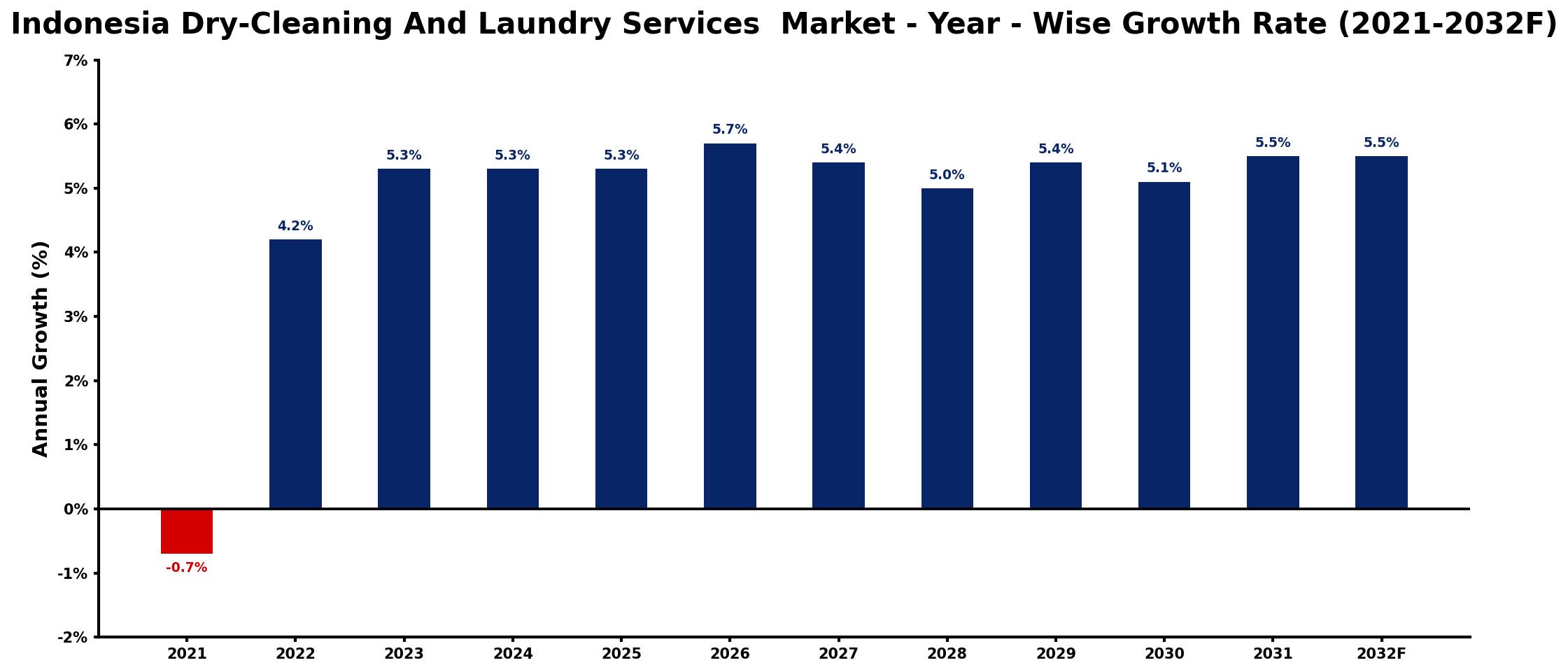
The table below presents the year‑wise growth rates along with the key drivers influencing the market
| Year | Growth Rate | Major Drivers |
| 2021 | -0.7% | Decreased consumer spending habits |
| 2022 | 4.2% | Rising disposable income levels |
| 2023 | 5.3% | Expansion of urban population centers |
| 2024 | 5.3% | Increased demand for convenience solutions |
| 2025 | 5.3% | Growth in professional workforce demographics |
| 2026 | 5.7% | Surge in eco-friendly initiatives |
| 2027 | 5.4% | Enhanced consumer awareness campaigns |
| 2028 | 5.0% | Emergence of subscription-based models |
| 2029 | 5.4% | Technological advancements in logistics |
| 2030 | 5.1% | Diversification of service offerings |
| 2031 | 5.5% | Strengthened partnerships with retailers |
| 2032 | 5.5% | Increased focus on sustainability practices |
Note: Market size estimations and growth projections presented in this report are based on 6Wresearch's proprietary forecasting methodology, utilizing the latest available industry data, government publications, and primary research inputs.
Indonesia Dry-Cleaning And Laundry Services Market Synopsis
The landscape of dry-cleaning and laundry services in Indonesia is transforming, as both residential and commercial consumers increasingly prefer professional cleaning solutions. Amidst bustling city life, the need for convenient, quick, and quality laundry services continues to escalate, prompting businesses to innovate their service offerings.
Furthermore, the integration of technology in this sector is revolutionizing customer interactions, with online bookings and delivery becoming standard practices. This shift not only enhances customer accessibility but also aligns with the rising expectations surrounding hygiene and garment care in contemporary society.
Indonesia Dry-Cleaning And Laundry Services Market Key Takeaways
- The market is experiencing steady expansion driven by urbanization and increased disposable incomes.
- Technological advancements, including mobile apps and online services, are reshaping customer engagement.
- There is a growing preference for eco-friendly practices in laundry services among consumers.
- The hospitality and tourism sectors are vital contributors to the demand for laundry services.
- Changing consumer lifestyles continue to spur growth in both traditional and modern laundry operations.
Evaluation of Restraints in Indonesia Dry-Cleaning And Laundry Services Market
Despite its promising growth, the Indonesia Dry-Cleaning and Laundry Services market faces significant constraints. Labor shortages remain a pressing issue, complicating service delivery and quality assurance. Additionally, maintaining high-quality standards while managing operational costs poses challenges, especially as consumer expectations evolve towards eco-friendliness and contactless service options. These factors necessitate strategic planning and adaptation from industry players to thrive in this competitive landscape.
Indonesia Dry-Cleaning And Laundry Services Market Trends
Several key trends are shaping the future of the dry-cleaning and laundry services market in Indonesia. A notable trend is the increased consumer awareness surrounding sustainable practices, leading to a rise in demand for eco-friendly cleaning solutions. Additionally, the use of technology—ranging from apps that facilitate service scheduling to automated payment systems—is enhancing operational efficiency. Furthermore, the market is witnessing a shift towards hybrid service models that combine traditional laundry with modern convenience, such as doorstep pickup and delivery.
Indonesia Dry-Cleaning And Laundry Services Market Opportunities
The Indonesia Dry-Cleaning and Laundry Services market presents numerous growth and investment opportunities. Businesses can capitalize on the demand for specialized cleaning services, particularly for luxury garments and delicate fabrics. There is also potential in expanding service offerings to cater to commercial clients, particularly within the hospitality and corporate sectors, which frequently require large-scale laundry solutions. Embracing technological innovations and sustainability initiatives will be crucial for companies looking to differentiate themselves and capture market share.
Government Initiatives in the Indonesia Dry-Cleaning And Laundry Services Market
The Indonesian government has recognized the importance of enhancing the service sector, which includes dry-cleaning and laundry services. Initiatives aimed at boosting small and medium enterprises (SMEs) through training programs, financial support, and infrastructure development are underway. Furthermore, efforts to promote environmentally sustainable practices could encourage laundry services to adopt greener technologies and operations, fostering overall industry growth.
Future Insights of the Indonesia Dry-Cleaning And Laundry Services Market
Looking ahead to 2026-2032, the Indonesia Dry-Cleaning and Laundry Services market is poised for sustained growth. The increasing prevalence of urban lifestyles and higher disposable incomes will drive demand for both traditional and technology-driven laundry solutions. As consumers become more health-conscious and aware of garment care, the emphasis on quality, speed, and sustainability will become paramount. Companies that adapt to these changing dynamics and invest in innovation will likely emerge as market leaders.
Indonesia Dry-Cleaning And Laundry Services Market Latest Developments (2025 - 2026)
Recent developments in the dry-cleaning and laundry services sector indicate a shift towards more technology-driven solutions. Many businesses are enhancing their online platforms, enabling customers to schedule services with greater ease and efficiency. The ongoing focus on hygiene protocols continues to influence operational practices, with companies adopting advanced cleaning technologies to ensure quality and safety in service delivery. This responsiveness to consumer needs reflects a commitment to maintaining relevance in a rapidly changing market environment.
Indonesia Dry-Cleaning And Laundry Services Market - Key Attractiveness of the Report
- 10 Years of Market Numbers
- Historical Data Starting from 2022 to 2025
- Base Year: 2025
- Forecast Data until 2032
- Key Performance Indicators Impacting the Market
- Major Upcoming Developments and Projects
Key Highlights of the Report:
- Indonesia Dry-Cleaning And Laundry Services Market Outlook
- Market Size of Indonesia Dry-Cleaning And Laundry Services Market, 2025
- Forecast of Indonesia Dry-Cleaning And Laundry Services Market, 2032
- Historical Data and Forecast of Indonesia Dry-Cleaning And Laundry Services Revenues & Volume for the Period 2022-2032F
- Indonesia Dry-Cleaning And Laundry Services Market Trend Evolution
- Indonesia Dry-Cleaning And Laundry Services Market Drivers and Challenges
- Indonesia Dry-Cleaning And Laundry Services Price Trends
- Indonesia Dry-Cleaning And Laundry Services Porter's Five Forces
- Indonesia Dry-Cleaning And Laundry Services Industry Life Cycle
- Historical Data and Forecast of Indonesia Dry-Cleaning And Laundry Services Market Revenues & Volume By Type for the Period 2022-2032F
- Historical Data and Forecast of Indonesia Dry-Cleaning And Laundry Services Market Revenues & Volume By Coin-Operated Laundries and Drycleaners for the Period 2022-2032F
- Historical Data and Forecast of Indonesia Dry-Cleaning And Laundry Services Market Revenues & Volume By Dry-Cleaning and Laundry Services for the Period 2022-2032F
- Historical Data and Forecast of Indonesia Dry-Cleaning And Laundry Services Market Revenues & Volume By Linen and Uniform Supply for the Period 2022-2032F
- Historical Data and Forecast of Indonesia Dry-Cleaning And Laundry Services Market Revenues & Volume By End-Use for the Period 2022-2032F
- Historical Data and Forecast of Indonesia Dry-Cleaning And Laundry Services Market Revenues & Volume By Commericial Dry-Cleaning and Laundry Services for the Period 2022-2032F
- Historical Data and Forecast of Indonesia Dry-Cleaning And Laundry Services Market Revenues & Volume By Residential Dry-Cleaning and Laundry Services for the Period 2022-2032F
- Historical Data and Forecast of Indonesia Dry-Cleaning And Laundry Services Market Revenues & Volume By Coin-Operated Laundries and Drycleaners for the Period 2022-2032F
- Historical Data and Forecast of Indonesia Dry-Cleaning And Laundry Services Market Revenues & Volume By Distribution Channel for the Period 2022-2032F
- Historical Data and Forecast of Indonesia Dry-Cleaning And Laundry Services Market Revenues & Volume By Offline for the Period 2022-2032F
- Historical Data and Forecast of Indonesia Dry-Cleaning And Laundry Services Market Revenues & Volume By Online for the Period 2022-2032F
- Indonesia Dry-Cleaning And Laundry Services Import Export Trade Statistics
- Market Opportunity Assessment By Type
- Market Opportunity Assessment By End-Use
- Market Opportunity Assessment By Distribution Channel
- Indonesia Dry-Cleaning And Laundry Services Top Companies Market Share
- Indonesia Dry-Cleaning And Laundry Services Competitive Benchmarking By Technical and Operational Parameters
- Indonesia Dry-Cleaning And Laundry Services Company Profiles
- Indonesia Dry-Cleaning And Laundry Services Key Strategic Recommendations






































