Indonesia Energy Efficient Lighting Market Size, Share & Growth Rate
The Indonesia Energy Efficient Lighting Market was estimated at USD 433 Million in 2025 and is projected to reach USD 573 Million by 2032, growing at a CAGR of 4.1% from 2026 to 2032. This growth trajectory is largely driven by the government's commitment to energy efficiency, as well as increasing awareness among consumers regarding the economic and environmental benefits of energy-saving lighting solutions. The expanding residential and commercial sectors are also propelling demand, fostering an environment ripe for investment and technological advancements.
Indonesia Energy Efficient Lighting Market Year-wise Growth Rate and Key Drivers
This graph highlights how the Indonesia Energy Efficient Lighting Market has steadily grown over the years, supported by major growth factors.
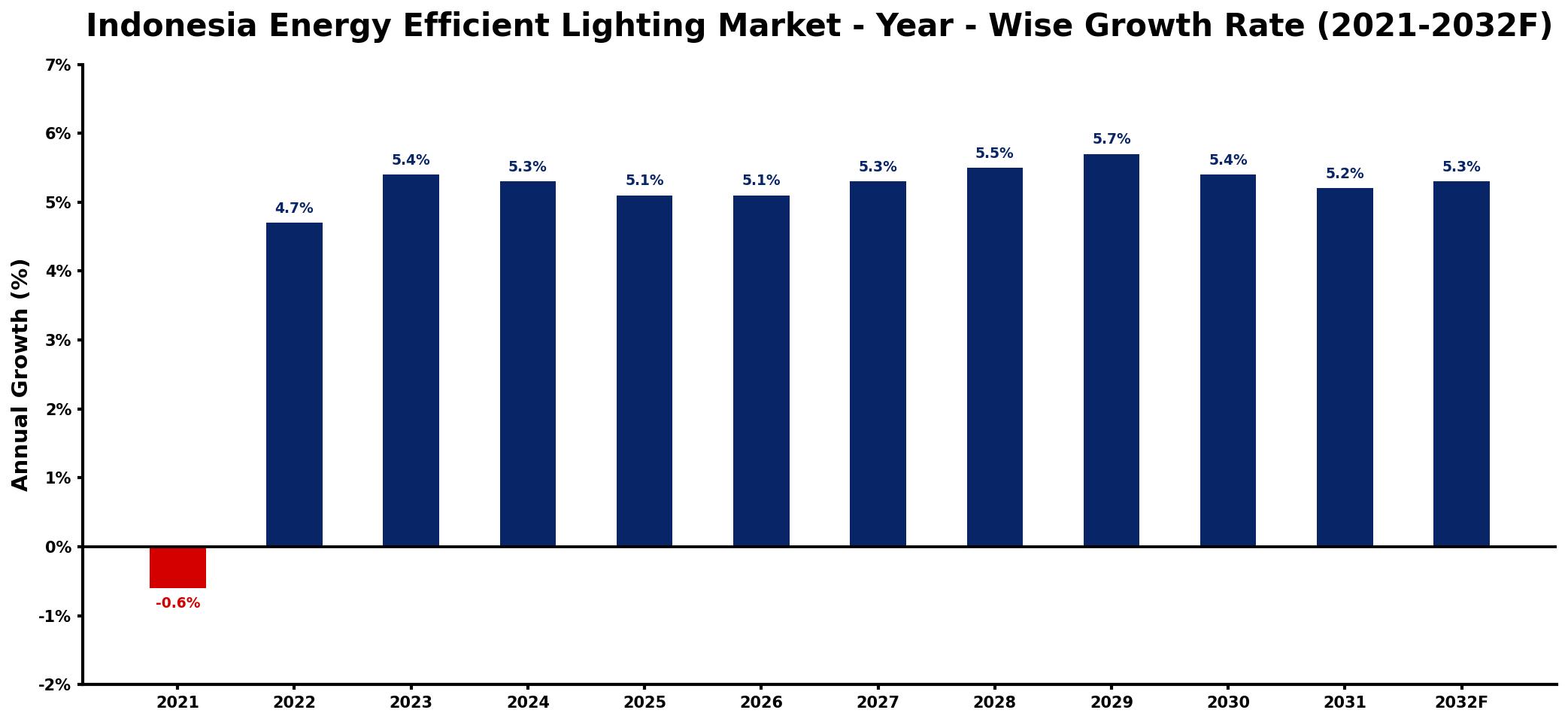
The table below presents the year‑wise growth rates along with the key drivers influencing the market
| Year | Growth Rate | Major Drivers |
| 2021 | -0.6% | Lower consumer spending on upgrades |
| 2022 | 4.7% | Growing awareness of sustainability practices |
| 2023 | 5.4% | Increased government incentives for adoption |
| 2024 | 5.3% | Rising investments in green technologies |
| 2025 | 5.1% | Higher residential construction activity |
| 2026 | 5.1% | Boost in commercial renovation projects |
| 2027 | 5.3% | Expansion of smart home integration |
| 2028 | 5.5% | Surge in urban development initiatives |
| 2029 | 5.7% | Enhanced public infrastructure projects |
| 2030 | 5.4% | Growing demand for renewable solutions |
| 2031 | 5.2% | Increased focus on corporate responsibility |
| 2032 | 5.3% | Widespread adoption of innovative solutions |
Note: Market size estimations and growth projections presented in this report are based on 6Wresearch's proprietary forecasting methodology, utilizing the latest available industry data, government publications, and primary research inputs.
Indonesia Energy Efficient Lighting Market Synopsis
The most significant force currently shaping the Indonesia Energy Efficient Lighting Market is the government's proactive stance on promoting energy-efficient technologies. Initiatives focused on reducing energy consumption and cutting greenhouse gas emissions are fostering the adoption of innovative lighting solutions, such as LEDs and CFLs.
Consumer demand is evolving, with an increasing number of individuals and organizations prioritizing cost-effective and sustainable lighting alternatives. As environmental concerns mount, the market is expected to witness significant growth, further supported by regulatory frameworks encouraging energy efficiency across various sectors.
Indonesia Energy Efficient Lighting Market Key Takeaways
- The market is set for steady growth driven by government initiatives and consumer demand.
- Technological advancements in LED and CFL technologies are enhancing product offerings.
- Rising awareness of energy efficiency benefits is influencing consumer purchasing decisions.
- Challenges such as counterfeit products need addressing to safeguard market integrity.
- Investment opportunities are abundant, especially in residential and commercial applications.
Evaluation of Restraints in Indonesia Energy Efficient Lighting Market
Despite favorable conditions for growth, several constraints could limit the markets potential. One of the main issues is the prevalence of counterfeit and substandard lighting products, which undermine consumer confidence and market integrity. Additionally, there is a notable lack of consumer awareness regarding the long-term benefits associated with energy-efficient lighting solutions. The initial cost of installing LED technologies may also deter potential buyers, hindering widespread adoption in the short term.
Indonesia Energy Efficient Lighting Market Trends
The Indonesia Energy Efficient Lighting Market is witnessing a shift toward smart lighting solutions that not only improve energy efficiency but also integrate seamlessly with home automation systems. Growing urbanization is leading to increased infrastructure development, which is boosting demand for innovative lighting applications in both public and private sectors. Furthermore, the trend toward sustainability is prompting manufacturers to focus on environmentally friendly production methods, thereby enhancing their market appeal.
Indonesia Energy Efficient Lighting Market Opportunities
Significant growth opportunities lie in the residential and commercial sectors, where energy-efficient lighting can substantially reduce electricity costs. With an increasing number of initiatives aimed at improving urban infrastructure, there are ample prospects for energy-efficient lighting in public spaces. Additionally, as the government promotes energy conservation practices, companies are encouraged to invest in R&D to innovate new products that cater to the evolving needs of consumers.
Government Initiatives in the Indonesia Energy Efficient Lighting Market
The Indonesian government has implemented various policies and programs to support the adoption of energy-efficient lighting solutions. Incentives such as tax breaks and subsidies for manufacturers of energy-efficient products are increasingly common. Public spending is also directed toward energy conservation initiatives that emphasize the importance of sustainable lighting technologies. These measures reflect a national commitment to reducing carbon emissions while promoting economic development.
Future Insights of the Indonesia Energy Efficient Lighting Market
Looking ahead to the period from 2026 to 2032, the Indonesia Energy Efficient Lighting Market is poised for substantial growth. Innovations in lighting technologies are expected to emerge, catering to both energy efficiency and user demands for aesthetic designs. As regulatory frameworks become more robust and consumer consciousness continues to evolve, we anticipate a stronger embrace of energy-efficient lighting solutions across various sectors. This trajectory will likely lead to increased investment opportunities and the potential for market expansion.
Indonesia Energy Efficient Lighting Market Latest Developments (2025 - 2026)
Recent developments in the Indonesia Energy Efficient Lighting Market indicate a growing emphasis on collaborations between public and private sectors. As new policies are introduced to bolster energy efficiency, many companies are responding with innovations in product design and functionality. Events showcasing sustainable lighting technologies are also gaining traction, contributing to increased consumer engagement and awareness of energy-efficient options.
Indonesia Energy Efficient Lighting Market - Key Attractiveness of the Report
- 10 Years of Market Numbers
- Historical Data Starting from 2022 to 2025
- Base Year: 2025
- Forecast Data until 2032
- Key Performance Indicators Impacting the Market
- Major Upcoming Developments and Projects
Key Highlights of the Report:
- Indonesia Energy Efficient Lighting Market Outlook
- Market Size of Indonesia Energy Efficient Lighting Market, 2025
- Forecast of Indonesia Energy Efficient Lighting Market, 2032
- Historical Data and Forecast of Indonesia Energy Efficient Lighting Revenues & Volume for the Period 2022-2032F
- Indonesia Energy Efficient Lighting Market Trend Evolution
- Indonesia Energy Efficient Lighting Market Drivers and Challenges
- Indonesia Energy Efficient Lighting Price Trends
- Indonesia Energy Efficient Lighting Porter's Five Forces
- Indonesia Energy Efficient Lighting Industry Life Cycle
- Historical Data and Forecast of Indonesia Energy Efficient Lighting Market Revenues & Volume By Product Type for the Period 2022-2032F
- Historical Data and Forecast of Indonesia Energy Efficient Lighting Market Revenues & Volume By Incandescent Lamp for the Period 2022-2032F
- Historical Data and Forecast of Indonesia Energy Efficient Lighting Market Revenues & Volume By Light Emitting Diode for the Period 2022-2032F
- Historical Data and Forecast of Indonesia Energy Efficient Lighting Market Revenues & Volume By Arc Lamp for the Period 2022-2032F
- Historical Data and Forecast of Indonesia Energy Efficient Lighting Market Revenues & Volume By Gas Discharge Lamps for the Period 2022-2032F
- Historical Data and Forecast of Indonesia Energy Efficient Lighting Market Revenues & Volume By Application for the Period 2022-2032F
- Historical Data and Forecast of Indonesia Energy Efficient Lighting Market Revenues & Volume By Commercial for the Period 2022-2032F
- Historical Data and Forecast of Indonesia Energy Efficient Lighting Market Revenues & Volume By Residential for the Period 2022-2032F
- Historical Data and Forecast of Indonesia Energy Efficient Lighting Market Revenues & Volume By Government for the Period 2022-2032F
- Historical Data and Forecast of Indonesia Energy Efficient Lighting Market Revenues & Volume By Correlated Color Temperature for the Period 2022-2032F
- Historical Data and Forecast of Indonesia Energy Efficient Lighting Market Revenues & Volume By 2700K-3000K for the Period 2022-2032F
- Historical Data and Forecast of Indonesia Energy Efficient Lighting Market Revenues & Volume By 3500K??4000K for the Period 2022-2032F
- Historical Data and Forecast of Indonesia Energy Efficient Lighting Market Revenues & Volume By 4000K-5000K for the Period 2022-2032F
- Historical Data and Forecast of Indonesia Energy Efficient Lighting Market Revenues & Volume By 5000K-6500K for the Period 2022-2032F
- Historical Data and Forecast of Indonesia Energy Efficient Lighting Market Revenues & Volume By More Than 6500K for the Period 2022-2032F
- Indonesia Energy Efficient Lighting Import Export Trade Statistics
- Market Opportunity Assessment By Product Type
- Market Opportunity Assessment By Application
- Market Opportunity Assessment By Correlated Color Temperature
- Indonesia Energy Efficient Lighting Top Companies Market Share
- Indonesia Energy Efficient Lighting Competitive Benchmarking By Technical and Operational Parameters
- Indonesia Energy Efficient Lighting Company Profiles
- Indonesia Energy Efficient Lighting Key Strategic Recommendations






































