Indonesia Fans and Ventilators Market Summary
The indonesia fans and ventilators market was estimated at USD 312 Million in 2025 and is projected to reach USD 410 Million by 2032, growing at a CAGR of 5.4% from 2026 to 2032.
Indonesia Fans and Ventilators Market Year-wise Growth Rate and Key Drivers
This graph highlights how the Indonesia Fans and Ventilators Market has steadily grown over the past five years, supported by major growth factors.
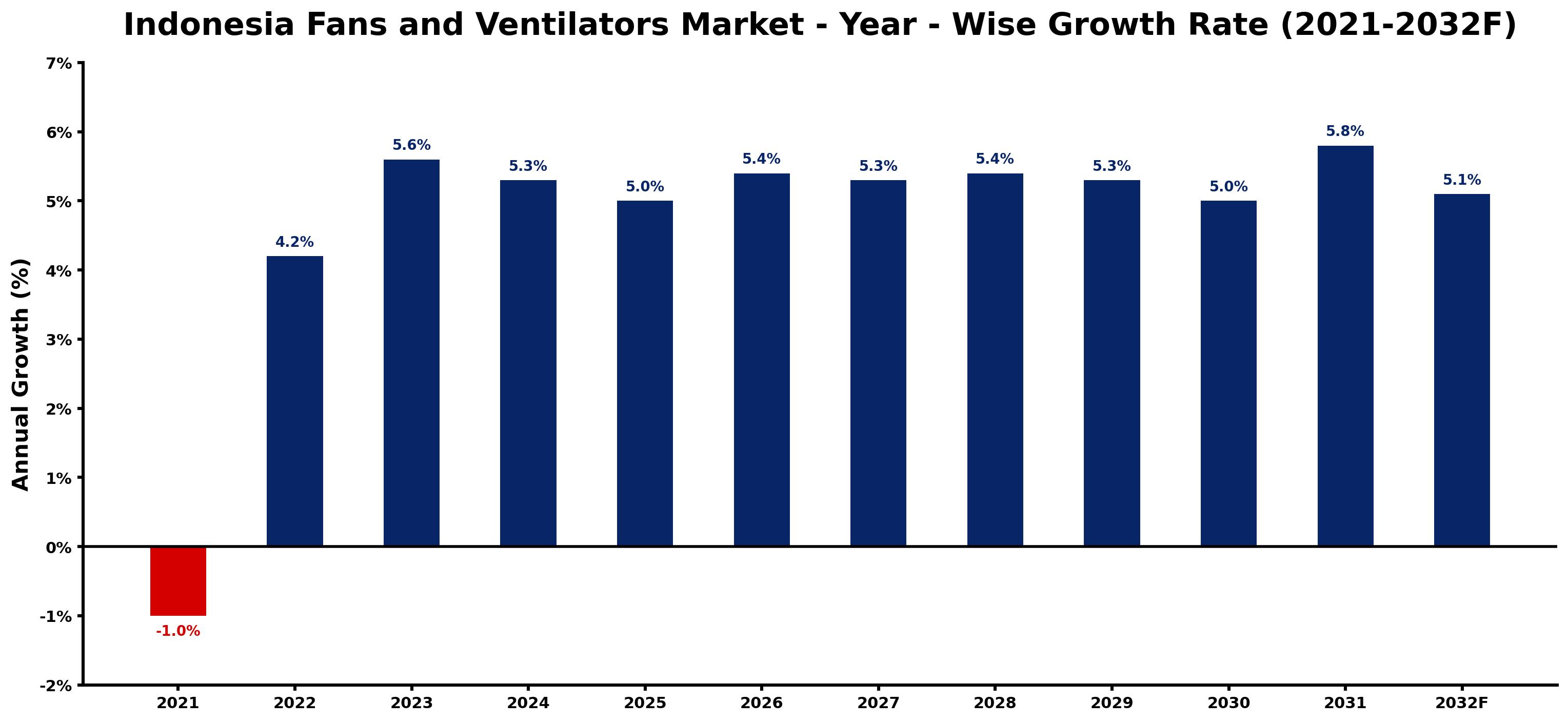
The table below presents the year wise growth rates along with the key drivers influencing the market
| Year | Growth Rate | Major Drivers |
| 2021 | -1.0% | Supply chain disruptions caused by the pandemic hindered product availability, diminishing sales in the fans and ventilators sector. |
| 2022 | 4.2% | Local manufacturing facilities began integrating energy-efficient ventilation systems to reduce costs. |
| 2023 | 5.6% | Awareness of indoor air quality problems prompted consumers to invest in advanced ventilation units. |
| 2024 | 5.3% | Climate change discussions heightened focus on sustainable cooling technologies among urban planners. |
| 2025 | 5.0% | Emerging middle-class consumers prioritize home comfort, driving growth in fan and ventilator sales. |
| 2026 | 5.4% | E-commerce platforms facilitated easier access to diverse ventilation products across various regions. |
| 2027 | 5.3% | Smart home technology trends encouraged investment in automated ventilation systems among homeowners. |
| 2028 | 5.4% | Urban development projects increasingly incorporate energy-efficient ventilation into new building designs. |
| 2029 | 5.3% | Health and wellness trends emphasize the importance of air quality, influencing consumer purchases significantly. |
| 2030 | 5.0% | Rising disposable incomes enable consumers to opt for premium ventilation solutions and brands. |
| 2031 | 5.8% | Technological innovations introduced more compact and efficient fans catering to diverse spaces. |
| 2032 | 5.1% | Partnerships between manufacturers and local firms enhanced distribution networks, improving market penetration. |
Note - Market size estimations and growth projections presented in this report are based on 6Wresearch's advanced forecasting approach, validated with industry datasets as of June 2026.
Indonesia Fans and Ventilators Market Synopsis
The Indonesia Fans and Ventilators Market is projected to reach 5.4% and witness significant growth during the forecast period (2026-2032). This anticipated growth is primarily driven by the increasing demand for air conditioning systems across various sectors, encompassing residential, commercial, and industrial applications. Coupled with this demand is the rising focus on energy efficiency, prompted by escalating electricity prices in the region. Furthermore, government initiatives aimed at promoting the deployment of advanced fans and ventilators are expected to significantly influence market dynamics during this time frame.
Indonesia Fans and Ventilators Market Growth Drivers
The growth of the Indonesia Fans and Ventilators Market can be attributed to several key factors:
- One of the primary drivers is the surging demand for air conditioning systems, largely instigated by rising temperatures attributed to climate change. This trend has led to increased investments in energy-efficient air conditioning units that concurrently boost the sales of fans and ventilators.
- The construction sector is experiencing a boom as the Indonesian government accelerates infrastructure development projects, including roads and bridges. These developments necessitate efficient ventilation systems, thereby amplifying the demand for fans and ventilators.
- Growing urbanization is another factor, with increasing population density in urban areas creating a pressing need for effective ventilation solutions. Residential and commercial establishments are seeking innovative products to ensure adequate airflow.
- The market is also benefiting from heightened awareness surrounding indoor air quality. Consumers are actively seeking products that can improve air circulation and ensure healthier living environments.
- Finally, the rising costs of electricity have intensified the search for energy-efficient solutions, leading to the adoption of advanced fans and ventilators designed to minimize energy consumption while maintaining optimal performance.
Indonesia Fans and Ventilators Market Trends and Opportunities
As the Indonesia Fans and Ventilators Market progresses towards 2032, several trends and opportunities are emerging:
- The shift towards smart technology integration in ventilation systems is notable, with increasing incorporation of IoT and smart controls that enhance user convenience and operational efficiency.
- There is a growing preference for eco-friendly and sustainable products, aligning with global trends towards sustainability. This presents opportunities for manufacturers to innovate and provide energy-efficient fans and ventilators.
- The post-pandemic recovery phase is expected to spur demand for air circulation systems in commercial spaces, as businesses focus on enhancing air quality to ensure safety in workplaces.
- With increasing disposable incomes, there is a marked rise in consumer expenditure on home improvement products, including advanced ventilation solutions that cater to aesthetic and functional needs.
- Expansion in the e-commerce sector offers a robust channel for the distribution of fans and ventilators, enabling manufacturers to reach a wider audience in urban and rural areas alike.
Indonesia Fans and Ventilators Market Challenges and Restraints
While the market holds significant growth potential, several challenges may impact its trajectory:
- Fluctuations in raw material prices can lead to increased production costs, challenging manufacturers' margins and potentially leading to higher consumer prices.
- Competition from low-cost alternatives presents a challenge, as price-sensitive consumers may opt for cheaper products that compromise on quality and efficiency.
- Limited awareness regarding the benefits of high-efficiency products may hinder market penetration, especially in rural areas where traditional solutions remain prevalent.
- Regulatory hurdles related to product approvals and standards may pose barriers to market entry for new players or innovative products.
- Finally, economic instability or downturns can adversely affect consumer spending on non-essential items, potentially slowing down market growth.
Indonesia Fans and Ventilators Market Government Investment and Initiatives
The Indonesian government is playing an active role in fostering the growth of the fans and ventilators market through a variety of investment and policy initiatives:
- Significant public spending on infrastructure projects, such as highways and urban development, is creating a demand for advanced ventilation systems, thus driving market growth.
- Government incentives, including tax credits for energy-efficient appliances, are encouraging both consumers and businesses to invest in high-quality fans and ventilators.
- Public awareness campaigns regarding energy consumption and air quality are promoting the adoption of more efficient products, benefiting the overall market.
- Policy frameworks aimed at reducing carbon emissions are also promoting the use of energy-efficient ventilation systems, aligning with the global shift towards sustainability.
- Collaborations between public and private sectors aimed at enhancing technology and infrastructure in the ventilation space are likely to create additional growth avenues.
Indonesia Fans and Ventilators Market Latest Developments (May 2025 - June 2026)
Recent developments in the Indonesia Fans and Ventilators Market reflect a rapidly evolving industry landscape:
- Manufacturers are increasingly launching innovative energy-efficient fan and ventilator models, designed to meet growing consumer demands for sustainability and efficiency.
- Advancements in smart technology have led to the introduction of connected ventilation systems that allow for automated control and monitoring, enhancing user experience.
- Trade exhibitions and industry events have seen a significant increase in participation, highlighting the sector's growth and the emphasis on showcasing cutting-edge technology.
- There has been a marked increase in research and development activities focused on optimizing airflow and energy consumption, with firms dedicating resources to enhance product offerings.
- Consumer preferences have shifted towards multifunctional units that combine cooling, heating, and air purification features, reflecting a trend toward holistic home climate management solutions.
Indonesia Fans and Ventilators Market - Key Attractiveness of the Report
- 10 Years of Market Numbers
- Historical Data Starting from 2022 to 2025
- Base Year: 2025
- Forecast Data until 2032
- Key Performance Indicators Impacting the Market
- Major Upcoming Developments and Projects
Key Highlights of the Report:
- Indonesia Fans and Ventilators Market Outlook
- Market Size of Indonesia Fans and Ventilators Market, 2025
- Forecast of Indonesia Fans and Ventilators Market, 2032F
- Historical Data and Forecast of Indonesia Fans and Ventilators Revenues & Volume for the Period 2022-2032F
- Indonesia Fans and Ventilators Market Trend Evolution
- Indonesia Fans and Ventilators Market Drivers and Challenges
- Indonesia Fans and Ventilators Price Trends
- Indonesia Fans and Ventilators Porter's Five Forces
- Indonesia Fans and Ventilators Industry Life Cycle
- Historical Data and Forecast of Indonesia Fans and Ventilators Market Revenues & Volume By Material for the Period 2022-2032F
- Historical Data and Forecast of Indonesia Fans and Ventilators Market Revenues & Volume By Metal for the Period 2022-2032F
- Historical Data and Forecast of Indonesia Fans and Ventilators Market Revenues & Volume By Composite for the Period 2022-2032F
- Historical Data and Forecast of Indonesia Fans and Ventilators Market Revenues & Volume By Rubber for the Period 2022-2032F
- Historical Data and Forecast of Indonesia Fans and Ventilators Market Revenues & Volume By Plastic for the Period 2022-2032F
- Historical Data and Forecast of Indonesia Fans and Ventilators Market Revenues & Volume By Application for the Period 2022-2032F
- Historical Data and Forecast of Indonesia Fans and Ventilators Market Revenues & Volume By Interior for the Period 2022-2032F
- Historical Data and Forecast of Indonesia Fans and Ventilators Market Revenues & Volume By Exterior for the Period 2022-2032F
- Historical Data and Forecast of Indonesia Fans and Ventilators Market Revenues & Volume By Structural for the Period 2022-2032F
- Historical Data and Forecast of Indonesia Fans and Ventilators Market Revenues & Volume By Powertrain for the Period 2022-2032F
- Historical Data and Forecast of Indonesia Fans and Ventilators Market Revenues & Volume By Vehicle Types for the Period 2022-2032F
- Historical Data and Forecast of Indonesia Fans and Ventilators Market Revenues & Volume By Passenger Vehicles for the Period 2022-2032F
- Historical Data and Forecast of Indonesia Fans and Ventilators Market Revenues & Volume By Light Commercial Vehicles for the Period 2022-2032F
- Historical Data and Forecast of Indonesia Fans and Ventilators Market Revenues & Volume By Heavy Commercial Vehicles for the Period 2022-2032F
- Indonesia Fans and Ventilators Import Export Trade Statistics
- Market Opportunity Assessment By Material
- Market Opportunity Assessment By Application
- Market Opportunity Assessment By Vehicle Types
- Indonesia Fans and Ventilators Top Companies Market Share
- Indonesia Fans and Ventilators Competitive Benchmarking By Technical and Operational Parameters
- Indonesia Fans and Ventilators Company Profiles
- Indonesia Fans and Ventilators Key Strategic Recommendations






































