Indonesia Food Additives Market: Import Trend Analysis
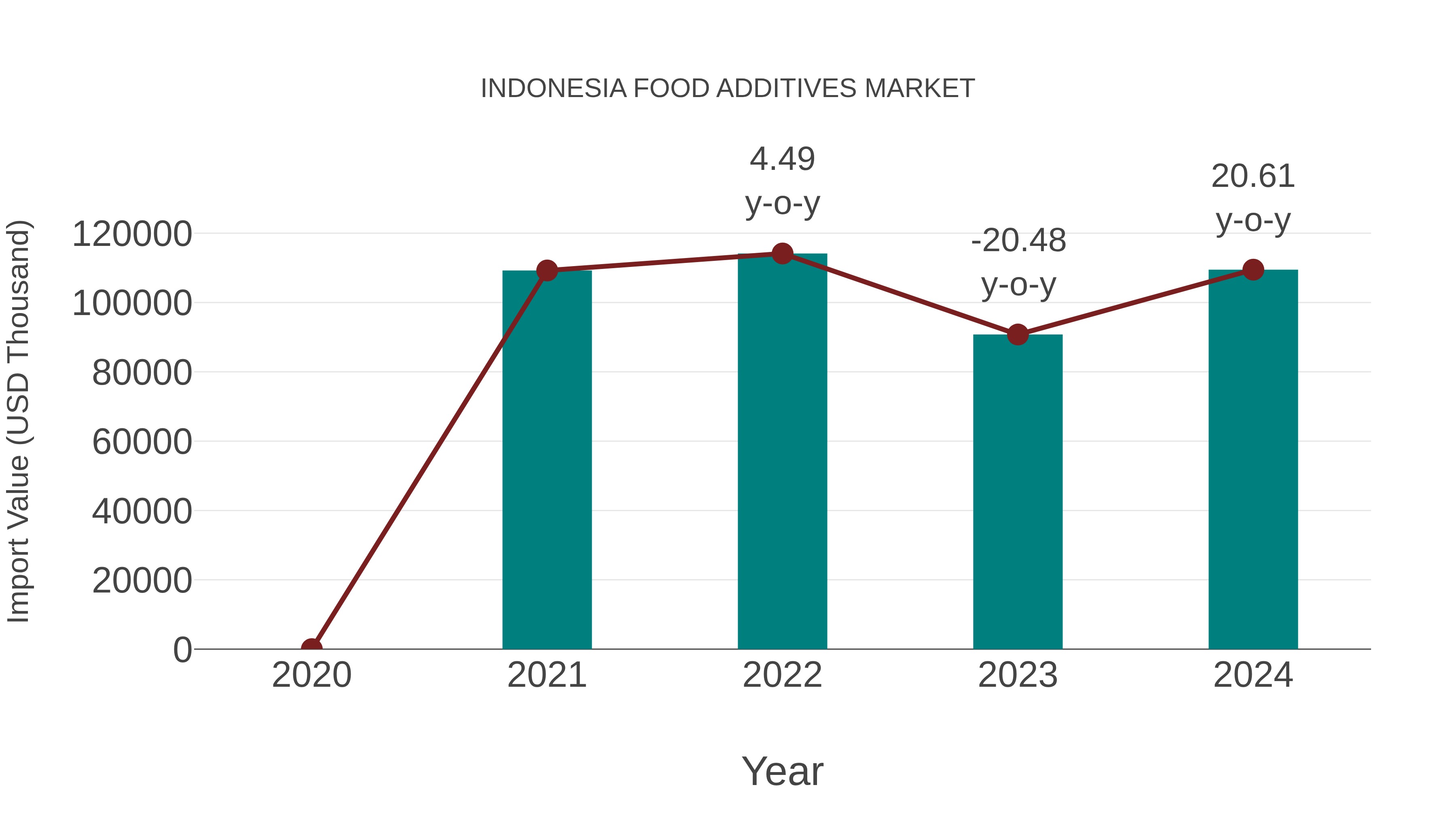
In the Indonesia food additives market, the import trend exhibited notable growth from 2023 to 2024, with a growth rate of 20.61%. The compound annual growth rate (CAGR) for the period 2020-2024 stood at 0.07%. This uptick in import momentum can be attributed to evolving consumer preferences and increased demand for diverse food products, driving the need for a wider range of food additives in the market.
Indonesia Food Additives Market Overview
The food additives market in Indonesia has witnessed significant growth in recent years, driven by the rising demand for processed and convenience foods. With a growing population and changing consumer preferences, the market has been characterized by a surge in the use of various food additives, such as preservatives, flavor enhancers, and colorants, to enhance the taste, appearance, and shelf life of food products. Manufacturers are increasingly focusing on producing natural and clean-label additives to cater to the health-conscious segment of the market.
Drivers of the Market
The Indonesia Food Additives Market is propelled by the expanding processed food industry. Food additives play a crucial role in enhancing the shelf life, texture, flavor, and appearance of packaged food products. The market is further driven by the increasing consumer awareness about food safety and the need for natural and clean label ingredients. Additionally, the demand for convenience foods and ready-to-eat meals is boosting the utilization of food additives in the Indonesian market.
Challenges of the Market
One of the significant challenges facing the food additives market in Indonesia is the need for strict adherence to regulations and safety standards. Ensuring that additives are used in appropriate quantities without compromising food safety and consumer health is a constant challenge.
COVID-19 Impacts on the Market
The COVID-19 pandemic had a notable impact on Indonesia`s food additives market. With the closure or limited operation of restaurants and foodservice outlets, the demand for food additives declined. Home cooking, however, created a surge in the retail sector. The market experienced fluctuations in demand, and manufacturers faced challenges related to supply chain disruptions and adapting to changing consumer preferences.
Key Players of the Makret
The food additives market in Indonesia is a dynamic and evolving sector with several key players. Some of the major companies contributing to this market include PT. Budi Acid Jaya, Prambanan Kencana, and PT. Essentra Indonesia. These companies are actively involved in providing a wide range of food additives, including preservatives, sweeteners, and flavor enhancers, to meet the growing demand for processed and convenience foods in Indonesia.
Key Highlights of the Report:
- Indonesia Food Additives Market Outlook
- Market Size of Indonesia Food Additives Market, 2025
- Forecast of Indonesia Food Additives Market, 2032
- Historical Data and Forecast of Indonesia Food Additives Revenues & Volume for the Period 2022-2032F
- Indonesia Food Additives Market Trend Evolution
- Indonesia Food Additives Market Drivers and Challenges
- Indonesia Food Additives Price Trends
- Indonesia Food Additives Porter's Five Forces
- Indonesia Food Additives Industry Life Cycle
- Historical Data and Forecast of Indonesia Food Additives Market Revenues & Volume By Type for the Period 2022-2032F
- Historical Data and Forecast of Indonesia Food Additives Market Revenues & Volume By Acidulants for the Period 2022-2032F
- Historical Data and Forecast of Indonesia Food Additives Market Revenues & Volume By Colors for the Period 2022-2032F
- Historical Data and Forecast of Indonesia Food Additives Market Revenues & Volume By Emulsifiers for the Period 2022-2032F
- Historical Data and Forecast of Indonesia Food Additives Market Revenues & Volume By Flavors for the Period 2022-2032F
- Historical Data and Forecast of Indonesia Food Additives Market Revenues & Volume By Hydrocolloids for the Period 2022-2032F
- Historical Data and Forecast of Indonesia Food Additives Market Revenues & Volume By Preservatives for the Period 2022-2032F
- Historical Data and Forecast of Indonesia Food Additives Market Revenues & Volume By Sweeteners for the Period 2022-2032F
- Historical Data and Forecast of Indonesia Food Additives Market Revenues & Volume By Source for the Period 2022-2032F
- Historical Data and Forecast of Indonesia Food Additives Market Revenues & Volume By Natural for the Period 2022-2032F
- Historical Data and Forecast of Indonesia Food Additives Market Revenues & Volume By Synthetic for the Period 2022-2032F
- Historical Data and Forecast of Indonesia Food Additives Market Revenues & Volume By Application for the Period 2022-2032F
- Historical Data and Forecast of Indonesia Food Additives Market Revenues & Volume By Bakery & Confectionery for the Period 2022-2032F
- Historical Data and Forecast of Indonesia Food Additives Market Revenues & Volume By Beverages for the Period 2022-2032F
- Historical Data and Forecast of Indonesia Food Additives Market Revenues & Volume By Dairy & Frozen Desserts for the Period 2022-2032F
- Indonesia Food Additives Import Export Trade Statistics
- Market Opportunity Assessment By Type
- Market Opportunity Assessment By Source
- Market Opportunity Assessment By Application
- Indonesia Food Additives Top Companies Market Share
- Indonesia Food Additives Competitive Benchmarking By Technical and Operational Parameters
- Indonesia Food Additives Company Profiles
- Indonesia Food Additives Key Strategic Recommendations






































