Indonesia Glass Ceramics Market Size, Share & Growth Rate
The Indonesia Glass Ceramics Market was estimated at USD 158 Million in 2025 and is projected to reach USD 209 Million by 2032, growing at a CAGR of 4.1% from 2026 to 2032. This promising trajectory is fueled by the booming construction sector, where glass ceramics are increasingly favored for their thermal insulation properties and aesthetic versatility. As urbanization continues and energy-efficient building practices gain traction, the demand for high-quality glass ceramics is expected to follow suit, further enhancing market dynamics.
Indonesia Glass Ceramics Market Year-wise Growth Rate and Key Drivers
This graph highlights how the Indonesia Glass Ceramics Market has steadily grown over the years, supported by major growth factors.
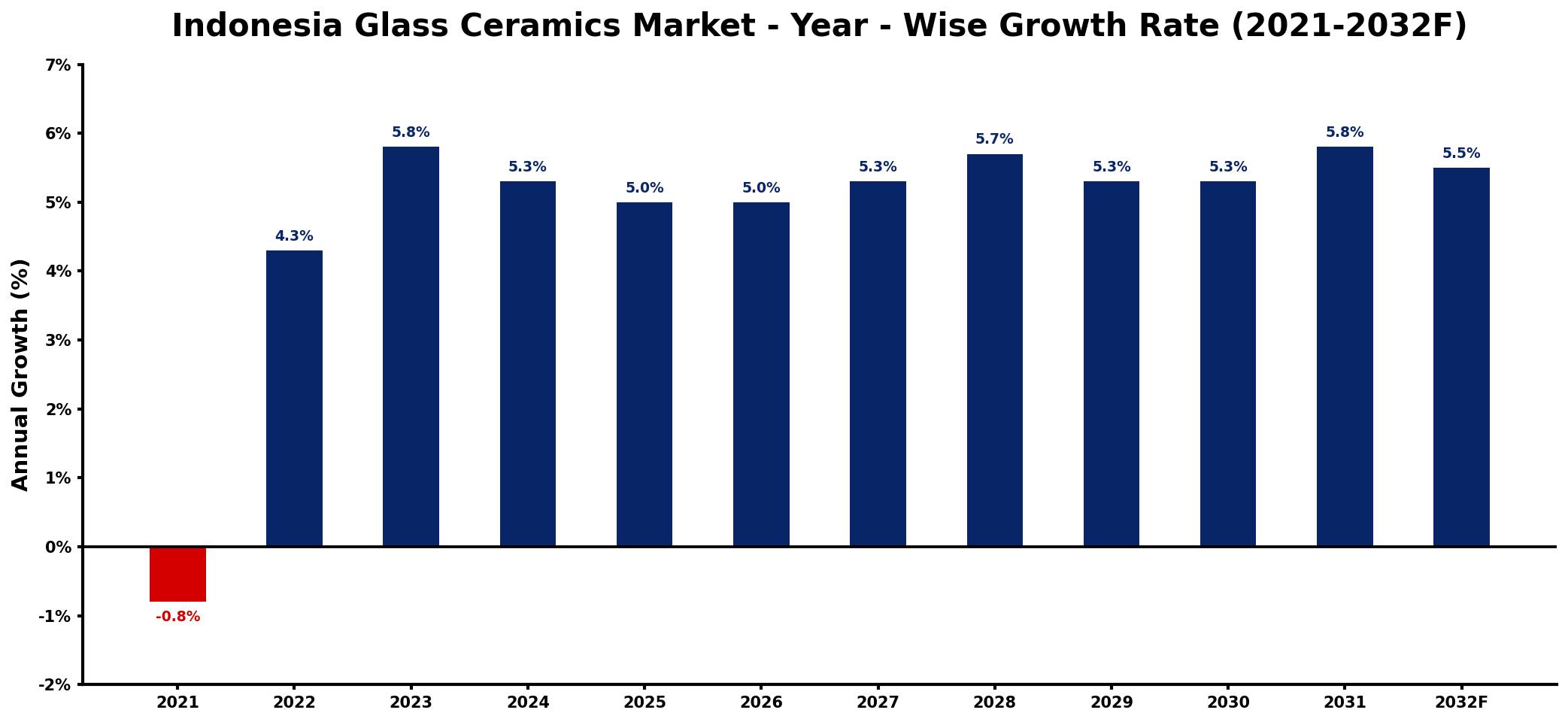
The table below presents the year‑wise growth rates along with the key drivers influencing the market
| Year | Growth Rate | Major Drivers |
| 2021 | -0.8% | Construction projects experiencing slowdown |
| 2022 | 4.3% | Rising demand from construction industry |
| 2023 | 5.8% | Increased investment in infrastructure projects |
| 2024 | 5.3% | Expansion of residential building sector |
| 2025 | 5.0% | Growing popularity of sustainable materials |
| 2026 | 5.0% | Revitalization of urban development initiatives |
| 2027 | 5.3% | Surge in export opportunities abroad |
| 2028 | 5.7% | Technological advancements driving efficiency |
| 2029 | 5.3% | Increased focus on decorative applications |
| 2030 | 5.3% | Strengthening of local manufacturing capabilities |
| 2031 | 5.8% | Heightened consumer awareness of aesthetics |
| 2032 | 5.5% | Broadening range of innovative uses |
Note: Market size estimations and growth projections presented in this report are based on 6Wresearch's proprietary forecasting methodology, utilizing the latest available industry data, government publications, and primary research inputs.
Indonesia Glass Ceramics Market Synopsis
The strongest force currently shaping the Indonesia Glass Ceramics Market is the burgeoning demand from the construction and interior design sectors. With a growing focus on sustainability and aesthetic appeal, glass ceramics are being integrated into various applications ranging from kitchen countertops to decorative tiles, creating new opportunities for manufacturers and investors alike.
Moreover, the increased adoption of glass ceramics in industries such as automotive and electronics underscores their versatility and functionality. As these sectors evolve, the ability to innovate and cater to specific application needs will be critical for market players looking to capitalize on this upward trend.
Indonesia Glass Ceramics Market Key Takeaways
- Steady market growth driven by robust construction and renovation activities.
- Rising demand for energy-efficient and sustainable building materials.
- Increasing applications in automotive and electronics sectors enhance market potential.
- Focus on innovation in production techniques is essential for competitive advantage.
- Strategic partnerships with local manufacturers can drive market penetration.
Evaluation of Restraints in Indonesia Glass Ceramics Market
Despite the positive outlook, several restraints are influencing the Indonesia Glass Ceramics Market. Production efficiency remains a significant challenge, as manufacturers must adapt to evolving consumer demands for advanced glass ceramics that balance enhanced properties with cost-effectiveness. Additionally, limited material diversity may hinder the development of niche applications, necessitating innovation and investment to broaden the product range. Addressing these constraints will be vital for companies aiming to maintain a competitive edge in this dynamic market.
Indonesia Glass Ceramics Market Trends
Current trends indicate a growing preference for multifunctional glass ceramics that not only serve aesthetic purposes but also contribute to energy efficiency. With consumers and builders increasingly favoring sustainable materials, manufacturers are adapting by incorporating eco-friendly practices into their production processes. Moreover, technological advancements in glass ceramics, aimed at enhancing their durability and usability, are becoming a focal point of market innovation.
Indonesia Glass Ceramics Market Opportunities
As Indonesia's economy continues to grow, significant opportunities lie in expanding applications for glass ceramics, especially in smart technology integration. The automotive and electronics sectors represent lucrative areas for investment, given their need for high-performance materials. Additionally, local manufacturers can leverage collaborations to enhance their technological capabilities and market reach, thereby unlocking new avenues for growth.
Government Initiatives in the Indonesia Glass Ceramics Market
The Indonesian government is increasingly prioritizing sustainable construction practices through various initiatives and incentives aimed at promoting energy-efficient building materials. Public spending on infrastructure development is set to enhance the overall market environment for glass ceramics, as these materials align well with the national agenda of fostering green construction. Collaboration with industry players will be crucial to realize these policy goals.
Future Insights of the Indonesia Glass Ceramics Market
Looking ahead to 2026-2032, the Indonesia Glass Ceramics Market is poised for significant growth, supported by continuous urbanization and a shift toward sustainability in construction. The anticipated increase in renovation projects alongside new constructions will drive demand for aesthetically pleasing and durable glass ceramics. Furthermore, as technological innovations lead to enhanced product offerings, the market is likely to witness a diversification of applications, enabling companies to adapt to changing consumer preferences.
Indonesia Glass Ceramics Market Latest Developments (2025 - 2026)
The Indonesia Glass Ceramics Market has seen notable direction in recent months, characterized by a resurgence in construction activities and an emphasis on sustainable materials. Companies are focusing on developing innovative glass ceramics that cater to the needs of both construction and electronics applications. Moreover, industry players are increasingly seeking collaborations with local entities to enhance distribution networks and meet regional demand more effectively.
Indonesia Glass Ceramics Market - Key Attractiveness of the Report
- 10 Years of Market Numbers
- Historical Data Starting from 2022 to 2025
- Base Year: 2025
- Forecast Data until 2032
- Key Performance Indicators Impacting the Market
- Major Upcoming Developments and Projects
The Indonesia Glass Ceramics Market was estimated at USD 158 Million in 2025 and is projected to reach USD 209 Million by 2032, growing at a CAGR of 4.1% from 2026 to 2032. This growth is primarily fueled by the increasing demand from construction and renovation activities.
The automotive sector is a critical demand driver, utilizing glass ceramics in applications such as sensors and display panels. As vehicle technologies evolve, the need for advanced materials like glass ceramics will likely increase, enhancing their market presence.
Sustainability is a key factor in the market's expansion, with builders and consumers increasingly prioritizing eco-friendly materials. Glass ceramics meet these requirements, making them a preferred choice for energy-efficient construction.
Manufacturers face challenges around production efficiency and the need for diversified material properties to meet consumer demands. Innovations will be crucial for addressing these challenges while keeping costs manageable.
Collaborations with local manufacturers enhance market access and distribution capabilities, allowing larger companies to cater more effectively to regional demands and preferences.
Key Highlights of the Report:
- Indonesia Glass Ceramics Market Outlook
- Market Size of Indonesia Glass Ceramics Market, 2025
- Forecast of Indonesia Glass Ceramics Market, 2032
- Historical Data and Forecast of Indonesia Glass Ceramics Revenues & Volume for the Period 2022-2032F
- Indonesia Glass Ceramics Market Trend Evolution
- Indonesia Glass Ceramics Market Drivers and Challenges
- Indonesia Glass Ceramics Price Trends
- Indonesia Glass Ceramics Porter's Five Forces
- Indonesia Glass Ceramics Industry Life Cycle
- Historical Data and Forecast of Indonesia Glass Ceramics Market Revenues & Volume By Material for the Period 2022-2032F
- Historical Data and Forecast of Indonesia Glass Ceramics Market Revenues & Volume By Lithium for the Period 2022-2032F
- Historical Data and Forecast of Indonesia Glass Ceramics Market Revenues & Volume By Mangnesium for the Period 2022-2032F
- Historical Data and Forecast of Indonesia Glass Ceramics Market Revenues & Volume By Zinc for the Period 2022-2032F
- Historical Data and Forecast of Indonesia Glass Ceramics Market Revenues & Volume By Application for the Period 2022-2032F
- Historical Data and Forecast of Indonesia Glass Ceramics Market Revenues & Volume By Building and Construction for the Period 2022-2032F
- Historical Data and Forecast of Indonesia Glass Ceramics Market Revenues & Volume By Electrical & Electronics for the Period 2022-2032F
- Historical Data and Forecast of Indonesia Glass Ceramics Market Revenues & Volume By Healthcare for the Period 2022-2032F
- Historical Data and Forecast of Indonesia Glass Ceramics Market Revenues & Volume By Aerospace for the Period 2022-2032F
- Historical Data and Forecast of Indonesia Glass Ceramics Market Revenues & Volume By Optical for the Period 2022-2032F
- Indonesia Glass Ceramics Import Export Trade Statistics
- Market Opportunity Assessment By Material
- Market Opportunity Assessment By Application
- Indonesia Glass Ceramics Top Companies Market Share
- Indonesia Glass Ceramics Competitive Benchmarking By Technical and Operational Parameters
- Indonesia Glass Ceramics Company Profiles
- Indonesia Glass Ceramics Key Strategic Recommendations






































