Indonesia Government Cloud Market Size & Growth Rate (2026-2032)
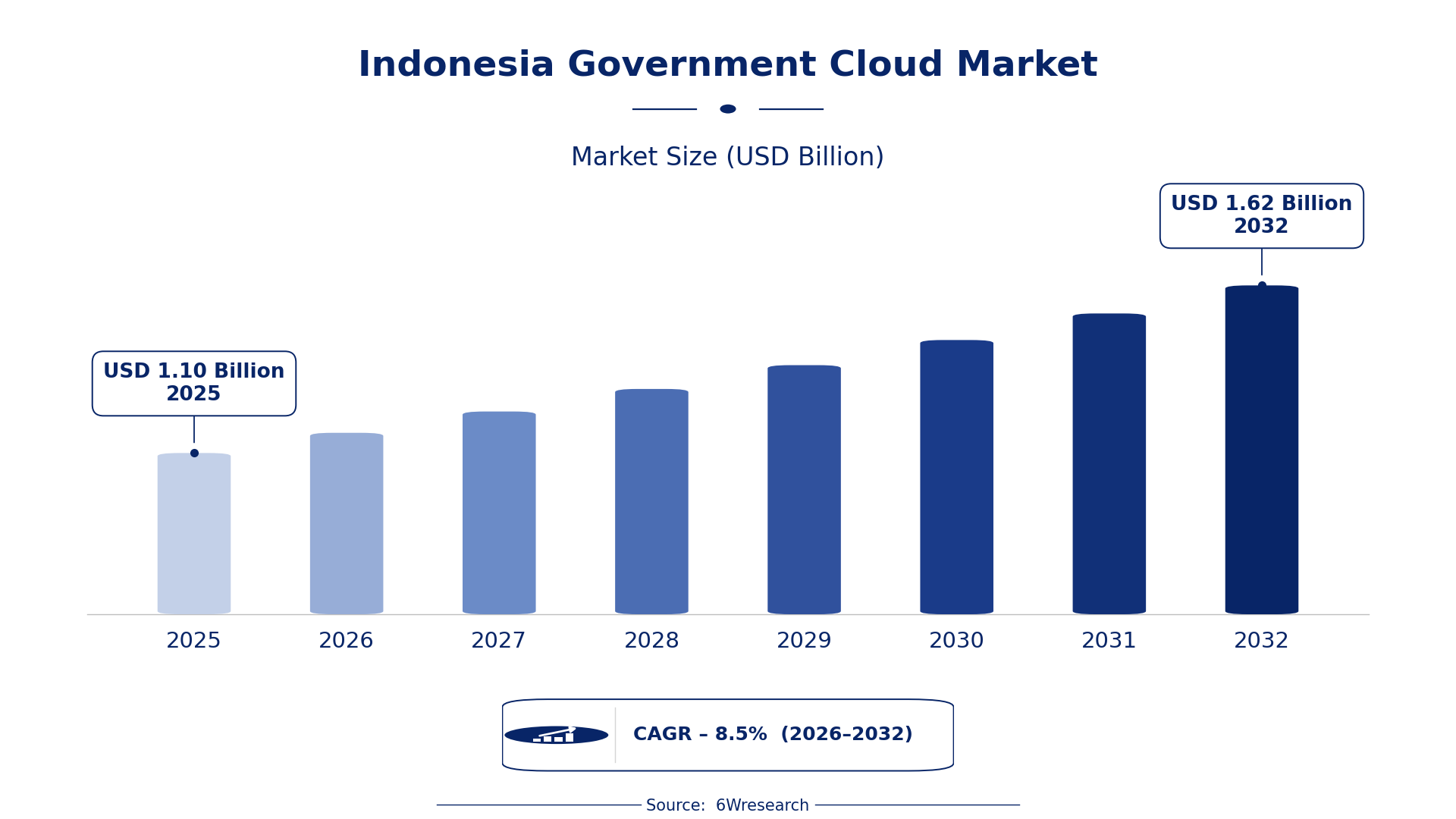
The Indonesia Government Cloud Market was estimated at USD 1101 Million in 2025 and is projected to reach USD 1616 Million by 2032, growing at a CAGR of 8.5% from 2026 to 2032.
Indonesia Government Cloud Market Synopsis
The Indonesia Government Cloud Market is experiencing a surge as public sector agencies recognize the efficiency and cost benefits of cloud computing. This shift is driven by a broader initiative to modernize IT infrastructures and improve citizen services through enhanced data management capabilities.
The urgency for adopting cloud solutions has intensified, especially in light of recent global challenges. As government bodies pivot towards digital platforms, the demand for secure, scalable cloud services is set to escalate, shaping the future of public service delivery in the nation.
Indonesia Government Cloud Market Year-wise Growth Rate and Key Drivers
This graph illustrates the annual growth rates of the Indonesia Government Cloud Market from 2021 to 2032, highlighting a steady upward trajectory and projected expansion over the forecast period.
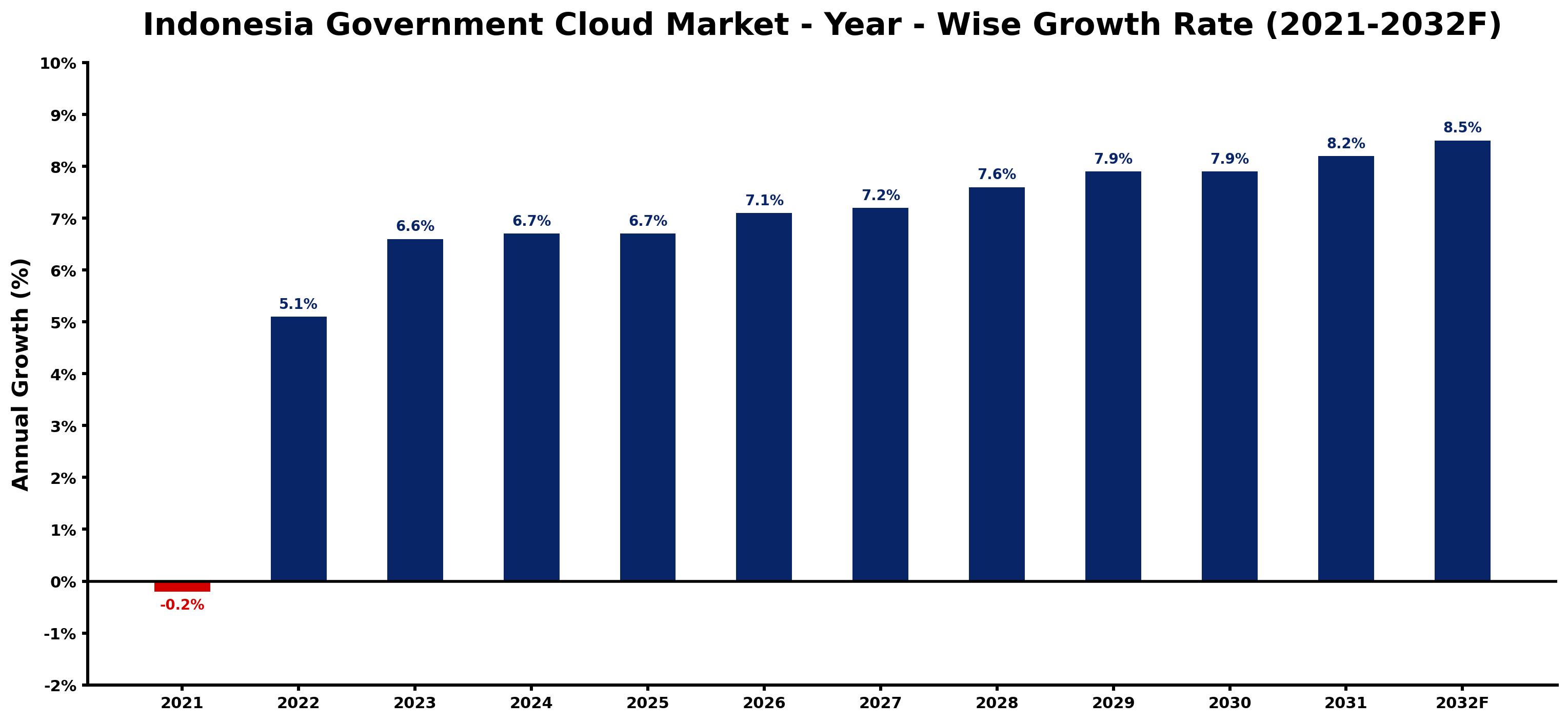
The table below presents the year‑wise growth rates along with the key drivers influencing the market
| Year | Growth Rate | Major Drivers |
| 2021 | -0.2% | Delays in government cloud adoption policies by PTSI |
| 2022 | 5.1% | Government adopting cloud-first policy for public services |
| 2023 | 6.6% | Increased focus on digital transformation by local governments |
| 2024 | 6.7% | Launching of Smart Nasional program encouraging cloud solutions |
| 2025 | 6.7% | Strengthening cybersecurity regulations driving cloud service adoption |
| 2026 | 7.1% | Investment in digital infrastructure boosting government cloud projects |
| 2027 | 7.2% | Rise in broadband penetration improving cloud access for institutions |
| 2028 | 7.6% | Local startups pushing innovation in public cloud services |
| 2029 | 7.9% | Partnerships between tech firms and government for cloud training |
| 2030 | 7.9% | Government initiatives supporting data-sharing across public sectors |
| 2031 | 8.2% | Implementation of digital identity systems increasing cloud dependency |
| 2032 | 8.5% | Growing awareness of climate resilience through cloud technologies |
Note: Market size estimations and growth projections presented in this report are based on 6Wresearch's proprietary forecasting methodology, utilizing the latest available industry data, government publications, and primary research inputs.
Indonesia Government Cloud Market Key Takeaways
Below are some of the specific key takeaways from the market, including:
- Cloud adoption by government agencies is primarily driven by needs for improved service delivery and cost efficiency.
- Data security and compliance with government regulations remain critical challenges in cloud deployments.
- The COVID-19 pandemic accelerated the adoption of cloud technologies for remote work and enhanced citizen services.
- Key players are offering tailored solutions to meet the unique requirements of Indonesia's public sector.
- Ongoing government initiatives are focused on enhancing digital infrastructure and regulatory compliance.
Evaluation of Restraints in Indonesia Government Cloud Market
The Indonesia Government Cloud Market faces several restraints that can hinder its growth trajectory. A primary concern is data security, as agencies manage sensitive information that necessitates stringent protection measures. Compliance with complex regulatory frameworks adds another layer of difficulty. on top of that, the challenge of interoperability between various governmental systems can create barriers to efficient data sharing, which is essential for seamless service delivery.
Indonesia Government Cloud Market Trends
Several trends are influencing the Indonesia Government Cloud Market. The shift towards hybrid cloud models is gaining traction, allowing agencies to balance between public and private cloud environments for optimal flexibility. Additionally, there is an increasing focus on using artificial intelligence and data analytics to improve service delivery and decision-making processes. Sustainability concerns are prompting public sector organizations to explore green cloud solutions, aligning with global environmental goals.
Indonesia Government Cloud Market Opportunities
Investment opportunities are plentiful as government agencies continue to digitize their operations. There is a growing demand for specialized cloud services that cater to specific governmental needs, such as cybersecurity and data compliance. Public-private partnerships are emerging as a strategic avenue for accelerating cloud adoption and enhancing infrastructure. on top of that, international collaboration in technology transfer can open up new avenues for growth.
Government Initiatives in the Indonesia Government Cloud Market
Government policy is significantly influencing the Indonesia Government Cloud Market, with a strong emphasis on digital transformation and regulatory compliance. Recent initiatives aim to establish a secure and efficient cloud infrastructure to better serve the public while ensuring that data governance standards are met. These efforts reflect a commitment to modernizing public services and improving operational efficiencies.
- A national digital infrastructure upgrade programme recently launched aims to enhance connectivity and cloud service accessibility across government agencies.
- Currently underway is a comprehensive review of existing regulations to streamline compliance requirements for cloud deployments in the public sector.
- A planned public-private initiative is expected to facilitate the integration of advanced cloud technologies into various governmental operations by 2028.
- The government has introduced a new framework to ensure transparency in cloud service billing, which is expected to be implemented by mid-2026.
- A nationwide training initiative targeting government employees is set to begin in early 2025, focusing on cloud technology proficiency and cybersecurity awareness.
Future Insights of the Indonesia Government Cloud Market
Looking ahead to 2026-2032, the Indonesia Government Cloud Market is likely to continue its upward trajectory, driven by ongoing digital transformation efforts. As agencies become more comfortable with cloud technology, we can expect an acceleration in service innovation and an expansion of cloud applications across various governmental functions. Enhanced focus on cybersecurity will also shape future cloud offerings, ensuring data protection remains a top priority.
Indonesia Government Cloud Market Latest Developments
In the past year, the Indonesia Government Cloud Market has seen significant developments as agencies ramp up their digital transformation efforts. Increased collaboration between government bodies and cloud service providers has resulted in the adoption of cutting-edge technologies tailored to meet public sector needs.
- A major technology vendor announced a partnership with a governmental agency to implement a cloud-based data analytics platform, which is currently ongoing.
- In early 2025, a leading regional operator launched a new cloud service specifically designed to enhance cybersecurity for government applications.
- A pilot programme aimed at integrating cloud services into local government operations began in Q3 2025 and remains underway.
- Plans for a comprehensive cloud migration initiative are set to kick off in mid-2026, focusing on transitioning legacy systems to cloud environments.
- A new research and development project, expected to start in late 2025, aims to explore innovative uses of AI within government cloud services.
Indonesia Government Cloud Market - Key Attractiveness of the Report
- 10 Years of Market Numbers
- Historical Data Starting from 2022 to 2025
- Base Year: 2025
- Forecast Data until 2032
- Key Performance Indicators Impacting the Market
- Major Upcoming Developments and Projects
Key Highlights of the Report:
- Indonesia Government Cloud Market Outlook
- Market Size of Indonesia Government Cloud Market, 2025
- Forecast of Indonesia Government Cloud Market, 2032
- Historical Data and Forecast of Indonesia Government Cloud Revenues & Volume for the Period 2022-2032F
- Indonesia Government Cloud Market Trend Evolution
- Indonesia Government Cloud Market Drivers and Challenges
- Indonesia Government Cloud Price Trends
- Indonesia Government Cloud Porter's Five Forces
- Indonesia Government Cloud Industry Life Cycle
- Historical Data and Forecast of Indonesia Government Cloud Market Revenues & Volume By Solutions for the Period 2022-2032F
- Historical Data and Forecast of Indonesia Government Cloud Market Revenues & Volume By Cloud Storage for the Period 2022-2032F
- Historical Data and Forecast of Indonesia Government Cloud Market Revenues & Volume By Disaster Recovery for the Period 2022-2032F
- Historical Data and Forecast of Indonesia Government Cloud Market Revenues & Volume By Identity and Access Management (IAM) for the Period 2022-2032F
- Historical Data and Forecast of Indonesia Government Cloud Market Revenues & Volume By Risk and compliance management for the Period 2022-2032F
- Historical Data and Forecast of Indonesia Government Cloud Market Revenues & Volume By Others (reporting and analytics, and security and vulnerability) for the Period 2022-2032F
- Historical Data and Forecast of Indonesia Government Cloud Market Revenues & Volume By Services for the Period 2022-2032F
- Historical Data and Forecast of Indonesia Government Cloud Market Revenues & Volume By Training, consulting, and education for the Period 2022-2032F
- Historical Data and Forecast of Indonesia Government Cloud Market Revenues & Volume By Support and Maintenance for the Period 2022-2032F
- Historical Data and Forecast of Indonesia Government Cloud Market Revenues & Volume By Integration and Migration for the Period 2022-2032F
- Historical Data and Forecast of Indonesia Government Cloud Market Revenues & Volume By Service Model for the Period 2022-2032F
- Historical Data and Forecast of Indonesia Government Cloud Market Revenues & Volume By Infrastructure as a Service (IaaS) for the Period 2022-2032F
- Historical Data and Forecast of Indonesia Government Cloud Market Revenues & Volume By Platform as a Service (PaaS) for the Period 2022-2032F
- Historical Data and Forecast of Indonesia Government Cloud Market Revenues & Volume By Software as a Service (SaaS) for the Period 2022-2032F
- Historical Data and Forecast of Indonesia Government Cloud Market Revenues & Volume By Deployment Model for the Period 2022-2032F
- Historical Data and Forecast of Indonesia Government Cloud Market Revenues & Volume By Public Cloud for the Period 2022-2032F
- Historical Data and Forecast of Indonesia Government Cloud Market Revenues & Volume By Private Cloud for the Period 2022-2032F
- Historical Data and Forecast of Indonesia Government Cloud Market Revenues & Volume By Hybrid Cloud for the Period 2022-2032F
- Indonesia Government Cloud Import Export Trade Statistics
- Market Opportunity Assessment By Solutions
- Market Opportunity Assessment By Services
- Market Opportunity Assessment By Service Model
- Market Opportunity Assessment By Deployment Model
- Indonesia Government Cloud Top Companies Market Share
- Indonesia Government Cloud Competitive Benchmarking By Technical and Operational Parameters
- Indonesia Government Cloud Company Profiles
- Indonesia Government Cloud Key Strategic Recommendations






































