Indonesia High Strength Steel Market Size, Share & Growth Rate
The Indonesia High Strength Steel Market was estimated at USD 477 Million in 2025 and is projected to reach USD 630 Million by 2032, growing at a CAGR of 4.1% from 2026 to 2032. This growth trajectory is fueled by the increasing demand from the automotive and aerospace sectors, which prioritize lightweight yet durable materials. As industries evolve towards greater efficiency and sustainability, high strength steel is emerging as a critical component in manufacturing processes across Indonesia.
Indonesia High Strength Steel Market Year-wise Growth Rate and Key Drivers
This graph highlights how the Indonesia High Strength Steel Market has steadily grown over the years, supported by major growth factors.
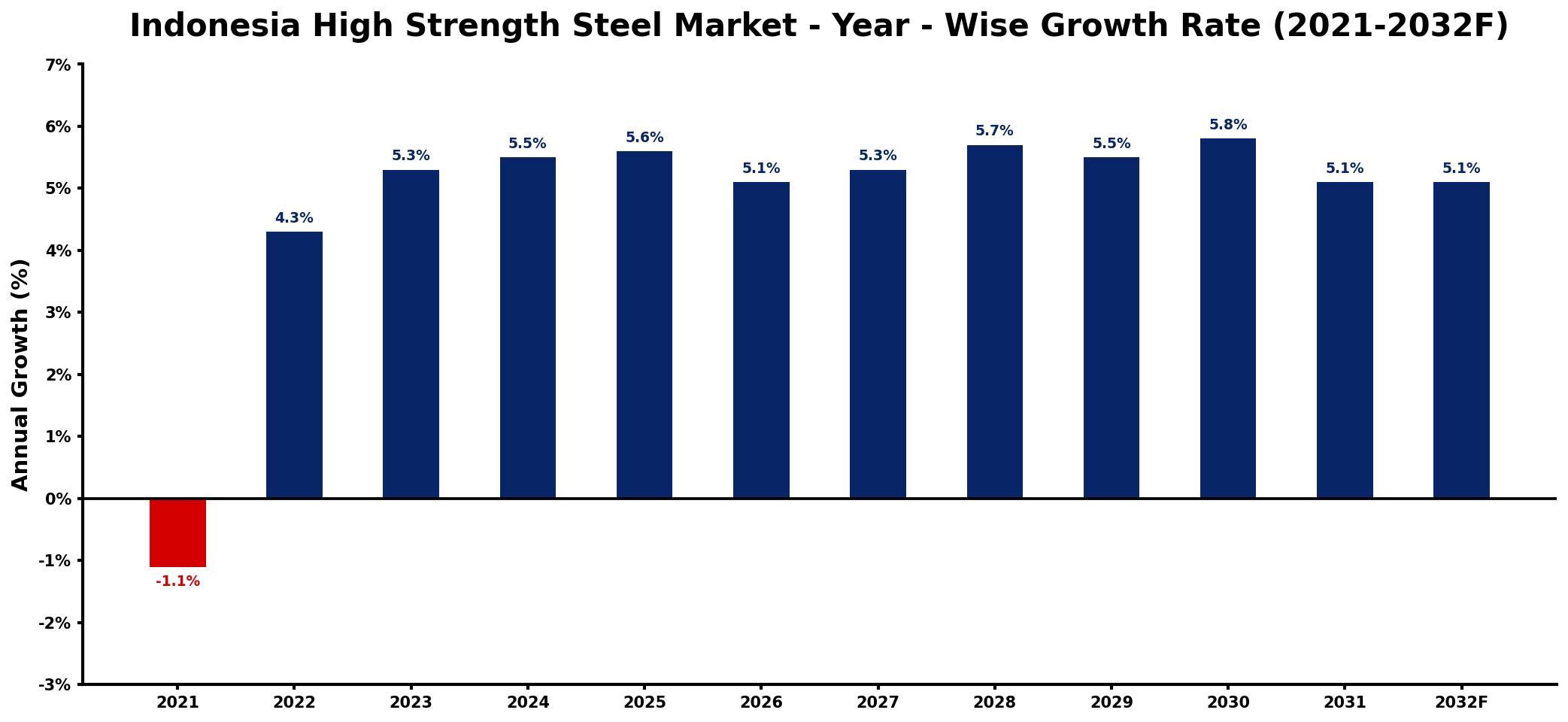
The table below presents the year‑wise growth rates along with the key drivers influencing the market
| Year | Growth Rate | Major Drivers |
| 2021 | -1.1% | decreased construction activity levels |
| 2022 | 4.3% | increased infrastructure investment projects |
| 2023 | 5.3% | growing automotive manufacturing demand |
| 2024 | 5.5% | expansion of renewable energy sector |
| 2025 | 5.6% | rising demand from shipbuilding industry |
| 2026 | 5.1% | increased urbanization and housing projects |
| 2027 | 5.3% | growing demand for green technologies |
| 2028 | 5.7% | expansion in rail transportation networks |
| 2029 | 5.5% | increased investment in construction equipment |
| 2030 | 5.8% | rising procurement volume requirements |
| 2031 | 5.1% | growing focus on sustainable practices |
| 2032 | 5.1% | increased demand from construction sector |
Note: Market size estimations and growth projections presented in this report are based on 6Wresearch's proprietary forecasting methodology, utilizing the latest available industry data, government publications, and primary research inputs.
Indonesia High Strength Steel Market Synopsis
The automotive industry's push for lightweight materials is the strongest force shaping the Indonesia High Strength Steel Market today. With vehicle manufacturers striving to enhance fuel efficiency, the demand for high strength steel is surging, driving innovation and production capabilities within the sector.
Simultaneously, the aerospace sector is increasingly relying on high strength steel for the construction of aircraft components that require exceptional strength-to-weight ratios. As these industries grow, the importance of advanced materials like high strength steel becomes undeniable, promising substantial opportunities for market participants.
Indonesia High Strength Steel Market Key Takeaways
- High strength steel is essential for lightweight design in the automotive and aerospace sectors.
- Construction projects are increasingly adopting high strength steel for durability and sustainability.
- The growing manufacturing sector in Indonesia is driving demand for advanced steel solutions.
- Infrastructure development initiatives are incorporating high strength steel to enhance structural integrity.
- Investment in R&D is critical for producing innovative steel grades to meet evolving industry needs.
Evaluation of Restraints in Indonesia High Strength Steel Market
While the market is experiencing notable growth, several restraints hinder its full potential. A key concern for producers is the need to invest heavily in advanced technology to meet stringent customer specifications and quality standards. The influx of imported high strength steel products presents additional competition, often at lower price points. Furthermore, fluctuations in global steel prices can impact local producers profit margins and overall competitiveness, requiring strategic management to navigate these challenges effectively.
Indonesia High Strength Steel Market Trends
One significant trend in the Indonesia High Strength Steel Market is the continuous evolution of manufacturing processes aimed at enhancing the properties of steel. Innovations are being introduced that not only improve performance but also focus on sustainability, which is increasingly important for industries such as automotive and construction. Additionally, collaborations between steel manufacturers and end-users are fostering the development of specialized grades that meet specific application needs, ensuring that high strength steel remains at the forefront of technological advancements.
Indonesia High Strength Steel Market Opportunities
As the market grows, substantial opportunities lie in expanding production capabilities to meet the rising demand across various sectors. Manufacturers are encouraged to explore partnerships with automotive and aerospace companies to tailor products that meet specific requirements. Additionally, the shift towards eco-friendly production methods presents avenues for investment in sustainable practices, potentially attracting environmentally conscious clients and projects. Furthermore, with Indonesia's ongoing infrastructure projects, there is a significant need for high-strength steel solutions, marking a ripe area for growth.
Government Initiatives in the Indonesia High Strength Steel Market
The Indonesian government is actively promoting initiatives aimed at boosting domestic manufacturing and infrastructure development, which directly benefit the high strength steel sector. Programs designed to improve industrial competitiveness include investment incentives and infrastructure upgrades. Additionally, policies encouraging the adoption of advanced materials in construction and manufacturing further support the growth of the high strength steel market. These governmental measures underscore the strategic importance of steel production in Indonesia's economic landscape.
Future Insights of the Indonesia High Strength Steel Market
Looking ahead to 2026-2032, the Indonesia High Strength Steel Market is expected to witness dynamic growth propelled by ongoing innovations and increasing industrial needs. As environmental sustainability becomes a focal point, the demand for high strength steel that offers weight reductions without compromising performance will intensify. Furthermore, advancements in production technologies are likely to yield new steel grades, enhancing the material's applicability across various sectors. This evolution not only positions high strength steel as a key player in the market but also aligns with Indonesia's broader economic objectives.
Indonesia High Strength Steel Market Latest Developments (2025 - 2026)
In recent months, the high strength steel industry has seen significant advancements in manufacturing techniques, with companies implementing cutting-edge technologies to optimize production efficiency. Additionally, partnerships between steel manufacturers and key industries have been established to co-develop new high-strength steel grades tailored for specific applications. As a result, the market is witnessing a proactive response to evolving consumer demands, which is set to bolster growth in the coming years.
Indonesia High Strength Steel Market - Key Attractiveness of the Report
- 10 Years of Market Numbers
- Historical Data Starting from 2022 to 2025
- Base Year: 2025
- Forecast Data until 2032
- Key Performance Indicators Impacting the Market
- Major Upcoming Developments and Projects
Key Highlights of the Report:
- Indonesia High Strength Steel Market Outlook
- Market Size of Indonesia High Strength Steel Market, 2025
- Forecast of Indonesia High Strength Steel Market, 2032
- Historical Data and Forecast of Indonesia High Strength Steel Revenues & Volume for the Period 2022-2032F
- Indonesia High Strength Steel Market Trend Evolution
- Indonesia High Strength Steel Market Drivers and Challenges
- Indonesia High Strength Steel Price Trends
- Indonesia High Strength Steel Porter's Five Forces
- Indonesia High Strength Steel Industry Life Cycle
- Historical Data and Forecast of Indonesia High Strength Steel Market Revenues & Volume By Product Type for the Period 2022-2032F
- Historical Data and Forecast of Indonesia High Strength Steel Market Revenues & Volume By Dual Phase Steel for the Period 2022-2032F
- Historical Data and Forecast of Indonesia High Strength Steel Market Revenues & Volume By Bake Hardenable Steel for the Period 2022-2032F
- Historical Data and Forecast of Indonesia High Strength Steel Market Revenues & Volume By Carbon Manganese Steel for the Period 2022-2032F
- Historical Data and Forecast of Indonesia High Strength Steel Market Revenues & Volume By Other Product Types for the Period 2022-2032F
- Historical Data and Forecast of Indonesia High Strength Steel Market Revenues & Volume By Application for the Period 2022-2032F
- Historical Data and Forecast of Indonesia High Strength Steel Market Revenues & Volume By Automotive for the Period 2022-2032F
- Historical Data and Forecast of Indonesia High Strength Steel Market Revenues & Volume By Construction for the Period 2022-2032F
- Historical Data and Forecast of Indonesia High Strength Steel Market Revenues & Volume By Yellow Goods and Mining Equipment for the Period 2022-2032F
- Historical Data and Forecast of Indonesia High Strength Steel Market Revenues & Volume By Aviation and Marine for the Period 2022-2032F
- Historical Data and Forecast of Indonesia High Strength Steel Market Revenues & Volume By Other Applications for the Period 2022-2032F
- Indonesia High Strength Steel Import Export Trade Statistics
- Market Opportunity Assessment By Product Type
- Market Opportunity Assessment By Application
- Indonesia High Strength Steel Top Companies Market Share
- Indonesia High Strength Steel Competitive Benchmarking By Technical and Operational Parameters
- Indonesia High Strength Steel Company Profiles
- Indonesia High Strength Steel Key Strategic Recommendations






































