Indonesia Industrial Machinery Market Size, Share & Growth Rate
The Indonesia Industrial Machinery Market was estimated at USD 322 Million in 2025 and is projected to reach USD 424 Million by 2032, growing at a CAGR of 4.0% from 2026 to 2032. This growth trajectory is primarily driven by Indonesia's aggressive push toward industrialization, with substantial investments in manufacturing and infrastructure development. The increasing demand for automation and advanced manufacturing technologies further amplifies the need for diverse industrial machinery across various sectors.
Indonesia Industrial Machinery Market Year-wise Growth Rate and Key Drivers
This graph highlights how the Indonesia Industrial Machinery Market has steadily grown over the years, supported by major growth factors.
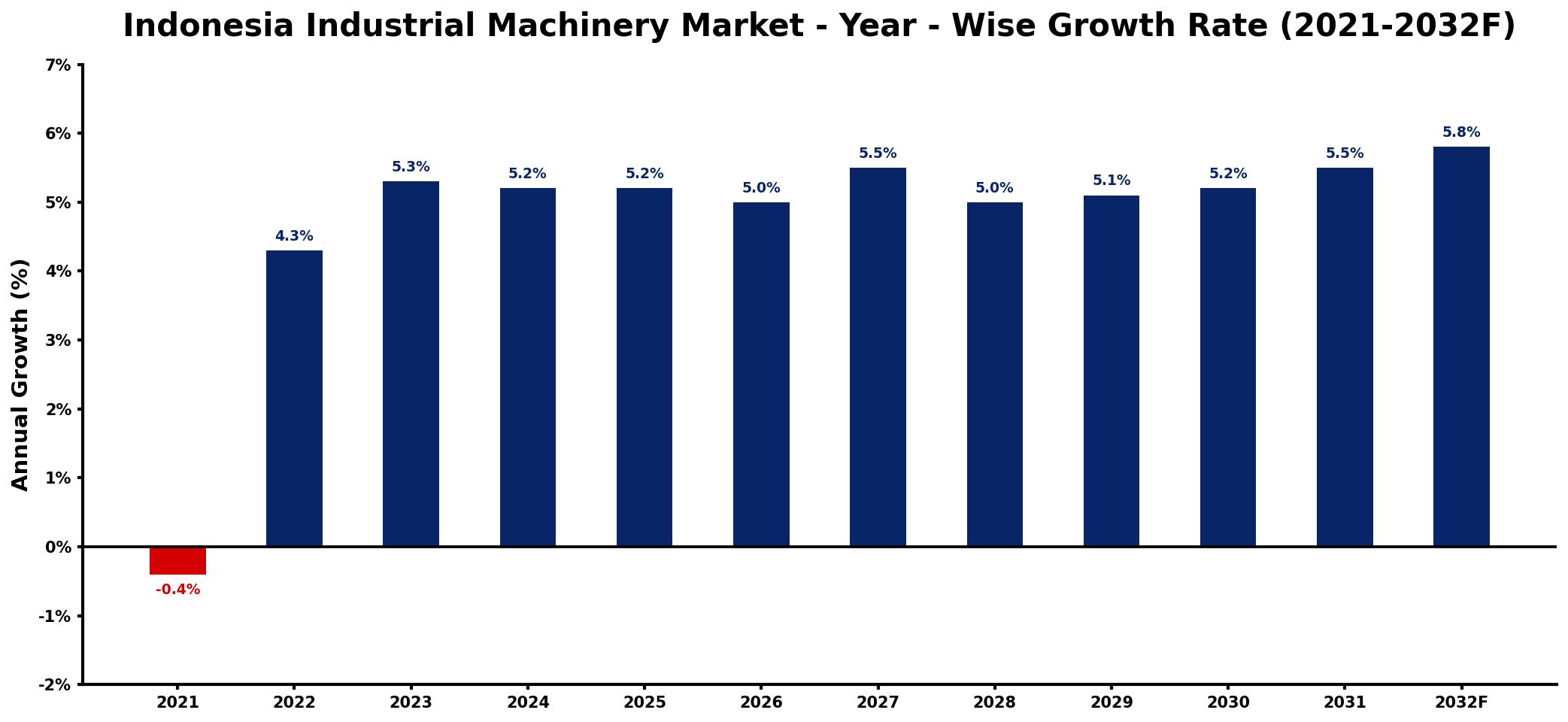
The table below presents the year‑wise growth rates along with the key drivers influencing the market
| Year | Growth Rate | Major Drivers |
| 2021 | -0.4% | decrease in construction activities |
| 2022 | 4.3% | increased foreign direct investment |
| 2023 | 5.3% | growing manufacturing sector demand |
| 2024 | 5.2% | expansion in renewable energy projects |
| 2025 | 5.2% | rise in automation initiatives |
| 2026 | 5.0% | enhanced infrastructure development plans |
| 2027 | 5.5% | growing demand for robotics solutions |
| 2028 | 5.0% | increased focus on sustainability practices |
| 2029 | 5.1% | expansion of logistics networks |
| 2030 | 5.2% | surge in export opportunities |
| 2031 | 5.5% | growing digitization of industries |
| 2032 | 5.8% | investment in smart technologies |
Note: Market size estimations and growth projections presented in this report are based on 6Wresearch's proprietary forecasting methodology, utilizing the latest available industry data, government publications, and primary research inputs.
Indonesia Industrial Machinery Market Synopsis
The most significant force shaping the Indonesia Industrial Machinery Market is the government's commitment to enhancing its manufacturing capabilities. With a strategic focus on infrastructure projects and modernization initiatives, the sector is gaining momentum, driving demand for heavy equipment and automation solutions.
Additionally, foreign investments are being welcomed to catalyze technological advancements, enabling local industries to access state-of-the-art machinery. This combination of local demand and international collaboration is integral to the market's ongoing evolution.
Indonesia Industrial Machinery Market Key Takeaways
- The market is characterized by robust growth driven by manufacturing sector expansion.
- Government infrastructure initiatives play a crucial role in stimulating demand for industrial machinery.
- Adoption of automation and advanced manufacturing technologies is reshaping the industry landscape.
- Collaboration with foreign entities is facilitating access to cutting-edge machinery and technology.
- Ongoing recovery from COVID-19 disruptions positions the market for renewed growth.
Evaluation of Restraints in Indonesia Industrial Machinery Market
Despite the positive outlook, the Indonesia Industrial Machinery Market faces significant restraints. Technological obsolescence is a critical concern; as industries shift toward advanced automation and smart manufacturing solutions, older machinery may struggle to remain competitive. Moreover, the shortage of skilled labor for both operation and maintenance of sophisticated equipment poses another challenge. Additionally, fluctuations in the global economic climate and trade restrictions can disrupt supply chains and affect market stability, impeding growth potential.
Indonesia Industrial Machinery Market Trends
Current trends in the Indonesia Industrial Machinery Market indicate a marked shift towards sustainability and efficiency. Companies are increasingly seeking machinery that not only enhances productivity but also minimizes environmental impact. Moreover, the adoption of Industry 4.0 principles, which integrate Internet of Things (IoT) and data analytics into manufacturing processes, is gaining traction. This evolution is fostering a competitive landscape where innovation drives demand for next-generation machinery.
Indonesia Industrial Machinery Market Opportunities
As Indonesia continues to industrialize, there are significant growth opportunities within the market. Sectors such as renewable energy, where machinery for solar and wind energy is critical, present a burgeoning area for investment. Furthermore, the ongoing urbanization in Indonesia fuels demand for construction and heavy machinery, particularly in infrastructure development. Collaborations between local manufacturers and international technology firms stand to create a rich landscape of innovation, ensuring long-term viability and growth in this sector.
Government Initiatives in the Indonesia Industrial Machinery Market
The Indonesian government is actively promoting the industrial machinery sector through various initiatives aimed at bolstering manufacturing capabilities. Public spending on infrastructure projects has surged, creating a conducive environment for machinery suppliers. Policy frameworks designed to facilitate foreign investments also play a pivotal role in attracting advanced technology into the market. These governmental efforts are not only enhancing domestic manufacturing but also ensuring that local industries remain competitive on a global scale.
Future Insights of the Indonesia Industrial Machinery Market
Looking ahead to 2026-2032, the Indonesia Industrial Machinery Market is poised for significant advancement. As industries continue to embrace automation and smart manufacturing practices, the demand for innovative machinery will rise correspondingly. Government-backed initiatives focusing on infrastructure and technology transfer will further bolster market growth. The influx of foreign investment and collaboration with international firms will enhance the technological capabilities of local industries, positioning the market to adapt and thrive amid evolving global standards.
Indonesia Industrial Machinery Market Latest Developments (2025 - 2026)
Recent developments in the Indonesia Industrial Machinery Market indicate a steady evolution toward greater automation and advanced technology integration. Industry participants are exploring partnerships and collaborations to leverage global innovations. Moreover, several key infrastructure projects are underway, fueling demand for construction and heavy machinery. As industries recover from the impacts of the COVID-19 pandemic, there is renewed optimism that the market will rebound and expand significantly.
Indonesia Industrial Machinery Market - Key Attractiveness of the Report
- 10 Years of Market Numbers
- Historical Data Starting from 2022 to 2025
- Base Year: 2025
- Forecast Data until 2032
- Key Performance Indicators Impacting the Market
- Major Upcoming Developments and Projects
Key Highlights of the Report:
- Indonesia Industrial Machinery Market Outlook
- Market Size of Indonesia Industrial Machinery Market, 2025
- Forecast of Indonesia Industrial Machinery Market, 2032
- Historical Data and Forecast of Indonesia Industrial Machinery Revenues & Volume for the Period 2022-2032F
- Indonesia Industrial Machinery Market Trend Evolution
- Indonesia Industrial Machinery Market Drivers and Challenges
- Indonesia Industrial Machinery Price Trends
- Indonesia Industrial Machinery Porter's Five Forces
- Indonesia Industrial Machinery Industry Life Cycle
- Historical Data and Forecast of Indonesia Industrial Machinery Market Revenues & Volume By Application for the Period 2022-2032F
- Historical Data and Forecast of Indonesia Industrial Machinery Market Revenues & Volume By Agriculture for the Period 2022-2032F
- Historical Data and Forecast of Indonesia Industrial Machinery Market Revenues & Volume By Construction for the Period 2022-2032F
- Historical Data and Forecast of Indonesia Industrial Machinery Market Revenues & Volume By Packaging for the Period 2022-2032F
- Historical Data and Forecast of Indonesia Industrial Machinery Market Revenues & Volume By Food Processing for the Period 2022-2032F
- Historical Data and Forecast of Indonesia Industrial Machinery Market Revenues & Volume By Mining for the Period 2022-2032F
- Historical Data and Forecast of Indonesia Industrial Machinery Market Revenues & Volume By Semiconductor Manufacturing for the Period 2022-2032F
- Indonesia Industrial Machinery Import Export Trade Statistics
- Market Opportunity Assessment By Application
- Indonesia Industrial Machinery Top Companies Market Share
- Indonesia Industrial Machinery Competitive Benchmarking By Technical and Operational Parameters
- Indonesia Industrial Machinery Company Profiles
- Indonesia Industrial Machinery Key Strategic Recommendations






































