Indonesia Lead Chemicals Market Size, Share & Growth Rate
The Indonesia Lead Chemicals Market was estimated at USD 207 Million in 2025 and is projected to reach USD 275 Million by 2032, growing at a CAGR of 4.1% from 2026 to 2032. This trajectory is predominantly driven by the burgeoning demand for automotive batteries, which utilize lead compounds as critical raw materials. Additionally, the rising usage of polyvinyl chloride (PVC) in various applications, compounded by the Indonesian government's supportive initiatives for lead-based products, is expected to bolster market growth.
Indonesia Lead Chemicals Market Growth Rate Analysis (2021-2032)
The Indonesian lead chemicals market has shown a compelling recovery after experiencing a slight decline of 0.6% in 2021. This reversal accelerated to a growth rate of 4.2% in 2022, followed by an impressive 5.6% growth in 2023, driven primarily by rising consumer demand across various industrial sectors. Factors such as increased investment in infrastructure development and the growing emphasis on digitalization have further bolstered market confidence. Growth is expected to stabilize around the 5% mark through 2025, with a projected uptick to 5.8% by 2031. This upward trend reflects the industry’s adaptability amidst technological advancements and a broader energy transition, positioning Indonesia favorably in the regional market landscape.
Indonesia Lead Chemicals Market Year-wise Growth Rate and Key Drivers
This graph highlights how the Indonesia Lead Chemicals Market has steadily grown over the past five years, supported by major growth factors.
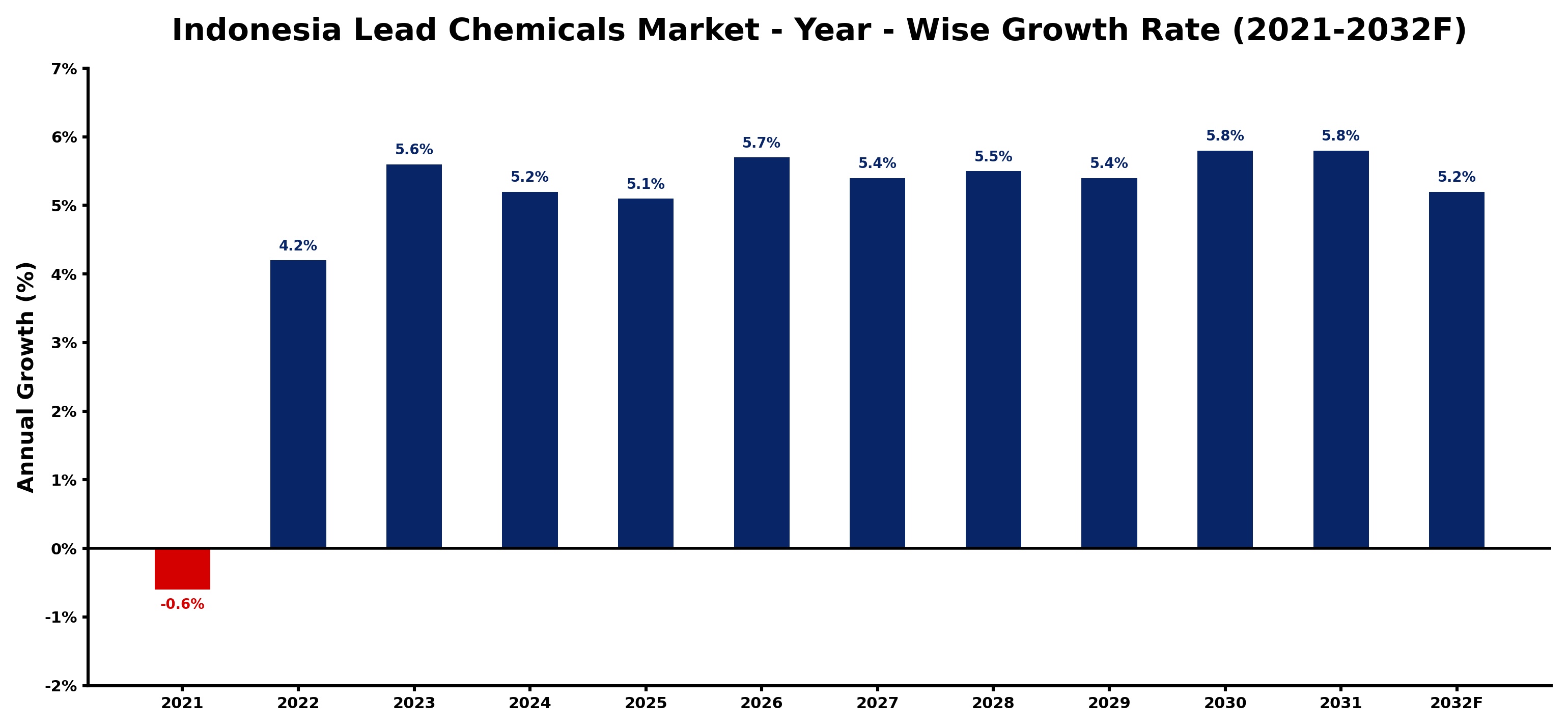
The table below presents the year‑wise growth rates along with the key drivers influencing the market
| Year | Growth Rate | Major Drivers |
| 2021 | -0.6% | Supply chain disruptions affected production |
| 2022 | 4.2% | Manufacturing recovery stimulated demand |
| 2023 | 5.6% | Infrastructure investments enhanced logistics |
| 2024 | 5.2% | Technological advancements improved efficiency |
| 2025 | 5.1% | Sustainability initiatives attracted investments |
| 2026 | 5.7% | Export opportunities expanded market reach |
| 2027 | 5.4% | Regulatory support fostered innovation |
| 2028 | 5.5% | Consumer awareness increased product usage |
| 2029 | 5.4% | Partnerships strengthened market presence |
| 2030 | 5.8% | Digital transformation enhanced operations |
| 2031 | 5.8% | Research and development drove innovation |
| 2032 | 5.2% | Market diversification created new opportunities |
Note - Market size estimations and growth projections presented in this report are based on 6Wresearch’s advanced forecasting approach, validated with industry datasets as of June 2026.
Indonesia Lead Chemicals Market Synopsis
Recent years have seen a significant uptick in the Indonesia Lead Chemicals Market, fueled by both automotive and construction sectors. However, as the industry adapts to evolving regulations and market dynamics, future growth will rely on sustainable practices and innovative technologies. The integration of lead-acid batteries into emerging electrical systems is also poised to reshape the landscape.
As Indonesia continues its industrial development journey, the demand for lead chemicals is anticipated to expand further. The increasing focus on infrastructure projects and the establishment of manufacturing hubs are key indicators that will further stimulate the market. However, balancing growth with stringent environmental regulations will be a pivotal challenge for stakeholders moving forward.
Indonesia Lead Chemicals Market Key Takeaways
- Rising demand for automotive batteries and PVC products are primary growth drivers in the market.
- Government initiatives support the increased use of lead-based materials, enhancing market opportunities.
- Developing economies, such as India and China, contribute positively to the growth prospects of the sector.
- Lead sulfate's popularity among manufacturers underscores the trend towards cost-effective, high-purity options.
- Investment in infrastructure and industrial projects will sustain demand for lead chemicals in the coming years.
Evaluation of Restraints in Indonesia Lead Chemicals Market
Despite the promising growth trajectory, the Indonesia Lead Chemicals Market faces significant restraints primarily driven by environmental regulations. Stringent government policies on hazardous materials impact manufacturing practices, with compliance often proving costly and complex. Additionally, varying emission standards across different countries create barriers for manufacturers looking to expand their reach, as they navigate the challenging landscape of international trade regulations. This conundrum could restrain potential growth opportunities as companies must invest heavily in adaptation and compliance measures.
Indonesia Lead Chemicals Market Trends
The current trends in the Indonesia Lead Chemicals Market highlight a shift towards more sustainable practices and higher energy density requirements in battery production. Lead sulfate is gaining traction due to its cost-effectiveness and pureness, becoming a preferred choice among battery manufacturers. Furthermore, electrical component producers are increasingly transitioning towards lead-acid batteries, which meet the demand for lighter, more efficient energy storage solutions. This evolution reflects a broader industry shift towards innovation and efficiency, which is critical for long-term competitiveness.
Indonesia Lead Chemicals Market Opportunities
Opportunities within the Indonesia Lead Chemicals Market are on the rise, particularly due to increasing investments in infrastructure development. The ongoing urbanization in Indonesia presents a vast potential for PVC applications in construction and building materials. Moreover, as the automotive sector continues to expand with the push for electric vehicles, the demand for advanced battery technologies will create new avenues for lead chemical manufacturers to explore and develop innovative products. Collaborations with local and international stakeholders could further enhance market penetration.
Government Initiatives in the Indonesia Lead Chemicals Market
The Indonesian government has introduced several initiatives aimed at promoting the use of lead-based products, which is expected to invigorate the lead chemicals market. These initiatives include regulatory frameworks that provide clear guidelines for sustainable practices, thereby creating a conducive environment for investments in the sector. Furthermore, public spending on infrastructure projects has significantly increased, leading to a heightened demand for products utilizing lead chemicals, particularly in the construction and automotive industries.
Future Insights of the Indonesia Lead Chemicals Market
Looking forward to the period from 2026 to 2032, the Indonesia Lead Chemicals Market is expected to witness continued expansion driven by ongoing infrastructure developments and technological advancements. As industries adapt to greener practices, the focus will shift towards more efficient production methods and innovative applications of lead chemicals. The expected surge in automotive battery demand, particularly in conjunction with the global move towards electric mobility, will further shape the market, necessitating agility and innovation from manufacturers in the sector.
Indonesia Lead Chemicals Market Latest Developments (May 2025 - June 2026)
In the recent months leading to mid-2026, the Indonesia Lead Chemicals Market has seen a concerted effort from industry players towards investing in research and development. Companies are actively pursuing advancements in battery technology to improve performance while reducing environmental impact. Notably, collaborative projects aimed at enhancing production processes have emerged, as firms seek to align with government mandates and regulations. As the market evolves, strategic partnerships may increasingly play a role in fostering innovation and competitiveness.
Indonesia Lead Chemicals Market - Key Attractiveness of the Report
- 10 Years of Market Numbers
- Historical Data Starting from 2022 to 2025
- Base Year: 2025
- Forecast Data until 2032
- Key Performance Indicators Impacting the Market
- Major Upcoming Developments and Projects
Key Highlights of the Report:
- Indonesia Lead Chemicals Market Outlook
- Market Size of Indonesia Lead Chemicals Market, 2025
- Forecast of Indonesia Lead Chemicals Market, 2032
- Historical Data and Forecast of Indonesia Lead Chemicals Revenues & Volume for the Period 2022-2032F
- Indonesia Lead Chemicals Market Trend Evolution
- Indonesia Lead Chemicals Market Drivers and Challenges
- Indonesia Lead Chemicals Price Trends
- Indonesia Lead Chemicals Porter's Five Forces
- Indonesia Lead Chemicals Industry Life Cycle
- Historical Data and Forecast of Indonesia Lead Chemicals Market Revenues & Volume By Types for the Period 2022-2032F
- Historical Data and Forecast of Indonesia Lead Chemicals Market Revenues & Volume By Lead Nitrate for the Period 2022-2032F
- Historical Data and Forecast of Indonesia Lead Chemicals Market Revenues & Volume By Lead Acetate for the Period 2022-2032F
- Historical Data and Forecast of Indonesia Lead Chemicals Market Revenues & Volume By Lead Stabilizers for the Period 2022-2032F
- Historical Data and Forecast of Indonesia Lead Chemicals Market Revenues & Volume By Lead Chloride for the Period 2022-2032F
- Historical Data and Forecast of Indonesia Lead Chemicals Market Revenues & Volume By Others for the Period 2022-2032F
- Historical Data and Forecast of Indonesia Lead Chemicals Market Revenues & Volume By Applications for the Period 2022-2032F
- Historical Data and Forecast of Indonesia Lead Chemicals Market Revenues & Volume By Mining for the Period 2022-2032F
- Historical Data and Forecast of Indonesia Lead Chemicals Market Revenues & Volume By PVC Stabilizers for the Period 2022-2032F
- Historical Data and Forecast of Indonesia Lead Chemicals Market Revenues & Volume By Dyes for the Period 2022-2032F
- Historical Data and Forecast of Indonesia Lead Chemicals Market Revenues & Volume By Pigment for the Period 2022-2032F
- Historical Data and Forecast of Indonesia Lead Chemicals Market Revenues & Volume By Others for the Period 2022-2032F
- Indonesia Lead Chemicals Import Export Trade Statistics
- Market Opportunity Assessment By Types
- Market Opportunity Assessment By Applications
- Indonesia Lead Chemicals Top Companies Market Share
- Indonesia Lead Chemicals Competitive Benchmarking By Technical and Operational Parameters
- Indonesia Lead Chemicals Company Profiles
- Indonesia Lead Chemicals Key Strategic Recommendations






































