Indonesia LED Professional Lighting Market Summary
The indonesia led professional lighting market was estimated at USD 429 Million in 2025 and is projected to reach USD 567 Million by 2032, growing at a CAGR of 5.6% from 2026 to 2032.
Indonesia LED Professional Lighting Market Year-wise Growth Rate and Key Drivers
This graph highlights how the Indonesia LED Professional Lighting Market has steadily grown over the past five years, supported by major growth factors.
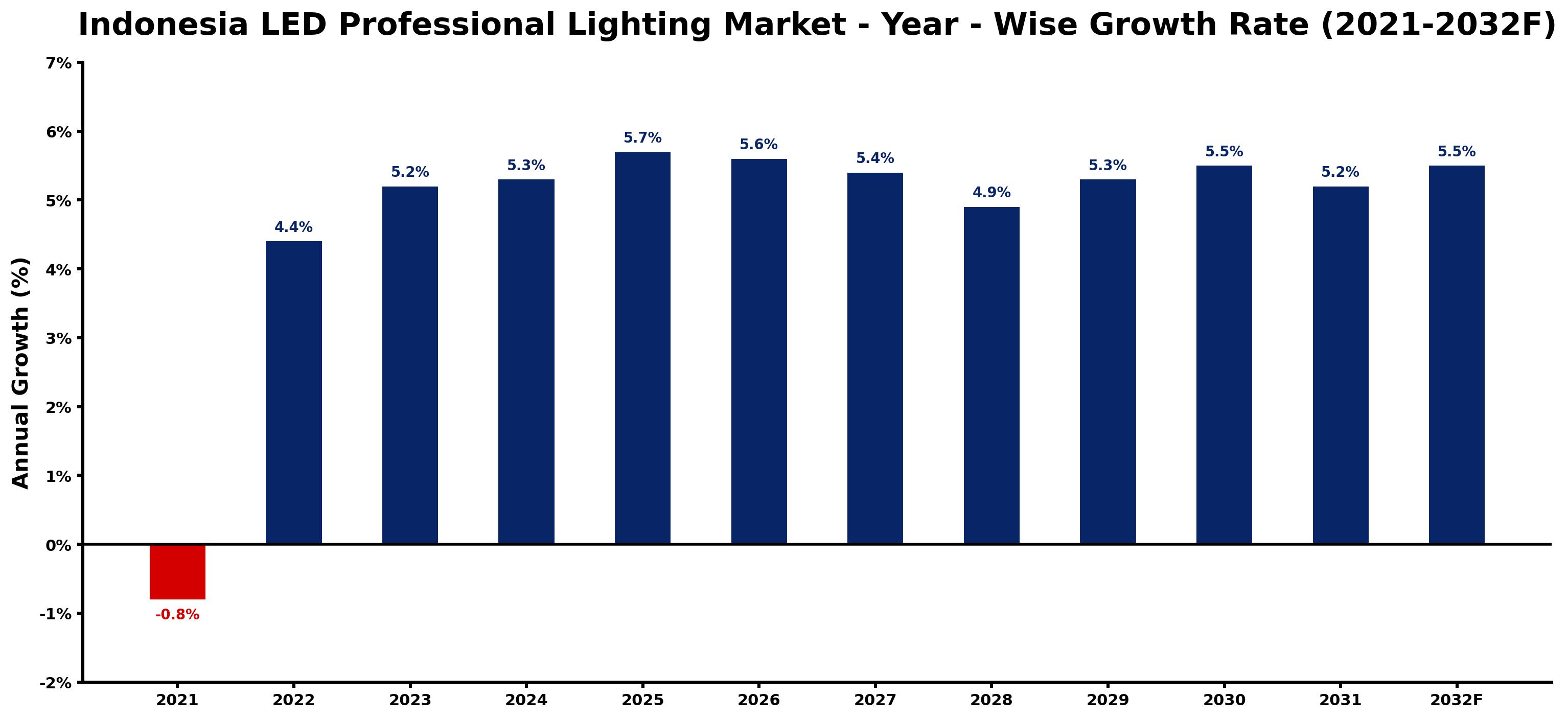
The table below presents the year wise growth rates along with the key drivers influencing the market
| Year | Growth Rate | Major Drivers |
| 2021 | -0.8% | Supply chain disruptions hindered project completions, limiting new installations and stalling market expansion in professional lighting. |
| 2022 | 4.4% | Rapid urbanization prompted more construction projects needing advanced lighting solutions. |
| 2023 | 5.2% | Increased focus on smart city initiatives highlighted the benefits of LED technology. |
| 2024 | 5.3% | Growing environmental awareness encouraged businesses to pursue sustainable lighting options. |
| 2025 | 5.7% | Infrastructural developments expanded in various sectors, bolstering demand for LED lighting. |
| 2026 | 5.6% | Retailers recognized enhanced customer experiences through improved ambient lighting designs. |
| 2027 | 5.4% | Technological integration in homes pushed for smart LED systems in households. |
| 2028 | 4.9% | Manufacturers began focusing on localized production to reduce supply chain complexities. |
| 2029 | 5.3% | Emerging local brands entered the market, offering competitively priced lighting solutions. |
| 2030 | 5.5% | Corporate sustainability strategies increasingly included energy-efficient lighting transitions. |
| 2031 | 5.2% | Government collaborations facilitated funding for large-scale public lighting projects. |
| 2032 | 5.5% | Home renovation trends accelerated demand for modern LED systems in residential spaces. |
Note - Market size estimations and growth projections presented in this report are based on 6Wresearch's advanced forecasting approach, validated with industry datasets as of June 2026.
Indonesia LED Professional Lighting Market Synopsis
The Indonesia LED Professional Lighting Market is projected to reach 5.6% and witness significant growth during the forecast period (2026-2032). This growth trajectory is primarily driven by several factors, including enhanced governmental efforts to promote energy-efficient lighting solutions, substantial investments in infrastructure development, and the increasing adoption of advanced lighting technologies. The rapid pace of urbanization and industrialization across Indonesia is further amplifying the demand for LED lighting products, contributing to a robust market outlook.
Indonesia LED Professional Lighting Market Growth Drivers
The growth of the Indonesia LED Professional Lighting Market can be attributed to a confluence of various key drivers:
- Government initiatives aimed at improving energy efficiency in public and commercial buildings have laid a solid foundation for market expansion.
- Significant investments in infrastructure development projects, such as new roads, hospitals, and commercial complexes, have heightened the demand for advanced lighting solutions.
- The increasing emphasis on energy-saving technologies is prompting both the public and private sectors to adopt LED lighting options.
- Rapid urbanization in cities is resulting in greater energy consumption, thereby necessitating efficient lighting solutions in various sectors.
- The cultivation of green smart cities has gained momentum, with a focus on enhancing living standards through environmentally friendly technologies.
Indonesia LED Professional Lighting Market Challenges and Restraints
Despite the promising growth prospects, the Indonesia LED Professional Lighting Market faces several challenges that could impede its progress:
- High initial investment costs associated with LED lighting solutions may deter some consumers and businesses from making the switch to more efficient technologies.
- Limited consumer awareness regarding the benefits of LED lighting can hinder market penetration, particularly in rural areas.
- The fluctuating prices of raw materials necessary for LED manufacturing could impact the availability and affordability of these products.
- Competition from alternative lighting sources, such as traditional incandescent and fluorescent lights, remains a significant threat to market growth.
- Regulatory challenges and inconsistencies related to energy efficiency standards may impede the adoption of LED technologies across various sectors.
Indonesia LED Professional Lighting Market Government Investment and Initiatives
The Indonesian government has actively invested in initiatives aimed at promoting energy efficiency and sustainable development within the LED Professional Lighting Market. These investments encompass:
- Implementation of regulations such as the Energy Efficient Building (EEB) program, which encourages the integration of energy-efficient lighting systems in new and existing structures.
- Substantial funding for public infrastructure projects that prioritize the use of LED lighting in urban development.
- Encouragement of private-public partnerships to foster innovation and investment in smart lighting solutions.
- Incentives and tax breaks for businesses that implement energy-saving technologies, thereby accelerating the adoption of LED solutions.
- Education and outreach programs aimed at increasing awareness of the benefits of LED technology among consumers and businesses.
Indonesia LED Professional Lighting Market Latest Developments (May 2025 - June 2026)
Recent developments in the Indonesia LED Professional Lighting Market have indicated a strategic shift towards enhancing energy efficiency and sustainability. Key trends noted during this period include:
- A growing number of commercial establishments are transitioning to LED lighting in response to both governmental regulations and rising operational costs.
- Investment in research and development has intensified, leading to the introduction of innovative LED products tailored for diverse applications.
- Increased collaboration between local manufacturers and global technology firms has facilitated the sharing of advanced lighting technologies.
- The rise of smart lighting solutions embedded with IoT capabilities has gained traction, reflecting a broader trend towards automation and efficiency in lighting systems.
- Awareness campaigns highlighting the long-term savings and environmental benefits associated with LED lighting have gained significant attention from both consumers and businesses.
Indonesia LED Professional Lighting Market - Key Attractiveness of the Report
- 10 Years of Market Numbers
- Historical Data Starting from 2022 to 2025
- Base Year: 2025
- Forecast Data until 2032
- Key Performance Indicators Impacting the Market
- Major Upcoming Developments and Projects
Key Highlights of the Report:
- Indonesia LED Professional Lighting Market Outlook
- Market Size of Indonesia LED Professional Lighting Market, 2025
- Forecast of Indonesia LED Professional Lighting Market, 2032
- Historical Data and Forecast of Indonesia LED Professional Lighting Revenues & Volume for the Period 2022-2032
- Indonesia LED Professional Lighting Market Trend Evolution
- Indonesia LED Professional Lighting Market Drivers and Challenges
- Indonesia LED Professional Lighting Price Trends
- Indonesia LED Professional Lighting Porter's Five Forces
- Indonesia LED Professional Lighting Industry Life Cycle
- Historical Data and Forecast of Indonesia LED Professional Lighting Market Revenues & Volume By Product Type for the Period 2022-2032
- Historical Data and Forecast of Indonesia LED Professional Lighting Market Revenues & Volume By LED Bulbs for the Period 2022-2032
- Historical Data and Forecast of Indonesia LED Professional Lighting Market Revenues & Volume By LED Fixtures for the Period 2022-2032
- Historical Data and Forecast of Indonesia LED Professional Lighting Market Revenues & Volume By Bare LED Tubes for the Period 2022-2032
- Historical Data and Forecast of Indonesia LED Professional Lighting Market Revenues & Volume By LED Down lights for the Period 2022-2032
- Historical Data and Forecast of Indonesia LED Professional Lighting Market Revenues & Volume By Applications for the Period 2022-2032
- Historical Data and Forecast of Indonesia LED Professional Lighting Market Revenues & Volume By Indoor for the Period 2022-2032
- Historical Data and Forecast of Indonesia LED Professional Lighting Market Revenues & Volume By Outdoor for the Period 2022-2032
- Historical Data and Forecast of Indonesia LED Professional Lighting Market Revenues & Volume By Automotive for the Period 2022-2032
- Historical Data and Forecast of Indonesia LED Professional Lighting Market Revenues & Volume By Backlighting for the Period 2022-2032
- Indonesia LED Professional Lighting Import Export Trade Statistics
- Market Opportunity Assessment By Product Type
- Market Opportunity Assessment By Applications
- Indonesia LED Professional Lighting Top Companies Market Share
- Indonesia LED Professional Lighting Competitive Benchmarking By Technical and Operational Parameters
- Indonesia LED Professional Lighting Company Profiles
- Indonesia LED Professional Lighting Key Strategic Recommendations
Market Covered
This report offers a comprehensive study of the subsequent market segments:
By Product Type
- LED Bulbs
- LED Fixtures
- Bare LED Tubes
- LED Down lights
By Applications
- Indoor, Outdoor
- Automotive
- Backlighting






































