Indonesia Lighting equipment Market Summary
The indonesia lighting equipment market was estimated at USD 437 Million in 2025 and is projected to reach USD 575 Million by 2032, growing at a CAGR of 5.2% from 2026 to 2032.
Indonesia Lighting equipment Market Year-wise Growth Rate and Key Drivers
This graph highlights how the Indonesia Lighting equipment Market has steadily grown over the years, supported by major growth factors.
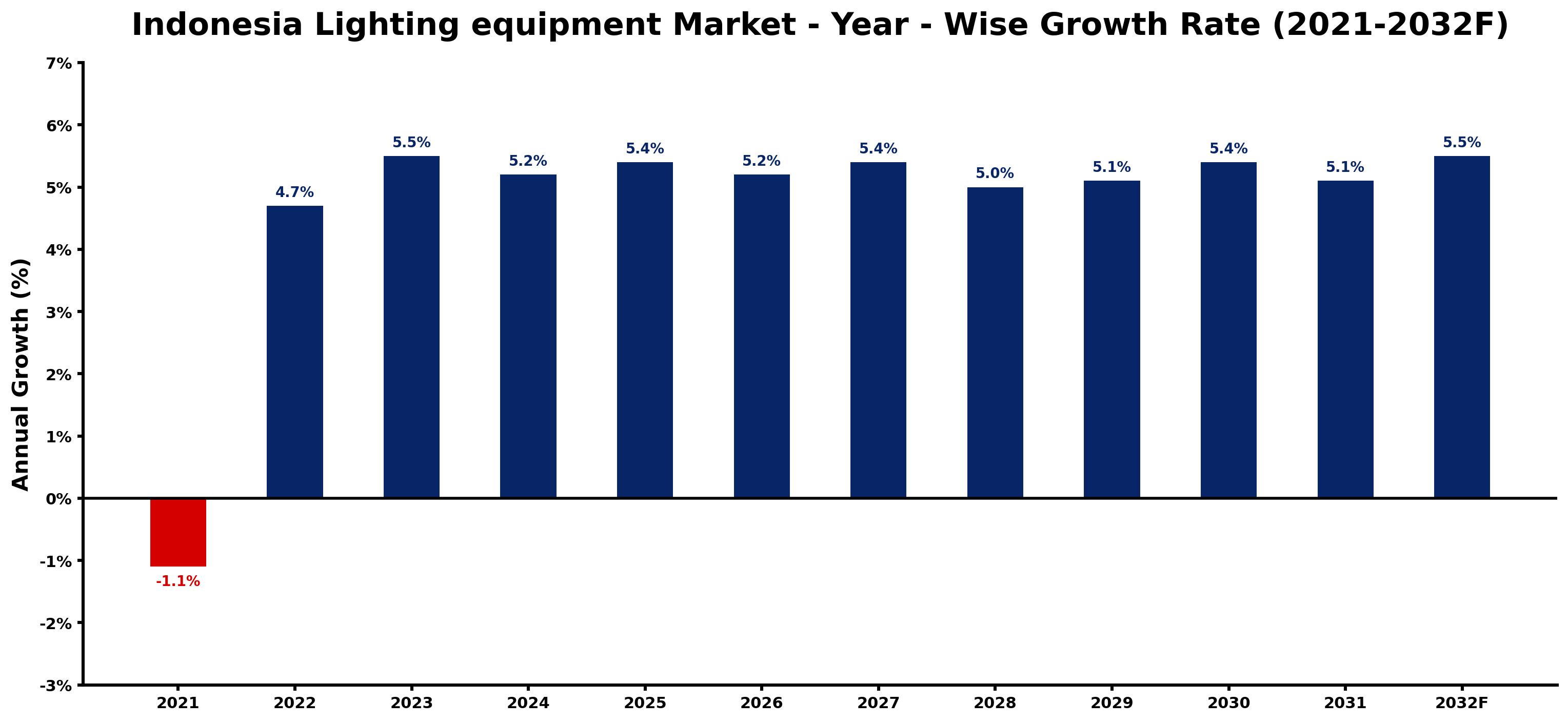
The table below presents the year wise growth rates along with the key drivers influencing the market
| Year | Growth Rate | Major Drivers |
| 2021 | -1.1% | Supply chain disruptions caused delays in product availability, leading to decreased sales across the lighting equipment sector. |
| 2022 | 4.7% | Increased urbanization prompted significant construction projects demanding advanced lighting systems. |
| 2023 | 5.5% | Smart city initiatives in major provinces stimulated demand for intelligent lighting technologies. |
| 2024 | 5.2% | Corporate sustainability goals encouraged investments in eco-friendly lighting innovations. |
| 2025 | 5.4% | Expansion of the middle class resulted in higher disposable incomes for lighting upgrades. |
| 2026 | 5.2% | Retail sector transformations necessitated modern lighting for enhanced customer experiences. |
| 2027 | 5.4% | Rising awareness about energy conservation drove consumers toward LED lighting adoption. |
| 2028 | 5.0% | Technological advancements enabled affordable smart lighting solutions for residential markets. |
| 2029 | 5.1% | Government policies incentivized manufacturers to develop localized lighting production capabilities. |
| 2030 | 5.4% | Integrated lighting solutions became essential for urban infrastructure and smart transport systems. |
| 2031 | 5.1% | Vibrant tourism growth catalyzed investments in aesthetically appealing outdoor lighting. |
| 2032 | 5.5% | Emerging startups in the lighting sector introduced innovative products and competitive pricing. |
Note - Market size estimations and growth projections presented in this report are based on 6Wresearch's advanced forecasting approach, validated with industry datasets as of June 2026.
Indonesia Lighting equipment Market Synopsis
The Indonesia Lighting equipment Market is projected to reach 5.2% and witness significant growth during the forecast period (2026-2032). This growth is expected at a compound annual growth rate (CAGR) of 8.3%, driven by various factors including the escalating demand for energy-efficient lighting solutions, primarily LEDs, coupled with rapid urbanization and industrial advancements. The Indonesian market is witnessing a shift from traditional lighting sources to modern alternatives due to declining costs associated with LED technology, alongside increasing awareness regarding energy efficiency among consumers.
Indonesia Lighting equipment Market Growth Drivers
One of the primary catalysts for the growth of the Indonesia Lighting equipment Market is the rising preference for LED lighting solutions. As consumers and businesses become more cognizant of energy consumption, LED fixtures are favored for their longevity and efficiency compared to incandescent bulbs and halogen lamps. The declining cost of LED technology further encourages this transition.
The ongoing urbanization in Indonesia fuels the demand for advanced lighting solutions in both residential and commercial sectors. Diverse applications are emerging in newly developed urban areas, where innovative lighting designs enhance aesthetic appeal and functionality. This urban expansion often necessitates smarter infrastructure and lighting systems that can adapt to the needs of a growing population.
Government initiatives to promote energy efficiency significantly bolster the market. These policies often include financial incentives for adopting LED lighting, alongside stringent regulations that favor energy-saving technologies. This supportive regulatory framework drives both consumer adoption and industry growth in Indonesia.
Moreover, the rising trend of smart city investments creates a burgeoning demand for integrated lighting solutions. Such solutions incorporate automation and advanced features like motion sensors and adaptive dimming, which enhance safety and user convenience in urban settings. The integration of smart technology in lighting is becoming increasingly critical as cities evolve to meet modern standards.
Finally, the proliferation of shopping malls and commercial establishments in urban centers contributes to the demand for decorative interior lighting, such as chandeliers and artistically designed fixtures. As a result, this sector is poised for substantial growth in the coming years, driven by the need for appealing visual environments.
Indonesia Lighting equipment Market Challenges and Restraints
Despite the optimistic growth projections, the Indonesia Lighting equipment Market faces several challenges. One significant hurdle is the initial investment required for transitioning to LED technology, which can deter some consumers, particularly in lower-income segments. Although LED prices have decreased, the up-front costs can still be prohibitive for those accustomed to traditional lighting solutions.
Additionally, inconsistent electricity supply and ongoing infrastructural issues in certain regions can impair the effectiveness of advanced lighting systems. These challenges can lead to skepticism regarding the reliability and performance of modern lighting solutions.
The market is also influenced by a lack of awareness among certain demographics about the benefits of energy-efficient lighting. Educational initiatives are necessary to promote a better understanding of how LED technology can result in long-term savings and environmental benefits.
Furthermore, competition from low-cost traditional lighting products persists, hindering the adoption of modern lighting solutions. The market dynamics require ongoing efforts to emphasize the value of energy efficiency and the total cost of ownership associated with LED lighting.
Finally, regulatory enforcement can be inconsistent, which may slow down the transition to energy-efficient products. A more consistent application of policies would foster a better environment for market growth.
Indonesia Lighting equipment Market Government Investment and Initiatives
The Indonesian government plays a pivotal role in shaping the lighting equipment market through various investment initiatives and policy measures. Authorities have launched numerous programs aimed at enhancing energy efficiency across different sectors, prominently featuring lighting technologies. Financial incentives, including subsidies for LED lighting purchases, are pivotal in facilitating consumer transitions away from less efficient lighting solutions.
Moreover, the government has established stricter regulatory measures to govern the use of energy-efficient lighting systems. These regulations often specify that only energy-saving products, such as LEDs, comply with the standards for new construction projects and public installations. This regulatory framework not only encourages manufacturers to innovate but also guides consumers toward sustainable choices.
In the context of smart cities, government investments in infrastructure development often encompass advanced lighting solutions that integrate sustainability and technology. By prioritizing investments in energy-efficient lighting, the Indonesian government aims to enhance urban living conditions while reducing overall energy consumption.
Furthermore, public initiatives to educate both consumers and businesses about the benefits of energy-efficient lighting play a crucial role in market acceptance. These awareness programs aim to dispel myths regarding the cost and performance of LED technologies, contributing to a more informed consumer base.
Lastly, collaboration between the public and private sectors is vital for the development of innovative lighting solutions tailored to Indonesia's unique urban landscape. Such partnerships are likely to enhance the overall efficacy of lighting systems implemented throughout the country.
Indonesia Lighting equipment Market Latest Developments (May 2025 - June 2026)
The period from May 2025 to June 2026 witnessed significant developments in the Indonesia Lighting equipment Market, with an accelerated focus on energy-efficient technologies and smart lighting systems. Companies are increasingly investing in research and development to enhance the capabilities and applications of LED lighting, aiming to meet the evolving needs of consumers.
Furthermore, the trend towards adopting energy-efficient lighting solutions in government buildings and public spaces has gained momentum, as authorities seek to comply with new sustainability regulations and standards. This move not only supports energy conservation efforts but also enhances public awareness regarding the benefits of LED technology.
Innovative smart lighting solutions have begun to emerge in the market, reflecting a growing interest in technology integration. These systems offer features such as automated controls, real-time monitoring, and energy management, aligning with the broader smart city initiatives being pursued in Indonesia.
Moreover, notable investments in commercial infrastructure, particularly in urban areas, have stimulated demand for decorative and functional lighting solutions. This has led to the introduction of a range of stylish interior lighting options designed to enhance the aesthetics of retail spaces and public venues.
Overall, this period has been characterized by a concerted effort to promote sustainable lighting solutions as part of a broader strategy for urban development and energy efficiency in Indonesia.
Indonesia Lighting equipment Market - Key Attractiveness of the Report
- 10 Years of Market Numbers
- Historical Data Starting from 2022 to 2025
- Base Year: 2025
- Forecast Data until 2032
- Key Performance Indicators Impacting the Market
- Major Upcoming Developments and Projects
Key Highlights of the Report:
- Indonesia Lighting equipment Market Outlook
- Market Size of Indonesia Lighting equipment Market, 2025
- Forecast of Indonesia Lighting equipment Market, 2032F
- Historical Data and Forecast of Indonesia Lighting equipment Revenues & Volume for the Period 2022-2032F
- Indonesia Lighting equipment Market Trend Evolution
- Indonesia Lighting equipment Market Drivers and Challenges
- Indonesia Lighting equipment Price Trends
- Indonesia Lighting equipment Porter's Five Forces
- Indonesia Lighting equipment Industry Life Cycle
- Historical Data and Forecast of Indonesia Lighting equipment Market Revenues & Volume By ?Application for the Period 2022-2032F
- Historical Data and Forecast of Indonesia Lighting equipment Market Revenues & Volume By General Purpose Lighting for the Period 2022-2032F
- Historical Data and Forecast of Indonesia Lighting equipment Market Revenues & Volume By Vehicle/Automobile Lighting for the Period 2022-2032F
- Historical Data and Forecast of Indonesia Lighting equipment Market Revenues & Volume By Backlighting for the Period 2022-2032F
- Historical Data and Forecast of Indonesia Lighting equipment Market Revenues & Volume By Others? for the Period 2022-2032F
- Historical Data and Forecast of Indonesia Lighting equipment Market Revenues & Volume By Technology for the Period 2022-2032F
- Historical Data and Forecast of Indonesia Lighting equipment Market Revenues & Volume By Conventional Lighting/Non-Environment Friendly Lighting for the Period 2022-2032F
- Historical Data and Forecast of Indonesia Lighting equipment Market Revenues & Volume By Environment Friendly Lighting for the Period 2022-2032F
- Historical Data and Forecast of Indonesia Lighting equipment Market Revenues & Volume By SSL (Solid State Lighting) for the Period 2022-2032F
- Historical Data and Forecast of Indonesia Lighting equipment Market Revenues & Volume By LED (Light Emitting Diodes) for the Period 2022-2032F
- Historical Data and Forecast of Indonesia Lighting equipment Market Revenues & Volume By OLED (Organic Light Emitting Diodes) for the Period 2022-2032F
- Historical Data and Forecast of Indonesia Lighting equipment Market Revenues & Volume By PLED (Polymer Light Emitting Diodes)? for the Period 2022-2032F
- Historical Data and Forecast of Indonesia Lighting equipment Market Revenues & Volume By ?End Users for the Period 2022-2032F
- Historical Data and Forecast of Indonesia Lighting equipment Market Revenues & Volume By Industrial for the Period 2022-2032F
- Historical Data and Forecast of Indonesia Lighting equipment Market Revenues & Volume By Commercial for the Period 2022-2032F
- Historical Data and Forecast of Indonesia Lighting equipment Market Revenues & Volume By Others? for the Period 2022-2032F
- Indonesia Lighting equipment Import Export Trade Statistics
- Market Opportunity Assessment By ?Application
- Market Opportunity Assessment By Technology
- Market Opportunity Assessment By ?End Users
- Indonesia Lighting equipment Top Companies Market Share
- Indonesia Lighting equipment Competitive Benchmarking By Technical and Operational Parameters
- Indonesia Lighting equipment Company Profiles
- Indonesia Lighting equipment Key Strategic Recommendations






































