Qatar Lighting equipment Market Summary
The qatar lighting equipment market was estimated at USD 435 Million in 2025 and is projected to reach USD 603 Million by 2032, growing at a CAGR of 5.5% from 2026 to 2032.
Qatar Lighting equipment Market Year-wise Growth Rate and Key Drivers
This graph highlights how the Qatar Lighting equipment Market has steadily grown over the past five years, supported by major growth factors.
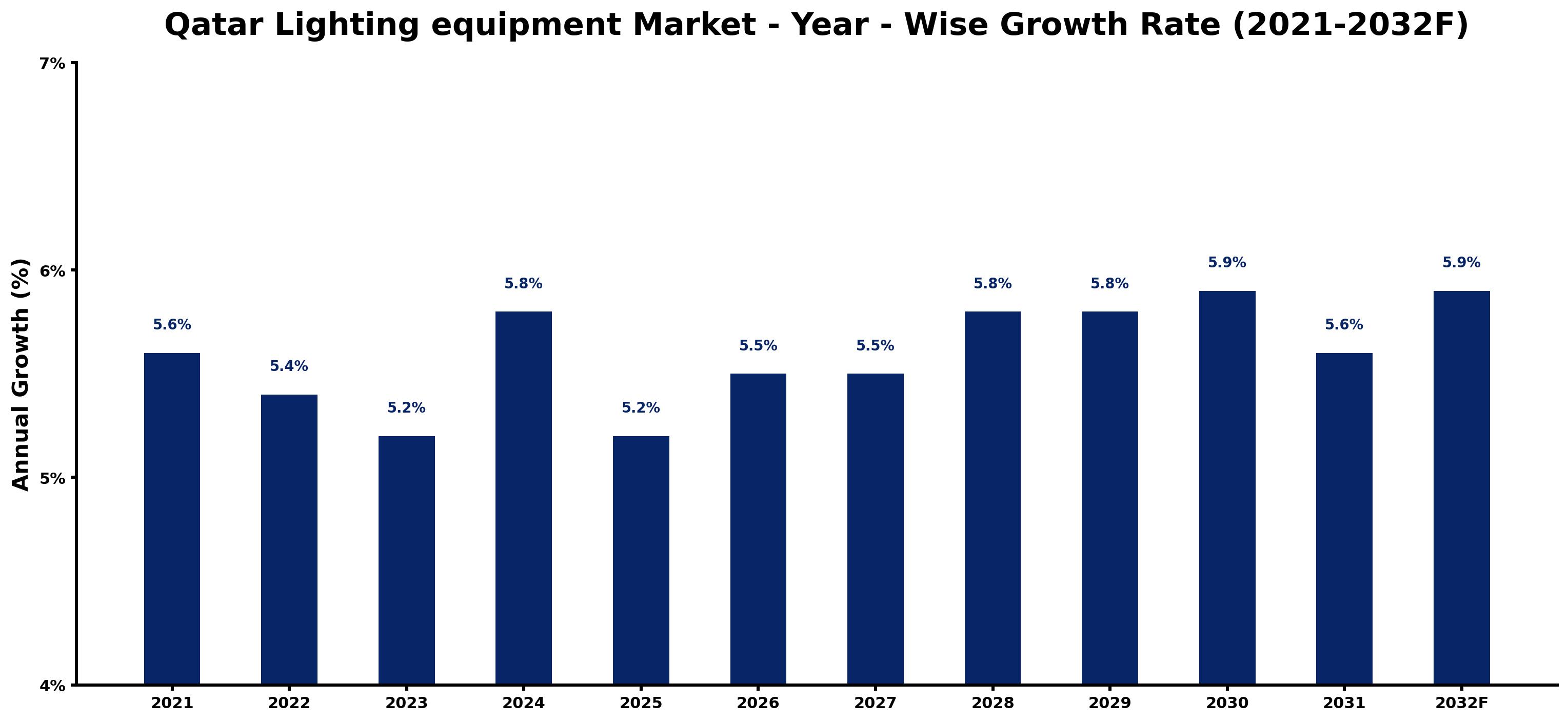
The table below presents the year wise growth rates along with the key drivers influencing the market
| Year | Growth Rate | Major Drivers |
| 2021 | 5.6% | Construction projects ramped up following pandemic-related delays, spurring lighting equipment needs. |
| 2022 | 5.4% | Expo 2023 preparations encouraged infrastructure investments, significantly boosting lighting demand. |
| 2023 | 5.2% | Innovations in energy-efficient lighting solutions attracted businesses aiming to reduce operational costs. |
| 2024 | 5.8% | Regional focus on smart city developments created opportunities for advanced lighting technologies. |
| 2025 | 5.2% | Local manufacturers began to introduce competitive products, enhancing market accessibility. |
| 2026 | 5.5% | Sustainability trends led to increased interest in solar-powered lighting installations. |
| 2027 | 5.5% | Urban expansion projects required extensive lighting solutions for new residential developments. |
| 2028 | 5.8% | Energy conservation initiatives prompted organizations to transition to LED technologies. |
| 2029 | 5.8% | Corporate investments in green building certifications stimulated demand for efficient lighting systems. |
| 2030 | 5.9% | Cultural events in Qatar drove temporary spikes in lighting equipment rentals and sales. |
| 2031 | 5.6% | Technological integration in residential spaces fostered a rise in smart lighting options. |
| 2032 | 5.9% | Market consolidation occurred as key players merged to enhance product offerings and reach. |
Note - Market size estimations and growth projections presented in this report are based on 6Wresearch's advanced forecasting approach, validated with industry datasets as of June 2026.
Qatar Lighting equipment Market Synopsis
The Qatar Lighting equipment Market is projected to reach 5.5% and witness significant growth during the forecast period (2026-2032). This growth is driven by an increasing demand for energy-efficient solutions, propelled by governmental initiatives such as Qatar National Vision 2031. The applications of lighting equipment are vast, encompassing homes, offices, public spaces, healthcare facilities, and retail stores. The rising population coupled with rapid urbanization in Qatar necessitates reliable and efficient lighting solutions. Furthermore, technological advancements, particularly the development and adoption of LED lighting technology, enhance energy efficiency, which subsequently reduces electricity bills for consumers. The pandemic period further catalyzed the demand for such energy-efficient products, as households and businesses sought cost-effective solutions amidst the economic constraints posed by global events.
Qatar Lighting equipment Market Growth Drivers
Several factors are contributing to the growth trajectory of the Qatar Lighting equipment market:
- The increasing investment in infrastructure, particularly due to projects related to the 2022 FIFA World Cup, is significantly boosting demand for advanced lighting solutions in stadiums and associated transportation networks.
- There is a notable rise in spending on housing construction projects, driven by urbanization and population growth, which is enhancing the requirement for effective lighting in residential areas.
- The adoption of energy-efficient lighting solutions, especially LED technology, is largely driven by environmental consciousness, translating into lower electricity consumption and reduced operational costs.
- Government incentives aimed at promoting green technologies are fostering a shift towards energy-efficient solutions, further solidifying the growth of the market.
- As companies and individuals increasingly prioritize sustainable practices, the market is witnessing a surge in the demand for innovative lighting solutions that are both cost-effective and environmentally friendly.
Qatar Lighting equipment Market Challenges and Restraints
While the Qatar Lighting equipment market shows promising growth, it is not without its challenges:
- The high installation costs associated with modernized and technologically advanced lighting fixtures can deter widespread adoption among consumers and businesses, affecting overall market trends.
- Supply chain disruptions, exacerbated by the COVID-19 pandemic, have posed challenges for manufacturers, affecting the availability of lighting products and components.
- Market players face increasing competition, which may drive down prices, impacting profit margins and creating a challenging environment for sustaining quality and innovation.
- Consumer awareness regarding the benefits of energy-efficient solutions varies significantly, which can slow the transition to modern lighting technologies.
- Regulatory challenges may also arise, where compliance with evolving standards and regulations can add complexity and cost to operations within the market.
Qatar Lighting equipment Market Government Investment and Initiatives
The Qatari government has implemented several initiatives that significantly influence the lighting equipment market. One of the cornerstones is Qatar National Vision 2031, focusing on sustainability and enhancing the quality of life, which prioritizes energy-efficient solutions in various sectors.
Additionally, substantial public investments are channeled into infrastructure projects, including transportation networks and public buildings, where advanced lighting solutions play a critical role. The government has also introduced incentives to promote the adoption of green technologies, further supporting energy-efficient lighting systems.
Moreover, initiatives aimed at fostering public awareness about energy conservation and the environmental benefits of efficient lighting help to stimulate market demand. The proactive government spending in construction and urban development ensures that the lighting market remains a key component of Qatar's broader economic strategy.
Qatar Lighting equipment Market Latest Developments (May 2025 - June 2026)
Recent developments in the Qatar Lighting equipment market from May 2025 to June 2026 reflect a strengthening focus on innovation and sustainability. Industry players have increased their efforts to integrate smart technologies into lighting solutions, enhancing efficiency and user-friendliness. There has also been a marked rise in collaborations between technology providers and construction companies to develop integrated lighting solutions tailored for new infrastructure projects.
Furthermore, the market has seen advancements in product offerings, with a significant emphasis on cost-effective and energy-efficient solutions, catering to both residential and commercial sectors. The ongoing recovery from the impacts of the pandemic has facilitated a gradual resumption of construction activities, thereby boosting demand for lighting systems. Consequently, strategic partnerships and investments aimed at enhancing manufacturing capabilities are becoming more prevalent, setting a positive outlook for the market.
Qatar Lighting equipment Market - Key Attractiveness of the Report
- 10 Years of Market Numbers
- Historical Data Starting from 2022 to 2025
- Base Year: 2025
- Forecast Data until 2032
- Key Performance Indicators Impacting the Market
- Major Upcoming Developments and Projects
Key Highlights of the Report:
- Qatar Lighting equipment Market Outlook
- Market Size of Qatar Lighting equipment Market, 2025
- Forecast of Qatar Lighting equipment Market, 2032
- Historical Data and Forecast of Qatar Lighting equipment Revenues & Volume for the Period 2022-2032F
- Qatar Lighting equipment Market Trend Evolution
- Qatar Lighting equipment Market Drivers and Challenges
- Qatar Lighting equipment Price Trends
- Qatar Lighting equipment Porter's Five Forces
- Qatar Lighting equipment Industry Life Cycle
- Historical Data and Forecast of Qatar Lighting equipment Market Revenues & Volume By ?Application for the Period 2022-2032F
- Historical Data and Forecast of Qatar Lighting equipment Market Revenues & Volume By General Purpose Lighting for the Period 2022-2032F
- Historical Data and Forecast of Qatar Lighting equipment Market Revenues & Volume By Vehicle/Automobile Lighting for the Period 2022-2032F
- Historical Data and Forecast of Qatar Lighting equipment Market Revenues & Volume By Backlighting for the Period 2022-2032F
- Historical Data and Forecast of Qatar Lighting equipment Market Revenues & Volume By Others? for the Period 2022-2032F
- Historical Data and Forecast of Qatar Lighting equipment Market Revenues & Volume By Technology for the Period 2022-2032F
- Historical Data and Forecast of Qatar Lighting equipment Market Revenues & Volume By Conventional Lighting/Non-Environment Friendly Lighting for the Period 2022-2032F
- Historical Data and Forecast of Qatar Lighting equipment Market Revenues & Volume By Environment Friendly Lighting for the Period 2022-2032F
- Historical Data and Forecast of Qatar Lighting equipment Market Revenues & Volume By SSL (Solid State Lighting) for the Period 2022-2032F
- Historical Data and Forecast of Qatar Lighting equipment Market Revenues & Volume By LED (Light Emitting Diodes) for the Period 2022-2032F
- Historical Data and Forecast of Qatar Lighting equipment Market Revenues & Volume By OLED (Organic Light Emitting Diodes) for the Period 2022-2032F
- Historical Data and Forecast of Qatar Lighting equipment Market Revenues & Volume By PLED (Polymer Light Emitting Diodes)? for the Period 2022-2032F
- Historical Data and Forecast of Qatar Lighting equipment Market Revenues & Volume By ?End Users for the Period 2022-2032F
- Historical Data and Forecast of Qatar Lighting equipment Market Revenues & Volume By Industrial for the Period 2022-2032F
- Historical Data and Forecast of Qatar Lighting equipment Market Revenues & Volume By Commercial for the Period 2022-2032F
- Historical Data and Forecast of Qatar Lighting equipment Market Revenues & Volume By Others? for the Period 2022-2032F
- Qatar Lighting equipment Import Export Trade Statistics
- Market Opportunity Assessment By ?Application
- Market Opportunity Assessment By Technology
- Market Opportunity Assessment By ?End Users
- Qatar Lighting equipment Top Companies Market Share
- Qatar Lighting equipment Competitive Benchmarking By Technical and Operational Parameters
- Qatar Lighting equipment Company Profiles
- Qatar Lighting equipment Key Strategic Recommendations






































