New Zealand Lighting Equipment Market Top 5 Importing Countries and Market Competition (HHI) Analysis
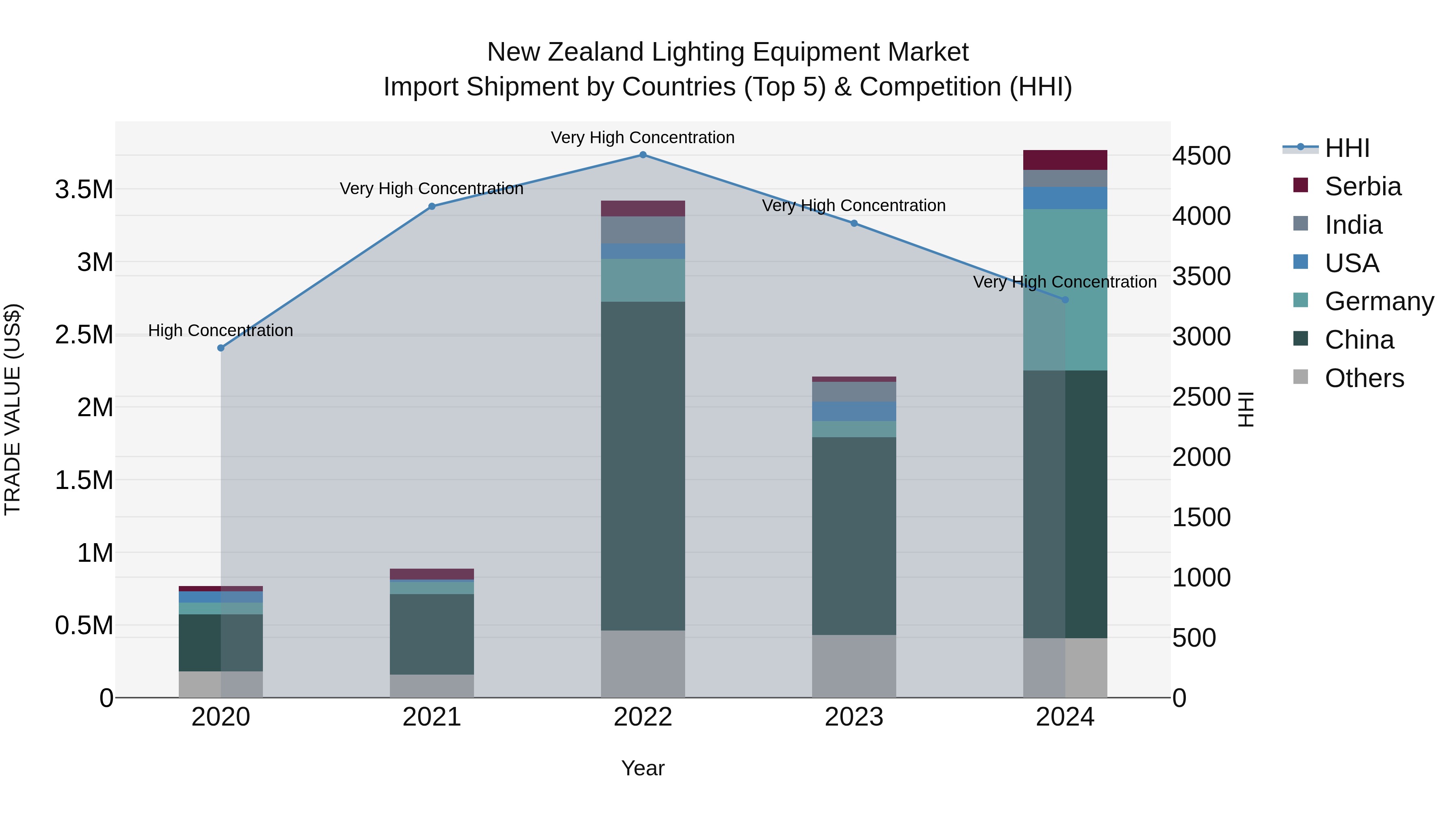
The New Zealand lighting equipment import market continued to thrive in 2024, with top exporters such as China, Germany, and the USA leading the way. The high Herfindahl-Hirschman Index (HHI) indicates a concentrated market, while the impressive CAGR of 48.83% from 2020 to 2024 highlights the sector`s rapid expansion. Notably, the exceptional growth rate of 70.56% in 2024 showcases the increasing demand for lighting equipment in New Zealand, signaling lucrative opportunities for both domestic and international suppliers in the coming years.
Key Highlights of the Report:
- New Zealand Lighting equipment Market Outlook
- Market Size of New Zealand Lighting equipment Market, 2025
- Forecast of New Zealand Lighting equipment Market, 2032
- Historical Data and Forecast of New Zealand Lighting equipment Revenues & Volume for the Period 2022 - 2032F
- New Zealand Lighting equipment Market Trend Evolution
- New Zealand Lighting equipment Market Drivers and Challenges
- New Zealand Lighting equipment Price Trends
- New Zealand Lighting equipment Porter`s Five Forces
- New Zealand Lighting equipment Industry Life Cycle
- Historical Data and Forecast of New Zealand Lighting equipment Market Revenues & Volume By Application for the Period 2022 - 2032F
- Historical Data and Forecast of New Zealand Lighting equipment Market Revenues & Volume By General Purpose Lighting for the Period 2022 - 2032F
- Historical Data and Forecast of New Zealand Lighting equipment Market Revenues & Volume By Vehicle/Automobile Lighting for the Period 2022 - 2032F
- Historical Data and Forecast of New Zealand Lighting equipment Market Revenues & Volume By Backlighting for the Period 2022 - 2032F
- Historical Data and Forecast of New Zealand Lighting equipment Market Revenues & Volume By Othersfor the Period 2022 - 2032F
- Historical Data and Forecast of New Zealand Lighting equipment Market Revenues & Volume By Technology for the Period 2022 - 2032F
- Historical Data and Forecast of New Zealand Lighting equipment Market Revenues & Volume By Conventional Lighting/Non-Environment Friendly Lighting for the Period 2022 - 2032F
- Historical Data and Forecast of New Zealand Lighting equipment Market Revenues & Volume By Environment Friendly Lighting for the Period 2022 - 2032F
- Historical Data and Forecast of New Zealand Lighting equipment Market Revenues & Volume By SSL (Solid State Lighting) for the Period 2022 - 2032F
- Historical Data and Forecast of New Zealand Lighting equipment Market Revenues & Volume By LED (Light Emitting Diodes) for the Period 2022 - 2032F
- Historical Data and Forecast of New Zealand Lighting equipment Market Revenues & Volume By OLED (Organic Light Emitting Diodes) for the Period 2022 - 2032F
- Historical Data and Forecast of New Zealand Lighting equipment Market Revenues & Volume By PLED (Polymer Light Emitting Diodes)for the Period 2022 - 2032F
- Historical Data and Forecast of New Zealand Lighting equipment Market Revenues & Volume By End Users for the Period 2022 - 2032F
- Historical Data and Forecast of New Zealand Lighting equipment Market Revenues & Volume By Industrial for the Period 2022 - 2032F
- Historical Data and Forecast of New Zealand Lighting equipment Market Revenues & Volume By Commercial for the Period 2022 - 2032F
- Historical Data and Forecast of New Zealand Lighting equipment Market Revenues & Volume By Othersfor the Period 2022 - 2032F
- New Zealand Lighting equipment Import Export Trade Statistics
- Market Opportunity Assessment By Application
- Market Opportunity Assessment By Technology
- Market Opportunity Assessment By End Users
- New Zealand Lighting equipment Top Companies Market Share
- New Zealand Lighting equipment Competitive Benchmarking By Technical and Operational Parameters
- New Zealand Lighting equipment Company Profiles
- New Zealand Lighting equipment Key Strategic Recommendations






































