Indonesia Managed Mobility Services Market Size & Growth Rate (2026-2032)
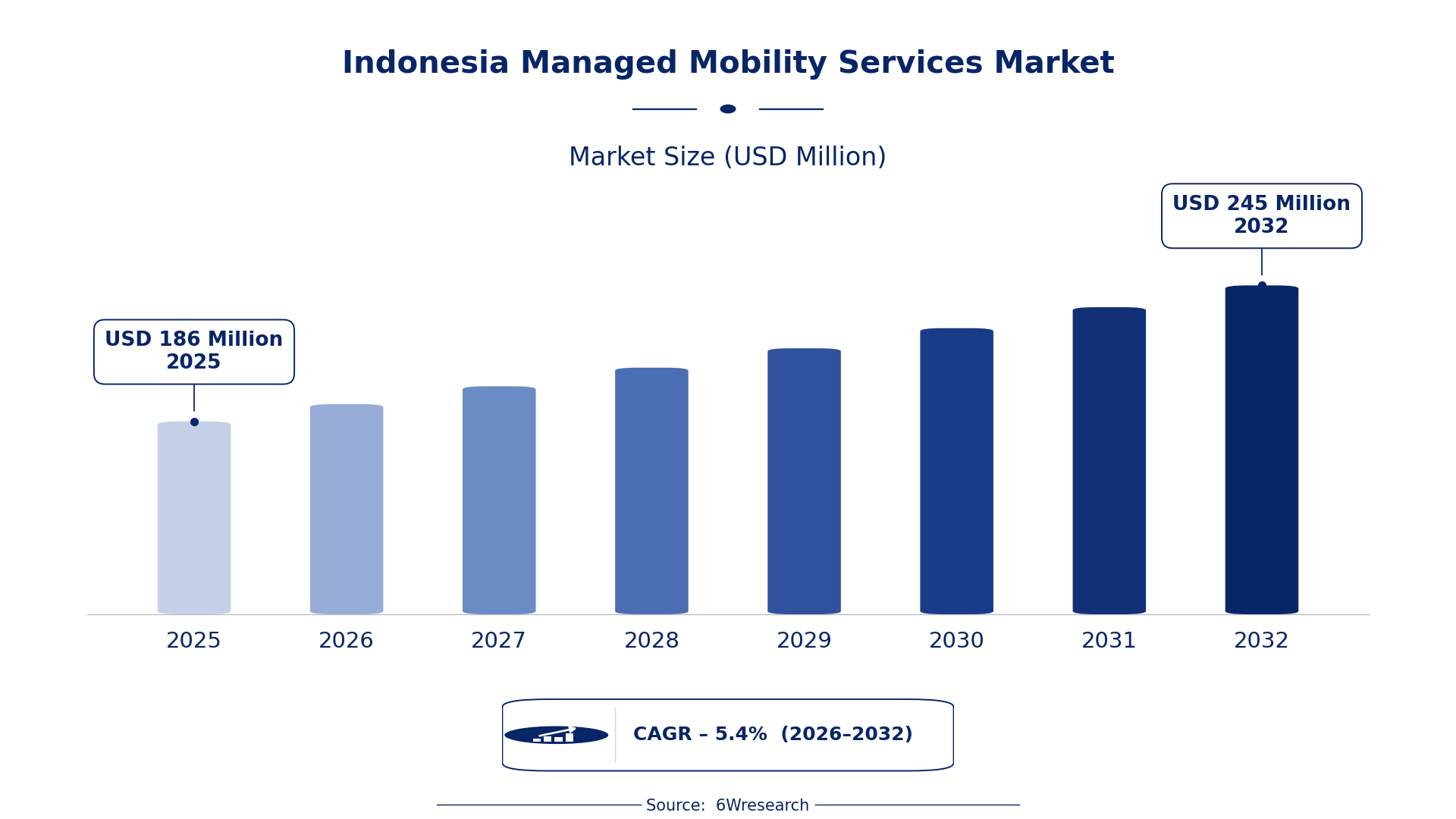
The Indonesia Managed Mobility Services Market was estimated at USD 186 Million in 2025 and is projected to reach USD 245 Million by 2032, growing at a CAGR of 5.4% from 2026 to 2032.
Indonesia Managed Mobility Services Market Synopsis
As organizations in Indonesia increasingly rely on mobile devices for day-to-day operations, the Managed Mobility Services market is gaining traction. Companies recognize the value of outsourcing mobility management to enhance operational efficiency and security.
This market is defined by a demand for services that go beyond simple device management, encompassing security, compliance, and application deployment. Managed Mobility Services providers facilitate a strategic focus on core business objectives while ensuring that mobile assets are effectively managed and secure.
Indonesia Managed Mobility Services Market Year-wise Growth Rate and Key Drivers
This graph illustrates the annual growth rates of the Indonesia Managed Mobility Services Market from 2021 to 2032, highlighting a steady upward trajectory and projected expansion over the forecast period.
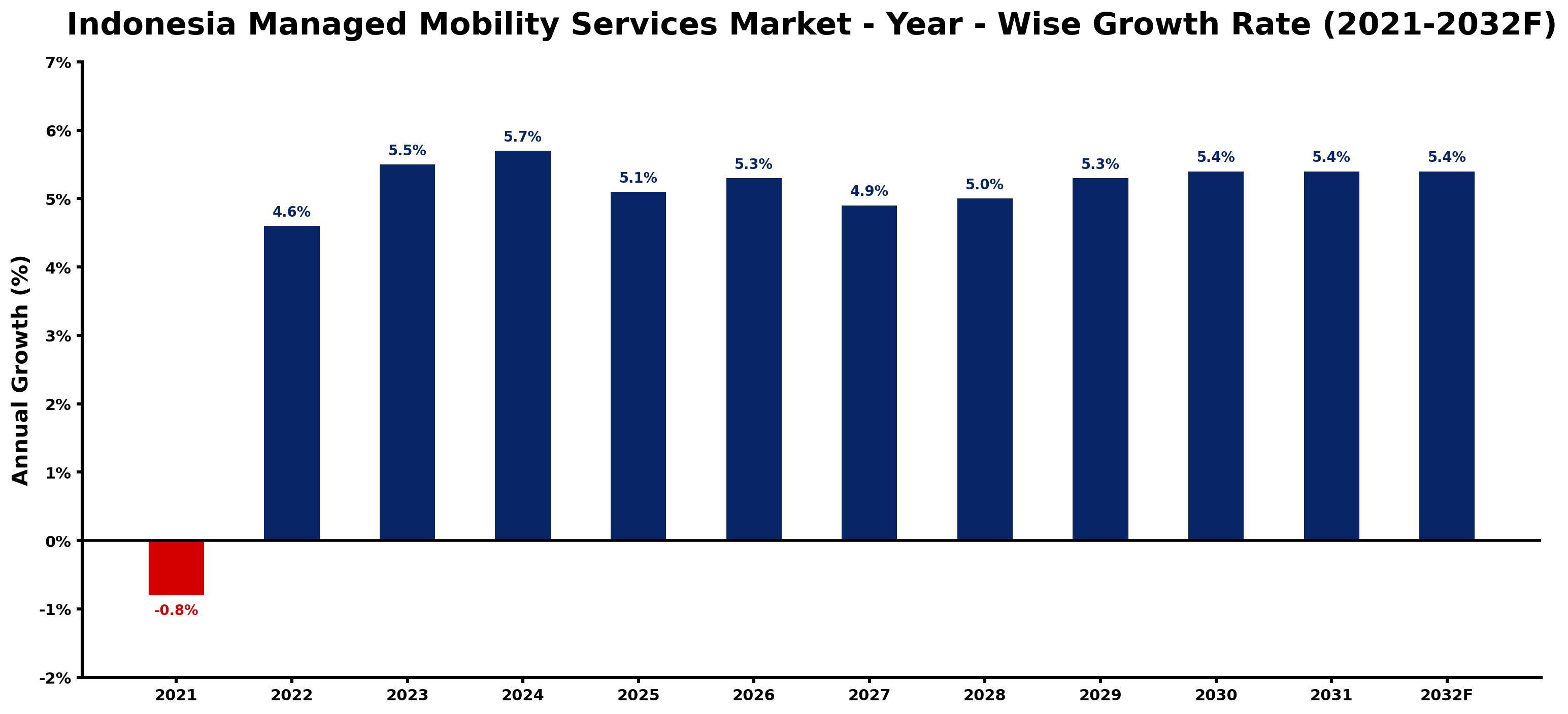
The table below presents the year‑wise growth rates along with the key drivers influencing the market
| Year | Growth Rate | Major Drivers |
| 2021 | -0.8% | Implementation delays of Indonesian government digital initiatives |
| 2022 | 4.6% | Government initiatives to improve digital infrastructure accessibility |
| 2023 | 5.5% | Increase in remote work driving mobile solutions adoption |
| 2024 | 5.7% | Surge in smartphone penetration among Indonesian consumers |
| 2025 | 5.1% | Focus on enhancing corporate mobility service offerings |
| 2026 | 5.3% | Investment in 5G infrastructure boosting mobile service demand |
| 2027 | 4.9% | Emergence of local startups in managed mobility services |
| 2028 | 5.0% | Growing trend of enterprise mobility management solutions |
| 2029 | 5.3% | Increased emphasis on cybersecurity for mobile devices |
| 2030 | 5.4% | Regulatory incentives for digitalization of business processes |
| 2031 | 5.4% | Rising consumer awareness of mobility solution benefits |
| 2032 | 5.4% | Partnerships between tech firms and logistics companies |
Note: Market size estimations and growth projections presented in this report are based on 6Wresearch's proprietary forecasting methodology, utilizing the latest available industry data, government publications, and primary research inputs.
Indonesia Managed Mobility Services Market Key Takeaways
Below are some of the specific key takeaways from the market, including:
- Growing dependence on mobile technology in business operations drives market demand.
- Security concerns and compliance requirements are major factors influencing service adoption.
- Remote work trends have accelerated the need for effective mobility management solutions.
- Providers are tasked with delivering tailored solutions for diverse client needs.
- Industry players are increasingly focusing on automation to streamline services.
Evaluation of Restraints in Indonesia Managed Mobility Services Market
The Managed Mobility Services market in Indonesia faces hurdles, particularly concerning the alignment of services to meet diverse client needs while adhering to stringent compliance requirements. Providers must continuously innovate to offer solutions that are secure and cost-effective, balancing affordability with quality. Additionally, the integration of new technologies presents challenges, as businesses may hesitate to transition from legacy systems to modern managed mobility solutions. These factors can slow down market growth and limit broader adoption.
Indonesia Managed Mobility Services Market Trends
A clear trend in the Indonesian Managed Mobility Services market is the shift towards integrated solutions that include advanced security features. With increasing cyber threats, businesses are prioritizing security in their mobility strategies. Another notable trend is the rising adoption of mobile device management (MDM) solutions that allow enterprises to have a comprehensive view of their mobile environments.
Furthermore, there is a growing interest in automation and artificial intelligence in managing mobility services. Organizations are seeking solutions that can simplify management tasks, reduce operational costs, and enhance user experience. This drive towards smart mobility management aligns well with global technological advancements and positions the Indonesian market for future growth.
Indonesia Managed Mobility Services Market Opportunities
The Indonesian Managed Mobility Services market presents substantial opportunities for providers, particularly as businesses continue to embrace digital transformation. Enterprises are looking for ways to enhance productivity while ensuring data security, creating an environment ripe for managed mobility solutions.
Emerging sectors, such as e-commerce and fintech, are further fueling demand as these industries require secure and efficient mobile solutions. Additionally, collaboration with local IT service providers can facilitate market entry for international players, allowing them to leverage existing customer relationships and market knowledge.
Government Initiatives in the Indonesia Managed Mobility Services Market
The Indonesian government is actively shaping the Managed Mobility Services market through various initiatives aimed at enhancing digital infrastructure and promoting cybersecurity measures. This regulatory support is crucial for fostering growth in the mobility sector, especially as businesses seek assurance around data protection and compliance.
- A national digital infrastructure upgrade program launched in 2025 aims to bolster connectivity and support mobility services.
- Current policies promote investments in cybersecurity frameworks, critical for businesses looking to enhance mobile data protection.
- Ongoing initiatives focus on public-private partnerships to drive innovation in digital services, including mobility management.
- A planned regulatory framework expected to be introduced by 2026 will enhance billing transparency for mobile service providers.
Future Insights of the Indonesia Managed Mobility Services Market
Looking ahead, the Indonesia Managed Mobility Services market is expected to continue its upward trajectory. As mobile technology further integrates into business operations, the demand for expert mobility management will grow. Companies are likely to adopt more sophisticated managed services that address not only device management but also data analytics and enhanced security measures.
The evolution of workplace models post-pandemic, with a mix of remote and hybrid settings, will drive further investment in managed mobility solutions. Businesses will seek more tailored services that reflect their unique operational needs, creating opportunities for providers that can innovate and adapt rapidly.
Indonesia Managed Mobility Services Market Latest Developments
In recent months, the Indonesia Managed Mobility Services market has seen notable activity as companies accelerate their digital initiatives in response to evolving operational demands. Service providers are actively enhancing their offerings to meet the increasing expectations of businesses seeking reliable mobility solutions.
- A major technology vendor launched an advanced mobility management platform in early 2025, aimed at improving mobile security features for enterprises.
- An initiative focused on integrating AI into mobility management services began in mid-2025 and remains underway, with promising results in automation and user experience.
- A public-private partnership program initiated in Q1 2025 seeks to enhance collaboration between tech firms and government bodies to improve digital services in the country.
- Plans for a new regulatory compliance support program were announced in mid-2026, designed to aid businesses in meeting upcoming data protection regulations.
Indonesia Managed Mobility Services Market - Key Attractiveness of the Report
- 10 Years of Market Numbers
- Historical Data Starting from 2022 to 2025
- Base Year: 2025
- Forecast Data until 2032
- Key Performance Indicators Impacting the Market
- Major Upcoming Developments and Projects
Key Highlights of the Report:
- Indonesia Managed Mobility Services Market Outlook
- Market Size of Indonesia Managed Mobility Services Market, 2025
- Forecast of Indonesia Managed Mobility Services Market, 2032
- Historical Data and Forecast of Indonesia Managed Mobility Services Revenues & Volume for the Period 2022-2032F
- Indonesia Managed Mobility Services Market Trend Evolution
- Indonesia Managed Mobility Services Market Drivers and Challenges
- Indonesia Managed Mobility Services Price Trends
- Indonesia Managed Mobility Services Porter's Five Forces
- Indonesia Managed Mobility Services Industry Life Cycle
- Historical Data and Forecast of Indonesia Managed Mobility Services Market Revenues & Volume By Function for the Period 2022-2032F
- Historical Data and Forecast of Indonesia Managed Mobility Services Market Revenues & Volume By Device Management for the Period 2022-2032F
- Historical Data and Forecast of Indonesia Managed Mobility Services Market Revenues & Volume By Application Management for the Period 2022-2032F
- Historical Data and Forecast of Indonesia Managed Mobility Services Market Revenues & Volume By Security Management for the Period 2022-2032F
- Historical Data and Forecast of Indonesia Managed Mobility Services Market Revenues & Volume By Maintenance & Support for the Period 2022-2032F
- Historical Data and Forecast of Indonesia Managed Mobility Services Market Revenues & Volume By Organization Size for the Period 2022-2032F
- Historical Data and Forecast of Indonesia Managed Mobility Services Market Revenues & Volume By SMEs for the Period 2022-2032F
- Historical Data and Forecast of Indonesia Managed Mobility Services Market Revenues & Volume By Large Enterprises for the Period 2022-2032F
- Historical Data and Forecast of Indonesia Managed Mobility Services Market Revenues & Volume By Industry Vertical for the Period 2022-2032F
- Historical Data and Forecast of Indonesia Managed Mobility Services Market Revenues & Volume By Healthcare for the Period 2022-2032F
- Historical Data and Forecast of Indonesia Managed Mobility Services Market Revenues & Volume By Manufacturing for the Period 2022-2032F
- Historical Data and Forecast of Indonesia Managed Mobility Services Market Revenues & Volume By Logistics and Transportation for the Period 2022-2032F
- Historical Data and Forecast of Indonesia Managed Mobility Services Market Revenues & Volume By Retail for the Period 2022-2032F
- Historical Data and Forecast of Indonesia Managed Mobility Services Market Revenues & Volume By Financial Services for the Period 2022-2032F
- Historical Data and Forecast of Indonesia Managed Mobility Services Market Revenues & Volume By Telecom and IT for the Period 2022-2032F
- Historical Data and Forecast of Indonesia Managed Mobility Services Market Revenues & Volume By Media and Entertainment for the Period 2022-2032F
- Historical Data and Forecast of Indonesia Managed Mobility Services Market Revenues & Volume By Travel and Hospitality for the Period 2022-2032F
- Indonesia Managed Mobility Services Import Export Trade Statistics
- Market Opportunity Assessment By Function
- Market Opportunity Assessment By Organization Size
- Market Opportunity Assessment By Industry Vertical
- Indonesia Managed Mobility Services Top Companies Market Share
- Indonesia Managed Mobility Services Competitive Benchmarking By Technical and Operational Parameters
- Indonesia Managed Mobility Services Company Profiles
- Indonesia Managed Mobility Services Key Strategic Recommendations






































