Indonesia Managed Services Market Size & Growth Rate (2026-2032)
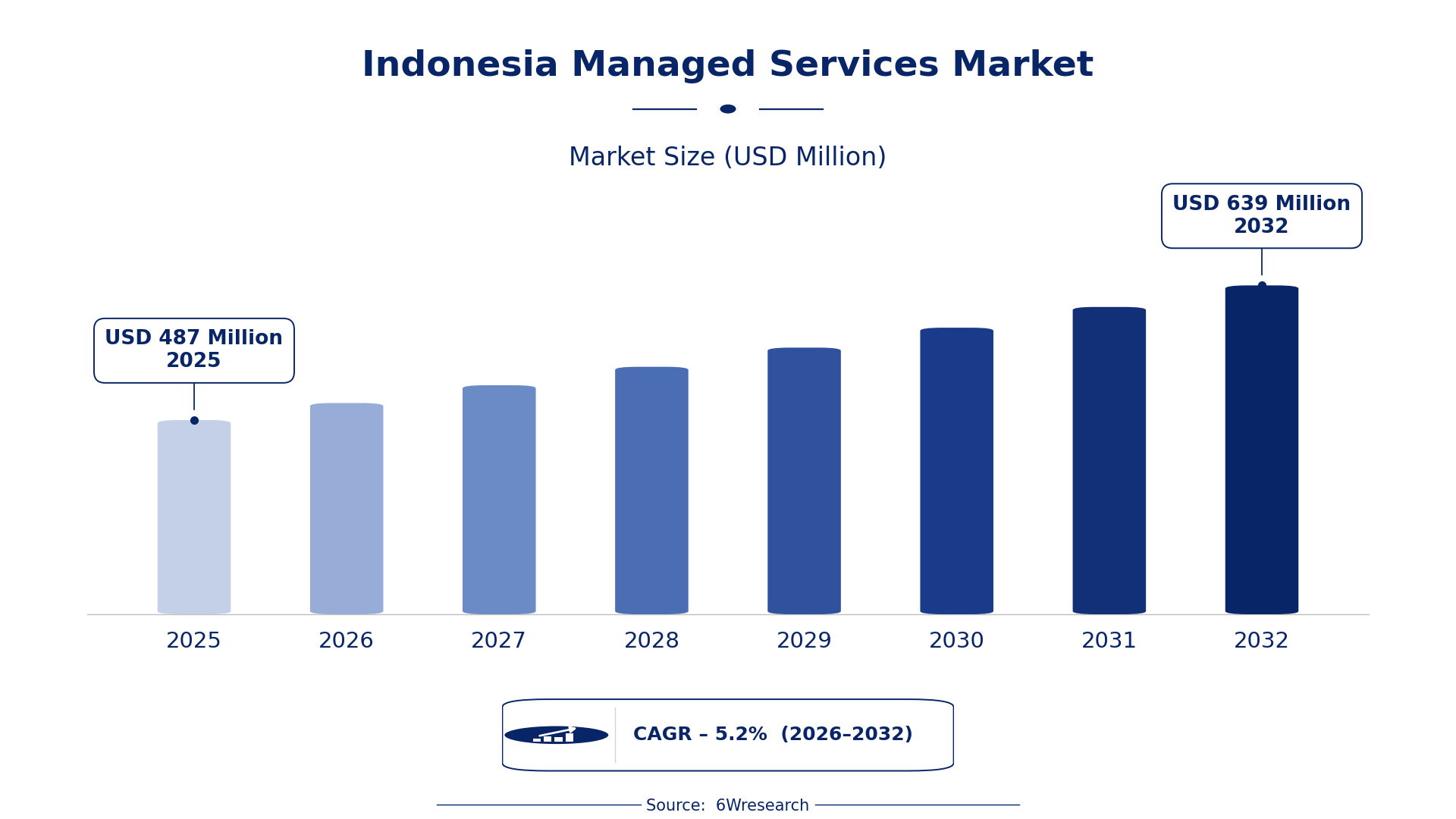
The Indonesia Managed Services Market was estimated at USD 487 Million in 2025 and is projected to reach USD 639 Million by 2032, growing at a CAGR of 5.2% from 2026 to 2032.
Indonesia Managed Services Market Synopsis
The primary force driving the Indonesia Managed Services Market is the growing demand for cost-effective IT solutions. Companies across various sectors are recognizing the advantages of outsourcing their IT needs to managed service providers, enabling them to focus on core business operations while reducing overhead costs.
As organizations confront increasing cybersecurity threats and the complexities associated with digital transformation, the need for reliable managed services becomes increasingly critical. This shift towards managed services is not just about efficiency; it's a strategic move towards enhancing business resilience and ensuring security in an increasingly digital economy.
Indonesia Managed Services Market Year-wise Growth Rate and Key Drivers
This graph illustrates the annual growth rates of the Indonesia Managed Services Market from 2021 to 2032, highlighting a steady upward trajectory and projected expansion over the forecast period.
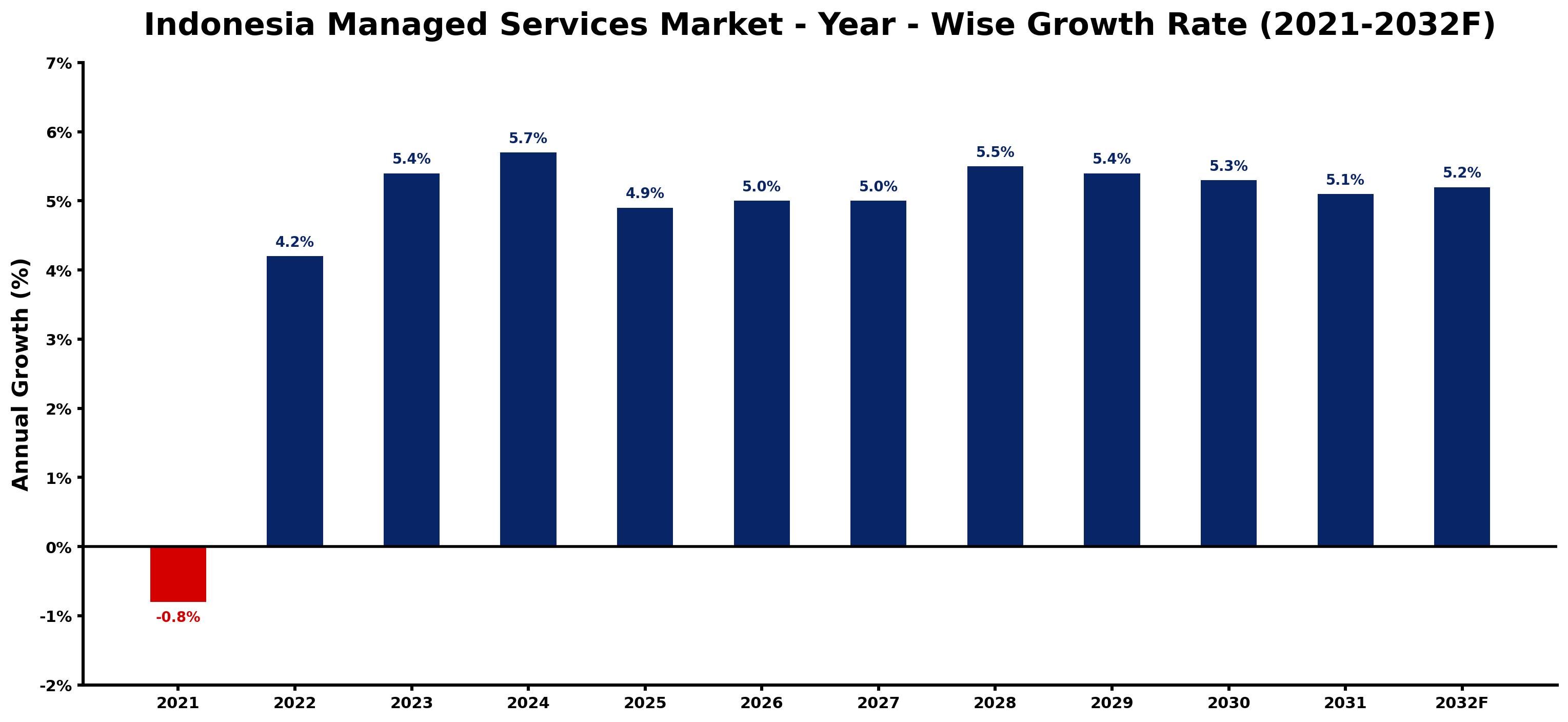
The table below presents the year‑wise growth rates along with the key drivers influencing the market
| Year | Growth Rate | Major Drivers |
| 2021 | -0.8% | Government restrictions on foreign IT service providers |
| 2022 | 4.2% | Government's push for digital infrastructure improvements. |
| 2023 | 5.4% | Increased reliance on cloud services by Indonesian enterprises. |
| 2024 | 5.7% | Emergence of FinTech solutions boosting IT service demand. |
| 2025 | 4.9% | Growing adoption of remote work solutions post-pandemic. |
| 2026 | 5.0% | Government incentives for tech startups enhancing service uptake. |
| 2027 | 5.0% | Rise in mobile internet penetration among urban populations. |
| 2028 | 5.5% | Digital payment solutions driving managed service growth. |
| 2029 | 5.4% | Local enterprises seeking efficiency through outsourced IT. |
| 2030 | 5.3% | Increased data privacy regulations prompting compliance services demand. |
| 2031 | 5.1% | Growth of Internet of Things in key industries. |
| 2032 | 5.2% | Upward trend in IT talent development programs nationwide. |
Note: Market size estimations and growth projections presented in this report are based on 6Wresearch's proprietary forecasting methodology, utilizing the latest available industry data, government publications, and primary research inputs.
Indonesia Managed Services Market Key Takeaways
Below are some of the specific key takeaways from the market, including:
- The market is projected to grow steadily, reflecting a growing reliance on outsourced IT solutions.
- Cloud management and cybersecurity services are becoming essential components of managed service offerings.
- Data security and compliance challenges pose significant hurdles for managed service providers in Indonesia.
- The COVID-19 pandemic has accelerated the adoption of managed services as companies seek to ensure business continuity.
- Key players are expanding their service portfolios to include advanced technologies like AI and machine learning.
Evaluation of Restraints in Indonesia Managed Services Market
While the Indonesia Managed Services Market is on an upward trajectory, it faces notable restraints, particularly concerning data security and compliance. With businesses increasingly dependent on third-party services for critical operations, the stakes for maintaining data confidentiality and integrity have never been higher. Compliance with local regulations and international standards complicates the landscape, as companies must navigate a myriad of legal requirements. This pressure can deter potential clients from fully embracing managed services, as they weigh the risks against the benefits of outsourcing their IT functions.
Indonesia Managed Services Market Trends
Several key trends are shaping the Indonesia Managed Services Market. The first is the increasing adoption of cloud services, which necessitates sophisticated management solutions to handle hybrid environments. As businesses migrate to the cloud, they require expert support to ensure performance and security. on top of that, the rise in remote work has led to a surge in demand for IT support and cybersecurity services, pushing managed service providers to innovate and expand their offerings.
Another trend is the integration of advanced technologies such as artificial intelligence and machine learning into managed services. These technologies enhance operational efficiency and enable more proactive service delivery, which is crucial in a competitive market. As organizations seek agility and responsiveness, the focus on automated solutions is likely to intensify.
Indonesia Managed Services Market Opportunities
The potential for growth in the Indonesia Managed Services Market is substantial. Businesses are increasingly aware of the advantages of outsourcing IT functions, especially in areas like cybersecurity, cloud management, and network monitoring. There is a significant opportunity for managed service providers to develop tailored solutions that cater to the unique needs of various industries, from healthcare to finance.
Emerging technologies also present a rich avenue for investment. As organizations adopt AI and machine learning, those providing managed services that incorporate these technologies will likely gain a competitive edge. The market is ripe for innovative solutions that address the evolving challenges faced by businesses in Indonesia.
Government Initiatives in the Indonesia Managed Services Market
Government policy plays a crucial role in shaping the Indonesia Managed Services Market. The regulatory framework is increasingly supportive of digital transformation initiatives, emphasizing the importance of cybersecurity and data protection. As the government prioritizes the development of a robust digital economy, the managed services sector stands to benefit significantly from these public policy efforts.
- A national digital infrastructure upgrade programme is currently underway, aimed at enhancing connectivity and access to digital services across the country.
- In 2025, a regulatory framework was introduced mandating stricter data protection measures for managed service providers, promoting industry compliance.
- A planned public-private partnership initiative seeks to expand cybersecurity capabilities, enhancing resilience against cyber threats by 2028.
- The Ministry of Communication and Information Technology is actively rolling out initiatives to promote cloud adoption among SMEs, ensuring broader access to managed services.
- Recently completed training programs aimed at boosting IT skills and knowledge among the workforce are expected to support the growth of managed service providers in the region.
Future Insights of the Indonesia Managed Services Market
Looking ahead to 2026-2032, the Indonesia Managed Services Market is expected to continue its upward trajectory. As digital transformation accelerates, businesses will increasingly turn to managed service providers to navigate complexities in IT management. With a growing emphasis on cybersecurity and compliance, the demand for specialized services will rise. Providers who can demonstrate expertise in emerging technologies will find themselves well-positioned to capture market share. The blend of innovation, regulatory support, and the evolving needs of businesses will shape the future landscape of managed services in Indonesia.
Indonesia Managed Services Market Latest Developments
Recent activity in the Indonesia Managed Services Market reflects a dynamic environment where providers are adapting to new challenges and opportunities. The emphasis on digital transformation continues to drive innovation, with companies exploring new service offerings and partnerships to enhance their capabilities.
- A major technology vendor launched a suite of cloud-based managed services in early 2025, targeting small to medium-sized enterprises.
- In mid-2025, a leading regional operator initiated a program to enhance its cybersecurity offerings, focusing on threat intelligence and incident response.
- Currently, a collaboration between multiple service providers is underway, aimed at developing AI-driven solutions to optimize IT management processes.
- An upcoming service upgrade is planned for Q1 2026, incorporating advanced analytics tools into existing managed services to enhance customer insights.
- In late 2025, a local firm completed a partnership with an international cybersecurity leader to bolster its service capabilities and expand market reach.
Indonesia Managed Services Market - Key Attractiveness of the Report
- 10 Years of Market Numbers
- Historical Data Starting from 2022 to 2025
- Base Year: 2025
- Forecast Data until 2032
- Key Performance Indicators Impacting the Market
- Major Upcoming Developments and Projects
Key Highlights of the Report:
- Indonesia Managed Services Market Outlook
- Market Size of Indonesia Managed Services Market, 2025
- Forecast of Indonesia Managed Services Market, 2032
- Historical Data and Forecast of Indonesia Managed Services Revenues & Volume for the Period 2022-2032F
- Indonesia Managed Services Market Trend Evolution
- Indonesia Managed Services Market Drivers and Challenges
- Indonesia Managed Services Price Trends
- Indonesia Managed Services Porter's Five Forces
- Indonesia Managed Services Industry Life Cycle
- Historical Data and Forecast of Indonesia Managed Services Market Revenues & Volume By Service Type for the Period 2022-2032F
- Historical Data and Forecast of Indonesia Managed Services Market Revenues & Volume By Managed Security Services for the Period 2022-2032F
- Historical Data and Forecast of Indonesia Managed Services Market Revenues & Volume By Managed Network Services for the Period 2022-2032F
- Historical Data and Forecast of Indonesia Managed Services Market Revenues & Volume By Managed Data Center and IT Infrastructure Services for the Period 2022-2032F
- Historical Data and Forecast of Indonesia Managed Services Market Revenues & Volume By Managed Communication and Collaboration Services for the Period 2022-2032F
- Historical Data and Forecast of Indonesia Managed Services Market Revenues & Volume By Managed Mobility Services for the Period 2022-2032F
- Historical Data and Forecast of Indonesia Managed Services Market Revenues & Volume By Managed Information Services for the Period 2022-2032F
- Historical Data and Forecast of Indonesia Managed Services Market Revenues & Volume By Deployment Type for the Period 2022-2032F
- Historical Data and Forecast of Indonesia Managed Services Market Revenues & Volume By Cloud for the Period 2022-2032F
- Historical Data and Forecast of Indonesia Managed Services Market Revenues & Volume By On-Premises for the Period 2022-2032F
- Historical Data and Forecast of Indonesia Managed Services Market Revenues & Volume By Organization Size for the Period 2022-2032F
- Historical Data and Forecast of Indonesia Managed Services Market Revenues & Volume By Small and Medium-sized Enterprises (SMEs) for the Period 2022-2032F
- Historical Data and Forecast of Indonesia Managed Services Market Revenues & Volume By Large Enterprises for the Period 2022-2032F
- Historical Data and Forecast of Indonesia Managed Services Market Revenues & Volume By Vertical for the Period 2022-2032F
- Historical Data and Forecast of Indonesia Managed Services Market Revenues & Volume By BFSI for the Period 2022-2032F
- Historical Data and Forecast of Indonesia Managed Services Market Revenues & Volume By IT and Telecom for the Period 2022-2032F
- Historical Data and Forecast of Indonesia Managed Services Market Revenues & Volume By Retail and Consumer Goods for the Period 2022-2032F
- Historical Data and Forecast of Indonesia Managed Services Market Revenues & Volume By Manufacturing for the Period 2022-2032F
- Historical Data and Forecast of Indonesia Managed Services Market Revenues & Volume By Government for the Period 2022-2032F
- Historical Data and Forecast of Indonesia Managed Services Market Revenues & Volume By Healthcare and Life Sciences for the Period 2022-2032F
- Historical Data and Forecast of Indonesia Managed Services Market Revenues & Volume By Energy and Utilities for the Period 2022-2032F
- Historical Data and Forecast of Indonesia Managed Services Market Revenues & Volume By Media and Entertainment for the Period 2022-2032F
- Indonesia Managed Services Import Export Trade Statistics
- Market Opportunity Assessment By Service Type
- Market Opportunity Assessment By Deployment Type
- Market Opportunity Assessment By Organization Size
- Market Opportunity Assessment By Vertical
- Indonesia Managed Services Top Companies Market Share
- Indonesia Managed Services Competitive Benchmarking By Technical and Operational Parameters
- Indonesia Managed Services Company Profiles
- Indonesia Managed Services Key Strategic Recommendations






































