Global Managed Services Market Highlights
| Market Size (2025) | USD 270.2 Billion |
| Forecast Size (2032) | USD 517.4 Billion |
| CAGR | 15.40% |
| Base Year | 2025 |
| Forecast Period | 2026-2032 |
| Largest Region | North America |
| Fastest Growing Region | Asia Pacific |
| Largest Segment | Managed Security Services |
| Fastest Growing Segment | Managed Mobility Services |
| Leading Companies | IBM, Accenture, Cisco Systems, Infosys, Dell Technologies |
Global Managed Services Market Size & Growth Rate (2026-2032)
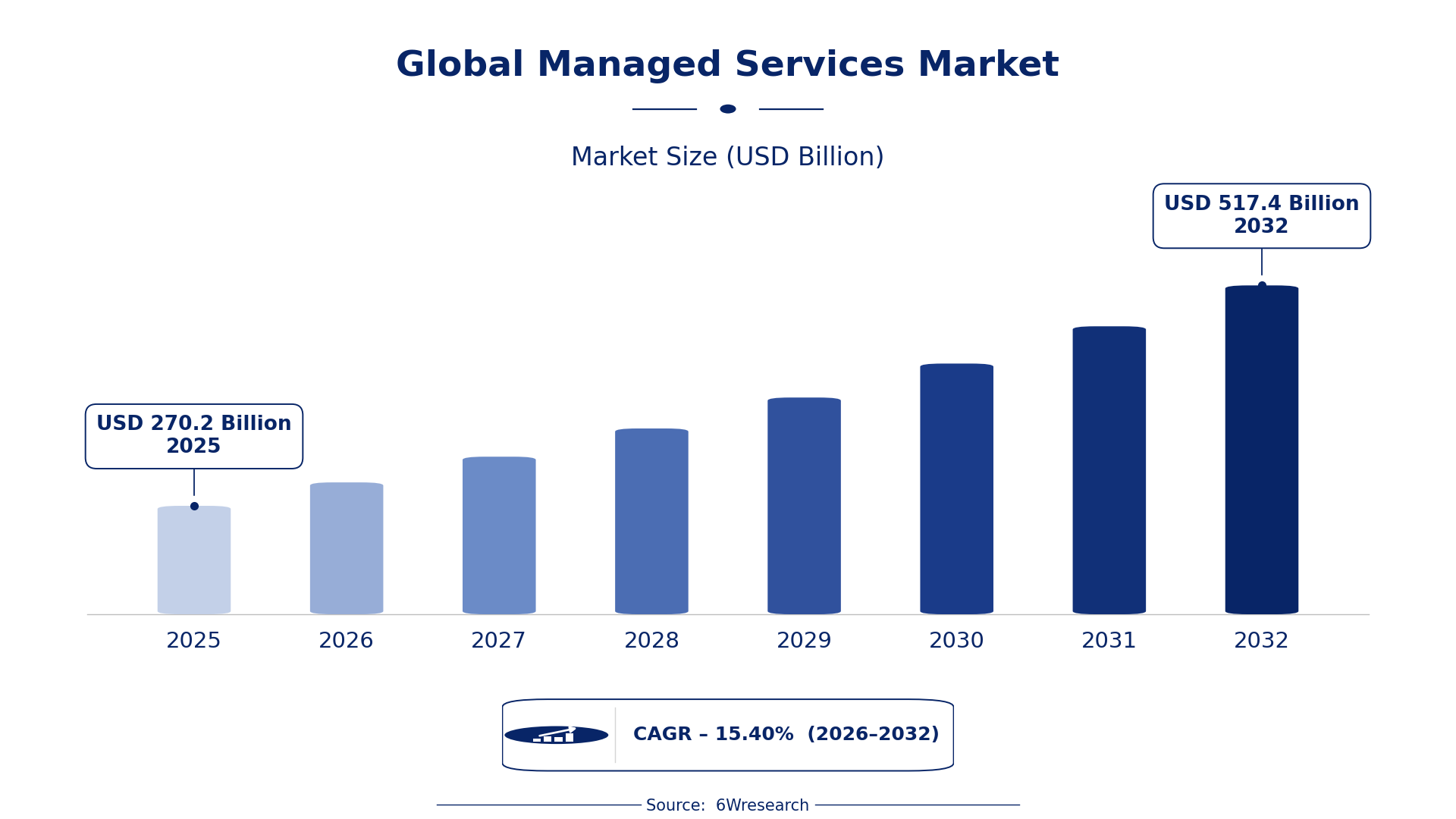
The Global Managed Services Market was estimated at USD 270.2 Billion in 2025 and is projected to reach USD 517.4 Billion by 2032, growing at a CAGR of 15.40% from 2026 to 2032.
Global Managed Services Market Synopsis
Presently, the Global Managed Services Market is undergoing a notable transformation, driven by the increasing complexity of IT infrastructure and organizational need for specialized support. Businesses are prioritizing their core competencies while outsourcing various IT functions, including security, network management, and data backup, thus creating new opportunities for managed service providers across sectors.
Emerging industries, particularly in healthcare and finance, are reshaping demand patterns for managed services through their stringent compliance requirements and data security needs. This shift highlights managed services as not just a cost-saving strategy but as a critical enabler of operational efficiency, allowing companies to adapt rapidly to market changes and attain competitive advantages.
Global Managed Services Market Year-wise Growth Rate and Key Drivers
This graph illustrates the annual growth rates of the Global Managed Services Market from 2022 to 2032, highlighting a steady upward trajectory and projected expansion over the forecast period.
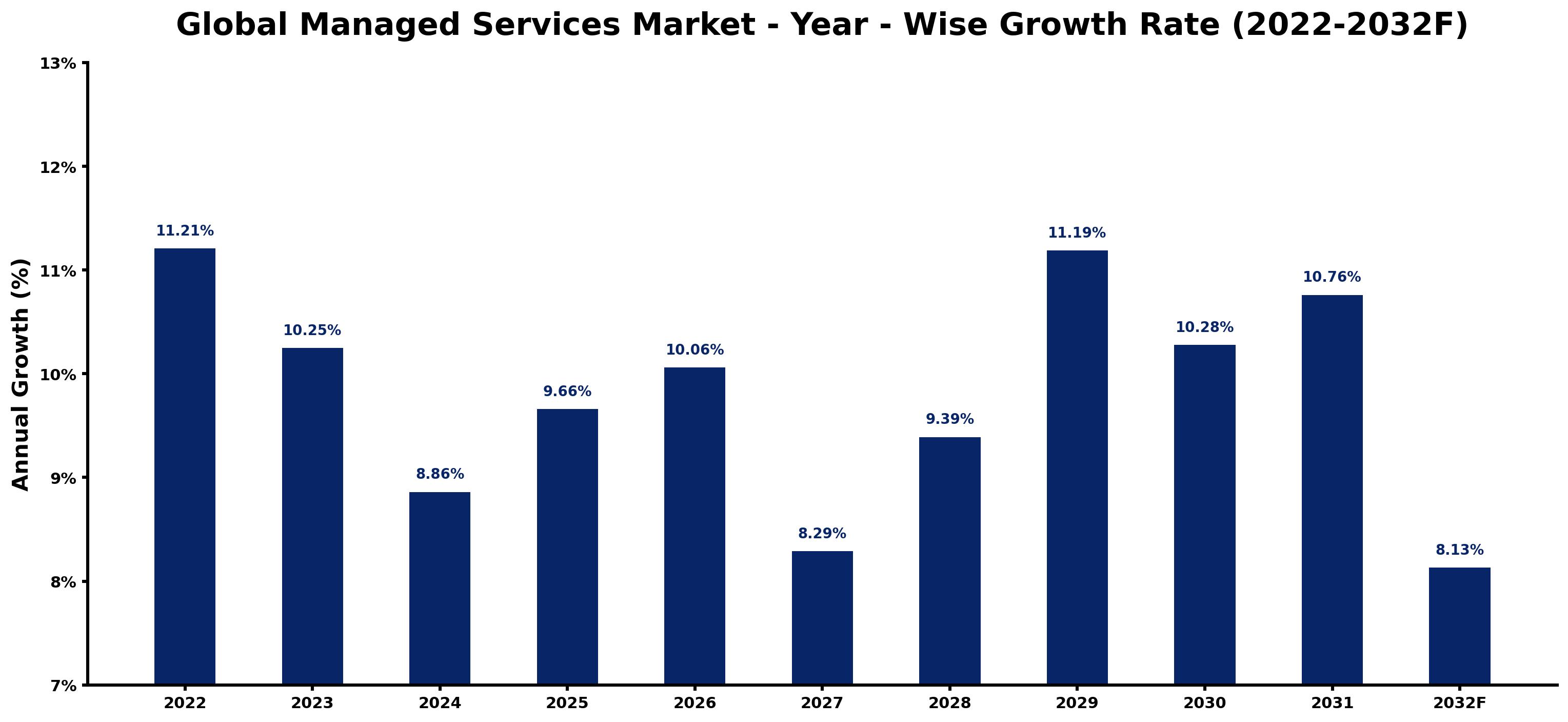
The table below presents the year‑wise growth rates along with the key drivers influencing the market
| Year | Growth Rate (%) | Major Drivers |
| 2022 | 11.21 | Supply chain disruptions have necessitated enhanced managed services for telecommunications networks. |
| 2023 | 10.25 | Growing skill shortages in IT professionals spur demand for specialized managed services. |
| 2024 | 8.86 | Healthcare organizations are increasingly adopting managed services to optimize their network infrastructure. |
| 2025 | 9.66 | A shift toward cloud-based solutions prompts higher demand for managed services like SaaS. |
| 2026 | 10.06 | As 5G rollout accelerates, managed services provide crucial support for network expansions. |
| 2027 | 8.29 | Increased collaboration on cybersecurity frameworks enhances competitive positions within managed services. |
| 2028 | 9.39 | With rising fiber-optic buildout, managed services can effectively meet evolving connectivity needs. |
| 2029 | 11.19 | Regulators are enforcing stricter compliance measures, driving investments in managed services. |
| 2030 | 10.28 | Expanding end-user engagement with cloud technologies accelerates the adoption of managed services. |
| 2031 | 10.76 | Hyperscale computing platforms are attracting significant investments in managed services for scalability. |
| 2032 | 8.13 | Telecom companies are prioritizing sustainability initiatives in managed services to meet ESG criteria. |
Note - Market size estimations and growth projections presented in this report are based on 6Wresearch's proprietary research methodology, combining internal industry data, secondary research, and primary validation, updated periodically to reflect current market conditions. As markets evolve rapidly, figures for certain industries may vary slightly and are intended as informed estimates rather than absolute figures. For the most current market sizing, we recommend validating figures with a 6Wresearch analyst.
Global Managed Services Market Key Takeaways
Below are some of the specific key takeaways from the market, including:
- Managed Security Services accounted for approximately 35% of the overall market share in 2025, reflective of increasing cybersecurity threats.
- Accenture reported a 9% revenue growth attributed specifically to its managed services division in Q1 2023.
- Asia Pacific is expected to see a CAGR of 17% from 2026 to 2032, significantly outpacing other regions.
- By 2028, more than 50% of enterprises are projected to rely on outsourced managed services, illustrating a paradigm shift in operational strategies.
- The managed mobility services segment is anticipated to grow at a CAGR of 18% from 2026 to 2032, fueled by a surge in mobile device usage.
Evaluation of Restraints in Global Managed Services Market
Despite the promising outlook, the Global Managed Services Market faces significant challenges. Regulatory compliance remains a formidable barrier, with enterprises facing potential penalties of up to $1.5 million for data breaches, amplifying their reluctance to fully outsource security functions. Additionally, skilled labor shortages in emerging technologies exacerbate operational difficulties. For example, only 25% of service providers reported sufficient staff training in AI and machine learning applications in 2023, hindering their ability to meet client demands effectively.
Global Managed Services Market Trends
Several impactful trends are currently reshaping the Global Managed Services Market. One significant movement is the increasing adoption of hybrid cloud environments, with companies like IBM leveraging its IBM Cloud services to provide businesses with flexible, scalable managed solutions that integrate seamlessly with on-premises systems. For instance, as of 2023, IBM noted a 24% increase in their business from hybrid cloud managed services alone.
Another critical trend is the integration of artificial intelligence and automation into service offerings. Cisco has pioneered this shift by implementing AI-driven analytics in its managed security services, enhancing threat detection and response times. By early 2023, Cisco documented a 30% improvement in incident resolution times, showcasing the operational benefits available through these technological advancements. Furthermore, organizations are gravitating toward proactive management systems, focusing on service continuity and performance optimization, indicating a clear shift from reactive to preventive solutions.
Global Managed Services Market Opportunities
Looking ahead, the Global Managed Services Market presents multiple compelling revenue opportunities. One notable sector is healthcare, where providers are increasingly adopting managed services for improved operational efficiencies and compliance with healthcare regulations. For example, a major healthcare provider in the U.S. has reported that outsourcing its IT services led to a 15% reduction in overhead costs in 2023, demonstrating substantial fiscal benefits.
Additionally, the expanding market for Internet of Things (IoT) devices is driving demand for managed services in various verticals, including agriculture and manufacturing. Companies like Dell Technologies are tapping into this potential; they projected a 20% market increase in IoT managed services by 2025. The focus on enhancing security and compliance measures associated with these developments marks a significant opportunity for managed service providers to offer value-added solutions tailored to specific industry needs.
Global Managed Services Market by Service Type
In the Global Managed Services Market, Managed Security Services lead with an approximately 35% share in 2025. This significant share can be attributed to the escalating importance of cybersecurity for organizations across sectors. On the other hand, Managed Mobility Services is the fastest-growing segment, projected to witness a CAGR of 18% from 2026 to 2032, driven by the increasing reliance on mobile technology within enterprises seeking to streamline operations and enhance productivity.
Global Managed Services Market by Deployment Type
The deployment landscape of the Global Managed Services Market is primarily led by Cloud solutions, which account for approximately 70% share in 2025. The preference for Cloud services stems from their flexibility and scalability, which are essential for organizations looking to innovate. In contrast, On-Premises solutions are expected to grow at a CAGR of 14% from 2026 to 2032, as certain sectors continue to prioritize data sovereignty and regulatory compliance over public Cloud options.
Global Managed Services Market by Organization Size
Among organization sizes, Medium-sized Enterprises (SMEs) dominate the Global Managed Services Market, holding an estimated 45% share in 2025. Their growing adoption of managed services can be attributed to the need for cost efficiency and access to advanced technology without substantial capital investment. Conversely, the Small Enterprises segment is anticipated to achieve a CAGR of 16% from 2026 to 2032, driven by their pursuit of agile solutions that can scale easily as they expand.
Global Managed Services Market by Vertical
In the Global Managed Services Market, the BFSI sector leads with an estimated 40% share in 2025. This dominance results from rigorous regulatory compliance requirements and escalating cybersecurity threats. Conversely, the Healthcare and Life Sciences segment is projected to exhibit the fastest growth, with a CAGR of 19% from 2026 to 2032, as the sector increasingly relies on managed services to navigate complex compliance landscapes and enhance patient care.
Global Managed Services Market by Region
North America maintains its position as the largest region within the Global Managed Services Market, accounting for approximately 48% share in 2025, bolstered by a rich ecosystem of service providers and significant investment in technology. Conversely, the Asia Pacific region is expected to experience the fastest growth, with a projected CAGR of 17% from 2026 to 2032, fueled by an ensuing demand for digital transformation initiatives in emerging economies.
Government Initiatives in the Global Managed Services Market
The regulatory framework governing the Global Managed Services Market is becoming increasingly robust, promoting structured growth and development within the sector. Governments worldwide are investing in programs that enhance IT service delivery while ensuring compliance with stringent standards. These initiatives are critical in fostering innovation and competitiveness among service providers.
- U.S. Department of Homeland Security: Cybersecurity and Infrastructure Security Agency (CISA) Activity 2023 - Federal Cybersecurity Initiative, aimed at improving cyber capabilities and readiness in government sectors, ongoing.
- European Commission: Digital Services Act 2022 - Aiming to establish standardized rules and frameworks for digital service provision, reinforces compliance and user protection.
- Indian Ministry of Electronics and Information Technology: Digital India Initiative, launched in 2020, aims to enhance digital infrastructure, fostering the adoption of managed services by public and private sectors.
- Australian Government: Cybersecurity Strategy 2020-2025, focusing on enhancing the resilience of the country's cyber security capabilities and promoting private sector investment in managed services.
Future Insights of the Global Managed Services Market
As organizations evolve, the Global Managed Services Market is expected to witness structural shifts, particularly through the integration of advanced technologies. With IBM's projected expansion in hybrid cloud services, we anticipate a significant focus on enhancing service scalability and flexibility by 2032. This strategic direction underscores a broader trend toward adopting AI and automation tools to improve operational efficiency. As firms increasingly seek agility, competitive strategies will pivot towards delivering tailored solutions that address specific industry needs, particularly in sectors like healthcare and finance where compliance and cybersecurity remain paramount.
Global Managed Services Market Latest Developments
Recent advancements in the Global Managed Services Market reflect the dynamic nature of the industry. Key companies are implementing initiatives that bolster their market position and drive technological innovation:
- Accenture recently completed a strategic acquisition in September 2023, enhancing its managed security portfolio to address rising cybersecurity threats more effectively.
- In January 2024, Cisco Systems is set to roll out a new AI-driven managed service solution aimed at automating network management, thereby streamlining customer operations.
- Dell Technologies announced an ongoing initiative in mid-2023 to increase their presence in the IoT managed services sector, anticipating a 20% market expansion by 2025.
- Infosys is currently piloting an innovative cloud-based platform as of February 2024, which aims to enhance data management efficiencies for its clientele.
Global Managed Services Market Key Players and Industry Positioning
The Global Managed Services Market is characterized by a competitive structure that is increasingly fragmenting as new entrants and innovations emerge. Established players like IBM and Accenture leverage their vast capabilities to maintain market share, while new challengers focus on niche segments, creating a vibrant ecosystem. This competitive diversity fosters strategic collaborations and drives advancements tailored to evolving client needs.
| Leading Company | Core Strength | Strategic Focus |
|---|---|---|
| IBM | Expertise in cloud services and AI integration | Expansion in hybrid cloud solutions |
| Accenture | Strong digital transformation capabilities | Enhancing cybersecurity services through acquisition |
| Cisco Systems | Leadership in network security solutions | Focusing on automation and AI in service delivery |
| Infosys | Proficiency in automation and analytics | Developing cloud-based data management solutions |
| Dell Technologies | Strength in IoT systems and device management | Increasing emphasis on IoT managed services |
As these companies navigate the complexities of the market, their unique strategies will shape future growth trajectories, highlighting the importance of technological adaptability in a rapidly changing space.
Key Attractiveness of the Report
- 10 Years of Market Numbers
- Historical Data Starting from 2022 to 2025
- Base Year: 2025
- Forecast Data until 2032
- Key Performance Indicators Impacting the Market
- Major Upcoming Developments and Projects
Key Highlights of the Report:
- Global Managed Services Market Outlook
- Market Size of Global Managed Services Market, 2025
- Forecast of Global Managed Services Market, 2032
- Historical Data and Forecast of Global Managed Services Revenues & Volume for the Period 2022-2032
- Global Managed Services Market Trend Evolution
- Global Managed Services Market Drivers and Challenges
- Global Managed Services Price Trends
- Global Managed Services Porter's Five Forces
- Global Managed Services Industry Life Cycle
- Historical Data and Forecast of Global Managed Services Market Revenues & Volume
- Historical Data and Forecast of Global Managed Services Market Revenues & Volume By Service Type for the Period 2022-2032
- Historical Data and Forecast of Global Managed Services Market Revenues & Volume By Managed Security Services for the Period 2022-2032
- Historical Data and Forecast of Global Managed Services Market Revenues & Volume By Managed Network Services for the Period 2022-2032
- Historical Data and Forecast of Global Managed Services Market Revenues & Volume By Managed Data Center and IT Infrastructure Services for the Period 2022-2032
- Historical Data and Forecast of Global Managed Services Market Revenues & Volume By Managed Communication and Collaboration Services for the Period 2022-2032
- Historical Data and Forecast of Global Managed Services Market Revenues & Volume By Managed Mobility Services for the Period 2022-2032
- Historical Data and Forecast of Global Managed Services Market Revenues & Volume By Managed Information Services for the Period 2022-2032
- Historical Data and Forecast of Global Managed Services Market Revenues & Volume By Deployment Type for the Period 2022-2032
- Historical Data and Forecast of Global Managed Services Market Revenues & Volume By Cloud for the Period 2022-2032
- Historical Data and Forecast of Global Managed Services Market Revenues & Volume By On-Premises for the Period 2022-2032
- Historical Data and Forecast of Global Managed Services Market Revenues & Volume By Organization Size for the Period 2022-2032
- Historical Data and Forecast of Global Managed Services Market Revenues & Volume By Small and Medium-sized Enterprises (SMEs) for the Period 2022-2032
- Historical Data and Forecast of Global Managed Services Market Revenues & Volume By Large Enterprises for the Period 2022-2032
- Historical Data and Forecast of Global Managed Services Market Revenues & Volume By Vertical for the Period 2022-2032
- Historical Data and Forecast of Global Managed Services Market Revenues & Volume By BFSI for the Period 2022-2032
- Historical Data and Forecast of Global Managed Services Market Revenues & Volume By IT and Telecom for the Period 2022-2032
- Historical Data and Forecast of Global Managed Services Market Revenues & Volume By Retail and Consumer Goods for the Period 2022-2032
- Historical Data and Forecast of Global Managed Services Market Revenues & Volume By Manufacturing for the Period 2022-2032
- Historical Data and Forecast of Global Managed Services Market Revenues & Volume By Government for the Period 2022-2032
- Historical Data and Forecast of Global Managed Services Market Revenues & Volume By Healthcare and Life Sciences for the Period 2022-2032
- Historical Data and Forecast of Global Managed Services Market Revenues & Volume By Energy and Utilities for the Period 2022-2032
- Historical Data and Forecast of Global BFSI Managed Services Market Revenues & Volume By Media and Entertainment for the Period 2022-2032
- Historical Data and Forecast of North America Managed Services Market Revenues & Volume By Service Type for the Period 2022-2032
- Historical Data and Forecast of North America Managed Services Market Revenues & Volume By Managed Security Services for the Period 2022-2032
- Historical Data and Forecast of North America Managed Services Market Revenues & Volume By Managed Network Services for the Period 2022-2032
- Historical Data and Forecast of North America Managed Services Market Revenues & Volume By Managed Data Center and IT Infrastructure Services for the Period 2022-2032
- Historical Data and Forecast of North America Managed Services Market Revenues & Volume By Managed Communication and Collaboration Services for the Period 2022-2032
- Historical Data and Forecast of North America Managed Services Market Revenues & Volume By Managed Mobility Services for the Period 2022-2032
- Historical Data and Forecast of North America Managed Services Market Revenues & Volume By Managed Information Services for the Period 2022-2032
- Historical Data and Forecast of North America Managed Services Market Revenues & Volume By Deployment Type for the Period 2022-2032
- Historical Data and Forecast of North America Managed Services Market Revenues & Volume By Cloud for the Period 2022-2032
- Historical Data and Forecast of North America Managed Services Market Revenues & Volume By On-Premises for the Period 2022-2032
- Historical Data and Forecast of North America Managed Services Market Revenues & Volume By Organization Size for the Period 2022-2032
- Historical Data and Forecast of North America Managed Services Market Revenues & Volume By Small and Medium-sized Enterprises (SMEs) for the Period 2022-2032
- Historical Data and Forecast of North America Managed Services Market Revenues & Volume By Large Enterprises for the Period 2022-2032
- Historical Data and Forecast of North America Managed Services Market Revenues & Volume By Vertical for the Period 2022-2032
- Historical Data and Forecast of North America Managed Services Market Revenues & Volume By BFSI for the Period 2022-2032
- Historical Data and Forecast of North America Managed Services Market Revenues & Volume By IT and Telecom for the Period 2022-2032
- Historical Data and Forecast of North America Managed Services Market Revenues & Volume By Retail and Consumer Goods for the Period 2022-2032
- Historical Data and Forecast of North America Managed Services Market Revenues & Volume By Manufacturing for the Period 2022-2032
- Historical Data and Forecast of North America Managed Services Market Revenues & Volume By Government for the Period 2022-2032
- Historical Data and Forecast of North America Managed Services Market Revenues & Volume By Healthcare and Life Sciences for the Period 2022-2032
- Historical Data and Forecast of North America Managed Services Market Revenues & Volume By Energy and Utilities for the Period 2022-2032
- Historical Data and Forecast of North America BFSI Managed Services Market Revenues & Volume By Media and Entertainment for the Period 2022-2032
- Historical Data and Forecast of United States of America Managed Services Market Revenues & Volume for the Period 2022-2032
- Historical Data and Forecast of Canada Managed Services Market Revenues & Volume for the Period 2022-2032
- Historical Data and Forecast of Rest of North America Managed Services Market Revenues & Volume for the Period 2022-2032
- Historical Data and Forecast of Latin America (LATAM) Managed Services Market Revenues & Volume By Service Type for the Period 2022-2032
- Historical Data and Forecast of Latin America (LATAM) Managed Services Market Revenues & Volume By Managed Security Services for the Period 2022-2032
- Historical Data and Forecast of Latin America (LATAM) Managed Services Market Revenues & Volume By Managed Network Services for the Period 2022-2032
- Historical Data and Forecast of Latin America (LATAM) Managed Services Market Revenues & Volume By Managed Data Center and IT Infrastructure Services for the Period 2022-2032
- Historical Data and Forecast of Latin America (LATAM) Managed Services Market Revenues & Volume By Managed Communication and Collaboration Services for the Period 2022-2032
- Historical Data and Forecast of Latin America (LATAM) Managed Services Market Revenues & Volume By Managed Mobility Services for the Period 2022-2032
- Historical Data and Forecast of Latin America (LATAM) Managed Services Market Revenues & Volume By Managed Information Services for the Period 2022-2032
- Historical Data and Forecast of Latin America (LATAM) Managed Services Market Revenues & Volume By Deployment Type for the Period 2022-2032
- Historical Data and Forecast of Latin America (LATAM) Managed Services Market Revenues & Volume By Cloud for the Period 2022-2032
- Historical Data and Forecast of Latin America (LATAM) Managed Services Market Revenues & Volume By On-Premises for the Period 2022-2032
- Historical Data and Forecast of Latin America (LATAM) Managed Services Market Revenues & Volume By Organization Size for the Period 2022-2032
- Historical Data and Forecast of Latin America (LATAM) Managed Services Market Revenues & Volume By Small and Medium-sized Enterprises (SMEs) for the Period 2022-2032
- Historical Data and Forecast of Latin America (LATAM) Managed Services Market Revenues & Volume By Large Enterprises for the Period 2022-2032
- Historical Data and Forecast of Latin America (LATAM) Managed Services Market Revenues & Volume By Vertical for the Period 2022-2032
- Historical Data and Forecast of Latin America (LATAM) Managed Services Market Revenues & Volume By BFSI for the Period 2022-2032
- Historical Data and Forecast of Latin America (LATAM) Managed Services Market Revenues & Volume By IT and Telecom for the Period 2022-2032
- Historical Data and Forecast of Latin America (LATAM) Managed Services Market Revenues & Volume By Retail and Consumer Goods for the Period 2022-2032
- Historical Data and Forecast of Latin America (LATAM) Managed Services Market Revenues & Volume By Manufacturing for the Period 2022-2032
- Historical Data and Forecast of Latin America (LATAM) Managed Services Market Revenues & Volume By Government for the Period 2022-2032
- Historical Data and Forecast of Latin America (LATAM) Managed Services Market Revenues & Volume By Healthcare and Life Sciences for the Period 2022-2032
- Historical Data and Forecast of Latin America (LATAM) Managed Services Market Revenues & Volume By Energy and Utilities for the Period 2022-2032
- Historical Data and Forecast of Latin America (LATAM) BFSI Managed Services Market Revenues & Volume By Media and Entertainment for the Period 2022-2032
- Historical Data and Forecast of Brazil Managed Services Market Revenues & Volume for the Period 2022-2032
- Historical Data and Forecast of Mexico Managed Services Market Revenues & Volume for the Period 2022-2032
- Historical Data and Forecast of Argentina Managed Services Market Revenues & Volume for the Period 2022-2032
- Historical Data and Forecast of Rest of LATAM Managed Services Market Revenues & Volume for the Period 2022-2032
- Historical Data and Forecast of Asia Managed Services Market Revenues & Volume By Service Type for the Period 2022-2032
- Historical Data and Forecast of Asia Managed Services Market Revenues & Volume By Managed Security Services for the Period 2022-2032
- Historical Data and Forecast of Asia Managed Services Market Revenues & Volume By Managed Network Services for the Period 2022-2032
- Historical Data and Forecast of Asia Managed Services Market Revenues & Volume By Managed Data Center and IT Infrastructure Services for the Period 2022-2032
- Historical Data and Forecast of Asia Managed Services Market Revenues & Volume By Managed Communication and Collaboration Services for the Period 2022-2032
- Historical Data and Forecast of Asia Managed Services Market Revenues & Volume By Managed Mobility Services for the Period 2022-2032
- Historical Data and Forecast of Asia Managed Services Market Revenues & Volume By Managed Information Services for the Period 2022-2032
- Historical Data and Forecast of Asia Managed Services Market Revenues & Volume By Deployment Type for the Period 2022-2032
- Historical Data and Forecast of Asia Managed Services Market Revenues & Volume By Cloud for the Period 2022-2032
- Historical Data and Forecast of Asia Managed Services Market Revenues & Volume By On-Premises for the Period 2022-2032
- Historical Data and Forecast of Asia Managed Services Market Revenues & Volume By Organization Size for the Period 2022-2032
- Historical Data and Forecast of Asia Managed Services Market Revenues & Volume By Small and Medium-sized Enterprises (SMEs) for the Period 2022-2032
- Historical Data and Forecast of Asia Managed Services Market Revenues & Volume By Large Enterprises for the Period 2022-2032
- Historical Data and Forecast of Asia Managed Services Market Revenues & Volume By Vertical for the Period 2022-2032
- Historical Data and Forecast of Asia Managed Services Market Revenues & Volume By BFSI for the Period 2022-2032
- Historical Data and Forecast of Asia Managed Services Market Revenues & Volume By IT and Telecom for the Period 2022-2032
- Historical Data and Forecast of Asia Managed Services Market Revenues & Volume By Retail and Consumer Goods for the Period 2022-2032
- Historical Data and Forecast of Asia Managed Services Market Revenues & Volume By Manufacturing for the Period 2022-2032
- Historical Data and Forecast of Asia Managed Services Market Revenues & Volume By Government for the Period 2022-2032
- Historical Data and Forecast of Asia Managed Services Market Revenues & Volume By Healthcare and Life Sciences for the Period 2022-2032
- Historical Data and Forecast of Asia Managed Services Market Revenues & Volume By Energy and Utilities for the Period 2022-2032
- Historical Data and Forecast of Asia BFSI Managed Services Market Revenues & Volume By Media and Entertainment for the Period 2022-2032
- Historical Data and Forecast of China Managed Services Market Revenues & Volume for the Period 2022-2032
- Historical Data and Forecast of India Managed Services Market Revenues & Volume for the Period 2022-2032
- Historical Data and Forecast of Japan Managed Services Market Revenues & Volume for the Period 2022-2032
- Historical Data and Forecast of Rest of Asia Managed Services Market Revenues & Volume for the Period 2022-2032
- Historical Data and Forecast of Africa Managed Services Market Revenues & Volume By Service Type for the Period 2022-2032
- Historical Data and Forecast of Africa Managed Services Market Revenues & Volume By Managed Security Services for the Period 2022-2032
- Historical Data and Forecast of Africa Managed Services Market Revenues & Volume By Managed Network Services for the Period 2022-2032
- Historical Data and Forecast of Africa Managed Services Market Revenues & Volume By Managed Data Center and IT Infrastructure Services for the Period 2022-2032
- Historical Data and Forecast of Africa Managed Services Market Revenues & Volume By Managed Communication and Collaboration Services for the Period 2022-2032
- Historical Data and Forecast of Africa Managed Services Market Revenues & Volume By Managed Mobility Services for the Period 2022-2032
- Historical Data and Forecast of Africa Managed Services Market Revenues & Volume By Managed Information Services for the Period 2022-2032
- Historical Data and Forecast of Africa Managed Services Market Revenues & Volume By Deployment Type for the Period 2022-2032
- Historical Data and Forecast of Africa Managed Services Market Revenues & Volume By Cloud for the Period 2022-2032
- Historical Data and Forecast of Africa Managed Services Market Revenues & Volume By On-Premises for the Period 2022-2032
- Historical Data and Forecast of Africa Managed Services Market Revenues & Volume By Organization Size for the Period 2022-2032
- Historical Data and Forecast of Africa Managed Services Market Revenues & Volume By Small and Medium-sized Enterprises (SMEs) for the Period 2022-2032
- Historical Data and Forecast of Africa Managed Services Market Revenues & Volume By Large Enterprises for the Period 2022-2032
- Historical Data and Forecast of Africa Managed Services Market Revenues & Volume By Vertical for the Period 2022-2032
- Historical Data and Forecast of Africa Managed Services Market Revenues & Volume By BFSI for the Period 2022-2032
- Historical Data and Forecast of Africa Managed Services Market Revenues & Volume By IT and Telecom for the Period 2022-2032
- Historical Data and Forecast of Africa Managed Services Market Revenues & Volume By Retail and Consumer Goods for the Period 2022-2032
- Historical Data and Forecast of Africa Managed Services Market Revenues & Volume By Manufacturing for the Period 2022-2032
- Historical Data and Forecast of Africa Managed Services Market Revenues & Volume By Government for the Period 2022-2032
- Historical Data and Forecast of Africa Managed Services Market Revenues & Volume By Healthcare and Life Sciences for the Period 2022-2032
- Historical Data and Forecast of Africa Managed Services Market Revenues & Volume By Energy and Utilities for the Period 2022-2032
- Historical Data and Forecast of Africa BFSI Managed Services Market Revenues & Volume By Media and Entertainment for the Period 2022-2032
- Historical Data and Forecast of South Africa Managed Services Market Revenues & Volume for the Period 2022-2032
- Historical Data and Forecast of Nigeria Managed Services Market Revenues & Volume for the Period 2022-2032
- Historical Data and Forecast of Egypt Managed Services Market Revenues & Volume for the Period 2022-2032
- Historical Data and Forecast of Rest of Africa Managed Services Market Revenues & Volume for the Period 2022-2032
- Historical Data and Forecast of Europe Managed Services Market Revenues & Volume By Service Type for the Period 2022-2032
- Historical Data and Forecast of Europe Managed Services Market Revenues & Volume By Managed Security Services for the Period 2022-2032
- Historical Data and Forecast of Europe Managed Services Market Revenues & Volume By Managed Network Services for the Period 2022-2032
- Historical Data and Forecast of Europe Managed Services Market Revenues & Volume By Managed Data Center and IT Infrastructure Services for the Period 2022-2032
- Historical Data and Forecast of Europe Managed Services Market Revenues & Volume By Managed Communication and Collaboration Services for the Period 2022-2032
- Historical Data and Forecast of Europe Managed Services Market Revenues & Volume By Managed Mobility Services for the Period 2022-2032
- Historical Data and Forecast of Europe Managed Services Market Revenues & Volume By Managed Information Services for the Period 2022-2032
- Historical Data and Forecast of Europe Managed Services Market Revenues & Volume By Deployment Type for the Period 2022-2032
- Historical Data and Forecast of Europe Managed Services Market Revenues & Volume By Cloud for the Period 2022-2032
- Historical Data and Forecast of Europe Managed Services Market Revenues & Volume By On-Premises for the Period 2022-2032
- Historical Data and Forecast of Europe Managed Services Market Revenues & Volume By Organization Size for the Period 2022-2032
- Historical Data and Forecast of Europe Managed Services Market Revenues & Volume By Small and Medium-sized Enterprises (SMEs) for the Period 2022-2032
- Historical Data and Forecast of Europe Managed Services Market Revenues & Volume By Large Enterprises for the Period 2022-2032
- Historical Data and Forecast of Europe Managed Services Market Revenues & Volume By Vertical for the Period 2022-2032
- Historical Data and Forecast of Europe Managed Services Market Revenues & Volume By BFSI for the Period 2022-2032
- Historical Data and Forecast of Europe Managed Services Market Revenues & Volume By IT and Telecom for the Period 2022-2032
- Historical Data and Forecast of Europe Managed Services Market Revenues & Volume By Retail and Consumer Goods for the Period 2022-2032
- Historical Data and Forecast of Europe Managed Services Market Revenues & Volume By Manufacturing for the Period 2022-2032
- Historical Data and Forecast of Europe Managed Services Market Revenues & Volume By Government for the Period 2022-2032
- Historical Data and Forecast of Europe Managed Services Market Revenues & Volume By Healthcare and Life Sciences for the Period 2022-2032
- Historical Data and Forecast of Europe Managed Services Market Revenues & Volume By Energy and Utilities for the Period 2022-2032
- Historical Data and Forecast of Europe BFSI Managed Services Market Revenues & Volume By Media and Entertainment for the Period 2022-2032
- Historical Data and Forecast of United Kingdom Managed Services Market Revenues & Volume for the Period 2022-2032
- Historical Data and Forecast of France Managed Services Market Revenues & Volume for the Period 2022-2032
- Historical Data and Forecast of Germany Managed Services Market Revenues & Volume for the Period 2022-2032
- Historical Data and Forecast of Rest of Europe Managed Services Market Revenues & Volume for the Period 2022-2032
- Historical Data and Forecast of Middle East Managed Services Market Revenues & Volume By Service Type for the Period 2022-2032
- Historical Data and Forecast of Middle East Managed Services Market Revenues & Volume By Managed Security Services for the Period 2022-2032
- Historical Data and Forecast of Middle East Managed Services Market Revenues & Volume By Managed Network Services for the Period 2022-2032
- Historical Data and Forecast of Middle East Managed Services Market Revenues & Volume By Managed Data Center and IT Infrastructure Services for the Period 2022-2032
- Historical Data and Forecast of Middle East Managed Services Market Revenues & Volume By Managed Communication and Collaboration Services for the Period 2022-2032
- Historical Data and Forecast of Middle East Managed Services Market Revenues & Volume By Managed Mobility Services for the Period 2022-2032
- Historical Data and Forecast of Middle East Managed Services Market Revenues & Volume By Managed Information Services for the Period 2022-2032
- Historical Data and Forecast of Middle East Managed Services Market Revenues & Volume By Deployment Type for the Period 2022-2032
- Historical Data and Forecast of Middle East Managed Services Market Revenues & Volume By Cloud for the Period 2022-2032
- Historical Data and Forecast of Middle East Managed Services Market Revenues & Volume By On-Premises for the Period 2022-2032
- Historical Data and Forecast of Middle East Managed Services Market Revenues & Volume By Organization Size for the Period 2022-2032
- Historical Data and Forecast of Middle East Managed Services Market Revenues & Volume By Small and Medium-sized Enterprises (SMEs) for the Period 2022-2032
- Historical Data and Forecast of Middle East Managed Services Market Revenues & Volume By Large Enterprises for the Period 2022-2032
- Historical Data and Forecast of Middle East Managed Services Market Revenues & Volume By Vertical for the Period 2022-2032
- Historical Data and Forecast of Middle East Managed Services Market Revenues & Volume By BFSI for the Period 2022-2032
- Historical Data and Forecast of Middle East Managed Services Market Revenues & Volume By IT and Telecom for the Period 2022-2032
- Historical Data and Forecast of Middle East Managed Services Market Revenues & Volume By Retail and Consumer Goods for the Period 2022-2032
- Historical Data and Forecast of Middle East Managed Services Market Revenues & Volume By Manufacturing for the Period 2022-2032
- Historical Data and Forecast of Middle East Managed Services Market Revenues & Volume By Government for the Period 2022-2032
- Historical Data and Forecast of Middle East Managed Services Market Revenues & Volume By Healthcare and Life Sciences for the Period 2022-2032
- Historical Data and Forecast of Middle East Managed Services Market Revenues & Volume By Energy and Utilities for the Period 2022-2032
- Historical Data and Forecast of Middle East BFSI Managed Services Market Revenues & Volume By Media and Entertainment for the Period 2022-2032
- Historical Data and Forecast of Saudi Arabia Managed Services Market Revenues & Volume for the Period 2022-2032
- Historical Data and Forecast of UAE Managed Services Market Revenues & Volume for the Period 2022-2032
- Historical Data and Forecast of Turkey Managed Services Market Revenues & Volume for the Period 2022-2032
- Historical Data and Forecast of Rest of Middle East Managed Services Market Revenues & Volume for the Period 2022-2032
- Global Managed Services Market - Key Performance Indicators
- Global Managed Services Market - Import Export Trade Statistics
- Global Managed Services Market - Opportunity Assessment By Countries
- Global Managed Services Market - Opportunity Assessment By Service Type
- Global Managed Services Market - Opportunity Assessment By Deployment Type
- Global Managed Services Market - Opportunity Assessment By Organization Size
- Global Managed Services Market - Opportunity Assessment By Vertical
- Global Managed Services Market - Top Companies Market Share
- Global Managed Services Market - Top Companies Profiles
- Global Managed Services Market - Comparison of Players in Technical and Operating Parameters
- Global Managed Services Market - Strategic Recommendations
Markets Covered
The Global Managed Services Market report provides a detailed analysis of the following market segments:
By Regions and Countries:
- North America
- Europe
- LATAM
- Middle East
- Asia
- Africa
By Service Type:
- Managed Security Services
- Managed Network Services
- Managed Data Center
- IT Infrastructure Services
- Managed Communication
- Collaboration Services
- Managed Mobility Services
- Managed Information Services
By Deployment Type:
- Cloud
- On-Premises
By Organization Size:
- Small
- Medium-sized Enterprises (SMEs)
- Large Enterprises
By Vertical:
- BFSI
- IT
- Telecom
- Retail
- Consumer Goods
- Manufacturing
- Government
- Healthcare
- Life Sciences
- Energy
- Utilities
- Media
- Entertainment






































