Japan Managed Services Market Size & Growth Rate (2026-2032)
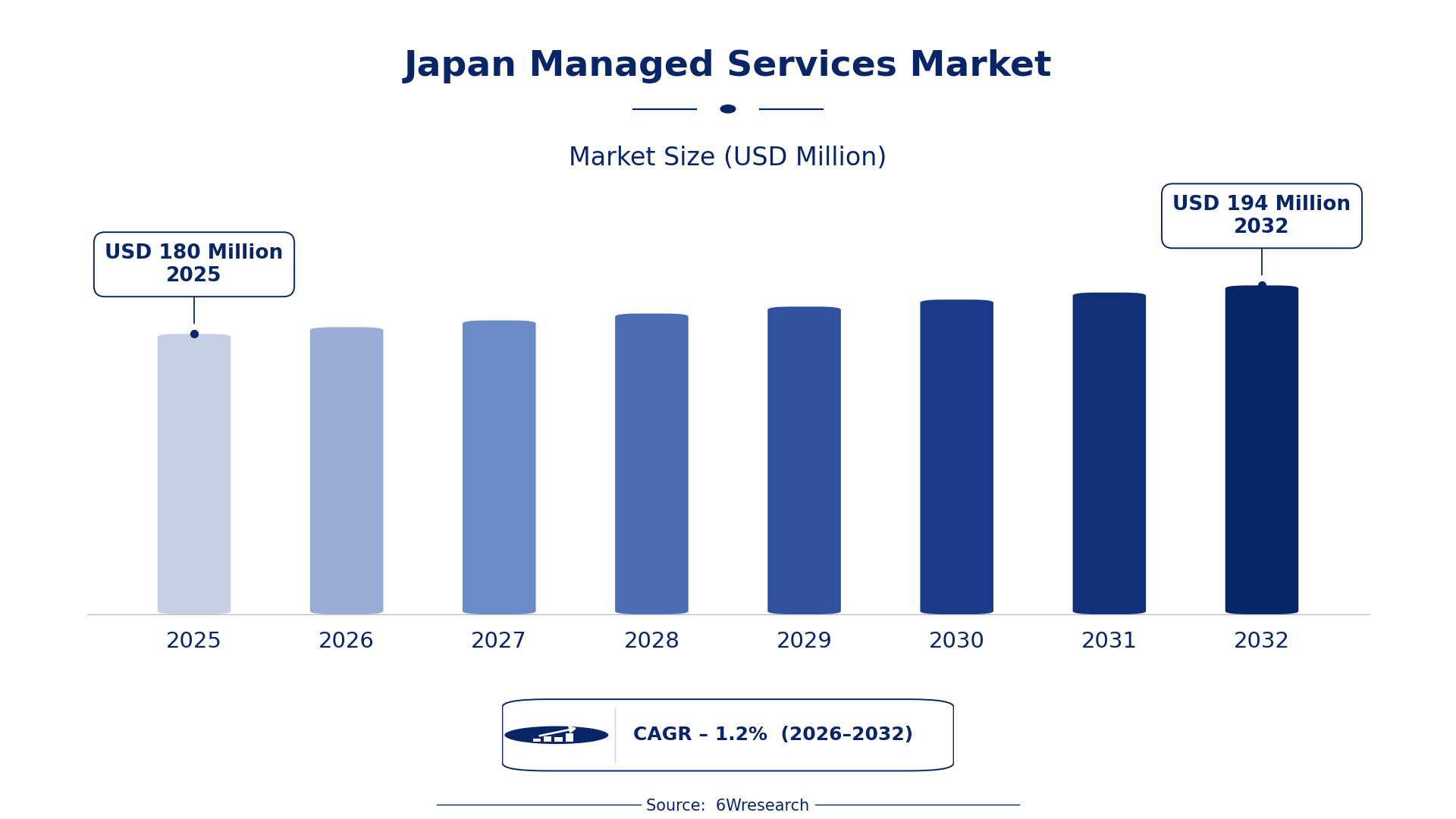
The Japan Managed Services Market was estimated at USD 180 Million in 2025 and is projected to reach USD 194 Million by 2032, growing at a CAGR of 1.2% from 2026 to 2032.
Japan Managed Services Market Synopsis
Japan’s managed services sector is gaining traction as organizations increasingly shift towards cloud-based solutions. The focus on operational efficiency and cost savings is compelling businesses to engage with specialized service providers to optimize their IT environments.
As the complexity of IT systems grows, so too does the demand for services that ensure security and reliability. Companies are eager to adopt managed security services, cloud solutions, and proactive infrastructure management, which are becoming crucial in the face of rising cyber threats.
Japan Managed Services Market Year-wise Growth Rate and Key Drivers
This graph illustrates the annual growth rates of the Japan Managed Services Market from 2021 to 2032, highlighting a steady upward trajectory and projected expansion over the forecast period.
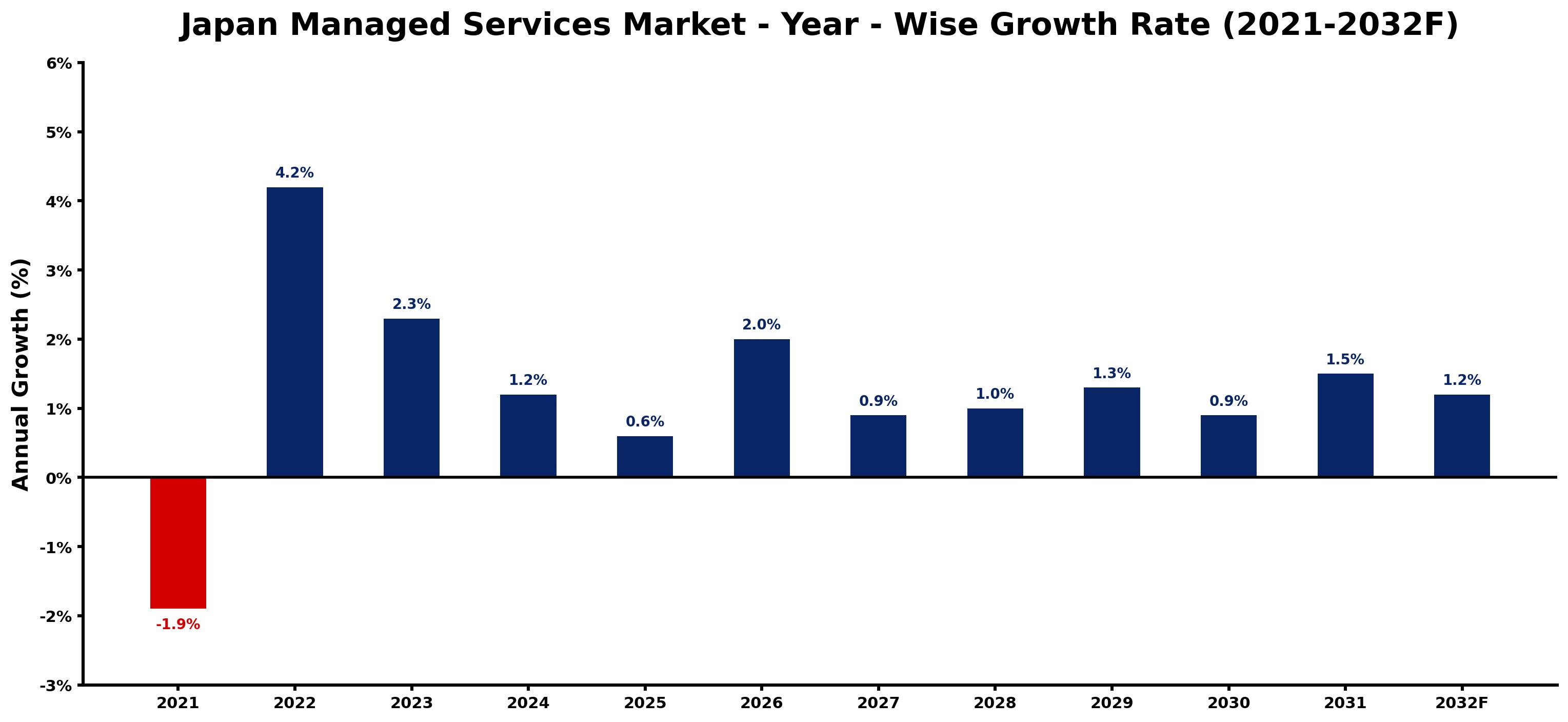
The table below presents the year‑wise growth rates along with the key drivers influencing the market
| Year | Growth Rate | Major Drivers |
| 2021 | -1.9% | Declining demand from Japan's aging population affecting services. |
| 2022 | 4.2% | Increased demand for IT security post-COVID recovery. |
| 2023 | 2.3% | Government digital transformation initiatives enhancing service adoption. |
| 2024 | 1.2% | Rising cybersecurity regulations driving managed services need. |
| 2025 | 0.6% | Aging workforce prompting outsourcing of IT functions. |
| 2026 | 2.0% | Investment in smart factory technologies boosting managed services. |
| 2027 | 0.9% | Growing trend of remote work increasing service reliance. |
| 2028 | 1.0% | Local enterprises shifting to cloud-based managed solutions. |
| 2029 | 1.3% | Increased awareness of data privacy regulations driving growth. |
| 2030 | 0.9% | Supportive government policies favoring tech-service collaborations. |
| 2031 | 1.5% | Surge in AI adoption requiring specialized managed services. |
| 2032 | 1.2% | Sustained growth in digital infrastructure supporting service demand. |
Note: Market size estimations and growth projections presented in this report are based on 6Wresearch's proprietary forecasting methodology, utilizing the latest available industry data, government publications, and primary research inputs.
Japan Managed Services Market Key Takeaways
Below are some of the specific key takeaways from the market, including:
- Cloud-based solutions are driving increased demand for managed services.
- Cybersecurity concerns are pushing companies towards managed security services.
- IT outsourcing is viewed as a strategic move to improve operational efficiency.
- The competition among service providers is intensifying, prompting innovation.
- Government initiatives are bolstering the adoption of managed services across industries.
Evaluation of Restraints in Japan Managed Services Market
A few notable constraints are impacting the Japan Managed Services Market. One primary issue is the fierce competition among service providers, which often leads to price wars that can devalue service quality. There's also a persistent shortage of skilled IT professionals, creating a talent bottleneck that limits growth potential.
on top of that, many Japanese companies still exhibit a strong preference for in-house IT management. This cultural mindset can hinder the broader acceptance of managed services. Stricter regulatory frameworks and heightened concerns regarding data security and privacy further complicate service provider operations.
Japan Managed Services Market Trends
Several trends are shaping the Japan Managed Services Market. There is a marked shift towards managed security services as businesses recognize the critical nature of safeguarding their digital assets. Additionally, the demand for managed cloud services is surging as companies undergo digital transformation initiatives.
Proactive monitoring and management are gaining traction, with organizations increasingly seeking real-time insights to ensure system reliability. The integration of data analytics, IoT, and AI into managed services is also on the rise, driven by businesses eager to harness cutting-edge technologies for competitive advantage.
Japan Managed Services Market Opportunities
Investment opportunities in the Japan Managed Services Market are abundant, particularly in areas like managed security and cloud computing. The growing complexity of IT systems necessitates specialized expertise that managed service providers can deliver.
on top of that, Japan's strong technological infrastructure presents fertile ground for service providers. Businesses are increasingly prioritizing efficiency, which translates into a favorable environment for innovative solutions and strategies tailored to meet evolving demands.
Government Initiatives in the Japan Managed Services Market
The Japanese government is actively fostering the adoption of managed services through several strategic initiatives. These policies emphasize digital transformation and economic competitiveness, highlighting the importance of managed services in achieving these goals.
- A recently completed initiative, the "Digital Transformation Promotion Strategy," aimed to enhance efficiency across various sectors through managed services.
- Currently underway is the "Information Security Policy," focusing on the protection of data and systems in managed services.
- Planned for the upcoming years is the "Industrial Competitiveness Enhancement Act," which includes provisions to support companies in adopting managed services.
- The government is also exploring partnerships with the private sector to develop a national digital infrastructure upgrade programme.
- Regulatory frameworks are being updated to ensure billing transparency and improved service delivery standards within the managed services sector.
Future Insights of the Japan Managed Services Market
Looking ahead to 2026-2032, the Japan Managed Services Market is set to witness sustained growth. Increasing reliance on cloud solutions and the need for comprehensive cybersecurity measures will remain primary drivers.
With more businesses seeking to streamline their IT operations and engage with specialized providers, the market will continue expanding. The rise in remote work and complex IT environments will further bolster demand for managed services, ensuring a dynamic and evolving market landscape.
Japan Managed Services Market Latest Developments
Over the past year, the Japan Managed Services Market has seen a flurry of activity, marked by significant developments and innovations. Service providers are increasingly focused on enhancing their offerings to meet the growing demands of clients.
- A major technology vendor launched a new suite of managed security services in early 2025, aimed at addressing the rising concerns over cyber threats.
- An initiative that began in mid-2025 is currently underway, focusing on integrating IoT solutions into managed services to provide clients with enhanced operational insights.
- In Q3 2025, a regional operator expanded its managed network services to cover additional geographical areas, increasing its market presence.
- Upcoming in early 2026 is a rollout of advanced data analytics services designed to help clients leverage their data for improved business decisions.
- A partnership formed in late 2024 between leading service providers aims to enhance cloud service offerings through shared expertise and resources.
Japan Managed Services Market - Key Attractiveness of the Report
- 10 Years of Market Numbers
- Historical Data Starting from 2022 to 2025
- Base Year: 2025
- Forecast Data until 2032
- Key Performance Indicators Impacting the Market
- Major Upcoming Developments and Projects
Key Highlights of the Report:
- Japan Managed Services Market Outlook
- Market Size of Japan Managed Services Market, 2025
- Forecast of Japan Managed Services Market, 2032
- Historical Data and Forecast of Japan Managed Services Revenues & Volume for the Period 2022-2032F
- Japan Managed Services Market Trend Evolution
- Japan Managed Services Market Drivers and Challenges
- Japan Managed Services Price Trends
- Japan Managed Services Porter's Five Forces
- Japan Managed Services Industry Life Cycle
- Historical Data and Forecast of Japan Managed Services Market Revenues & Volume By Service Type for the Period 2022-2032F
- Historical Data and Forecast of Japan Managed Services Market Revenues & Volume By Managed Security Services for the Period 2022-2032F
- Historical Data and Forecast of Japan Managed Services Market Revenues & Volume By Managed Network Services for the Period 2022-2032F
- Historical Data and Forecast of Japan Managed Services Market Revenues & Volume By Managed Data Center and IT Infrastructure Services for the Period 2022-2032F
- Historical Data and Forecast of Japan Managed Services Market Revenues & Volume By Managed Communication and Collaboration Services for the Period 2022-2032F
- Historical Data and Forecast of Japan Managed Services Market Revenues & Volume By Managed Mobility Services for the Period 2022-2032F
- Historical Data and Forecast of Japan Managed Services Market Revenues & Volume By Managed Information Services for the Period 2022-2032F
- Historical Data and Forecast of Japan Managed Services Market Revenues & Volume By Deployment Type for the Period 2022-2032F
- Historical Data and Forecast of Japan Managed Services Market Revenues & Volume By Cloud for the Period 2022-2032F
- Historical Data and Forecast of Japan Managed Services Market Revenues & Volume By On-Premises for the Period 2022-2032F
- Historical Data and Forecast of Japan Managed Services Market Revenues & Volume By Organization Size for the Period 2022-2032F
- Historical Data and Forecast of Japan Managed Services Market Revenues & Volume By Small and Medium-sized Enterprises (SMEs) for the Period 2022-2032F
- Historical Data and Forecast of Japan Managed Services Market Revenues & Volume By Large Enterprises for the Period 2022-2032F
- Historical Data and Forecast of Japan Managed Services Market Revenues & Volume By Vertical for the Period 2022-2032F
- Historical Data and Forecast of Japan Managed Services Market Revenues & Volume By BFSI for the Period 2022-2032F
- Historical Data and Forecast of Japan Managed Services Market Revenues & Volume By IT and Telecom for the Period 2022-2032F
- Historical Data and Forecast of Japan Managed Services Market Revenues & Volume By Retail and Consumer Goods for the Period 2022-2032F
- Historical Data and Forecast of Japan Managed Services Market Revenues & Volume By Manufacturing for the Period 2022-2032F
- Historical Data and Forecast of Japan Managed Services Market Revenues & Volume By Government for the Period 2022-2032F
- Historical Data and Forecast of Japan Managed Services Market Revenues & Volume By Healthcare and Life Sciences for the Period 2022-2032F
- Historical Data and Forecast of Japan Managed Services Market Revenues & Volume By Energy and Utilities for the Period 2022-2032F
- Historical Data and Forecast of Japan Managed Services Market Revenues & Volume By Media and Entertainment for the Period 2022-2032F
- Japan Managed Services Import Export Trade Statistics
- Market Opportunity Assessment By Service Type
- Market Opportunity Assessment By Deployment Type
- Market Opportunity Assessment By Organization Size
- Market Opportunity Assessment By Vertical
- Japan Managed Services Top Companies Market Share
- Japan Managed Services Competitive Benchmarking By Technical and Operational Parameters
- Japan Managed Services Company Profiles
- Japan Managed Services Key Strategic Recommendations






































