Argentina Managed Services Market Size & Growth Rate (2026-2032)
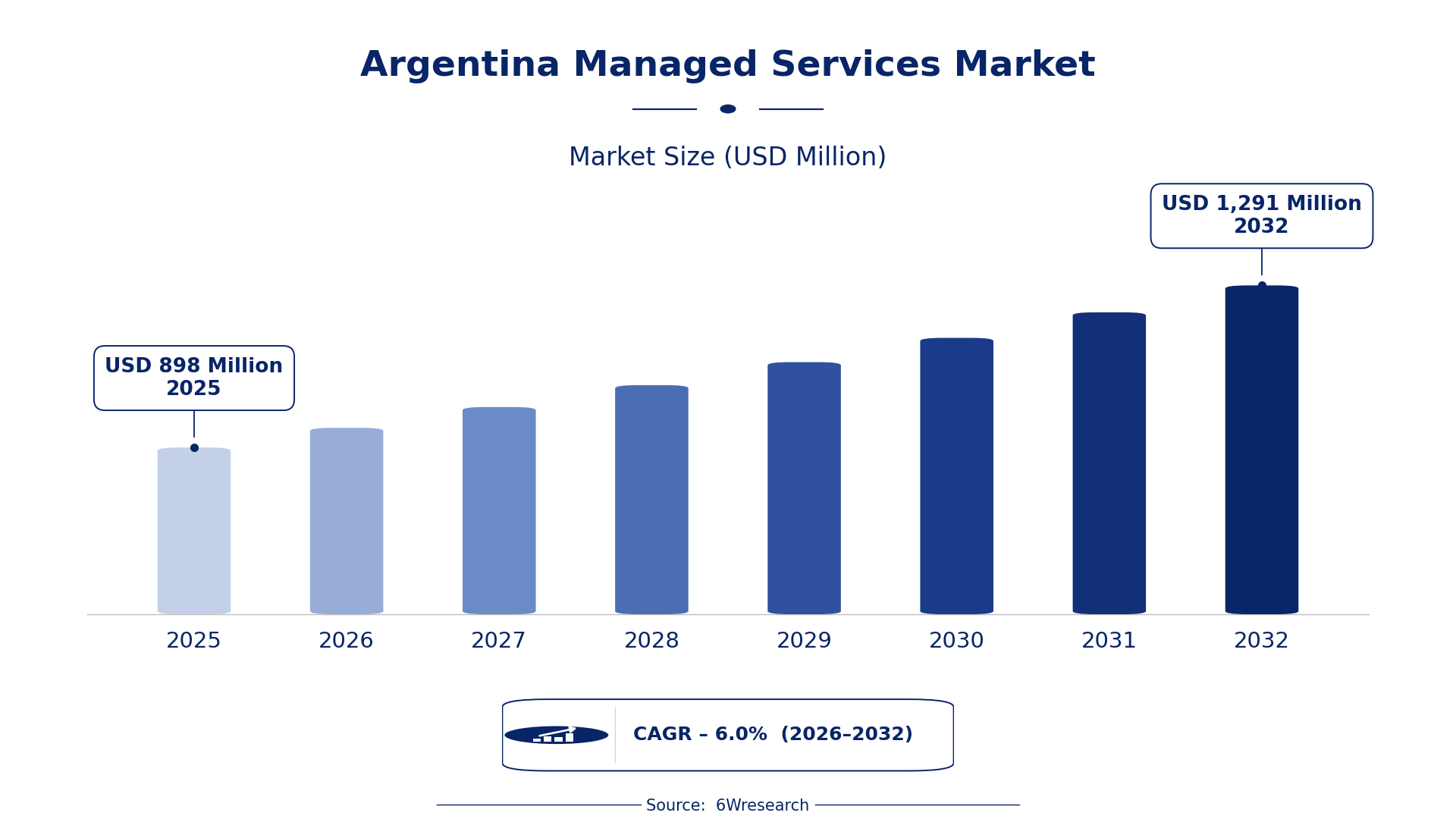
The Argentina Managed Services Market was estimated at USD 898 Million in 2025 and is projected to reach USD 1291 Million by 2032, growing at a CAGR of 6.0% from 2026 to 2032.
Argentina Managed Services Market Synopsis
The Argentina Managed Services Market is on a notable upward trajectory, driven primarily by the increasing adoption of cloud technologies and a pressing need for enhanced cybersecurity measures. Businesses across various sectors are increasingly recognizing the value of outsourcing IT operations to focus on their core functions, leading to a surge in demand for managed services.
Small and medium-sized enterprises (SMEs) are particularly active in this space, seeking cost-effective solutions that improve operational efficiency. As the complexity of IT infrastructures grows, the need for specialized expertise is becoming more critical, shaping the future dynamics of the Argentina Managed Services Market.
Argentina Managed Services Market Year-wise Growth Rate and Key Drivers
This graph illustrates the annual growth rates of the Argentina Managed Services Market from 2021 to 2032, highlighting a steady upward trajectory and projected expansion over the forecast period.
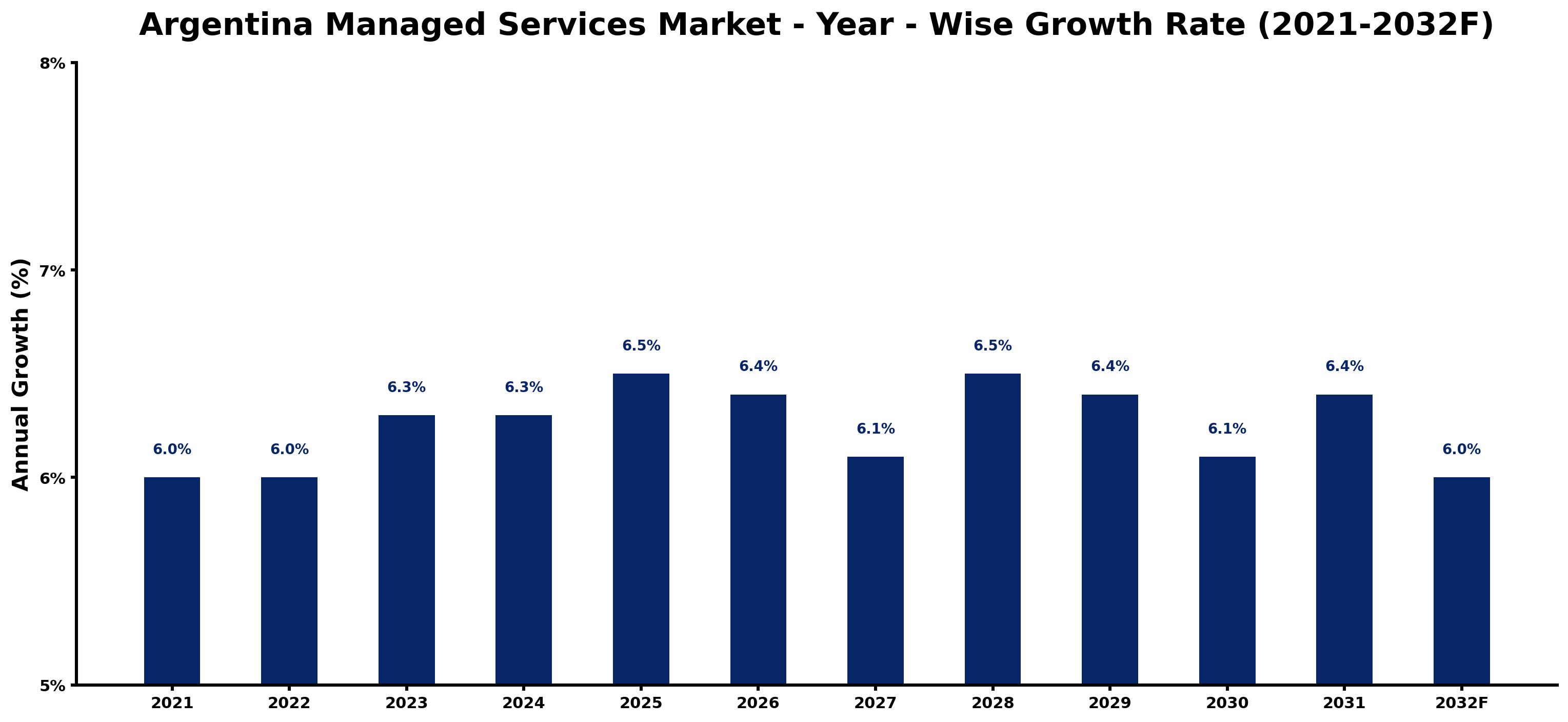
The table below presents the year‑wise growth rates along with the key drivers influencing the market
| Year | Growth Rate | Major Drivers |
| 2021 | 6.0% | Growth in local startups driving managed IT services demand. |
| 2022 | 6.0% | Government push for digital transformation initiatives across sectors. |
| 2023 | 6.3% | Rising digitalization in education sector enhances managed services. |
| 2024 | 6.3% | Increased mobile device penetration facilitating managed app services. |
| 2025 | 6.5% | Adoption of e-commerce solutions boosts managed service contracts. |
| 2026 | 6.4% | Local companies seek efficiency through outsourced IT management. |
| 2027 | 6.1% | Emergence of agritech startups needing robust IT support. |
| 2028 | 6.5% | Adoption of IoT applications drives demand for managed services. |
| 2029 | 6.4% | Growing telehealth services require reliable managed IT solutions. |
| 2030 | 6.1% | Increased financial technology offerings boost managed service requirements. |
| 2031 | 6.4% | Public sector modernization efforts demand effective IT management. |
| 2032 | 6.0% | Rising cybersecurity threats necessitate specialized managed services. |
Note: Market size estimations and growth projections presented in this report are based on 6Wresearch's proprietary forecasting methodology, utilizing the latest available industry data, government publications, and primary research inputs.
Argentina Managed Services Market Key Takeaways
Below are some of the specific key takeaways from the market, including:
- The market is witnessing a significant shift towards cloud-based managed services.
- Cybersecurity concerns are prompting businesses to invest in managed security services.
- SMEs are increasingly outsourcing IT functions to enhance efficiency and reduce costs.
- Healthcare, finance, and telecommunications sectors show rising demand for managed services.
- Emerging technologies like AI and IoT are being integrated into service offerings.
Evaluation of Restraints in Argentina Managed Services Market
Economic volatility and regulatory uncertainties pose notable challenges to the Argentina Managed Services Market. Fluctuating currency values complicate pricing strategies for service providers, creating an unpredictable environment for both businesses and their clients. on top of that, evolving regulations surrounding data security and privacy can hinder compliance efforts, making it imperative for managed service providers to remain agile and informed about local market dynamics.
Argentina Managed Services Market Trends
A few clear trends are shaping the Argentina Managed Services Market. The transition to hybrid cloud solutions is gaining traction, as businesses seek flexibility and cost-effectiveness. Managed security services are becoming essential as organizations prioritize cybersecurity amidst increasing threats. Additionally, customized solutions tailored to specific industry needs are in demand, enabling providers to differentiate themselves in a competitive market.
Argentina Managed Services Market Opportunities
There are substantial growth opportunities for managed service providers in Argentina. Expanding service offerings to include advanced technologies, such as AI and IoT, will attract businesses looking to modernize their operations. on top of that, the shift towards remote work setups creates a demand for managed services that can ensure business continuity and effective remote IT management.
Government Initiatives in the Argentina Managed Services Market
Government policy plays a crucial role in shaping the Argentina Managed Services Market, with various initiatives aimed at fostering sector growth. Recent regulations focus on enhancing data security and privacy for managed service providers, while incentives are in place to encourage the adoption of managed services across industries. These efforts aim to create a conducive environment that attracts investment and promotes innovation.
- A regulatory framework introduced in 2025 mandating enhanced data protection measures for managed services providers.
- An initiative launched in early 2025 to streamline the registration process for new managed service companies.
- A current program encouraging SMEs to adopt managed services for operational efficiency, which is gaining traction.
- A planned public-private initiative expected to improve digital infrastructure by 2028, facilitating better service delivery.
Future Insights of the Argentina Managed Services Market
Looking ahead to 2026-2032, the Argentina Managed Services Market is expected to thrive as digital transformation continues to accelerate. Businesses will increasingly turn to managed services to handle the complexities of IT management, allowing them to focus on core operations. As cybersecurity becomes a non-negotiable aspect of IT strategy, demand for specialized managed security services will likely grow. Providers that can adapt to these evolving needs will find ample opportunities for growth and innovation.
Argentina Managed Services Market Latest Developments
In the past year, the Argentina Managed Services Market has seen a flurry of activity, with providers enhancing their offerings and responding to market demands. The focus has been on improving service delivery and expanding into new technological areas to meet the needs of diverse clients.
- A major technology vendor launched a new suite of managed cybersecurity services in Q1 2025, aimed at SMEs.
- An ongoing initiative began in mid-2025 to develop a network of partnerships with local startups to foster innovation in IT services.
- A regional operator is currently upgrading its IT infrastructure to support increased demand for cloud services, with completion expected by late 2025.
- A planned service expansion targeting the healthcare sector is set to begin in Q3 2026, focusing on compliance and data management.
Argentina Managed Services Market - Key Attractiveness of the Report
- 10 Years of Market Numbers
- Historical Data Starting from 2022 to 2025
- Base Year: 2025
- Forecast Data until 2032
- Key Performance Indicators Impacting the Market
- Major Upcoming Developments and Projects
Key Highlights of the Report:
- Argentina Managed Services Market Outlook
- Market Size of Argentina Managed Services Market, 2025
- Forecast of Argentina Managed Services Market, 2032
- Historical Data and Forecast of Argentina Managed Services Revenues & Volume for the Period 2022-2032F
- Argentina Managed Services Market Trend Evolution
- Argentina Managed Services Market Drivers and Challenges
- Argentina Managed Services Price Trends
- Argentina Managed Services Porter's Five Forces
- Argentina Managed Services Industry Life Cycle
- Historical Data and Forecast of Argentina Managed Services Market Revenues & Volume By Service Type for the Period 2022-2032F
- Historical Data and Forecast of Argentina Managed Services Market Revenues & Volume By Managed Security Services for the Period 2022-2032F
- Historical Data and Forecast of Argentina Managed Services Market Revenues & Volume By Managed Network Services for the Period 2022-2032F
- Historical Data and Forecast of Argentina Managed Services Market Revenues & Volume By Managed Data Center and IT Infrastructure Services for the Period 2022-2032F
- Historical Data and Forecast of Argentina Managed Services Market Revenues & Volume By Managed Communication and Collaboration Services for the Period 2022-2032F
- Historical Data and Forecast of Argentina Managed Services Market Revenues & Volume By Managed Mobility Services for the Period 2022-2032F
- Historical Data and Forecast of Argentina Managed Services Market Revenues & Volume By Managed Information Services for the Period 2022-2032F
- Historical Data and Forecast of Argentina Managed Services Market Revenues & Volume By Deployment Type for the Period 2022-2032F
- Historical Data and Forecast of Argentina Managed Services Market Revenues & Volume By Cloud for the Period 2022-2032F
- Historical Data and Forecast of Argentina Managed Services Market Revenues & Volume By On-Premises for the Period 2022-2032F
- Historical Data and Forecast of Argentina Managed Services Market Revenues & Volume By Organization Size for the Period 2022-2032F
- Historical Data and Forecast of Argentina Managed Services Market Revenues & Volume By Small and Medium-sized Enterprises (SMEs) for the Period 2022-2032F
- Historical Data and Forecast of Argentina Managed Services Market Revenues & Volume By Large Enterprises for the Period 2022-2032F
- Historical Data and Forecast of Argentina Managed Services Market Revenues & Volume By Vertical for the Period 2022-2032F
- Historical Data and Forecast of Argentina Managed Services Market Revenues & Volume By BFSI for the Period 2022-2032F
- Historical Data and Forecast of Argentina Managed Services Market Revenues & Volume By IT and Telecom for the Period 2022-2032F
- Historical Data and Forecast of Argentina Managed Services Market Revenues & Volume By Retail and Consumer Goods for the Period 2022-2032F
- Historical Data and Forecast of Argentina Managed Services Market Revenues & Volume By Manufacturing for the Period 2022-2032F
- Historical Data and Forecast of Argentina Managed Services Market Revenues & Volume By Government for the Period 2022-2032F
- Historical Data and Forecast of Argentina Managed Services Market Revenues & Volume By Healthcare and Life Sciences for the Period 2022-2032F
- Historical Data and Forecast of Argentina Managed Services Market Revenues & Volume By Energy and Utilities for the Period 2022-2032F
- Historical Data and Forecast of Argentina Managed Services Market Revenues & Volume By Media and Entertainment for the Period 2022-2032F
- Argentina Managed Services Import Export Trade Statistics
- Market Opportunity Assessment By Service Type
- Market Opportunity Assessment By Deployment Type
- Market Opportunity Assessment By Organization Size
- Market Opportunity Assessment By Vertical
- Argentina Managed Services Top Companies Market Share
- Argentina Managed Services Competitive Benchmarking By Technical and Operational Parameters
- Argentina Managed Services Company Profiles
- Argentina Managed Services Key Strategic Recommendations






































