Indonesia Oil & Gas Pumps Market Size, Share & Growth Rate
The Indonesia Oil & Gas Pumps Market was estimated at USD 415 Million in 2025 and is projected to reach USD 551 Million by 2032, growing at a CAGR of 4.1% from 2026 to 2032. This promising trajectory is primarily driven by the increasing demand for efficient pumping solutions due to the expansion of oil & gas exploration and production activities. Additionally, the government's sustained investment in infrastructure and energy projects further propels the market's growth.
Indonesia Oil & Gas Pumps Market Year-wise Growth Rate and Key Drivers
This graph highlights how the Indonesia Oil & Gas Pumps Market has steadily grown over the years, supported by major growth factors.
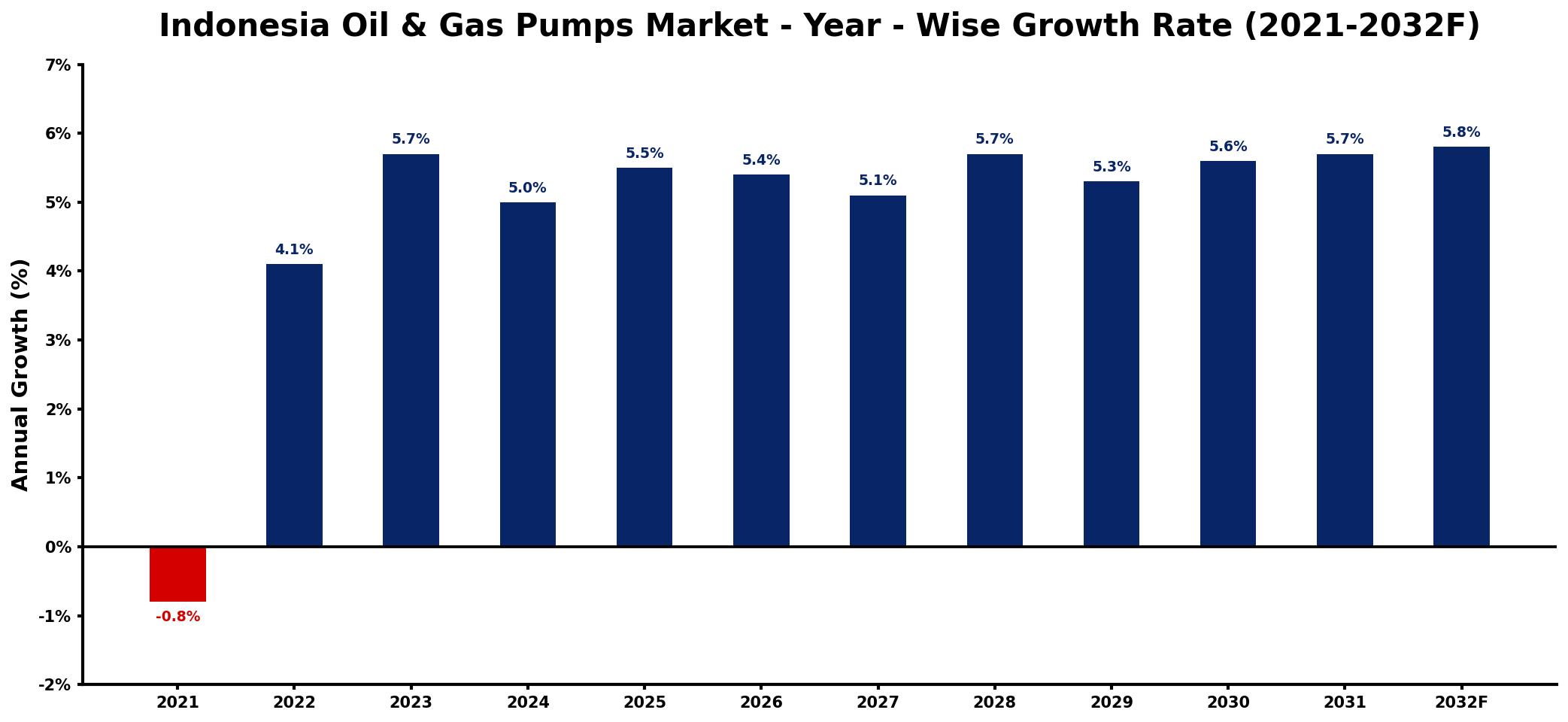
The table below presents the year‑wise growth rates along with the key drivers influencing the market
| Year | Growth Rate | Major Drivers |
| 2021 | -0.8% | decreased industrial production capacity |
| 2022 | 4.1% | rising energy sector investments |
| 2023 | 5.7% | increased infrastructure development projects |
| 2024 | 5.0% | growing demand for renewable energy |
| 2025 | 5.5% | expansion of manufacturing capabilities |
| 2026 | 5.4% | rising urbanization and population growth |
| 2027 | 5.1% | increased focus on energy efficiency |
| 2028 | 5.7% | growing exports of energy products |
| 2029 | 5.3% | enhanced regulatory support initiatives |
| 2030 | 5.6% | growing emerging market penetration |
| 2031 | 5.7% | increased technological advancements adoption |
| 2032 | 5.8% | growing emphasis on sustainability practices |
Note: Market size estimations and growth projections presented in this report are based on 6Wresearch's proprietary forecasting methodology, utilizing the latest available industry data, government publications, and primary research inputs.
Indonesia Oil & Gas Pumps Market Synopsis
Following a period of resilience during the COVID-19 pandemic, the Indonesia Oil & Gas Pumps Market is poised for a robust recovery and expansion. The anticipated growth comes as various sectors ramp up their operations, creating a renewed demand for effective pumping solutions essential for exploration and refining processes.
Despite recent challenges, including global economic fluctuations, the sector's long-term outlook remains positive. The strategic initiatives by both the government and private enterprises to enhance offshore exploration and bolster technological advancements in pumping equipment will be pivotal in shaping the market's future.
- The market is set for significant growth, with a projected value of USD 551 Million by 2032.
- Government investments in energy infrastructure are driving demand for advanced pump solutions.
- Technological innovation in pump systems is enhancing efficiency and operational reliability.
- The transition towards sustainability presents both challenges and opportunities for future market dynamics.
- Key developments in offshore exploration are expected to boost pump demand significantly.
While the Indonesia Oil & Gas Pumps Market shows promising growth potential, it is not without its constraints. Fluctuating global oil prices can create uncertainty for operators, impacting investment and operational decisions. Additionally, geopolitical tensions can affect exploration and production, leading to project delays. The ongoing transition towards renewable energy sources and an increasing focus on sustainability might also overshadow long-term demand for oil & gas pumps, prompting a shift in market dynamics that requires careful navigation.
Several key trends are influencing the Indonesia Oil & Gas Pumps Market. Firstly, there is a notable shift towards the integration of smart technologies within pumping systems, enhancing monitoring and control capabilities. Secondly, the demand for energy-efficient and environmentally friendly pumping solutions is on the rise, reflecting a broader industry trend towards sustainability. Lastly, improved offshore drilling techniques and advancements in pump design are driving higher efficiencies, further solidifying their importance in operations.
Investment opportunities in the Indonesia Oil & Gas Pumps Market are abundant. The government's commitment to expanding energy infrastructure, especially in remote areas, presents avenues for pump manufacturers to supply advanced solutions. Furthermore, the increasing focus on upgrading existing equipment to enhance efficiency and reduce operational costs creates room for innovation and new product development. Collaborations with local enterprises can also facilitate market entry and distribution, allowing for quicker adaptation to local needs.
The Indonesian government has introduced various initiatives aimed at bolstering the oil & gas sector, which includes significant investments in infrastructure and technology upgrades. Policies promoting sustainable practices in energy production and exploration are also becoming increasingly prominent. By focusing on partnerships with private sectors and enhancing regulatory frameworks, the government aims to create a conducive environment for the growth of oil & gas operations, including the essential components such as pumping systems.
Looking ahead to 2026-2032, the Indonesia Oil & Gas Pumps Market is expected to continue its upward trend, driven by enhanced exploration activities and technological advancements. Companies investing in innovative pump designs that meet both efficiency and sustainability targets will likely gain a competitive edge. Additionally, as the energy landscape evolves, the ability to adapt to changing market demands will be crucial for stakeholders, paving the way for sustainable growth.
Recent developments in the Indonesia Oil & Gas Pumps Market include a noticeable uptick in partnerships between local and international firms focused on enhancing pumping technologies. Innovations aimed at increasing operational efficiency and reducing environmental impacts are becoming a focal point of these collaborations. Moreover, the government is ramping up investments in offshore and onshore drilling projects, which are expected to necessitate advanced pumping solutions in the near future.
- 10 Years of Market Numbers
- Historical Data Starting from 2022 to 2025
- Base Year: 2025
- Forecast Data until 2032
- Key Performance Indicators Impacting the Market
- Major Upcoming Developments and Projects
Key Highlights of the Report:
- Indonesia Oil & Gas Pumps Market Outlook
- Market Size of Indonesia Oil & Gas Pumps Market, 2025
- Forecast of Indonesia Oil & Gas Pumps Market, 2032
- Historical Data and Forecast of Indonesia Oil & Gas Pumps Revenues & Volume for the Period 2022-2032F
- Indonesia Oil & Gas Pumps Market Trend Evolution
- Indonesia Oil & Gas Pumps Market Drivers and Challenges
- Indonesia Oil & Gas Pumps Price Trends
- Indonesia Oil & Gas Pumps Porter's Five Forces
- Indonesia Oil & Gas Pumps Industry Life Cycle
- Historical Data and Forecast of Indonesia Oil & Gas Pumps Market Revenues & Volume By Type for the Period 2022-2032F
- Historical Data and Forecast of Indonesia Oil & Gas Pumps Market Revenues & Volume By Submersible Pumps for the Period 2022-2032F
- Historical Data and Forecast of Indonesia Oil & Gas Pumps Market Revenues & Volume By Non-submersible Pumps for the Period 2022-2032F
- Historical Data and Forecast of Indonesia Oil & Gas Pumps Market Revenues & Volume By Pump Type for the Period 2022-2032F
- Historical Data and Forecast of Indonesia Oil & Gas Pumps Market Revenues & Volume By Centrifugal Pump for the Period 2022-2032F
- Historical Data and Forecast of Indonesia Oil & Gas Pumps Market Revenues & Volume By Positive Displacement Pump for the Period 2022-2032F
- Historical Data and Forecast of Indonesia Oil & Gas Pumps Market Revenues & Volume By Cryogenic Pump for the Period 2022-2032F
- Historical Data and Forecast of Indonesia Oil & Gas Pumps Market Revenues & Volume By Application for the Period 2022-2032F
- Historical Data and Forecast of Indonesia Oil & Gas Pumps Market Revenues & Volume By Upstream for the Period 2022-2032F
- Historical Data and Forecast of Indonesia Oil & Gas Pumps Market Revenues & Volume By Midstream for the Period 2022-2032F
- Historical Data and Forecast of Indonesia Oil & Gas Pumps Market Revenues & Volume By Downstream for the Period 2022-2032F
- Indonesia Oil & Gas Pumps Import Export Trade Statistics
- Market Opportunity Assessment By Type
- Market Opportunity Assessment By Pump Type
- Market Opportunity Assessment By Application
- Indonesia Oil & Gas Pumps Top Companies Market Share
- Indonesia Oil & Gas Pumps Competitive Benchmarking By Technical and Operational Parameters
- Indonesia Oil & Gas Pumps Company Profiles
- Indonesia Oil & Gas Pumps Key Strategic Recommendations






































