Indonesia Ore & Alloys Market Size, Share & Growth Rate
The Indonesia Ore & Alloys Market was estimated at USD 376 Million in 2025 and is projected to reach USD 497 Million by 2032, growing at a CAGR of 4.1% from 2026 to 2032. This growth trajectory is primarily driven by Indonesia's substantial ore reserves and the escalating demand for alloy metals within diverse industrial applications, including manufacturing and construction. Furthermore, the increasing foreign investments in mining, bolstered by government incentives, are set to enhance production capabilities and market stability.
Indonesia Ore & Alloys Market Year-wise Growth Rate and Key Drivers
This graph highlights how the Indonesia Ore & Alloys Market has steadily grown over the years, supported by major growth factors.
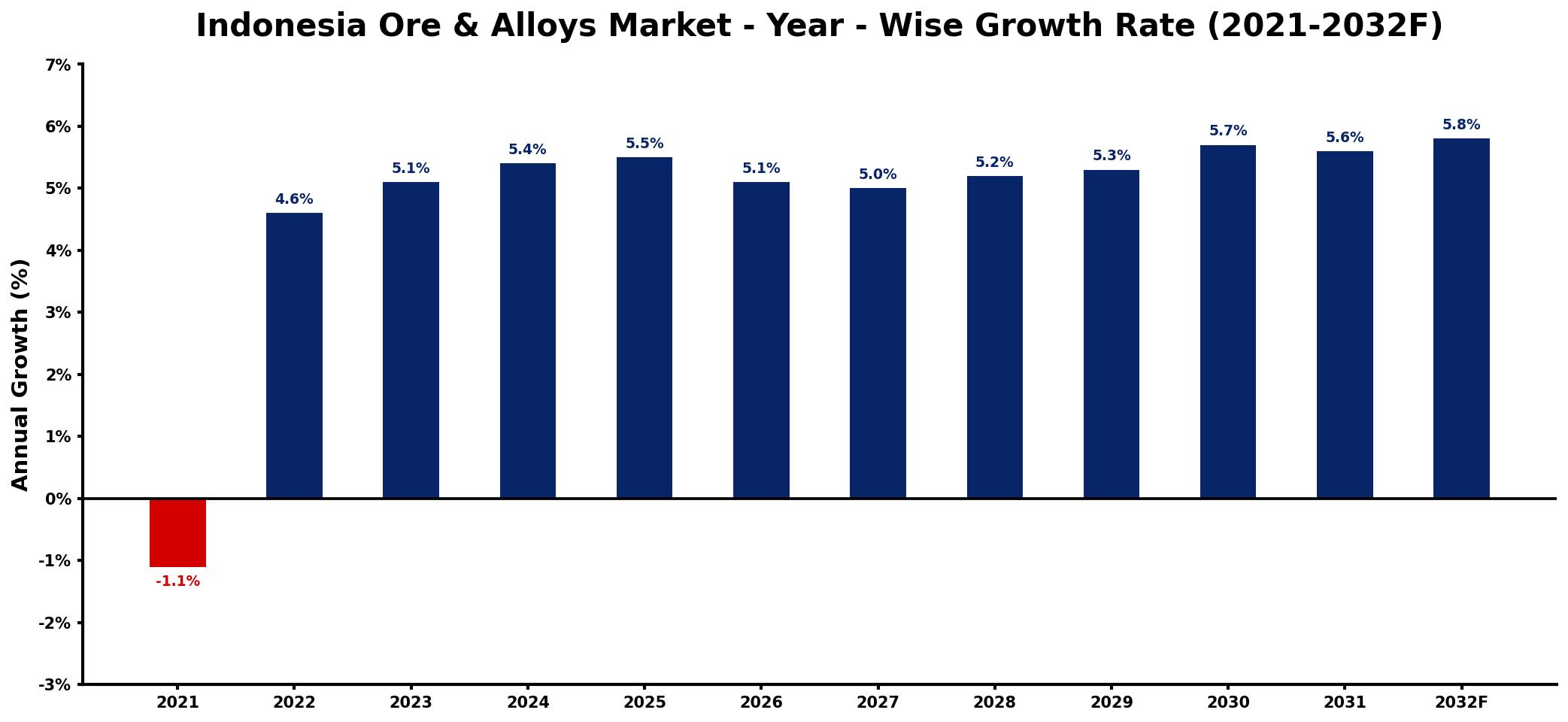
The table below presents the year‑wise growth rates along with the key drivers influencing the market
| Year | Growth Rate | Major Drivers |
| 2021 | -1.1% | Reduced industrial production rates |
| 2022 | 4.6% | Increased infrastructure development projects |
| 2023 | 5.1% | Growing demand from construction sector |
| 2024 | 5.4% | Expansion of renewable energy investments |
| 2025 | 5.5% | Rising automotive manufacturing activities |
| 2026 | 5.1% | Boost in electronics manufacturing growth |
| 2027 | 5.0% | Strengthened international trade agreements |
| 2028 | 5.2% | Surge in urbanization initiatives |
| 2029 | 5.3% | Enhanced mining technology adoption |
| 2030 | 5.7% | increased overall sector activity |
| 2031 | 5.6% | rising infrastructure development spending |
| 2032 | 5.8% | Increased government policy support |
Note: Market size estimations and growth projections presented in this report are based on 6Wresearch's proprietary forecasting methodology, utilizing the latest available industry data, government publications, and primary research inputs.
Indonesia Ore & Alloys Market Synopsis
Recently, the Indonesia Ore & Alloys Market has exhibited robust momentum, underscored by rising industrial activities and sustained demand for key alloys like ferrochrome and ferromanganese. As the market evolves, it is expected to further capitalize on Indonesia's rich mineral resources, positioning itself as a vital player in the global supply chain for metals and alloys.
Looking ahead, the market's growth outlook remains positive, supported by favorable trade conditions and advancements in metallurgy. However, global competition and price volatility may introduce complexity, necessitating strategic initiatives from stakeholders to ensure resilience and competitiveness in the face of market fluctuations.
- The market is driven by a strong demand for alloy metals in manufacturing and construction.
- Indonesia's rich ore reserves provide a strategic advantage for market players.
- Government initiatives aimed at attracting foreign investment will play a pivotal role in market growth.
- Fluctuations in global prices and competition may impact industry stability.
- Technological advancements in metallurgy are expected to enhance production efficiency.
Despite the favorable outlook, the Indonesia Ore & Alloys Market faces notable restraints that could hinder growth. Price volatility of raw materials remains a significant concern, as fluctuating commodity prices can impact profitability for suppliers. Additionally, international trade policies and geopolitical factors may introduce uncertainty, affecting the ease of trade. Consequently, market players must navigate these complexities while ensuring consistent quality and efficient supply chain operations to maintain their competitive edge.
Emerging trends within the Indonesia Ore & Alloys Market highlight a shift towards sustainable practices and advanced technologies. The adoption of innovative metallurgical processes is becoming increasingly prominent, enhancing material efficiency and reducing environmental impact. Additionally, there is a growing emphasis on sourcing raw materials locally to mitigate supply chain risks and ensure sustainability. As industries increasingly prioritize environmentally friendly solutions, the demand for alloys that support such initiatives is likely to rise, shaping the market dynamics.
The potential for growth in the Indonesia Ore & Alloys Market is significant, particularly as global demand for stainless steel and high-performance alloys continues to rise. Opportunities exist in developing specialized alloys for sectors such as aerospace and automotive, where technological advancements can create new applications. Moreover, the government's push for infrastructure development presents an excellent opportunity for market players to engage in projects that require high-quality alloys, further driving demand.
The Indonesian government has implemented several initiatives aimed at bolstering the mining sector, which directly impacts the Ore & Alloys Market. These initiatives include regulatory reforms designed to attract foreign investment and enhance operational efficiency within the industry. Additionally, public spending in infrastructure projects is expected to stimulate demand for ore alloys, aligning government objectives with market growth. Policies promoting sustainable mining practices are also being developed to ensure environmental considerations are integrated into the industrys advancement.
Looking towards 2026-2032, the Indonesia Ore & Alloys Market is poised for continued growth driven by expanding industrial applications and evolving technological landscapes. Increased foreign investment, coupled with a focus on innovative production techniques, will likely enhance the competitiveness of Indonesian alloys on the global stage. Additionally, as sustainability becomes a paramount concern, the market will need to adapt to evolving demands for environmentally friendly and resource-efficient products, setting the course for future innovation and development.
Recent developments in the Indonesia Ore & Alloys Market indicate a strategic shift towards enhancing local production capabilities. Stakeholders are increasingly investing in modernizing existing facilities and adopting advanced technologies to improve efficiency. Furthermore, there is a noted increase in partnerships between domestic suppliers and international firms to foster innovation and expand market access. This collaborative approach is expected to drive growth and resilience in the face of global competition.
- 10 Years of Market Numbers
- Historical Data Starting from 2022 to 2025
- Base Year: 2025
- Forecast Data until 2032
- Key Performance Indicators Impacting the Market
- Major Upcoming Developments and Projects
Key Highlights of the Report:
- Indonesia Ore & Alloys Market Outlook
- Market Size of Indonesia Ore & Alloys Market, 2025
- Forecast of Indonesia Ore & Alloys Market, 2032
- Historical Data and Forecast of Indonesia Ore & Alloys Revenues & Volume for the Period 2022-2032F
- Indonesia Ore & Alloys Market Trend Evolution
- Indonesia Ore & Alloys Market Drivers and Challenges
- Indonesia Ore & Alloys Price Trends
- Indonesia Ore & Alloys Porter's Five Forces
- Indonesia Ore & Alloys Industry Life Cycle
- Historical Data and Forecast of Indonesia Ore & Alloys Market Revenues & Volume By Product Type for the Period 2022-2032F
- Historical Data and Forecast of Indonesia Ore & Alloys Market Revenues & Volume By Chrome Ore for the Period 2022-2032F
- Historical Data and Forecast of Indonesia Ore & Alloys Market Revenues & Volume By Manganese Ore for the Period 2022-2032F
- Historical Data and Forecast of Indonesia Ore & Alloys Market Revenues & Volume By Ferro-chrome for the Period 2022-2032F
- Historical Data and Forecast of Indonesia Ore & Alloys Market Revenues & Volume By Ferro-manganese for the Period 2022-2032F
- Historical Data and Forecast of Indonesia Ore & Alloys Market Revenues & Volume By Ferro-nickel for the Period 2022-2032F
- Historical Data and Forecast of Indonesia Ore & Alloys Market Revenues & Volume By Ferro- Silicon for the Period 2022-2032F
- Historical Data and Forecast of Indonesia Ore & Alloys Market Revenues & Volume By Silico-manganese for the Period 2022-2032F
- Historical Data and Forecast of Indonesia Chrome Ore Ore & Alloys Market Revenues & Volume By Others for the Period 2022-2032F
- Historical Data and Forecast of Indonesia Ore & Alloys Market Revenues & Volume By Application for the Period 2022-2032F
- Historical Data and Forecast of Indonesia Ore & Alloys Market Revenues & Volume By Automobiles for the Period 2022-2032F
- Historical Data and Forecast of Indonesia Ore & Alloys Market Revenues & Volume By Surgical Tools for the Period 2022-2032F
- Historical Data and Forecast of Indonesia Ore & Alloys Market Revenues & Volume By Aerospace Industry for the Period 2022-2032F
- Historical Data and Forecast of Indonesia Ore & Alloys Market Revenues & Volume By Buildings for the Period 2022-2032F
- Historical Data and Forecast of Indonesia Ore & Alloys Market Revenues & Volume By Others for the Period 2022-2032F
- Indonesia Ore & Alloys Import Export Trade Statistics
- Market Opportunity Assessment By Product Type
- Market Opportunity Assessment By Application
- Indonesia Ore & Alloys Top Companies Market Share
- Indonesia Ore & Alloys Competitive Benchmarking By Technical and Operational Parameters
- Indonesia Ore & Alloys Company Profiles
- Indonesia Ore & Alloys Key Strategic Recommendations






































